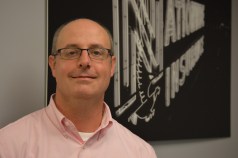
Archival Innovators: Bryan Giemza, Director of UNC Chapel Hill’s Southern Historical Collection (Part 1)

This is the inaugural post in our new series Archival Innovators!  In this new series, we aim to raise awareness of the individuals, institutions, and collaborations that are helping to boldly chart the future of the the archives profession and set new precedents for the role of the archivist in society.
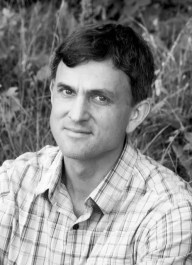
Bryan Giemza

Our first Archival Innovators post brings you an interview with Bryan Giemza, Director of the Southern Historical Collection (SHC) at the Wilson Special Collections Library, part of the University Libraries at the University of North Carolina at Chapel Hill (Bryan’s bio is contained at the end of this post).  Bryan and the SHC might already be on your radar as archival innovators thanks to the publicity around Archivist in a Backpack and the Maya from the Margins project, the latter of which was awarded SAA’s 2018 Diversity Award as well as a Spotlight Award for team member Bernetiae Reed.  COPA member Lindsay Anderberg, Interdisciplinary Science & Technology Librarian and Poly Archivist at New York University, spoke with Bryan to find out how one archive was able to launch multiple innovative projects while challenging the notion of who creates and maintains archives.

This is Part 1 of Lindsay and Bryan’s interview; stay tuned for Part 2 next week!

LA: Could you start by telling us a little about Archivist in a Backpack and how it fits within the concept of participatory research?
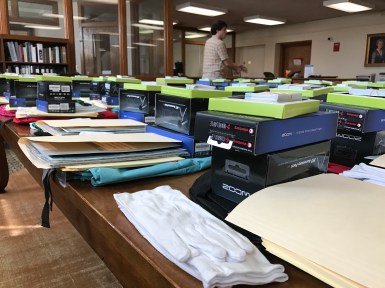
Assembling the Archivist in a Backpack kits at the Southern Historical Collection

BG: Archivist in a Backpack distills some basic tools of archival trade into a kit that’s small enough, and accessible enough, to act as starter material for a community-driven archive project.  We know from experience that oral histories are great for jumpstarting community-driven archives projects. And we know that people love the tangibility of archives experience.  You can see that in the moment of electricity when a student opens a nineteenth-century journal for the first time.  So, the question was, how do you get people of all ages comfortable thinking about themselves as archivists in a way that’s fun and interactive and ultimately empowering?

That’s what participatory research is all about: moving away from methods of enquiry that perpetuate the idea that expertise comes from outside a community. In the world of archives, it addresses a recurrent problem, that communities have limited say in what goes into an archive, what happens to it afterwards, even in its interpretation. Archivist in a Backpack is a kind of hook, it’s a straightforward way to get people into the participatory process and to say, You can do this, too.
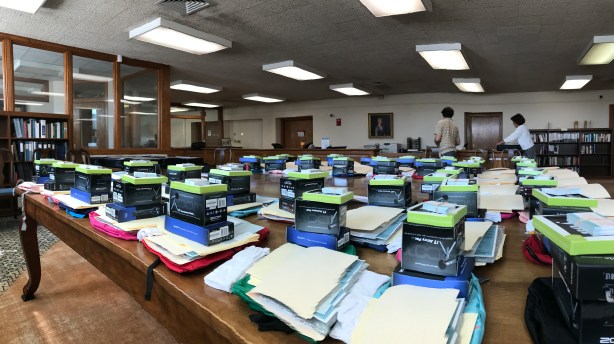
Assembling the Archivist in a Backpack kits at the Southern Historical Collection
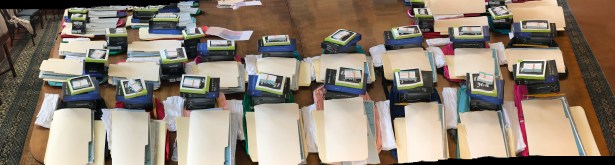
Assembling the Archivist in a Backpack kits at the Southern Historical Collection

LA: What about your Maya from the Margins project? How does that draw on participatory methodology?

BG: The spirit of participatory research infused Maya from the Margins, too. A lightbulb moment came from conversations I’d had with Latinos who were at best reluctant to acknowledge their indigenous past. I knew that young North Carolinians with both Latinx and indigenous roots often feel like outsiders. Their identity is really complex, and as second-generation Americans they’re at an uneasy remove from the experiences and culture of their immigrant parents. In addition to barriers to inclusion, the historic suppression of indigenous culture and language in Latin America poses a problem if you want to transmit a living history. Colonialism is not exactly a force for making people the curators of their own histories—which is what we’re trying to do.
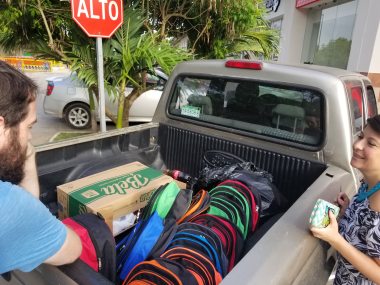
Khristin Landry-Montes and Douglas “Biff” Hollingsworth (Collections and Outreach Archivist, Southern Historical Collection) prepare backpacks that have been translated into Yucatec Mayan for distribution to teachers and students in Valladolid, Mexico

When I visited the State Archive of Yucatán, I viewed Mexican plantation documents that were every bit the counterpart of items held in the Southern Historical Collection, and I began to discern in the archive some common themes in history, movement and migration.  How could we bring people together around the topic of Mayan identity, and, in the participatory mode, enable them to take ownership of those histories, and claim that common ground?

The core idea was to create programming and archives-based exhibits by pairing a cohort of young Maya-identifying people in Yucatán with counterparts in North Carolina. Along with two Morganton high school teachers and two UNC-Chapel Hill undergraduate student mentors, the student participants visited the Southern Historical Collection and the State Archives of Yucatán, crisscrossed North Carolina and Yucatán, and collaboratively curated a travelling exhibition that was displayed at exchange sites.
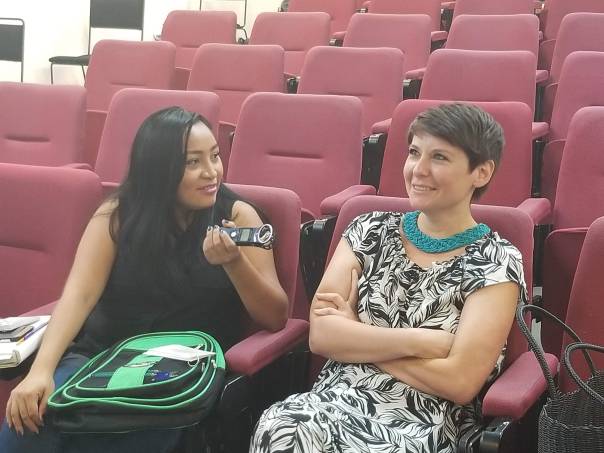
Daniela Garrido Durán uses backpack materials to interview Khristin Landry-Montes at a teacher training workshop sponsored by National Geographic at Universidad de Oriente in Valladolid, Mexico

LA: There’s a been a lot of talk in the archives profession about diversity, inclusion, and social justice, but I think people can be unsure of how to enact these ideas within the existing structures of academic and cultural institutions.  Can you talk about how your projects aim to disrupt power disparities and to empower communities or individuals?

BG: Sure!  One thing I can say from experience is that the challenge endemic to enacting the ideals of participatory research is making sure the implementation of projects matches the soaring rhetoric.  That’s actually where a lot of the space of invention comes in. The conceptual forms have to find embodiment in institutional and operational procedures, and finally, the tangible. We find ourselves answering a thousand sub-questions: for example, what’s the appropriate workflow, and what are the rights considerations, for ingesting material from a community history harvest?  Often it’s a case of first impression.  It puts demands on the imagination of the participants, the practitioners, and the institution.
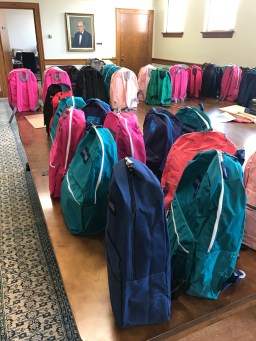
Assembling the Archivist in a Backpack kits at the Southern Historical Collection

Let me try to make this a little more real and a little less aspirational or abstract. We gathered feedback on Archivist in a Backpack from community partners by including in each a stamped card to be returned to us. One community partner reported, “We all witnessed how meaningful it was for the … participants to get those protectors, a certain kind of unexpected acknowledgement of the value of their memories.” Here again, tangibility matters; having the plastic sleeves made interviewees feel their material is cared for by someone else and not just of value to them.  Archivists can’t be everywhere at once; not everyone has the experience of seeing their materials foldered and rehoused.  There’s intrinsic power in letting the community member be the bearer of that gift.

History from below, as a school of thought in public history, needs to be matched with archives from below.  It’s an orientation toward finding what’s not in the grand narratives and making it present and accessible.  This manifests differently in diverse disciplines, but there’s a kind of interdisciplinary convergence happening, in my view.  It’s happening in sociology, anthropology, public health, and so on.  It’s not an accident that Maya from the Margins required partnerships with colleagues in anthropology, a nonprofit, archives and higher ed abroad, and institutions across campus.  Participatory research provides the common ground for the real interdisciplinary work that we hear a lot about but that’s so rarely achieved.
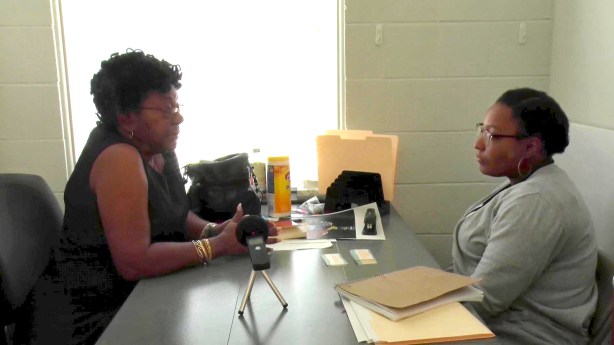
Delores Porter and Adreonna Simmons use backpack materials to conduct an interview in the historic black town of Princeville, NC

Certainly there’s a built-in tension in the fact that institutions innately want to control narratives. It’s revealing to speak with communities where outside institutions have walked away on their own terms, or pursued their own extractive ends.  The traditional quid-pro-quo nature of collecting ignores the fact that generosity is usually repaid handsomely and that it takes a relationship to bring a person, a story, to an archive.  There’s a long way to go with all this. We still have a hard time paying community experts, for example, and reaching carceral populations, and finding ways to fund community projects directly.

LA: What was the Southern Historical Collection (SHC) like, both in content and in practice, before you started working there four years ago?
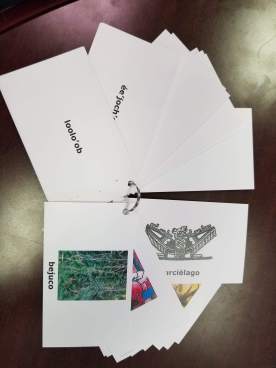
As one element of the backpack, these oral history prompt cards pertaining to the terminology of cenotes were translated into Yucatec Mayan and Spanish

BG: The Collection’s origins give it a tremendous magnetic force, since good collections have a way of attracting more good collections. I happened to be hired under a charter for change.  The SHC had a longstanding tradition of outreach, so I wanted to think about how to shift it beyond the podium.  We operated in a fairly conventional manuscripts mode: the goal traditionally has been to get primary material behind thick archival walls.  I was interested in how we could make those walls less intimidating and how we might render them invisible in a manner of speaking.  We took the time to do some planning and to hold ourselves accountable, which put us in a position to do more than react and to set a proactive collecting agenda. My SHC colleagues Chaitra Powell and Douglas “Biff” Hollingsworth bring tremendous creativity and experience to all of these efforts.  Our team agreed that we would be inspirited by an ethic of outrageous generosity and joyful participation, and that we would not lose sight of that simple mission.

LA: Since you were hired under a “charter for change,” what was your strategy for shifting the culture of SHC and launching these innovative projects?

BG: When I joined the Southern Historical Collection, I was determined to shift toward a participatory paradigm as a way of collecting that chimed with the best part of our “Of the People” institutional history. It offered a means to perpetuate a culture of respect and reciprocity. It’s a collecting ethos that will carry into the future, because collecting, broadly, is all about people and relationships. Those relationships are the most important corrective to the selective vision of academe. One of my favorite aphorisms is, No one sees his own ears.  Participatory research methods tend to point to our blind spots.  This is healthy not just for academic institutions; it’s good for communities, and it’s fundamentally an equitable way to go about the process. The power differences between academic institutions and communities—particularly those underrepresented in archives—are beyond enormous. From a collections standpoint, it’s like, the balance of power is tipped in favor of the institution before you arrive, not to mention while you’re there, so how do you continually put yourself in the perspective of a community member?  In those conversations, how can you be aware of the silencing effect of legacies and power disparities that extend well into the past?
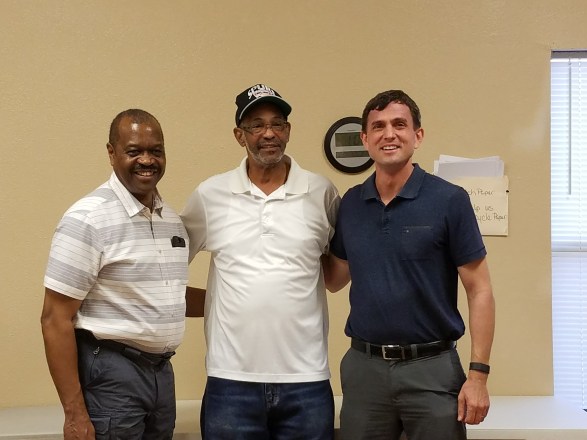
Everett Fly, George Frederick (SAAACAM – San Antonio African American Community Archive and Museum) and Bryan Giemza. SAAACAM is one of the community partners that is deploying Archivist in a Backpack

There is also an admittedly wonkish side to the business of change management; reading a book or two on the topic or taking a course can be helpful. It sounds calculated, and it is: you can develop a campaign for change, and that’s what I set out to do with the SHC team. We thought about how we might build allies across the organization, knowing that we wouldn’t get perfect buy-in from everyone, and that’s something we would have to accept and write off.

Trying to usher in community archives as a new way of thinking about what we do posed a lot of challenges, and it’s still a work in progress.  It’s a first principle of change management that most major change initiatives don’t pan out, and the ones that do require an absolutely relentless communication campaign. That’s very hard to do when you’re building the airplane in the air and doing your best to be responsive to communities.  We’ve been persistent in delivering the message that this work is essential to our identity. Put differently, community-driven archives aren’t just what we do—they’re who we are. It’s another gift to work in a place where others are innately disposed toward trying new things in service of others—and where there’s room for failure.

Stay tuned for Part 2 of our Archival Innovators interview with Bryan Giemza!
Bryan Giemza is Director of the Southern Historical Collection in Wilson Special Collections at the University of North Carolina at Chapel Hill, where he has been developing practices in community-driven archives. He is author or an editor of six academic books on American literary and cultural history, including Irish Catholic Writers and the Invention of the American South and Images of Depression-Era Louisiana: The FSA Photographs of Ben Shahn, Russell Lee, and Marion Post Wolcott. As principal investigator of grants from the Andrew W. Mellon Foundation and National Endowment for the Humanities, among others, he has led a variety of public humanities projects concerning the history and culture of the U.S. South. In 2019 he joins the faculty of the Honors College at Texas Tech University as professor of humanities and literature. Among his duties: working with students in the Sowell Family Collection in Literature, Community and the Natural World.
Federal Funding Impact Story #10

dennis meissner on NHPRC’s Archival research fellowships program and “more product, less process”

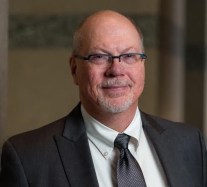
Dennis Meissner

Dennis Meissner is the retired Deputy Director for Programs at the Minnesota Historical Society, a Fellow of the Society of American Archivists, and a past president of SAA. Most of his career has focused on the arrangement, description, and use of archival materials, and he has participated in a number of national and international efforts to develop standards and practices in those areas.  In 2003-2004 he collaborated with Mark Greene on the NHPRC-funded More Product, Less Process research project, which has seen broad adoption within American archives and special collections.

In this special contribution to our Federal Funding Impact Stories series, Mr. Meissner reflects on the importance of federal funding in facilitating the research project that resulted in the seminal article “More Product, Less Process: Revamping Traditional Archival Processing” in the fall/winter 2005 issue of The American Archivist.

Granting Agency: National Historical Publications and Records Commission (NHPRC)
Grant Program: Archival Research Fellowships Program
Program Fellows: Mark Greene, American Heritage Center, University of Wyoming; Dennis Meissner, Minnesota Historical Society
Project Title: More Product, Less Process
Grant Period: 2003-2004
Award Amount: $10,000

Project Description
There is no shortage of archivists and repositories that have benefitted materially and professionally from the largesse and strategic investments made by the NHPRC over the past half century.  My own institution, the Minnesota Historical Society, received microfilming grants beginning in the 1960s and continued to benefit from Commission funding up through the past decade with generous backlog reduction and digitization grants. These are the sort of benefits with which archivists are most familiar.  Although the NHPRC budget has usually been modest, its grants have greatly assisted countless repositories in their efforts to achieve programmatic sustainability, records preservation, and service innovation.

But NHPRC has invested in a variety of other projects over the years, less well known but equally helpful to archivists and their profession.  One of those projects, near and dear to my heart, was the Archival Research Fellowships Program that was active from 2002 through 2005.  The Research Fellowships were set up as a three-year program established with an award of $143,000 to manage a new, non-residential archival research fellowship program. The program was administered by representatives from the Massachusetts Historical Society, Massachusetts Institute of Technology, Northeastern University, Schlesinger Library at the Radcliffe Institute, and WGBH Educational Foundation.

Members of the three annual cohorts of Fellows (4-6 per year) were each required to conduct research and write about a topic of importance to the archival profession, with proposals concerning electronic records given a somewhat higher priority.  The program resulted in a number of fine projects that advanced archival thinking and produced important publications, perhaps the most widely beneficial of them being Richard Pearce-Moses’s A Glossary of Archival & Records Terminology (SAA, 2005).

The program also funded the year of research that led to the publication of the “More Product, Less Process” article.  So, it is with great fondness and deep gratitude that I think back on the crucial role that NHPRC funding played in making that project a reality for Mark Greene and me.  In short, we would probably not have attempted that significant work without the financial support provided by the Fellows Program and (equally important) without its absolute deadline and firm expectation that we would report out something of merit at the end of a year.  The stipend itself funded an important research trip to D.C. to research historical grant files, my travel to Wyoming so that we could work shoulder to shoulder in early project scoping and writing sessions, and to hire student help in capturing and analyzing a large body of survey data.  The expectation to produce results focused our thinking and forced us to work quickly and energetically toward our goal.  That compressed work and energy could not have happened without our Commission support.

MPLP was made possible by generous NHPRC support through the funding vehicle provided by its Archival Research Fellowships Program, a gift that supported important work by a number of archivists over its brief duration.  This type of strategic investment in archivists and the archival profession is carried on today though the Commission’s support of the Archives Leadership Institute, which is helping a large number of mid-level professionals prepare themselves to become senior leaders in their repositories and in their profession.  I am continually impressed with NHPRC’s ability to strategically plant modest seeds that grow innovation and resilience throughout the U.S. archives community.

There’s an Archivist for That! Interview with Meredith Torre, Archivist, Atlanta Housing

This is the seventh post in our There’s an Archivist for That! series, which will feature examples of archivists working in places you might not expect.  To continue this new series, COPA member Rachel Seale, Outreach Archivist at Iowa State University, brings you an interview with Meredith Torre, Archivist for Atlanta Housing Archives (AH).

Writing

Photograph of Meredith Torre. Courtesy of Meredith Torre.

Meredith Torre is the Archivist for Atlanta Housing Archives. Torre earned her MLS with specializations in archives, rare books, and conservation at the University of Wisconsin, Madison. She has been a member of both the Society of American Archivists, Society of Georgia Archivists, and also the Heritage Emergency Response Alliance.  In August 2017, Torre received the Employee of the Month from Atlanta Housing Authority and has also won the CEO Award for Preserving Our Past from the Atlanta Housing Authority in 2015.

Be sure to also check out the profile of the Atlanta Housing Archives Torre wrote for the SAA Business Archives Section.

RS: How did you get your gig?

MT: In 2014, I saw that Atlanta Housing was hiring an archivist. Then Director of Records and Information Management, David Carmichael, had been Director of the Georgia Archives where I first worked as an archives intern. I did a little bit of investigating into the position and learned that the hiring would be Atlanta Housing’s first archivist, which intrigued me. I also liked that the lone ranger position would provide the opportunity to engage in all aspects of archival work. The archivist position started out as a temporary one. However, the agency began to see the archives as a valuable program within Records and Information Management and in 2015 invested in making the position a permanent one.

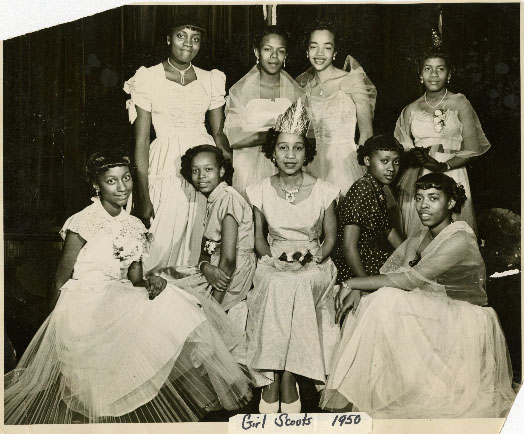
Girl scouts

“Girl Scouts.” AHA 2013.00258, 1950. Courtesy of the Atlanta Housing Archives.

RS: Tell us about your organization.

MT: For eight decades, Atlanta Housing (AH) has been at the forefront of providing affordable housing for many low-income families. The Housing Authority of the City of Atlanta formed May 18, 1938. AH’s founding Chairman Charles Forrest Palmer with Dr. John Hope, first black president of Morehouse College envisioned public housing that would eliminate Atlanta of its festering slums and provide decent, safe and sanitary housing at rent affordable to low income families. Under President Roosevelt’s New Deal these men formed an alliance to create the first federally subsidized public housing in the United States: Techwood and University Homes, serving as a national model for public housing. During the war AH again became a national model when President Roosevelt appointed AH’s founder as the Defense Housing Coordinator and AH lead national efforts for the construction of defense housing and housing for migrant war-workers and their families. Public housing nationally in the United States is still relatively young. AH recently reached its 80th anniversary (May 2018). During these years, public housing has undergone many changes and implemented new programs with Atlanta Housing continuing to play a key role in public housing policy. It’s a very exciting time to be an archivist for this type of organization!

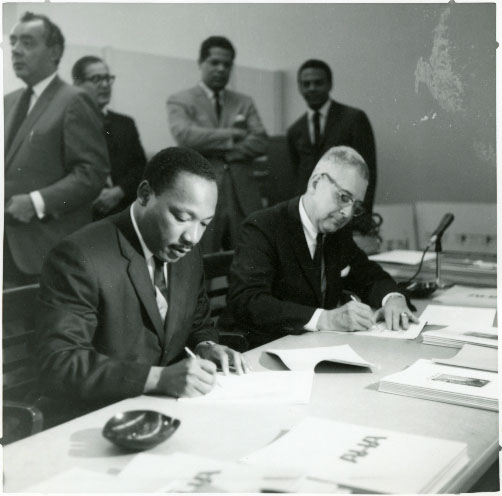
MLK

Martin Luther King, Jr. at Ebenezer Baptist Church signing an agreement with Edwin L. Sterne, AHA board chairman to develop a low and moderate income housing complex in the Rawson-Washington Urban Renewal Area. AHA 2013.01115, 1967. Courtesy of the Atlanta Housing Archives.

RS: Describe your collections.

SH: Atlanta Housing (“AH”) collects and preserves records of permanent and historical value dating back to the 1930’s. These records document the history of AH’s work and support its mission. Materials preserved in AH’s Archives have significant relevance to AH and document the evolution and history of AH, its achievements, administrative policy, programs, and projects. Records of enduring research value document the early history of public housing in Atlanta or in which AH played a pivotal and innovative role in shaping public housing policy and/or history. In particular, collecting areas include:

  • The United States first federally funded housing developments Techwood and University Homes.
  • AH during the period of war housing.
  • Housing project and real estate development/redevelopment records.
  • Urban Renewal records.
  • Official policies, reports, and agreements.
  • Programmatic records.
  • Papers and correspondence of executive directors, deputy executive directors, senior vice-presidents, and the President/CEO.
  • Photographs, audiovisual materials, and artifacts.
  • Oral histories.
  • Community life.
  • Marketing, media, and publications created by AH.
  • Materials published outside AH that describe AH, its programs, projects, and history (such as newspaper and magazine articles).
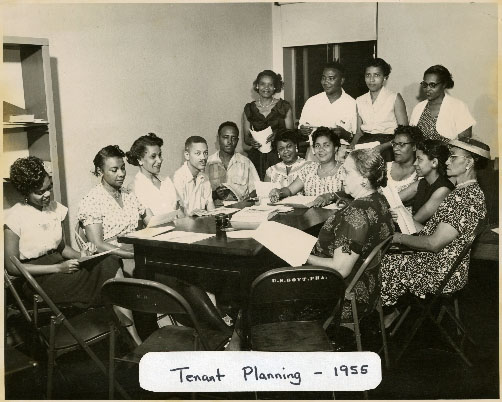
Tenant planning

“Tenant Planning” AHA 2013.00252, 1955. Courtesy of the Atlanta Housing Archives.

RS: What are some challenges unique to your collections?

MT: Up until 2014, AH’s records were poorly housed in cardboard boxes, exposed to pests and profusely lined the floors and racks of the agency’s headquarters attic and basement prone to floods. A historian compiling a history for AH rearranged all records according to subjects in her book. Loss of original order, poor labeling, no indexing, duplications, separation of signatures from original agreements to create “a signature file of important persons”, and poor storage lead to issues in record retrieval, authenticity, loss of information, and damage to valuable historical records.

Part of the unique challenge I faced when first coming to AH was to build an archives from the ground up. I was tasked with creating an archival environment for the records and to restore original order to the records. Because the loss of original order and the necessity of its restoration, the processing of record collections is ongoing. Records are now arranged and described following best practices and standards including MPLP, DACs, and assigning Library of Congress and the ATT authorized subject and name authorities. Preliminary finding aids for AH’s collections are now available. Processed records are reboxed using archival materials and in 2016, the archives moved to a secure, climate-monitored space.

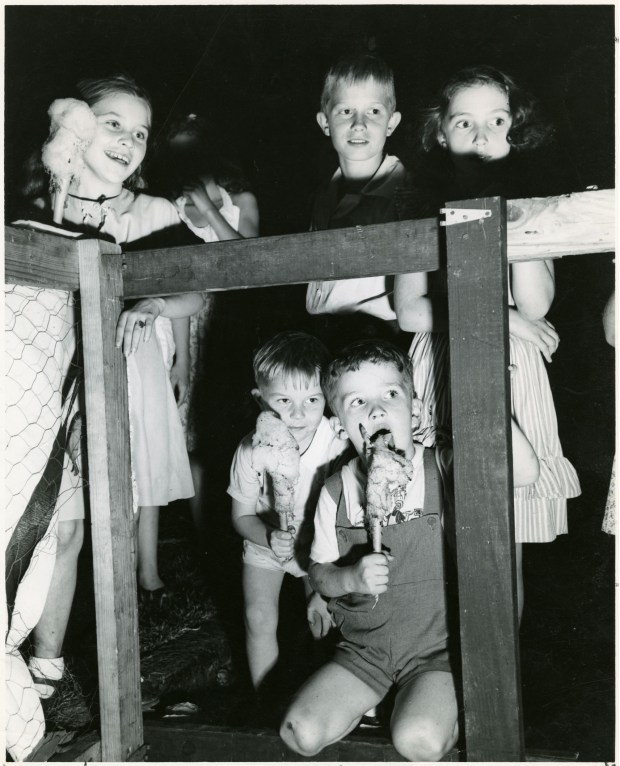
Techwood Clark

Techwood-Clark Howell Homes Carnival, community life. AHA 2013.00298, circa 1940-1949. Courtesy of the Atlanta Housing Archives.

RS: What is the favorite part of your job?

MT: I have worked in many different types of archival environments (government, academic, theological) and one of the most favorite aspects of my job for me is working within its unique environment. Atlanta Housing is a quasi-governmental entity. It functions as a business. It’s also a service oriented nonprofit institution. The business environment at AH requires flexibility in setting processing priorities and providing quick turnaround while realistically managing expectations. This environment offers its challenges. It also offers me the opportunity to tell people what it is archivists do frequently and to experience that moment of discovery from different people throughout the agency when they realize archives can work for them, has meaning, and is practically useful and magical. I also really enjoy working with our researchers. AH has hosted researchers and students locally and from all over the country interested in public housing history.

Stay tuned for future posts in the “There’s an Archivist for That!” series, featuring stories on archivists working in places you might not expect. If you know of an archivist who fits this description or are yourself an archivist who fits this description, the editors would love to hear from you—share in the comments below or contact archivesaware@archivists.org to be interviewed for ArchivesAWARE!

Recap of “Carpe Media! Communications and Media Training for Archivists” Workshop at ARCHIVES*RECORDS 2018

In this post, authors Vince Lee and Rachel Seale, members of SAA’s Committee on Public Awareness (COPA), share their impressions from attending the COPA-sponsored “Carpe Media! Communications and Media Training for Archivists” workshop at ARCHIVES*RECORDS 2018.

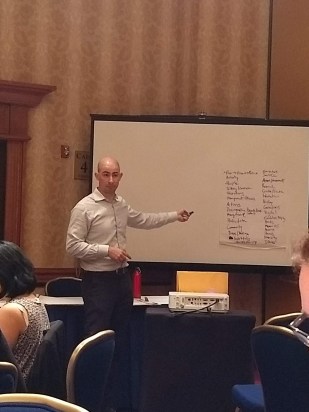
Workshop facilitator Jason Steinhauer role-playing with an attendee. Photo courtesy of Vince Lee.

Carpe Media! Communications and Media Training for Archivists” was a day long workshop put together by SAA’s Committee on Public Awareness (COPA) and facilitated by Jason Steinhauer at Archives*Records 2018. This workshop offered archivists the necessary tools and confidence to be better communicators on their profession and organization to a wide variety of audiences. Many of us were forced out of our comfort zones to participate in activities that helped focus our message about archives, in general, and specific messages to our respective stakeholders and users, in particular.

COPA worked with SAA Executive Director, Nancy Beaumont, and Director of Publishing, Teresa Brinati, to bring this professional development opportunity to SAA members. Communicating effectively to the media or on social media is something most archivists have learned on the job and many of us would still like to develop these skills.  Reasons for attending the training and what they hoped to get out of it were articulated at the beginning of the session during introductions between Jason and the attendees:

  • Tools to raise awareness of what they do and the collections they have to the general public
  • Make communications more interesting and impactful to targeted audience
  • Communicate more strategically
  • Awareness and advocacy targeted to grass roots audience on why archivists and their organizations need additional resources/facilities to house and process their collections
  • Donor communications and bridging perceptions on archivists and our roles
  • Awareness and community outreach to potential donors
  • Get “buy-in” from organizational leadership for additional resources
  • Communicating history and heritage to internal stakeholders

    Leadership slide from workshop. Photo courtesy of Teresa Brinati.

Takeaways

  • Be concise and consistent.
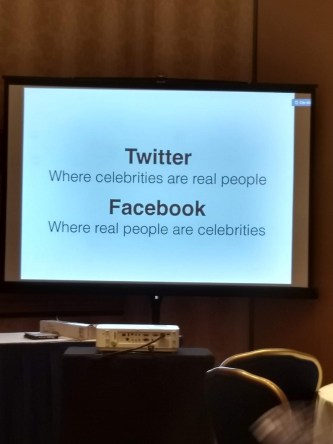
  • Social media slide from workshop. Photo courtesy of Vince Lee.

    Be repetitive, don’t assume people are going to see your one Tweet amidst the 500 million other Tweets that day.

  • You have customers and users. Tailor your message to each group.
  • Your brand is a promise to deliver something to your customers and also how you are perceived.
  • Resist the temptation to be clever.
  • Stick to the message, don’t be cute or snarky or that’s what the journalist may cut out of context and use in their piece.
  • Choose the platform/s that is most used by your customers and users. Don’t know which platform? Survey!
  • Always be connected (ABC)-think about who you are connecting to and with and what message your audience wants/expects to receive.

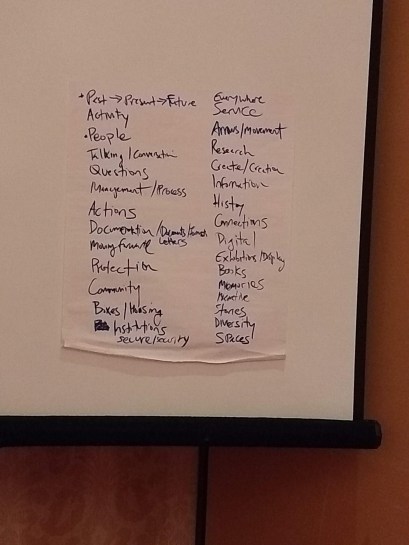
List of “our words” that we can use to communicate what an archives is to an external audience. Photo courtesy of Vince Lee.

Jason pointing to our “words” to describe what an Archives means to each of us. Photo courtesy of Vince Lee.

Attendees from the workshop came away with a newfound appreciation that words matter and time is short. The words we use to tell our stories about ourselves, our profession, and the organizations we work for must come from us in order to be authentic and resonate to those we are trying to communicate to. We all have a limited amount of time and space to get our point across. We need to think of the essence of the thing without the whole thing. What is the essence of archives? It’s important to strip and distill what an archives is down for our audience in digestible chunks. The essence of archives is about the words we choose to describe ourselves and our profession. It’s important that we incorporate and use our words in conversations with donors, media, and our customers on a consistent basis.

At the end attendees had the opportunity to practice what they have learned in a one-on-one role-play exercise with Jason on various scenarios and situations they may find themselves in- whether it is interviewing in front of a camera, requesting more funding from an administrator or donor, or requesting additional resources in support of a project. Attendees would then receive feedback on their performance from both Jason and their peers.

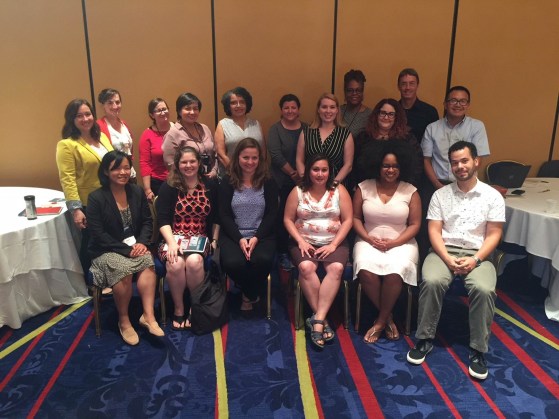
Group photo of attendees. Photo courtesy of Teresa Brinati.

Archives + Audiences: Wendy MacNaughton on “Leave Me Alone with the Recipes: The Life, Art, and Cookbook of Cipe Pineles”

This post is the latest entry in our Archives + Audiences series, which features the perspectives of archival audiences – scholars, journalists, filmmakers, artists, activists, and more – for whom archives have been an important part of their life and work.

Wendy MacNaughton portrait by John Keatley

Wendy MacNaughton. Photo by John Keatley.

In this Archives + Audiences entry, we bring you an interview with artist, illustrator, and graphic journalist Wendy MacNaughton on her experience researching  Cipe (C.P.) Pineles, Conde Nast’s first female art director. MacNaughton found Pineles’s manuscript at an antiquarian book fair. With her coeditors, Sarah Rich, Maria Popova, and Debbie Millman, MacNaughton compiled Pineles’s recipes and drawings into Leave Me Alone with the Recipes: The Life, Art, and Cookbook of Cipe Pineles (Bloomsbury, 2017). [To learn more about the coeditors’ experience, see A Rare Find: Trailblazing Female Designer’s Unpublished Family Cookbook.] In the process, MacNaughton examined Pineles’s papers at the Rochester Institute of Technology.

MacNaughton’s books include  Lost Cat: A True Story of Love, Desperation, and GPS Technology (Bloomsbury, 2013) and Pen and Ink: Tattoos and the Stories Behind Them (Bloomsbury, 2014).

ArchivesAWARE:  What was it like to work with Pineles’s papers at the Rochester Institute of Technology?

MacNaughton: Exciting. The Cipe Pineles archives at RIT is filled with original drawings, publications, sketches, thumbnails . . . it was a treat to hold her work, see it up close. There were pieces I’d never seen before—it gave the opportunity to discover details, make connections, examine her process and technique . . . It felt like an exploration—like discovering Cipe’s work all over again.

ArchivesAWARE: Did anything in the materials surprise you or were there any a-ha moments?

MacNaughton: Seeing her thumbnails and gouache paintings up close showed us a lot about her technique and process that you just can’t get looking at it in a book. Holding the board and seeing how the light hits the surface of the paint . . . the time and care she put into her work beyond the time she spent in the office—it brought all the stories we’d heard about her to life.

ArchivesAWARE: Was there something you were hoping to find but didn’t?

MacNaughton: Cipe created a lot of personal projects and 3D objects—I was hoping to find more of those. Turns out many are with her family members. Though we didn’t find them in the archive, we discovered some in personal collections.

ArchivesAWARE: What was the impact of being able to access/use these collections?

Leave Me Alone with the Recipes

Cover of Leave Me Alone with the Recipes: The Life, Art, & Cookbook of Cipe Pineles (Bloomsbury).

MacNaughton: Cipe was influential and important and overlooked by history. Without RIT’s archive we wouldn’t have been able to create the book and exhibition we did about Cipe’s work and life. The archivists at RIT were responsive to my co-editor Sarah Rich’s and my requests and queries and helped us gather visual materials—many of which made their way into the book or exhibition—as well as information like rights and contact info for further research.

ArchivesAWARE: Did you encounter many barriers to accessing or using archival resources?

MacNaughton: Because the funding isn’t there at RIT for the archive to be cataloged properly, we weren’t able to access the materials online in advance of going. With only one day at RIT, it was hard to go through everything. The folks at RIT were incredibly helpful, pulling materials they thought might be of interest and useful. But we all know that discovery is a big part of creation, and so going through it myself was important. Ideally someday all the materials will be digitized and cataloged in such a way that anyone can access them from anywhere. But that won’t replace the experience of visiting the archive in person.

ArchivesAWARE: Is there anything else you would like to share about your experience working with archives?

MacNaughton: My co-editors (Sarah Rich, Debbie Millman and Maria Popova) are grateful to the archivists and librarians for the work they do, their dedication and expertise and generosity with their time. Theirs is a slow, quiet, careful process in a fast paced world, and we would be lost without them.

There’s an Archivist for That! Interview with May Haduong, Public Access Manager, Academy Film Archive

This is the sixth post in our There’s an Archivist for That! series, which features examples of archivists working in places you might not expect. COPA member Anna Trammell, University Archivist and Special Collections Librarian at Pacific Lutheran University, brings you an interview with May Haduong, Public Access Manager of the Academy Film Archive. 

May Haduong

Courtesy of Nate Christenson / ©A.M.P.A.S.

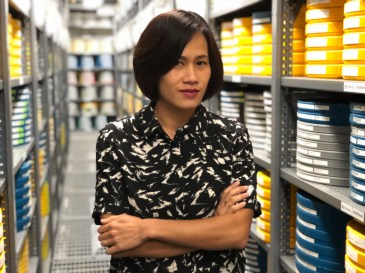
May Haduong is the Public Access Manager at the Academy Film Archive, where she oversees access to the Archive’s collection. Prior to serving at the Academy Film Archive, she was the Project Manager for the Outfest UCLA Legacy Project for LGBT Moving Image Preservation, a collaboration between the UCLA Film & Television Archive and Outfest, which produces the Los Angeles LGBT Film Festival. She currently serves on the Legacy Project Advisory Committee and is the chair for the Elections Committee for the Association of Moving Image Archivists.

AT: How did you get your job?

MH: As a UCLA graduate student, I interned with the Academy in 2005 and 2006 to help process home movies and a collection of Asian American cinema. After receiving my master’s degree, I served as the Legacy Project Manager for the Outfest/UCLA Legacy Project for LGBT Moving Image Preservation. When a job at the Academy Film Archive opened up in 2008, I jumped at the opportunity to return to the Academy and applied for the position. I firmly believe that my internship experiences at the Academy and the support that I received during that time helped me get hired.

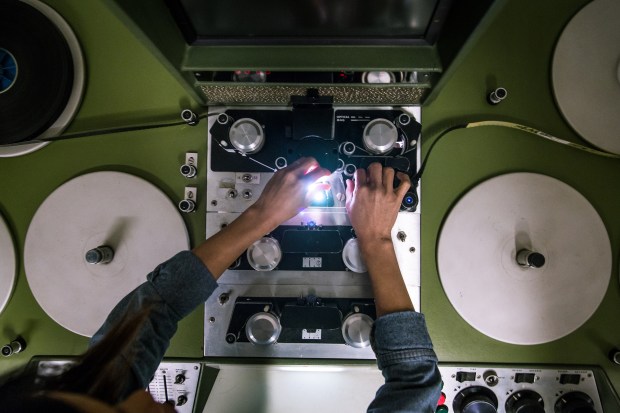
20160520_pickford_center_0870

Courtesy of Nate Christenson / ©A.M.P.A.S.

AT: Tell us about your organization.

MH: While many people know of the Academy for the Oscars, they don’t know that the viewership of the awards show helps fund the Academy’s philanthropic work, including grants, scholarships, an internship program aimed at bringing more diversity to the field, a world-class library, and the archiving and preservation work conducted at the Academy Film Archive. As a queer woman of color, it’s important to me that my professional work aligns with my own personal beliefs. I’m proud to work for an organization that focuses on all aspects of filmmaking, from supporting underserved communities to preserving rarely seen films.

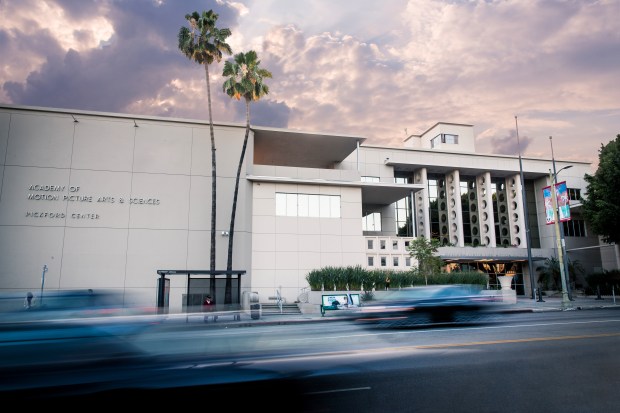
20160520_pickford_center_0795

Courtesy of Nate Christenson / ©A.M.P.A.S.

AT: Describe your collections.

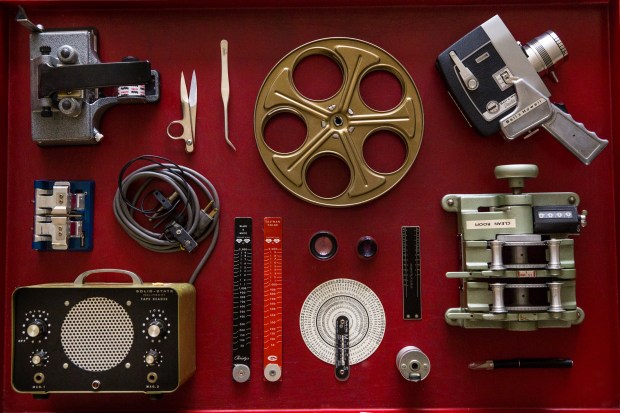
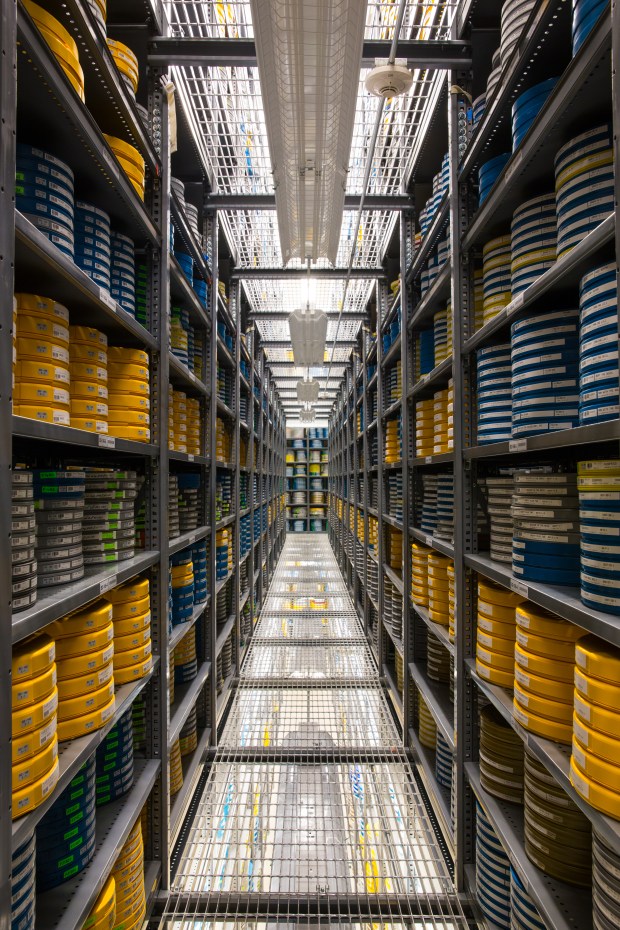
MH: The Academy Film Archive is home to one of the most diverse and extensive motion picture collections in the world. With over 200,000 moving image items in our collection, the Archive’s collection includes moving images from the advent of cinema to the present day, with significant holdings related to the history of the Academy and the Oscars, experimental cinema, studio titles, independent film, documentaries, early cinema, the history of the motion picture industry, home movies and amateur documentation, theatrical advertising and short films. Since its establishment in 1991, the Archive has completed over a thousand film preservation and restoration projects.


AT: What are some challenges unique to your collections?

MH: While the Oscars help fund the great work that we do, it also becomes a focal point for some months of the year before the live broadcast. Because of the unique nature of the organization, some staff in the Archive – including myself and those in the access department – shift from traditional projects and workflow to working with show producers and the press to deliver archival content from our collections. This shift and the expectations implicit with the Academy’s work and reputation set a very high bar for service, speed, and quality. While “Oscar season” can certainly be stressful and busy, it also helps shine a light on the Academy’s work to preserve moving image history. As a film archive, we have technological considerations that are continually shifting. While we work to preserve moving images in the format in which they were originally seen, we also make choices to help provide as much access as possible through available mediums. The digital transition, while challenging both fiscally and logistically, has helped push the Archive and the Academy towards a more forward-thinking approach towards conservation and preservation.

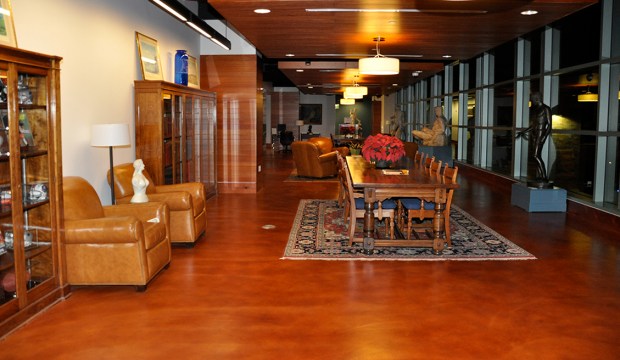
20160520_pickford_center_0695

Courtesy of Nate Christenson / ©A.M.P.A.S.

AT: What is your favorite part of your job?

MH: I love finding unique items in our collection and providing access to them. As I’ve mentioned, we hold a wide range of material and thus we often come across films that have rarely been seen. Recently, a colleague and I located a family member of a home movie collection that was filmed by a queer interracial couple in the 1970s. We were able to show the films, with the family’s permission, at a conference, discussing concerns around privacy, cultural competency, and archival ethics. The access department also works with film programmers and scholars from around the world, providing access to the collection online, on-site in Hollywood, and through loans of 16mm and 35mm prints to repertory venues. I became fascinated with film archiving as a queer film programmer some many years ago and I see the work that archives do, including the Academy, as important in helping ensure that films are conserved, preserved, and seen.

20160520_pickford_center_0925

Courtesy of Nate Christenson / ©A.M.P.A.S.

Stay tuned for future posts in the “There’s an Archivist for That!” series, featuring stories on archivists working in places you might not expect. If you know of an archivist who fits this description or are yourself an archivist who fits this description, the editors would love to hear from you—share in the comments below or contact archivesaware@archivists.org to be interviewed for ArchivesAWARE!

I’m Not an Archivist but I Play One at the Office: Interview with Cindy Slater of the Stark Center for Physical Culture and Sports

COPA member Lindsay Anderberg, Interdisciplinary Science & Technology Librarian and Poly Archivist at New York University, interviews Cindy Slater, Assistant Director for Library Services at The H.J. Lutcher Stark Center for Physical Culture and Sports.  Slater explains how the Stark Center came to be and why sports and physical culture collections are relevant to just about everyone.

ArchivesAWARE: We’ll get this out of the way first: you are not an archivist.  But, here you are on an archives blog!  Could you tell us your title and the way in which your work supports archival collections, patrons, and/or donors at the Stark Center?

Cindy Slater

Slater: To paraphrase the old television commercial, I’m not an archivist but I play one at the office.  My title is Assistant Director for Library Services but we are a small shop so we all wear several hats.  While I am primarily focused on patron reference services and library collection maintenance, I also spend a lot of time doing basic registrar duties, what I call triage preservation, collection assessment and some arrangement/description work. I’m joined on staff by two digital archivists and one processing archivist.  In addition, our directors, Jan and Terry Todd, have offices here, as do two other faculty members, Kim Beckwith and Tommy Hunt.

ArchivesAWARE: Tell us about the Stark Center.  What does it collect and how did it come to be?

Slater: The H.J. Lutcher Stark Center for Physical Culture and Sport is a research center within the Department of Kinesiology & Health Education at the University of Texas, Austin.  As the name implies, our collection is focused on materials that document the world of physical fitness and sports, with an emphasis on weight training and strength development.  You’ll note, though, that we use the term “physical culture,” an old term, common at the end of the 19th Century, that denotes the  “various activities people have employed over the centuries to strengthen their bodies, enhance their physiques, increase their endurance, enhance their health, fight against aging, and become better athletes.”  For a number of reasons, the term fell out of favor but we’d like to see it revived since it best describes the wide-ranging focus of early pioneers of physical fitness, men and women who believed a well-rounded person was one who exercised their body, their mind, and their emotions.

The Stark Center Reading Room

The Stark Center Reading Room

The Stark Center exists through the perseverance of Terry and Jan Todd.  Both were world-class, record-setting athletes in the sport of powerlifting and both are world-class academics in the realm of sports history.  When Terry started working on his dissertation, back in the mid-1960s, he quickly discovered that weightlifting and strength training materials were rarely found in academic libraries.  Instead, those materials had been collected and preserved by individuals whose passion for the field was on display in their homes, attics, garages – any place they could set up one more bookcase or file cabinet.  Terry believed these materials showcased and explained an important part of human history – the idea that “building the body” was as important as, and  integral to, enriching the mind or the soul.  So, the Todds began collecting material themselves, sometimes adding the collections of those private individuals who had befriended Terry as he researched his dissertation.  When they settled at the University of Texas at Austin (UT) in the mid-1980s, they brought the collection with them and began to petition the University to help with space and support.  In 2008, the University gave them about 22,000 square feet of space in a new building situated in the UT football stadium but money to build out the space had to be raised outside the University.

Knowing the connection of Lutcher Stark to UT (Board of Regent President), to the University’s football program (manager of the 1910 team), and to physical fitness in general (studied weight training with Alan Calver), the Todds approached The Nelda C. and H.J. Lutcher Stark Foundation requesting funds to build out a library/archive/exhibit space that would house their extensive and growing historical collection, as well as illustrate the history of physical culture.  We are eternally grateful to the Stark Foundation for seeing the value of the Todds’ vision and, consequently, providing the majority of funds necessary to build out the space and to continue operations.  We are also grateful to the Betty and Joe Weider Foundation for providing further funds to create and maintain our exhibit space.  

ArchivesAWARE: Who is your typical researcher?

Slater: We have two broad groups of researchers.  One is currently enrolled students at UT, most of whom are working on papers within their major.  Even though we are part of the Department of Kinesiology, we’ve supported the research needs of students in American Studies, Art History, Health Promotion, Economics, among others.  The second group of researchers include both dissertation and book writers.  While some of these researchers come from within UT, a large number have come from other institutions or are independent writers.  These individuals, who are taking a deeper look at a specific aspect of physical culture, find our collection to hold materials they’ve not seen elsewhere.

ArchivesAWARE: What is your favorite item or collection in the Stark Center?

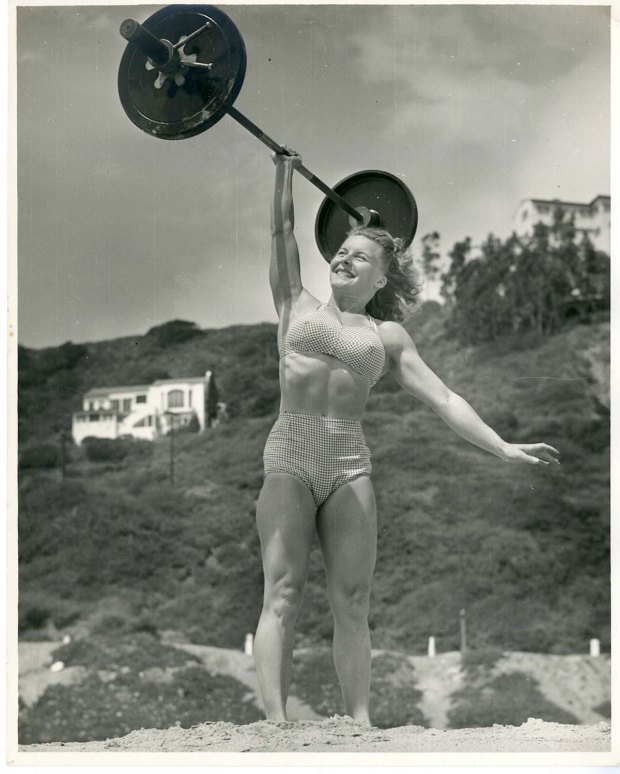
Slater: Oh boy, this is like asking a parent which child is their favorite!  But I have to admit that there are two collections that I frequently refer to when talking about the value of preserving our legacies.  One is the collection of Abbye and Les Stockton, a couple who were at the center of Muscle Beach during its prime.  “Pudgy” (Abbye’s childhood nickname stuck, even though she was anything but!) was a strong proponent of getting women in the weight room.  She believed a strong woman was a beautiful woman.  Her collection is full of fantastic photographs of strong men and women doing incredible gymnastic feats before a beach-happy crowd of admirers.

The other amazing collection is a set of 20 scrapbooks compiled by Mauryene Kite, mother of the professional golfer (and UT grad), Tom Kite.  Mrs. Kite must have had a strong intuition that her son would become one of the best golfers on the PGA Tour because she started an incredibly detailed scrapbook when Tom was still in junior high school.  And she continued compiling scrapbooks, almost one for each year of his long career.  These scrapbooks include photographs, letters, scorecards, programs, course layouts, newspaper clippings – they are a perfect microcosm of an athlete’s life.  The three scrapbooks she made of Tom’s years at UT tell us more about the UT golf program than we’d ever be able to find on our own.

Photograph of "Pudgy," from the Abbye and Les Stockton Collection

“Pudgy,” from the Abbye and Les Stockton Collection

 ArchivesAWARE: What is the most interesting experience you’ve had with a Stark Center researcher or donor?

Slater: We were recently visited by a professor from South Africa who has been researching the history of physical culture/fitness in his native country.  He came to the Stark Center to specifically review early issues of Health & Strength, a British publication that included news of physical culture activities held throughout the British Commonwealth.  Growing up, his mother had told him that a photograph of her had been published in Health & Strength but neither she nor anyone in the family had a copy.  So it was with some emotion that, late one afternoon, he announced that he had found her photograph.  It made his long and expensive trip very worthwhile and it just made our day. 

ArchivesAWARE: Why do you think it is important to collect, preserve, and provide access to sports collections?

Slater: There are a number of sociological, economic, medical, and psychological studies out there that tout the value of both sport, in the big picture sense, and sports, in the daily activity sense.  The findings of these studies help us to understand the hundreds of ways in which sports impact our lives.  As important as these findings are,  I think the reason for archiving sports collections is really very simple – sports are part of our whole.  Archivists are in the business of documenting our culture, all aspects of our culture, and sports are part of that.  I suppose there are folks for whom sports have little relevancy but the vast majority of us have some connection to the sports world.  Maybe we cheer on our local high school football team, or we have a nephew competing in junior figure skating, or a friend who raises cancer awareness by running marathons.  Maybe we spend Saturday on the golf course and Sunday watching the NFL, or we’re part of a “soccer mom” carpool.  Sports may be a little piece or a large piece but either way, it’s a piece of the whole of our lives.  And so it is worth our time to study, explore and understand – and that’s not possible without archives.

ArchivesAWARE: What are the common misconceptions (if any) archivists have about sports-related collections?

Slater: Actually, I don’t think most archivists have misconceptions about sport because, almost across the spectrum, I find archivists to be keenly aware that they are responsible for the whole picture.  So whether their collections are personal or organizational, archivists know that if the collection includes sports-related materials, then they have a value as part of the whole.

To the degree that misconceptions exist, I think they exist in the minds of the athletes, coaches, and administrators who often simply don’t think that their professional and personal legacies are that important.  But, with few exceptions, isn’t this the same problem faced by many archivists who are focused on a specific segment of our culture?  It’s so hard to convince people that the decisions they make, the activities in which they participate, the outcomes of their daily work, all have value to current and future generations.  Sometimes it’s a very personal value (like our South African professor finding his mother in Health & Strength) and sometimes it’s a culture-wide value.  The sports community is no different, so for those of us who love sports, our mission is to persuade and assist members of that community with identifying and keeping records that tell their story.

An Interview with Jason Steinhauer, Public Historian and Creator of History Communication

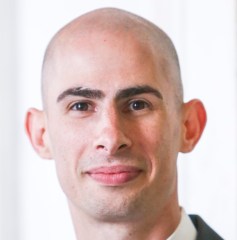
Public communication has perhaps never been more important for the archives profession as it is today.  That’s why we wanted to talk with Jason Steinhauer, public historian, director of the Lepage Center for History in the Public Interest at Villanova University, and creator of the field of history communication.  In this interview with ArchivesAWARE!, Steinhauer discusses his entry into the historical profession as a curator and archivist, his work as a public historian and the creator of history communication, and how archivists can apply the principles of history communication to their own work.  Steinhauer will also be leading the “Carpe Media! Communications and Media Training for Archivists” workshop on August 14 at ARCHIVES*RECORDS 2018.

ArchivesAWARE: Can you tell us about your background working as a museum curator and archivist?

Jason Steinhauer. Photo by Amanda Reynolds.

Steinhauer: I always enjoyed museums; as a child I created exhibits in my parents’ basement. In college, I interned at two museums and fell in love with the work. So, following graduation, I was very fortunate to land a position with the Museum of Jewish Heritage—A Living Memorial to the Holocaust, working as an exhibitions assistant on an exhibit about American Jewish soldiers in WWII. That exhibit went on to win the AAM Grand Prize for Excellence in Exhibitions and spring-boarded me into becoming a curator.

I also always had a passion for historical records. I inherited that from my parents, who love to sleuth around in archives and used book stores for clues about the past. After working closely with objects as a curator, I decided to get my archivists’ certificate, to learn how to work closely and properly with archival records. The training and experience in archives and museums prepared me for the next phases of my career.

ArchivesAWARE: You’ve since gone on to work as a public historian, first at the Library of Congress and now as the inaugural director of the Albert Lepage Center for History in the Public Interest at Villanova University.  What motivated you to transition out of curatorial/archival work and onto the “front lines” of the history profession?

Steinhauer: As a curator and archivist, I was always a public historian; I just didn’t know it. It was after I joined the Library of Congress Veterans History Project that I learned about public history through the National Council on Public History. NCPH really resonated with me. It was a community grappling with the same questions I had been grappling with since starting my career: How do you make historical scholarship accessible to diverse public audiences? How do you include those audiences in the process of historical inquiry? And how do we use physical spaces, records, and objects to tell stories about the past? I have always been fascinated by those questions, and my work at the Library of Congress and now as the first director of the Lepage Center for History in the Public Interest offered me the opportunity to wrestle with them in a variety of settings: with Members of Congress and elected officials, with diplomats, foreign governments, business communities, funders, scholars, and students. As the environments in which we operate grow more complex, the challenges become greater and the task more urgent.

ArchivesAWARE: You’re also the creator of the field of history communication.  What is history communication, and where did the idea come from?

Steinhauer: In 2014, I worked at The John W. Kluge Center inside the Library of Congress. At the time I was friendly with several “science communicators,” and became intrigued by science communication. The sciences have made huge investments in ensuring scientists are trained to communicate scientific research to various audiences through a variety of media formats, not solely for disseminating scholarship but also for the purpose of informing public debates and shaping policy. It seemed to me that the history profession could do the same. I began asking if Masters and PhD programs had made such investments in communications, and found that few had. So I proposed the creation of history communication and set out with colleagues to develop coursework that would wrestle with how history gets communicated across contemporary media spaces—Web, social, video, VR—and identify the skillset necessary to do that work effectively. Four years later we have history communication courses being offered and trainings being conducted nationwide.

ArchivesAWARE: How do you think archivists can apply the ideas behind history communication to their work?  What would you say are some of the biggest challenges facing archivists in this regard?

Steinhauer: I hazard to guess that some of the challenges are cultural and institutional. Institutions and organizations tend to be conservative in keeping up with technological change and taking risks. But history communication work involves risk-taking and innovation, and that’s where training becomes critical. Archives programs can help by preparing archivists to do this work in a systematic way, so that when new archivists are hired, they have the tools and skillset to contribute right away.

ArchivesAWARE: Breaking into history communication would likely require many archivists to develop new competencies on top of their traditional archival training.  Do you have any thoughts on how archivists could best acquire the training necessary to undertake this innovative form of public outreach?

Steinhauer: Our Intro to History Communication syllabus is a great place to start. The syllabus was developed by more than 35 people in two working groups held in 2016. It lays the foundations for communicating history in this current environment. It covers historical thinking, media literacy, different media formats, even the business aspects of history. Second, I think connecting with others, either on Twitter at #histcomm or through our LinkedIn group, would be beneficial. Third, attending workshops such as the one being sponsored at this year’s SAA annual meeting. And, finally, nothing beats learning by doing. I would love to see history communication assignments integrated into archives programs nationwide, so that archivists graduate with the skillset needed for this crucial work.

ArchivesAWARE: Is there anything else you’d like to share regarding your work as an archivist and public historian, and the role of history communication in the cultural heritage professions?

Steinhauer: Communication is an essential part of what we do as historians, archivists, and records managers. We must continue to find strategic and creative ways to communicate, adapting to new audiences and new media formats as they emerge. This has been a recurring theme at NCPH, AASLH, SHAFR, AHA and other conferences the past few years, so I think the profession is awakened to this reality. I’m excited for the future and for the role that the Lepage Center can play.

Archives + Audiences: Anna Shternshis on “Yiddish Glory: The Lost Songs of World War II”

This post is part of our new Archives + Audiences series, which features the perspectives of archival audiences – scholars, journalists, filmmakers, artists, activists, and more – for whom archives have been an important part of their life and work.

AnnaShternshis

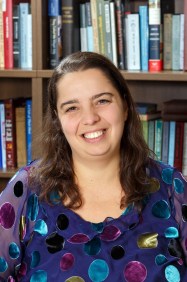
Anna Shternshis. Photograph by Roman Boldyrev.

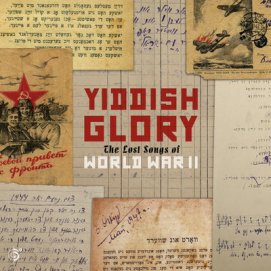
In this Archives + Audiences entry, we bring you an interview with Anna Shternshis, Associate Professor of Yiddish and Diaspora Studies at the University of Toronto, on her experience researching a collection of song lyrics by amateur Jewish authors in the Soviet Union during World War II.  Originally collected by Soviet ethnomusicologists toward the end of the war, the song lyrics collection is now housed at the Vernadsky National Library of Ukraine.  Shternshis’s work with the collection helped produce the recently released album Yiddish Glory: The Lost Songs of World War II (Six Degrees Records), in which select songs have been reconstructed and performed by professional musicians.

Shternshis is the author of Soviet and Kosher: Jewish Popular Culture in the Soviet Union, 1923 – 1939 (Bloomington: Indiana University Press, 2006) and When Sonia Met Boris: An Oral History of Jewish Life under Stalin (New York: Oxford University Press, 2017). She is the author of over 20 articles on the Soviet Jews during World War II, Russian Jewish culture and post-Soviet Jewish diaspora. Together with David Shneer, Shternshis co-edits East European Jewish Affairs, the leading journal in the field of East European Jewish Studies.

ArchivesAWARE: What was it like to work with the collection of Jewish song lyrics at the Vernadsky National Library?  Did anything in the collection surprise you, or were there any “a-ha” moments?

Shternshis: The work of a historian consists of many hours of monotonous research, and this project is not an exception. But when I really began analyzing the lyrics of these Yiddish songs, and understood that these were grassroots accounts of Nazi atrocities that had been set to music, and that none of these songs had been known before, emotions took over. I felt excited about reading these materials, and strongly moved by the lyrics. Above all, I felt enormous gratitude to Moisei Beregovsky and his colleagues, Soviet ethnomusicologists of the 1940s, who spent years collecting these unique materials.  They were arrested by Stalin’s government for doing so, and died thinking their work was lost to history without any recognition for what they had done. I felt professional solidarity with these people, who, of course, I have never met.

I was struck both by the magnitude of this finding, and by the fact that all these songs told stories of people who we rarely get to hear from. In the context of writing history, we often hear people’s voices as “interpreted” as opposed to given a platform, and I was determined to do something about it. In many ways, these songs represented the range of experiences of Jews in the Soviet Union during the war:  the stories of the 440,000 who served in the Red Army and the 1.4 million who managed to survive through a harrowing evacuation to the Soviet Rear, and they also were actual testimonies of those who were killed in the Holocaust.  Of the 6 million who were killed, more than 2.5 million Jews were murdered in Nazi-occupied parts of the Soviet Union, and we learned that, some of the last things people did, was to write songs to document the horrors they witnessed.

ArchivesAWARE: Was there something you were hoping to find in the collection but didn’t?

Shternshis: While the discovery of this collection has often been described as an incredible “needle in a haystack”, and the songs indeed change our understanding of the Holocaust in the Soviet Union, especially Jewish resistance to fascism, I didn’t begin the project by hoping to find, prove or disprove a certain idea, and in the end, the songs led to many new findings about Jewish life in the Soviet Union during World War II.

One definite thing that we have learned from these materials is that Jews sang in Yiddish in the Soviet Union during the war, and that they forgot all about doing so decades later. When I started looking at these documents, I was in the middle of a related project, on Jewish oral histories of Stalin’s Soviet Union, and interviewed almost 500 people from the generation of Soviet Jews born in the early 1920s, and not a single one of them could remember of a Yiddish song depicting the war. This material means that history and memory tell different stories of the war. Without these materials we would not have known that.

The second finding is that Soviet soldiers, some of them amateur authors, continued to create in Yiddish during combat. We knew that Yiddish culture survived in the Soviet Rear, but we did not know about the soldiers. This is an important insight of how Jews made sense of these events during the war.

Third, these songs give us a chance to learn about how children and women, who authored a majority of these songs, used music to make sense of their experiences.  There are songs written by orphans, one by a 10-year old whose mother was murdered in the Holocaust.  There are songs written by women serving in the army, women working in factories to support the war effort. The songs give us an opportunity to hear their direct voices, something that rarely happens in the context of historical research.

Finally, some songs are rare, or sometimes the only, eyewitness testimonies of the destruction of Jews in Ukraine. Some were written as early as 1941, and these represent the first documents of the Holocaust in Ukraine. Given that we have very few Jewish testimonies of this destruction, these are especially valuable.

ArchivesAWARE: Did you encounter many barriers to accessing or using the collection?

Shternshis: No, the collection is in the open access in the Vernadsky Ukrainian National Library in Kiev.

The biggest barrier was the condition of the documents (through no fault of the library).  Many were hand written on scraps of paper during the war, and after more than seven decades, the handwriting wasn’t always clear.  Some of the songs had been typed up just after the war by the ethnomusicologists who collected them as they were preparing to publish a book about Yiddish folk songs describing the horrors of the war, and resistance to fascism, but they had used a very poor typewriter, and many of the Yiddish letters were quite difficult to decipher.

ArchivesAWARE: How did the Yiddish Glory album come about?

YiddishGlory

Cover of Yiddish Glory: The Lost Songs of World War II (Six Degrees Records)

Shternshis: To be honest, choosing to do an album was not my first instinct. I wanted to publish a book, an academic monograph, maybe a website, and only then do some sort of multi-media. But I was planning a conference at the University of Toronto about Yiddish culture during World War II, and I asked Dr. Pavel Lion (better known by his artistic name, Psoy Korolenko), to help me with the presentation. We selected a few songs for Psoy to reconstruct. After that, Dan Rosenberg, a music producer who was at the event, encouraged us to record the songs with a larger group of musicians. He invited Sergei Erdenko, an amazing Russian violinist, who created arrangements for the songs based on the melodies that Psoy selected. Erdenko and his band “Loyko”, which also includes another violinist, Artur Gorbenko and guitarist Mikhail Savichev, flew to Toronto from Russia to record the CD.  They were joined by Psoy, Sophie Milman, a Juno-award winning Canadian Jazz singer and four acclaimed local musicians who all participated in this project because they believed in the historical significance of these materials, and were generous to use their talents to make this music shine.

Eventually, after three years of work, this project resulted in Yiddish Glory.  I am still working on an academic monograph that will incorporate these songs as well as a website.

ArchivesAWARE: How did you go about selecting the songs to be included on the album, and how were the melodies for these songs written?

Shternshis: Singer Psoy Korolenko and I selected songs that would give voice to the amateur authors of various backgrounds – women, children, soldiers, refugees – who composed music and poetry under the most difficult circumstances, and therefore provided some of the first testimonies of what it was like to live in the Soviet Union during World War II. Each individual composition has its own story, and together, these songs reveal a collective history of an entire generation, they provide an artistic comment on the Jewish experience in the Soviet Union during World War II.  Each song was chosen because its lyrics conveyed a unique, often under-discussed historical experience, such as life and survival in the Tulchin ghetto or in the Pechora camp, serving in the Red Army, working on the Soviet home front or fighting as a partisan.

Many songs came as texts only, sometimes unfinished or even without beginnings.  A few actually had their melodies as well, including “My Mother’s Grave,” a song written by a 10-year old orphan after his mother was killed during the Holocaust, and “Chuvasher Tekhter,” a piece that describes how women served in the Red Army to fight against fascism.

For the vast majority, Psoy Korolenko had to reconstruct the melodies for many of the rest of the songs.  After closely examining the lyrics, he realized that most were actually based on popular songs at the time.  He also carefully considered the context of when the songs were created, and also about how today’s audiences would react to this music. We did not want to resurrect these songs and treat them as archival rarities. We wanted people to listen to them, think about history and also enjoy the music.

ArchivesAWARE: Is there anything else you would like to share about the process of creating the Yiddish Glory album?

Shternshis: Another motivation for all of us involved in the project was because the fight against fascism, racism, bigotry and antisemitism is timely. Unfortunately, violence and wars did not disappear in the 21st century either. Women and children are often the first, and the least noticeable victims of it. The songs alert us to the dangers of wars and who suffers from it most.

Enjoy clips of the songs from Yiddish Glory: The Lost Songs of World War II with this Spotify playlist: https://open.spotify.com/embed?uri=spotify%3Aalbum%3A0V79cdGu4uahpLh48vEoGr

There’s an Archivist for That! Interview with Steven G. Hausfeld, Manager, Nationwide Library and History & Archives Center

This is the fifth post in our new There’s an Archivist for That! series, which features examples of archivists working in places you might not expect.  To continue this new series, COPA member Rachel Seale, Outreach Archivist at Iowa State University, brings you an interview with Steve Hausfeld, manager of the Nationwide Library and History & Archives Center.

Steve Profile Photo

Photograph of Steve Hausfeld (courtesy Nationwide History & Archives Center).

Steve Hausfeld is Manager of the Nationwide Insurance History & Archives Center and Library, which is part of the Marketing, Customer Insights & Analytics team. Steve came to Nationwide in 2006 as corporate archivist to reestablish the heritage management initiative for Nationwide. Steve holds a Bachelor of Fine Arts from Bowling Green State University (1995), Master of English with Public History Certificate from Wright State University (1998), and a Master of Science in Library and Information Studies from Florida State University (2010). Steve lives in Lewis Center, OH with  his wife Lisa and two children, Carter and Sydney.

RS: How did you get your gig?

SH: Prior to joining Nationwide, I held positions that focused on managing corporate/organizational archives. I started my career in 1998 with a consultancy, The History Factory, managing the archives of corporate and association clients. This was great experience for a young archivist; I learned that organizations have significant archival collections, which opened my eyes to the potential for a career outside of a more traditional archives institution. I learned how to manage large archival collections, work with clients, and communicate the value archives and heritage can create for an organization. Following that, I started the archives for a government-owned corporation, The Export-Import Bank of the United States. This not only gave me insight into working for the federal government, but also introduced me to special libraries, which I hadn’t experienced before. These were the skills needed to come to Nationwide Insurance and restart the archives and heritage program.

RS: Tell us about your organization.

SH: Nationwide Insurance is a Fortune® 68 company headquartered in Columbus, OH with major offices in Des Moines, IA; Harleysville, PA; Scottsdale, AZ; Brea, CA; San Antonio, TX; and Gainesville, FL. Nationwide is a mutual insurance and financial services company, meaning we report to our policyholders, not shareholders. Nationwide was founded in 1926 by the Ohio Farm Bureau Federation to help Ohio farmers save money insuring their vehicles. Our original name was Farm Bureau Mutual Automobile Insurance Company. We have over 34,000 employees nationally with about 11,000 in the Columbus area.

RS: Describe your collections.

SH: The Nationwide History & Archives Center holds historical records, photographs, artifacts and memorabilia for the entire Nationwide enterprise. Our records range in date from the mid-18th century through to present. Nationwide has acquired dozens of companies over the years; our collections reflect the breadth of these companies. For example, we have the original charter of the first life insurance company in America (the Presbyterian Ministers’ Fund) established in 1759. We also collect modern digital records such as the newly redesigned Nationwide website preserved through Archive-IT. The collection is managed by myself along with two other full-time archivists, Mandy Jennings and Sadie Chen.

This slideshow requires JavaScript.

RS: What are some challenges unique to your collections?

SH: My team and I often joke about the challenge of making insurance and financial services history interesting. Fortunately, our associates are very engaged with Nationwide and our history. Most recently, our biggest challenge has been to make the case for expanding the Nationwide History & Archives Center. Two years ago, I began having conversations with key stakeholders to build support for the expansion idea after space became available. Our storage space was maxed-out and we were acquiring collections from a couple large subsidiaries. Additionally, we had over 1,500 associates through on tours per year; and our art collection (which we oversee) needed improved storage.

These conversations resulted in approval for the expansion, which came in the summer of 2017. Construction was completed in February and our grand re-opening was held April 11, 2018. This expansion was a huge “win” and a demonstration of support for our mission. Looking forward, with the significant investment made by the company, we must continue to demonstrate our value to the organization. I see this as a huge opportunity, because I have a great team and our employees are so engaged in the work we’re doing.

RS: What is the favorite part of your job?

First, I love working with my archives team. I can’t imagine working with people more passionate about their work and Nationwide’s heritage than Mandy and Sadie. Second, I really enjoy meeting with associates and telling them stories about our history. Whether I’m leading tours or giving talks at team meetings, I enjoy engaging associates with stories about our heritage. And finally, I like diving into our history to answer research questions that connect our past successes to business decisions today.

Stay tuned for future posts in the “There’s an Archivist for That!” series, featuring stories on archivists working in places you might not expect. If you know of an archivist who fits this description or are yourself an archivist who fits this description, the editors would love to hear from you—share in the comments below or contact archivesaware@archivists.org to be interviewed for ArchivesAWARE!