THERE’S AN ARCHIVIST FOR THAT! INTERVIEW WITH ASHTON WINGATE, THE DIGITAL ARCHIVIST OF THE NAACP LEGAL AND EDUCATIONAL DEFENSE FUND, INC.

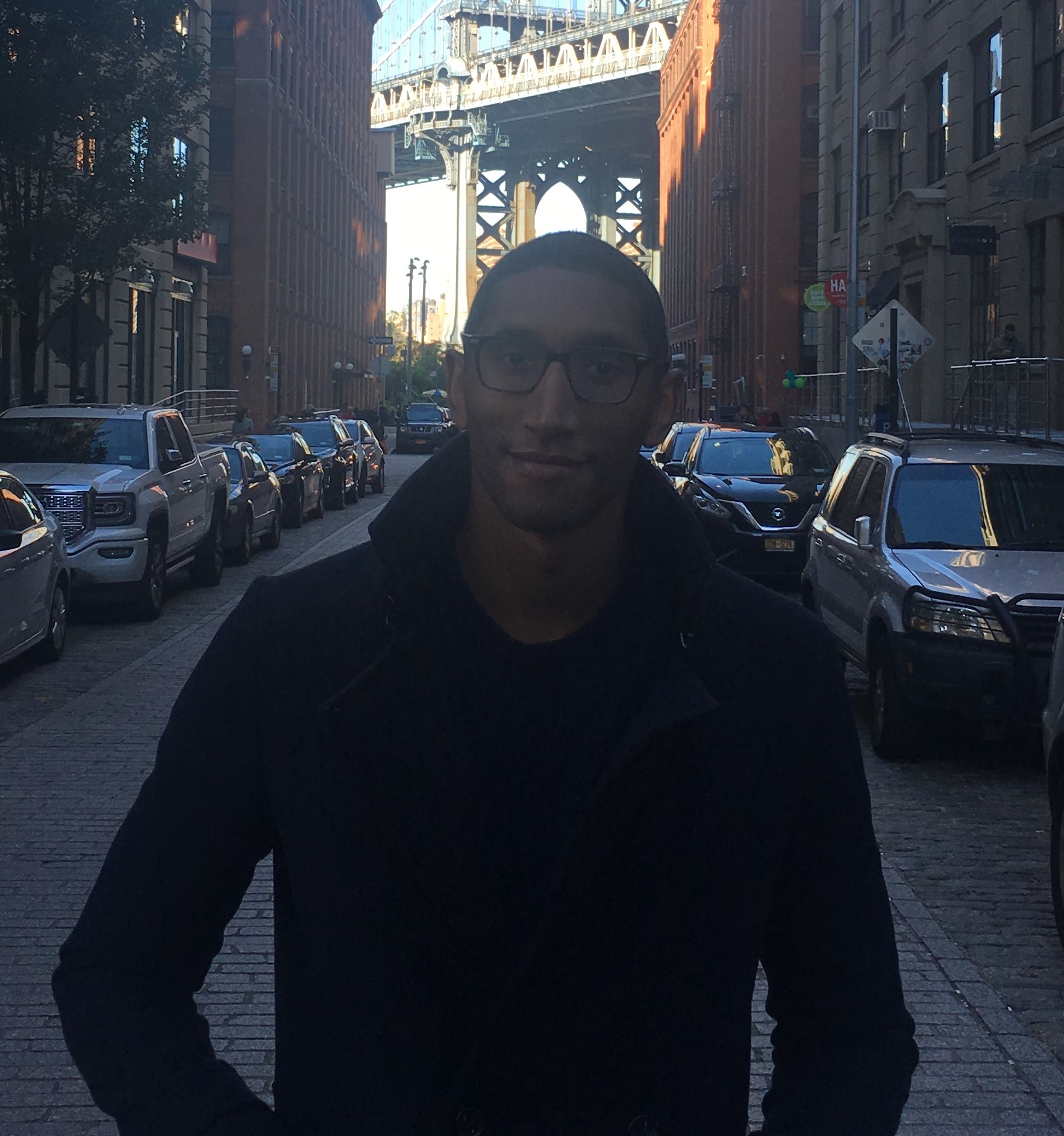
Ashton Wingate, Digital Archivist of the NAACP Legal and Educational Defense Fund, Inc.

This is the newest post in our There’s an Archivist for That! series, which features examples of archivists working in places you might not expect. COPA member Rachael Woody, owner of Rachael Cristine Consulting LLC, brings you an interview with Ashton Wingate, the Digital Archivist of the NAACP Legal and Educational Defense Fund, Inc. (LDF).

Ashton Wingate currently works for the NAACP Legal and Educational Defense Fund, Inc. (LDF), where he preserves the organization’s 80 year history in the fight for racial justice, equality and an inclusive society. To learn more about Wingate, please visit his website.

RW: Please tell us a little bit about yourself.

AW: On the professional side… I am fairly new in my position, I joined LDF in January of 2019. Previous to becoming a Digital Archivist, I was a librarian in the D.C. Public Library system leading early literacy outreach/programming. My time at the D.C. Public Library taught me a lot and I highly encourage every information professional to work in a public library for at least a little bit of time to understand the power and responsibility of our profession. I am a board member of the National Home Library Foundation and the board treasurer for the Archives Roundtable of Metropolitan New York. Personally, I spend most of my time with my fiancé and our two dogs in our cozy Brooklyn, NY apt which has become MUCH “cozier” during quarantine. I have interests in music, sports, craft beer and cult films. In the past I’ve done radio and podcasting so I’m possibly looking to start that back up if I can find time. I have a small side hustle doing graphic design and building websites for friends and family. If you’re looking to spruce up your personal/professional brand hit me up!

RW: How did you get into archives, or why archives?

AW: After I graduated from undergrad, I spent the first nine months selling cereal for Kellogg’s. Worst job ever! Nothing wrong with Frosted Flakes but I didn’t take the job as seriously as I should have and I am definitely not a salesman. After that didn’t work out, I spent the next 8 years or so in communications for a variety of non-profits and government organizations in Washington, D.C. Eventually, I hit a wall and just wanted to do something different. I saw the advertisement for the Department of Library and Information Science at Catholic University on the train and something just told me to check it out. Looking back on it now, I think access to information is just so big for me. It is probably one of the biggest civil rights issues of our time and I just wanted to be a part of that in some way. Keeping people informed and allowing everyone an equal opportunity to understand more about the world around them is key.
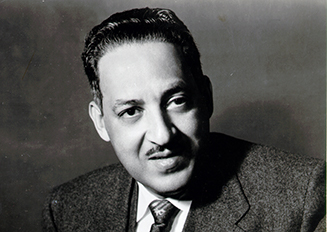
Thurgood Marshall was an influential leader of the civil rights movement. He also had a profound contribution to the NAACP and his legacy lives on in the pursuit of racial justice. 
Thurgood Marshall founded LDF in 1940 and served as its first Director-Counsel. He was the architect of the legal strategy that ended the country’s official policy of segregation. Marshall was the first African American to serve on the Supreme Court on which he served as Associate Justice from 1967-1991 after he was successfully nominated by President Johnson. He retired from the bench in 1991 and passed away on January 24, 1993, in Washington DC at the age of 84. Civil rights and social change came about through meticulous and persistent litigation efforts, at the forefront of which stood Thurgood Marshall and the Legal Defense Fund. Through the courts, he ensured that Blacks enjoyed the rights and responsibilities of full citizenship. 

RW: How did you get your gig at the NAACP-LDF?

AW: Fate? I’m not really sure. I know many people can relate but it’s not easy getting a job in this field especially as a new graduate. Whether it’s the unrealistic expectations/job descriptions or the (sometimes) low pay, it’s difficult to find the right opportunity. I knew that I wanted to move to NYC so that narrowed things down, from there it was a mixture of luck and perseverance. I applied for A LOT of jobs; my heart wasn’t set on just archivist. I was on every job board, every website, contacting friends of friends… I never thought it was going to happen, especially not an opportunity like the one at LDF. I’m eternally grateful to my boss and LDF leadership for taking a chance on me and I can’t imagine working anywhere else or doing anything else with my skills and expertise.
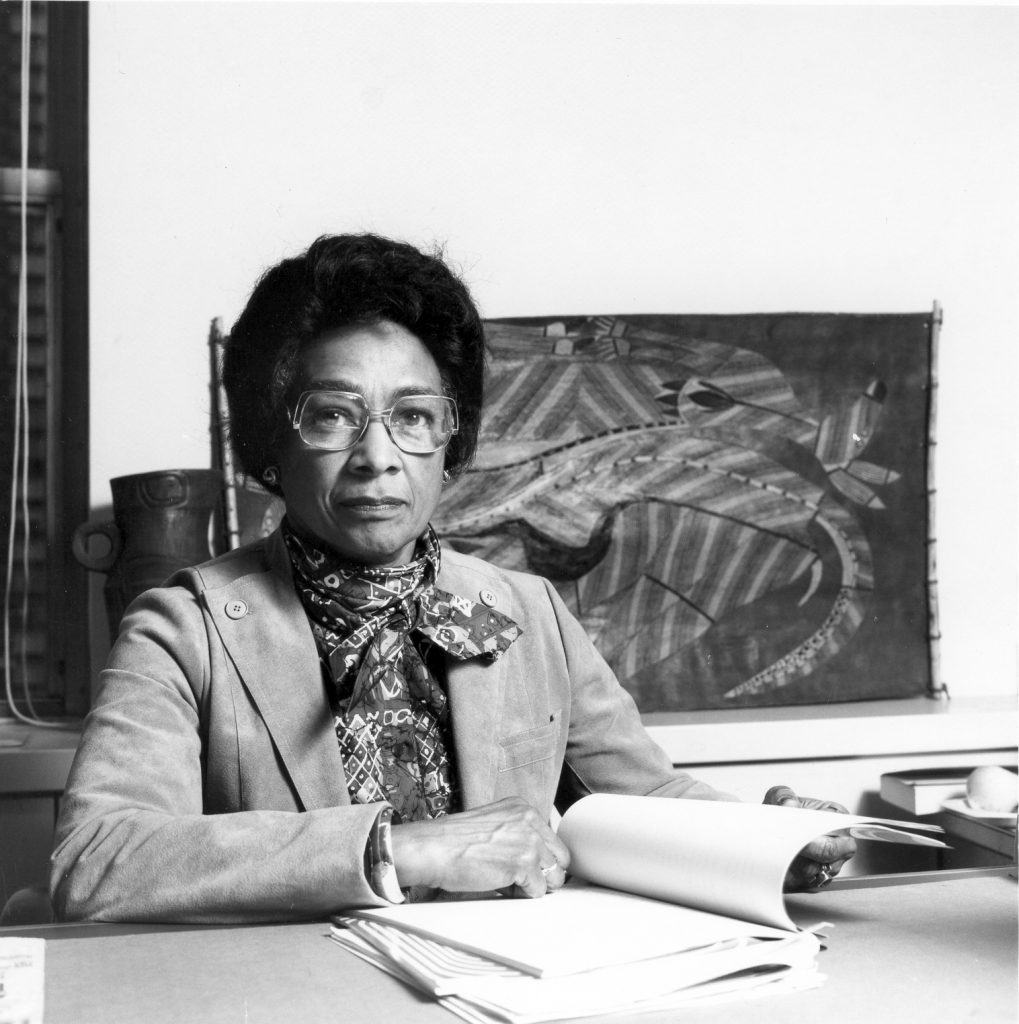
“Our Division is committed to the principle that minority group citizens must be empowered to work for their own liberation. Our role is to heighten their consciousness of their legal rights and to assist them in developing strategies to make bureaucracies accountable,” Jean Fairfax stated in a 1972 report to funders. The NAACP Legal Defense & Educational Fund’s (LDF) Division of Legal Information and Community Service was created in 1965 by Fairfax, who served as the Division’s director until her retirement in 1984.

RW: Please tell us about your work at NAACP-LDF.

AW: The way that I have come to describe our work is that we add historical context to the ongoing conversation about race and its relationship to justice, politics and society. We are tasked with preserving the 80-year history of the country’s most prestigious legal organization fighting for racial justice. From Brown vs. Board of Education to representing Muhammad Ali and Martin Luther King, to the current moment we’re facing as a country… it is a daunting task. We are a team of three serving an organization of almost 200 people. We answer reference questions, maintain collections of physical and digital legal and social science research resources, manage records retention and physical box storage as well as work strategically to ensure that each and every legal, policy, educational and community organizing effort is informed by the organization’s rich history. We are a unique archive but we are tackling some of the same problems as others including document management, data governance, training staff and getting buy-in on archival best practices/priorities and of course dealing with budgets and constantly presenting the value proposition for how archives fits within the organization’s mission and vision.

Right now, we’re in the midst of what we’re referring to as an “archives modernization”. With incredible support from LDF leadership and from generous donors, we’ve undergone an evaluation of our current archival structure, policies and procedures which has given us a roadmap going forward on where to invest our time and funding. We plan to update our workflows and processes, strengthen our technological infrastructure, procure new software for e-discovery and box management as well as identifying high priority physical and digital processing projects and work towards sharing our collections publicly through an online research portal containing information about LDF’s 6,000+ cases from 1940-present day. As a law firm, we have yet to open our collections up to the general public due to concerns over privileged and sensitive legal information.
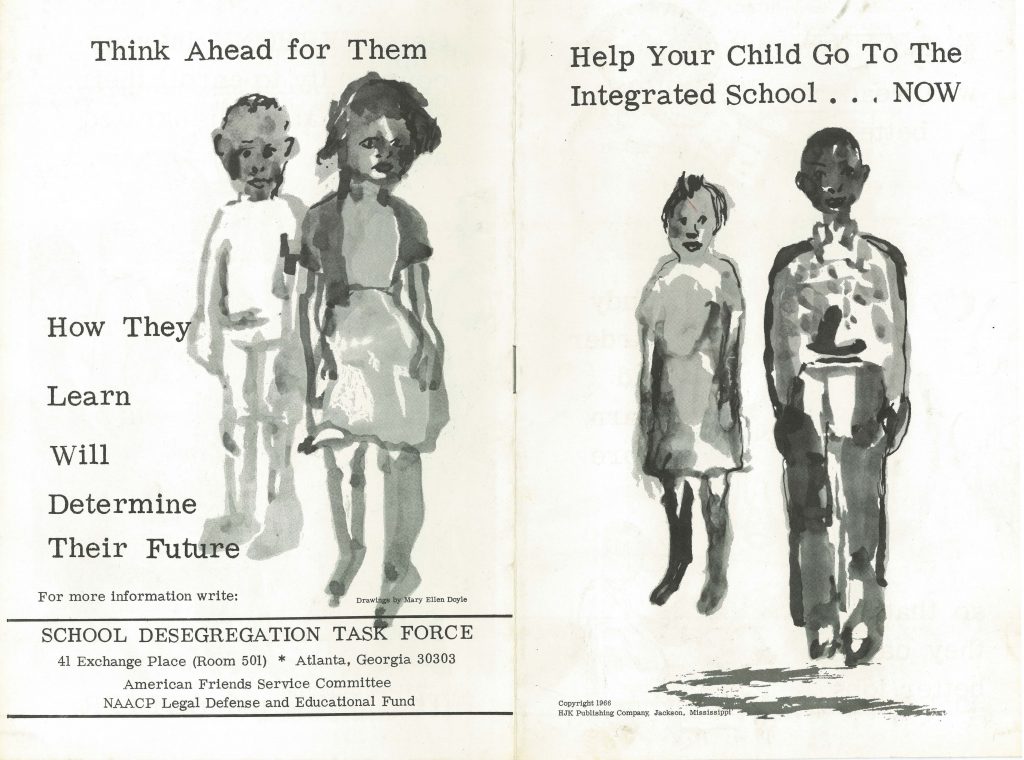
The School Desegregation Task Force was a core program of the Division in the mid-1960s, with Fairfax serving as the project administrator. In a 1967 memo to funders, LDF Director-Counsel Jack Greenberg explained the aims and impact of the task force: “The opportunity for equal education for Negro children was finally at hand, but the problems incident to its realization were overwhelming. The Legal Defense Fund joined with the American Friends Service Committee to create a School Desegregation Task Force which operated in hundreds of local communities, especially in rural areas, in nine southern states.

RW: Please describe the collections or one of your favorite collections.

AW: The core of our collection is pleadings, research, and correspondence related to thousands of cases LDF has litigated. Our holdings also include photographs, videos, policy files, publications, fundraising materials, administrative records, and documentation of LDF’s sustained efforts in community organizing and social science research. We have over 250 boxes of physical material at the Library of Congress and over 10,000 boxes in storage between our New York and DC locations in addition to an ever-increasing amount of digital records.

LDF’s second Director-Counsel Jack Greenberg describes LDF’s ability as an organization to “bridge the gap” among the laws that govern our society, the enforcement of these laws, and the everyday people who are impacted by these laws and practices. He highlights LDF’s focus on not only setting legal precedent, but creating substantive social impact to improve the lives of African Americans.

RW: What are some challenges unique to the collections?

AW: One of the biggest challenges is the fact that we cannot share the information publicly with any level of ease. The majority of our collections is case material and cannot be released publicly without thorough review for privileged and sensitive information. Another challenge is just our relative youth as an archival institution. The archives at LDF was created in 2014/2015 and the majority of our collections have not been processed or digitized. It makes it difficult to fully gain an appreciation or understanding of LDF’s work and impact over the past 80 years. We are steadfast in our mission to work through the backlog of physical material and we’ve highlighted important cases and collections that we will be processing for the next three years. Because we are essentially a non-profit law firm and our retention and document management hasn’t been as strong as it is now, there is a lot of LDF material outside of the archives at other universities, repositories and still hiding in people’s basements! In the past, members of our litigation staff have been transitory, and they’ve taken their papers with them. A long-term goal for us is to track down these collections, take note of where they are and make efforts to accession them into our collections if the current steward cannot or no longer wishes to preserve them.
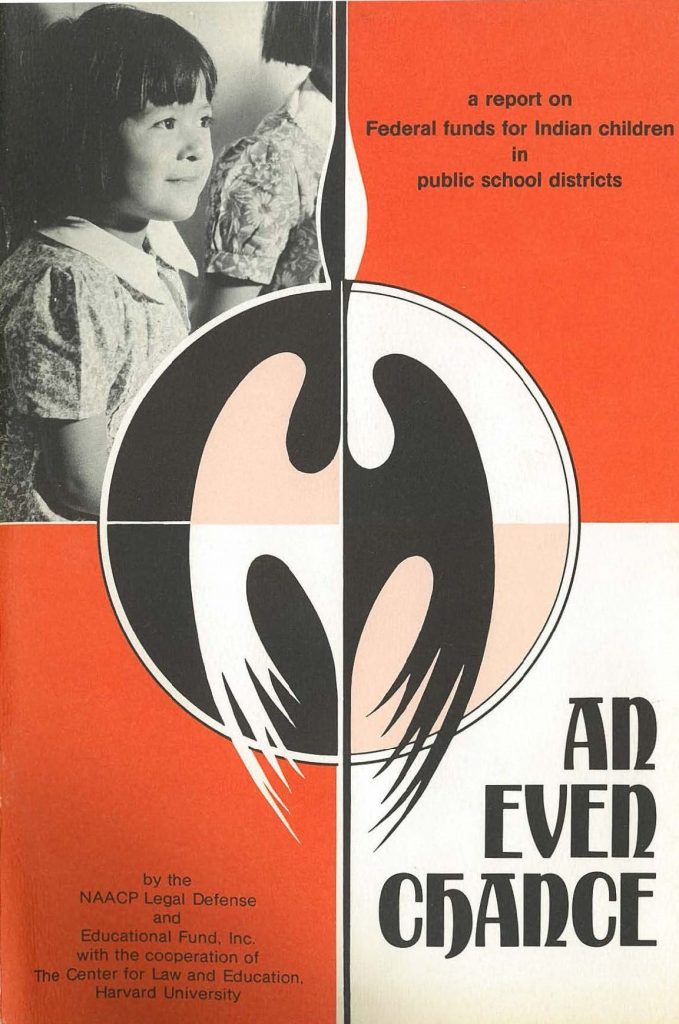

Phyllis McClure, author of An Even Chance,  introduces the research as having a “familiar theme:” the misuse of Federal education money intended to benefit poor and minority children. According to a 1971 LDF annual report, “the impact of this report on Governmental agencies responsible for the education of Indian children has been stunning. The facts revealed in the study present a shocking record of disregard of the rights of Indians guaranteed them by treaties, laws passed by Congress, and laws of individual states. The report opens the way, based on facts, for action to correct wrongs inflicted upon Indian children and their parents.”

RW: What’s your favorite part of the job?

AW: My favorite part of the job is just knowing the importance of my work to the organization’s larger mission and the way in which we are all working together at LDF to meet this moment in time that is so important for civil rights and racial justice.

RW: What advice to you have for aspiring archivists?

  1. Believe in yourself! Shake the imposters syndrome as best you can.
  2. Advocate for what you need to do your job well.
  3. Join a board or professional network to continue to make connections and see different aspects of our field.
  4. Do whatever it takes to get the job done. Specialization is nice and important in some ways but to me there’s no difference between an archivist, a digital archivist, a librarian or a records manager… everyone on our team is doing all of that because that’s what the job calls for.
  5. Be visible in your organization. As a department, don’t hide in the archives, get out there and offer your services wherever there is opportunity for collaborative work. Share your successes. As an individual, just try to be seen. I always try to find some way to be helpful to leadership so they know they can depend on me. I also try to be vocal during meetings so that people know I’m there.

RW: Is there anything else you’d like to share with us?

It is our organization’s 80th Anniversary, keep your eyes out for the launch of our timeline covering 80 years of groundbreaking legal milestones in the fight for civil rights. It was a heavy lift for our department digging up archival information on over 100 cases as well as biographies on important figures and finding ways to relate the historic moments to the work we’re doing today. It’s something we’re proud of and it is coming soon! Check this link for more information: https://80th.naacpldf.org/
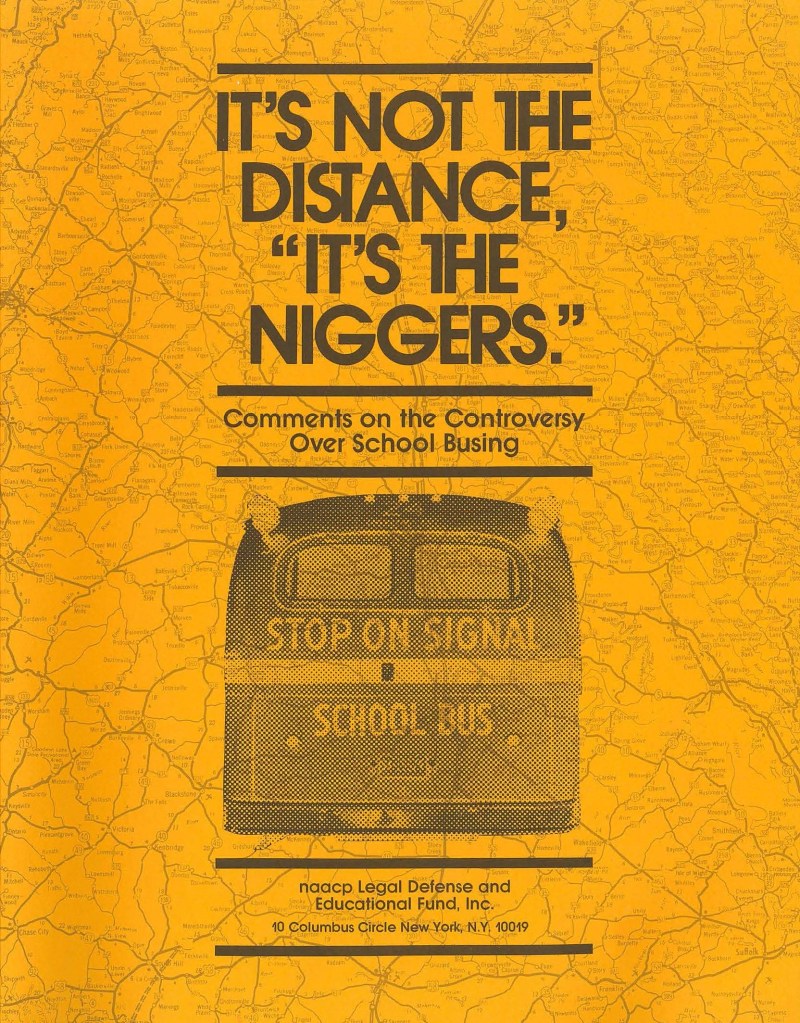
It’s not The Distance, “It’s the Niggers.” Comments on the Controversy Over School Busing, May 1972, attempted to “bring facts and reason to bear on the current hysterical and politicized discussion about busing,” said Fairfax. The report found that “busing for integration…has not required a major reallocation of scarce funds and has usually been accepted once plans have been implemented.”

Also, I want to put in another plug for the Archives Roundtable of New York. It is an awesome organization; membership is super affordable, and we do our best to make sure we’re contributing to the archivist community in a real way. We’ve just launched a mentorship program and a skill-share and we have office hours every other Tuesday where members can call in and talk about whatever is going on professionally. We also have an open call for submissions to our quarterly publication the Metropolitan Archivist and a call for proposals for a virtual symposium that we’re holding as part of our Archives Week event this fall. More information can be found at www.nycarchivists.org.


While the LDF collections are closed, the archives does accept external inquires on a case by case basis. You can email your request to this address: archives@naacpldf.org.
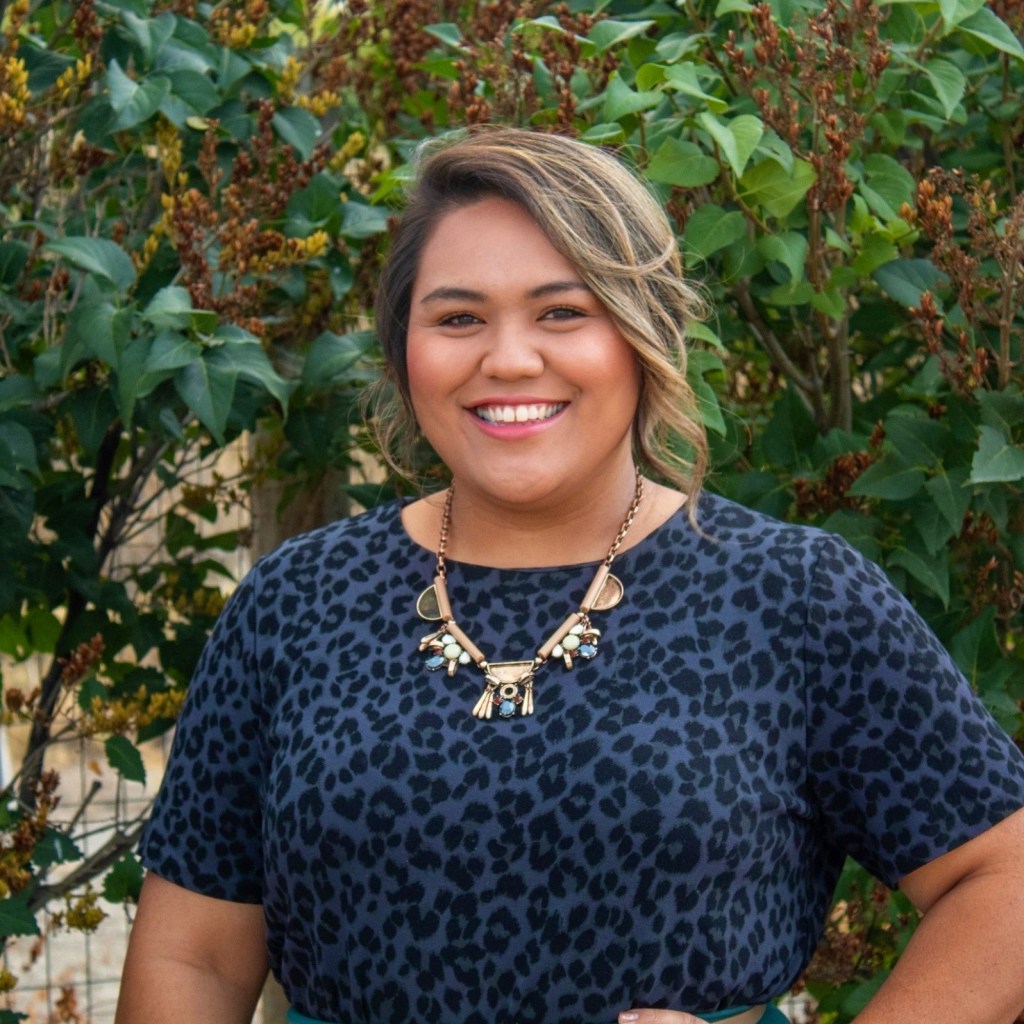
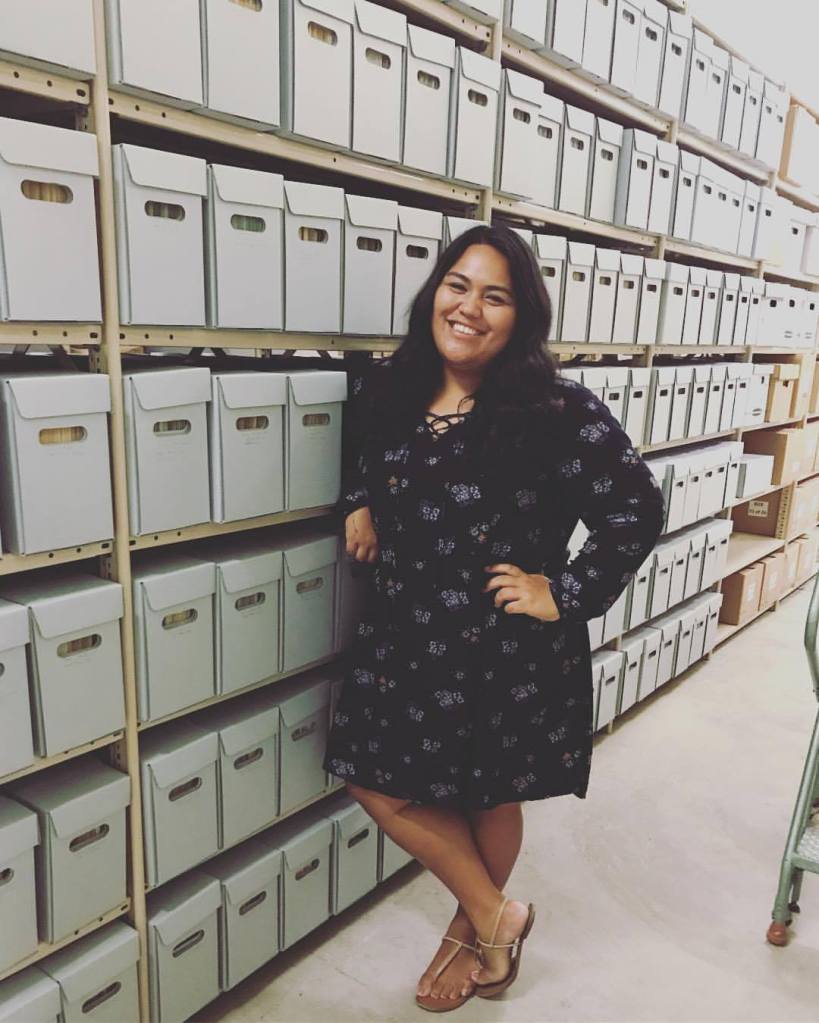
Archival Innovators: Miyamoto Loretta Jensen, “The Polynesian Genealogist,” and Pacific Islands Records and Oral Genealogies Analyst of FamilySearch.

This is the latest post in our new series Archival Innovators, which aims to raise awareness of the individuals, institutions, and collaborations that are helping to boldly chart the future of the the archives profession and set new precedents for the role of the archivist in society.

In this installation of Archival Innovators, SAA Committee on Public Awareness (COPA) member Rachael Woody of Rachael Cristine Consulting LLC interviews Miyamoto Loretta Jensen, “The Polynesian Genealogist,” and Pacific Inslands Records and Oral Genealogies Analyst of FamilySearch. Jensen is a professional genealogist specializing in Polynesian and Oceania genealogy. She works as a Pacific Islands Records and Oral Genealogies Analyst at FamilySearch. Her ancestry includes Samoan, Tongan, Hawaiian, Japanese, German, French, and English.

Miyamoto Loretta Jensen, also known as “The Polynesian Genealogist”.

RW: Please describe the work you do as the Polynesian Genealogist.

MLJ: My work as the Polynesian Genealogist consists of connecting individuals and families to their Oceania ancestors. My social media platform is used to share Oceania history, culture, and research methodology. I do this work because I enjoy teaching and assisting people in finding their ancestors. Along with social media, I do contract research work for clients.

RW: Where did the idea to be involved in Polynesian genealogy come from? What inspired it?

MLJ: I knew that I wanted to get involved with Polynesian genealogy when I tried to research my own family. With my rich Polynesian heritage, there was a lot of frustration and confusion as I tried to find my ancestors. I had no professional Polynesian genealogist in the field to turn to for help. Realizing this, I knew that this was my opportunity to really make a difference for my people. I am inspired everyday as I receive DMs from people all over the world saying that what I do has given them hope in their genealogy journeys. My son is also a major part of my inspiration because I want him to have a strong sense of his identity. What better way to achieve this than by knowing his family history?

RW: How does your work with oceanic records differ (or not?) from records found in the US, Western Europe, etc.? What are some challenges unique to the collections?

MLJ: The two most notable differences between Eurocentric and Oceania research are the cultural approaches to genealogy and the historical method of record keeping. Genealogies served as functions in Oceania societies. One’s ancestry determined the following:

  • Territorial organization
  • Land ownership
  • Inheritance
  • Marriage regulation
  • Social control
  • Political representation
  • Feud support
  • Ritual Observance

This is why genealogies were, and still are, viewed as sacred. They are heavily guarded and protected from anyone who may want to take advantage of ancestral lines for personal gain.

In Eurocentric cultures, facts and stories were mainly kept on paper. Oceania practiced and preserved their culture, heritage, and histories through the spoken word. Because of this, oral genealogies were passed down generation after generation until the arrival of foreigners to their homelands. This is when paper was introduced. Overtime, paper replaced oral traditions because of colonization. Now, oral genealogies are either completely lost or are generally not practiced as much in Oceania today.

RW: How does your work with Polynesian genealogy intersect with your work on ancestral trauma?

MLJ: My work has everything to do with ancestral trauma. Oceanians today are living and experiencing the effects of generational trauma. The very introduction of foreigners to Oceania brought forth diseases which destroyed much of the indigenous populations across the Pacific. Some peoples were completely eradicated because of it. Other cultures were forced to end their cultural practices; some were kidnapped and put into slavery in a foreign land; kingdoms were illegally overthrown; and now, the descendants of the trauma survivors are living with and feeling the heartache and pain experienced by their ancestors. This trauma, if left unchecked and unhealed, is passed down generation after generation. Family history is the means of identifying, addressing, and healing ours and our ancestors’ trauma.

RW: Can you tell us more about your work with ancestral trauma as a genealogist?

MLJ: I come across all kinds of families in my research. Some have many children, others don’t. Some have famous family members; others have common folk. No matter the background, I find traumatic experiences in every family. For me, it can be emotionally taxing to see and constantly be exposed to the horrific experiences of an ancestor – be it my own ancestors or another’s. Practicing my own self-care gives me strength to bare and endure my own emotional response to ancestral trauma. Ultimately, I feel like this work has transformed me into a better wife, mother, sister, daughter, and friend.

RW: What barriers or challenges did/do you face?

MLJ: I think my biggest challenge is being a pioneer in this work. I only know of one other professional genealogist that is specialized in Hawaiian genealogy. I am working towards being a genealogy professional in every Oceania culture. I often feel lonely in my pursuits, but I know that I am never truly alone. I have so many people – both living and dead – coaching, cheering, and encouraging me on!

RW: What worked? What didn’t work? Were there any surprises in the process of developing your work, or lessons learned that you can share with us?

MLJ: What has brought me great success in this work is my understanding of Oceania culture. For example, I recently learned how my Oceania ancestors reckoned with time and space. Out here in the West, we believe that the future is in front and the past is behind. This was the opposite for my ancestors – the past is in front of us and the future is behind. Because the past has already happened, we can see it clearly and therefore, it must be in front of us. This is the past. If we cannot see something, then it must be behind us. This is the future. As we navigate through our lives, our ancestors are in front of us to prepare us for what we cannot see – the future. In the present, we are the embodiment of all of our ancestors in a living, breathing body. My ancestors had their hearts turned to their ancestors since the day the were born. This mentality changed the way I viewed myself and my own family. It also allowed me the ability to see how my ancestors saw the circle of life. I now know they are there guiding me every single day and it is my job to study their histories and to learn their lessons in preparation for my future life.

RW: In your own words, how would you describe the importance of archival records?

MLJ: Archival records either oral or written are shreds of evidence that we existed. It is our job to leave bits and pieces of us behind so that our posterity can hear us as we guide them through our pasts to prepare them for their futures.

Miya as an intern at the Hawaii State Archives. Summer 2017.

RW: What is your favorite part of the job?

MLJ: I love the “high” I get when I find records, stories, facts, and when I break through brick walls. It is extremely satisfying. I could chase this gratification all day and all night!

More than my personal gain, I love being able to connect the dots in family trees for those who could not do it for themselves. I feel honored and privileged to be given the trust and responsibility find families.

RW: What tips do you have for budding innovators?

MLJ: I would say to any budding innovators, find your niche and RUN WITH IT! It doesn’t matter if there are others who have done what you want to do or if there is no one (like me) who has done what you want to do. Just do it! You can do it! If you are willing to pay the price, YOU CAN DO IT.

I am 1000% dedicated to this work. I eat, think, breathe, sleep, dream, walk the walk, and talk the talk when it comes to Polynesian and Oceania genealogy. It is all I do and want to do. I am constantly reading and researching credible sources, consistently networking with other professionals, pursuing more and more education, writing articles, teaching classes once a week on my Instagram Lives on various Polynesian genealogy topics, investing in myself by attending classes, conferences, workshops, etc. You name it! I am putting in the work to learn more and do better 24/7.

RW: What’s next for you?

MLJ: My next thing step is to become a certified genealogist. That’s in the works. I am almost ready to submit my portfolio for review!

In the next two years, I plan on attending law school. I did not expect to be doing this at all, but after many promptings, I feel that this is the next best thing to do.

I want to also learn more about genetic genealogy. I recently binge watched Cece Moore’s show “The Genetic Detective” and it has inspired me to want to do what she does! I want to gain experience in unknown parentage and genetic genealogy research like Cece, but for all Oceanian people. And the terrible stories of many murdered and missing indigenous women in the United States has strengthened my resolve to not just learn, but become a master at genetic genealogy. I want to help those women and their families.

RW: How can people connect with you to learn more about your work?

MLJ: Y’all can find me at the following places:

When Miya isn’t researching, she is wishing she could be back home in Hawaii surfing the waves with her family!

Do you know an Archival Innovator who should be featured on ArchivesAWARE?  Send us your suggestions at archivesaware@archivists.org!

THERE’S AN ARCHIVIST FOR THAT! INTERVIEW WITH ANNETTE LA RUE FROM ELECTROMAGNETIC TATTOO AND ADAM JEFFERY FROM THE BALTIMORE TATTOO MUSEUM BY ALLISON TERMINE

This is the newest post in our There’s an Archivist for That! series, which features examples of archivists working in places you might not expect. Allison Termine, brings you an interview with Adam Jeffery, the Tattooer, Collector of The Baltimore Tattoo Museum (est. 1999) and Annette La Rue, Tattooer, Collector from Electromagnetic Tattoo in Chesapeake, Virginia.

Interviewer: Allison Termine, I’m a trained Librarian, Archivist and Collections Manager, learning Taxonomy and Ontology. Capturing the essence of nostalgia in my life has always led me to activities, professional and personal, where I had the opportunity to observe, record, preserve, display, learn and organize primary and secondary material of history.

Image by Annette La Rue of Paul Rogers.

INTRODUCTION

The pioneering style in the trade of tattooing is called Americana. Knowledge of this trade was passed down orally by August “Cap” Coleman, 1884-1973 and Franklin Paul Rogers, 1905-1990, the for-father’s, what remains is tattoo ephemera and an oral tradition that lives on today through those they taught. Important historical artifacts of modern electric tattooing exist in various collections who are archivists in their own right. It is a treat to interview two artists and collectors of the Tattoo Trade to learn of a niche subculture through its remnants / ephemera. Just like other collected historical archives, provenance of the Tattoo Trade is based on oral dissemination and the now primary objects that were used to apply the final product were secondary to them and therefore have become a nostalgic link to the past. Such object items are; the tattoo machines, drawings on fragile tracing paper, business cards, pictures, adapted furniture for the tattoo sitting, banners, and flash to name a few. These accidental archivists, interviewed are artists and collectors and are what I consider boots on the ground archivists. A term that describes the importance of gathering material in the present time, which they have done throughout their career in the Tattoo Trade.

*To discover an in depth history of the origins of Americana Tattooing visit:
http://www.tattooarchive.com/index.php and
https://selvedgeyard.com/2009/07/21/forefathers-of-american-tattooing/.

Image by Annette La Rue. Pictured is a Paul Rogers original tracing paper flash from “Sailor Eddies” Shop in Camden, New Jersey 1971. With additional acetate stencil rubbing of a “Cap” Colemans’ drawing reworked by Sailor Jerry.

Our first interview is with Annette La Rue of Electromagnetic Tattoo, Chesapeake Virginia. Find her shop owned by her and her husband Steve Tiberi, also a tattooer and collector on Instagram @electromagnetictattoo, @annettlelarulex, and @tiberitattoo.

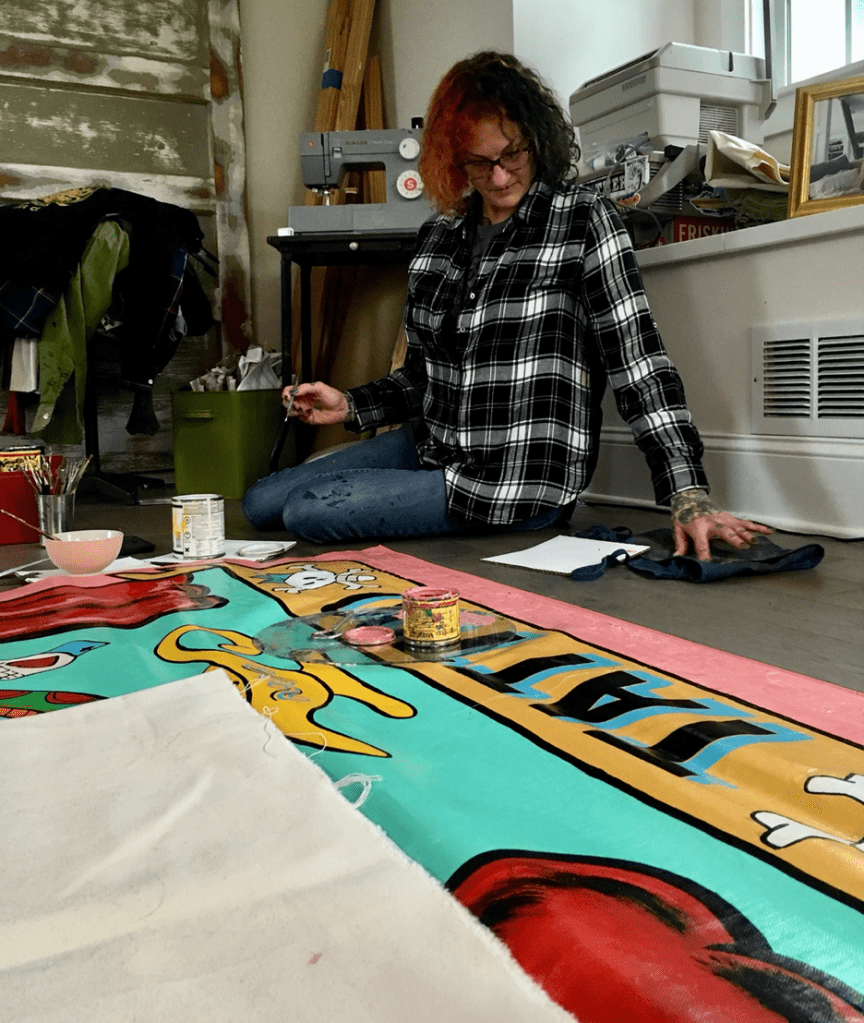
Image by Allison Termine. Annette La Rue and I doing conservation work, on a banner made by her friend, Ernie “Ernie the hat” Gosnell, of her former tattoo shop in New Orleans, Louisiana. Electric LadyLand.

Q: As a Tattooer of 30 years can you tell me about the history of Americana Tattooing?

Americana style tattooing means a bold colorful style consisting of bold thick outlines, solid black shading and bright solid colors. Americana tattooing was popular among sailors and circuses at the turn of the century. Most tattooers traveled with the circus or went to busy Navy port towns. It was seedy and frowned upon to have ink on your skin until the late 90’s into the 2000’s.

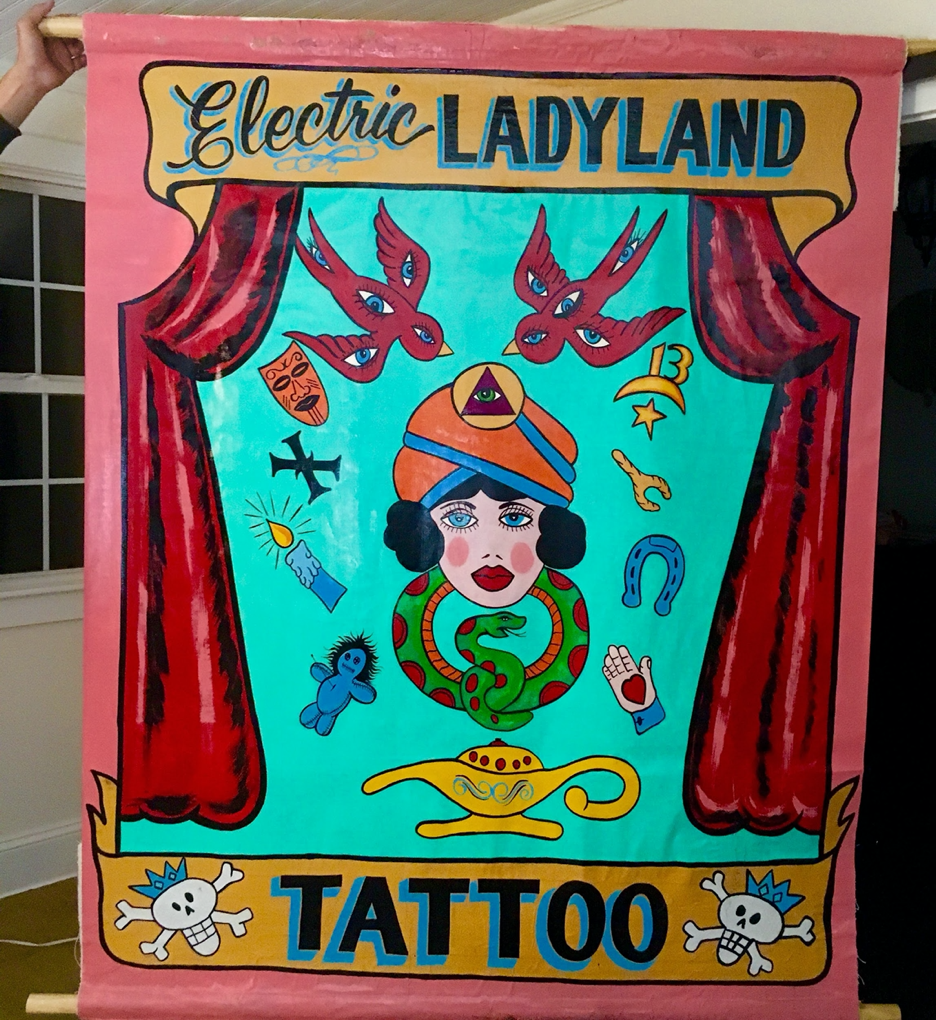
Image by Allison Termine. The Electric LadyLand banner made by, Ernie “Ernie the hat” Gosnell, of Annette La Rue’s former tattoo shop in New Orleans, Louisiana.

Q: As a collector of your trade what drove you to save ephemera of the tattoo trade throughout your career? (Your perspective then and now).

I was fascinated with older tools and designs because they connected me to the old ways. Kind of like a bridge to the heroes of yesterday. I felt a little “magic” in those tools. It made me feel like I had a link to the past and it made me proud to have possession of the tools of the trade. Now it’s just more stuff and I’m selling and trading my collection for things I can actually use. I want the younger tattooers to have those objects so they can feel like I did. To own historical tattoo pieces is like instant “cred” for anyone who has it. If you have money, you can be a collector. When I was buying you had to track someone down, go to their shop or house and beg them to sell you things. Now it’s on ebay and craigslist, too easy to get.

Q: Can you tell me about the significance of early tattoo machines and how the knowledge of building them was passed on and evolved through the years?

At the time there was no significance to old tattoo machines; they were simply a tool to make money. Tattooers would travel and visit each other and learn different ways to build machines. Most machine builders have their own style or frame configuration. They would mail parts and write about the secret trick they had to make to make their machines better. There was a lot of friendly competition between tattooers. Some builders got famous and some were more obscure. Machines from the old times are very valuable today. When the old guys died a lot of families were embarrassed about the line of work and tons were thrown out, leaving a few for younger tattooers to scourge to find them. Good builders would invite younger ones to come build and learn. You could spend the day or a few weeks with a builder and get secrets and tips while making your machine. A smart person would go to everyone’s house they could and did blend all the knowledge and make it on his or her own. This is significant because the younger generation needed to know the tips of the trade in order to keep machines up and running and it also helped the young guys to progress using old ways.

Q: If the collected ephemera of Americana Tattooing is the result of a trade learned orally, could you tell us about how the forefathers of Americana Tattooing influenced this particular style that remains “timeless” and how it has lasting power today over all other styles of tattooing being applied to skin?

I believe Americana style remains timeless because the designs were timeless. From the 1800’s to the late 1990’s an eagle looked like an eagle. A rose was a rose. You could tell what it was in two seconds. That is what makes it timeless. Today’s tattoos are trendy and you can tell if someone got it in their 90’s or early 2000 or 2010 or 2020 because of the design. They may seem more personal now but they aren’t. People get the same bad trendy design over and over, thinking they are “custom” and they don’t realise we tattooed that same design 40 times that month. Most timeless designs can be changed with different colors or leaves or background etc. Modern designs have not much room to change, as customers want it to look the same.

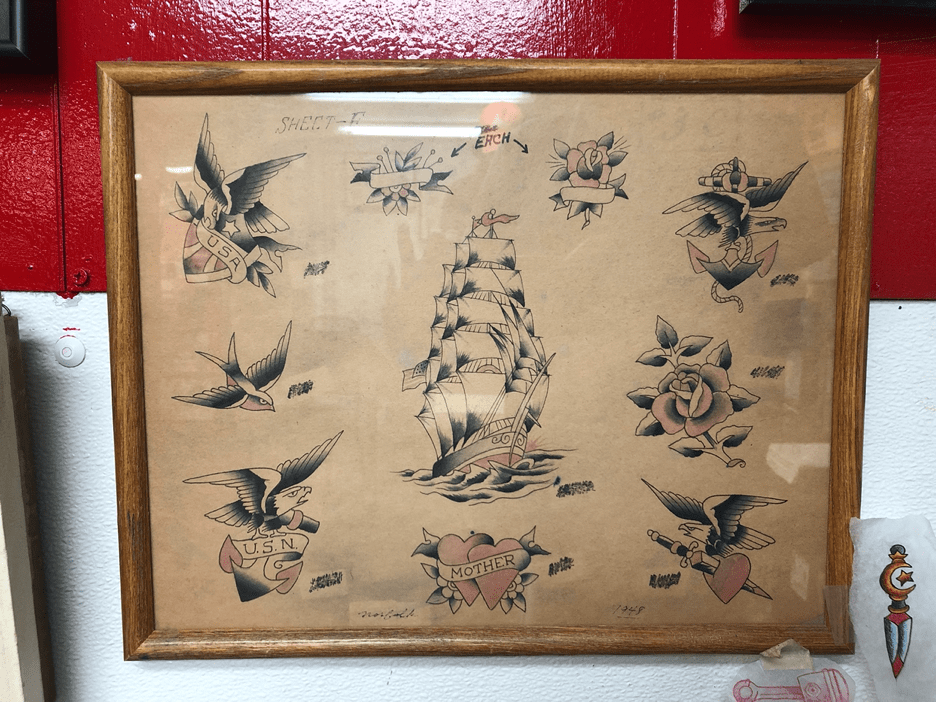
Image and caption by Annette La Rue. Pictured is a “Cap” Coleman original flash with signature and date, 1948. The significance of owning this sheet of flash is that 72 years ago “Cap” Coleman was in the next town over applying these very designs. This is my favorite piece in my collection and probably priceless.

Q: What is your favorite part of knowing you are an accidental archivist?

My favorite part of knowing I’m an accidental archivist is just knowing I can make young tattooers as excited and happy as I was when I started collecting. Of course these items all increase in value every year. It is the younger Tattooers having interest in keeping this history alive that I find interesting.

Our next interview is with Adam Jeffrey of The Baltimore Tattoo Museum. You can find Adam on Instagram @adamjeffreytattooer, and @thebaltimoretattomuseum.

Q: What are the types or formats of tattoo ephemera that were saved and what makes them significant? For example; how did a single piece of torn tracing paper with a pencil drawing become deemed “to save”, or a business card from Paul Rogers.

At The Baltimore Tattoo Museum we hope to explore the history and artifacts of modern tattooing in the Americana style. When it comes to the types of ephemera we collect that makes them significant are varied. For example, from some artists the art itself was secondary to their abilities to apply tattoos or build and tune tattoo equipment. So there are varying reasons we try to collect the many things we have. Some are significant to the tattooers of our area and the designs of a given town, for example, shipping and navy type tattoos in Baltimore, as it is a major east coast port. In other cases it might be the little inventions they crafted to make their everyday tasks a little easier like, retrofitting an old dental type chair to create better access to an area of skin to be tattooed. In other cases it’s their amazing ability, these untrained artists had to create very well drawn and thought out lasting style designs that even years later folks still would like to have applied to their skin.

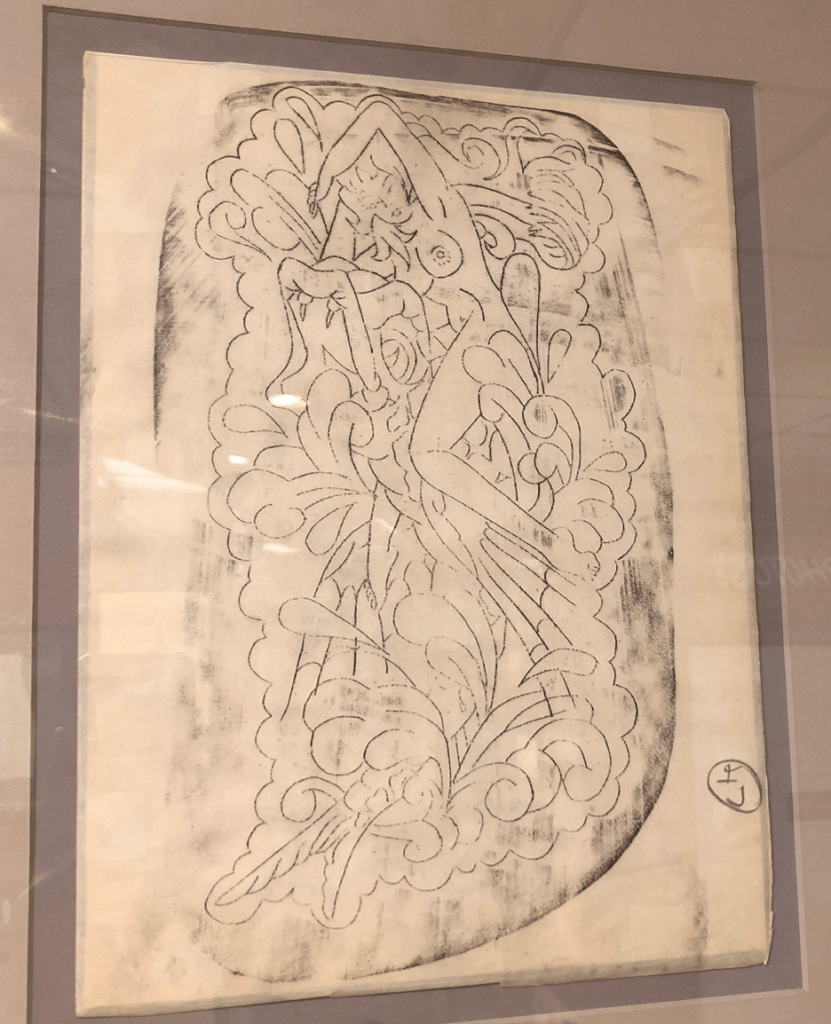
Image and caption by Adam Jeffrey from The Baltimore Tattoo Museum. Pictures is a rubbing of an acetate stencil made by Paul Rogers and sent in the mail to Ernie Carafa to share the design to make money. Back then, designs were common and people liked them that way. Uniformity with subtle differences to make it each artist’s own with various colors or background elements.

Q: If the collected ephemera of Americana Tattooing is the result of a trade learned orally, could you tell us about how the forefathers of Americana Tattooing influenced this particular style that remains “timeless” and how it has lasting power today over all other styles of tattooing being applied to skin?

Like us at Baltimore Tattoo and Museum and the majority of tattooers, still apply tattoos with the same electromagnet style tattoo machine they’ve always used. There are even modern makers making the same style frames that were being made in the turn of the century. As well as the same hand motions and application styles that were handed down to get the pigment under the skin, to have a good outcome to the tattoo once it’s healed. Also, the way the machinery is set up and tuned, to make precise lines and shading etc.

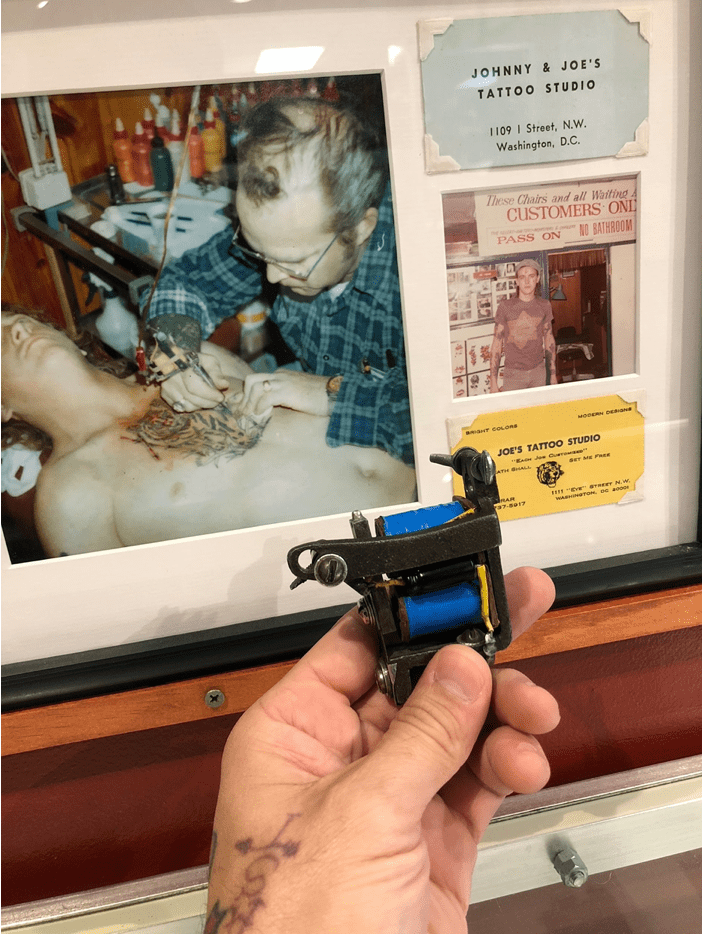
Image and caption by Adam Jeffery from The Baltimore Tattoo Museum. Pictured is a Joe Farrar machine built for Johnny Walker who tattooed with “Cap” Coleman of Norfolk, Virginia, and Sailor Jerry Collins in Honolulu, Hawaii. The machine is a Percy Waters model #7 from the 1940’s-1950’s era, that Farrar rebuilt to serve as a shader. Pictured in the right-hand corner is Joe’s tattooing and business card from their DC location.

Q: Can you tell us of one of your favorite collections?

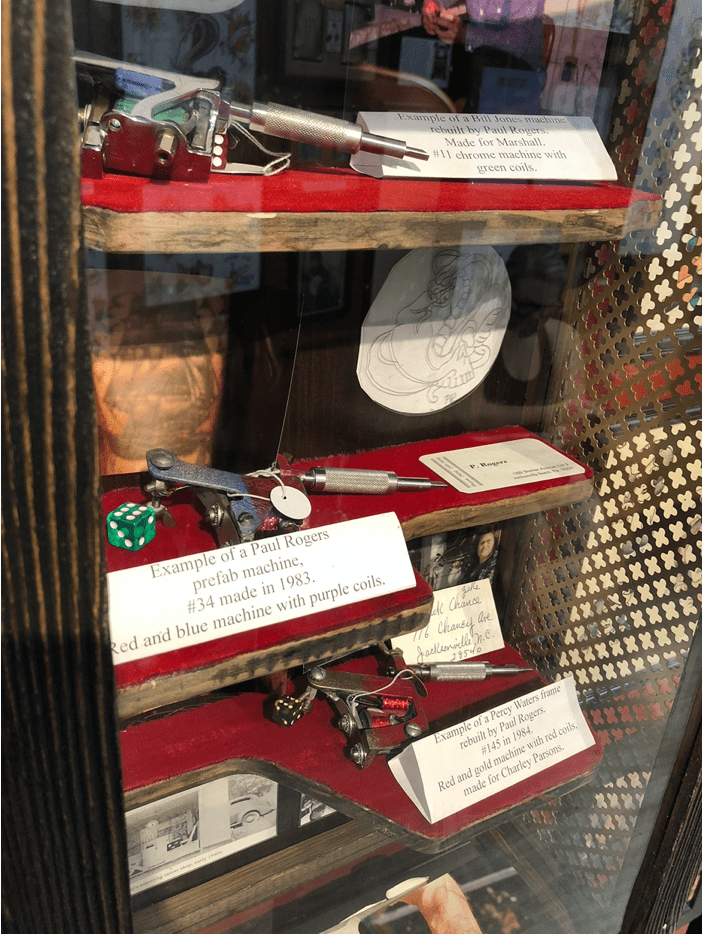
I personally love our collection of Paul Rogers tattoo machines acetate stencils and flash. Most of it came from the collection of Charley and Sandy Parsons who are two of my mentors and were close friends with Paul who tattooed from the late 1920s till the late 1980s. Paul was an innovator and all around crafty artist making his own equipment, mixing his own colors and a designer of tattoos. The total package and to boot a good person as I am told.

Image and caption by Adam Jeffery from The Baltimore Tattoo Museum. Displayed are Paul Rogers machines, acetate stencils made by Paul and a photo of a tattoo he did.

Q: What are some challenges unique to the collections?

The largest challenge is that prior to the 2000s Tattoo memorabilia was just old stuff or junk so a lot of it was thrown away or lost to time as tattooing was nowhere near as common as it is currently. So honestly, there isn’t as much of it to be had as one might think as well the prior you get it thru can be hard to deal with as it has become more popular. Prices have gone up and you are getting it second and third hand now so the provenance of it isn’t easy to establish.

Q: What is your favorite part of knowing you are an accidental archivist?

My favorite part of being an accidental archivist is interacting with other collectors who have been collecting for a long time, their knowledge helps me place dates and times on artists, machines and flash that I’ve had questions about. It can be an awesome community.

THERE’S AN ARCHIVIST FOR THAT! INTERVIEW WITH LAURA LAPLACA, THE DIRECTOR OF ARCHIVES OF THE NATIONAL COMEDY CENTER

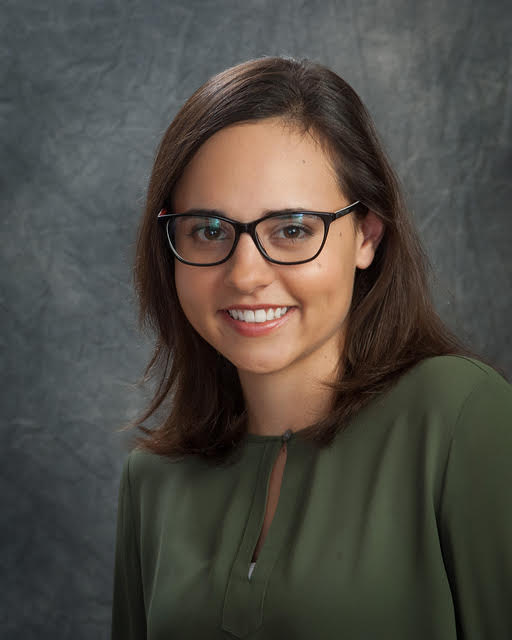
Laura LaPlaca, Director of Archives. Photo courtesy of Laura LaPlaca.

Laura LaPlaca, Director of Archives. Photo courtesy of Laura LaPlaca.

This is the newest post in our There’s an Archivist for That! series, which features examples of archivists working in places you might not expect. COPA member Rachael Woody, owner of Rachael Cristine Consulting LLC, brings you an interview with Laura LaPlaca, the Director of Archives of the National Comedy Center.

Before her tenure as Director of Archives for the National Comedy Center in Jamestown, NY, Laura earned a PhD in Screen Cultures in the Department of Radio/TV/Film at Northwestern University. Her work focused on the early history of broadcasting in the United States, and particularly the development of the sitcom genre from the late 1920s to early 1960s. She also holds a master’s degree from Northwestern University’s Dept. of Radio/TV/Film, and bachelor’s degrees in Art History and English Literature from Pepperdine University. During her 10+ years as an archivist of popular culture and media, Laura has led or contributed to processing and preservation efforts at institutions including the Library of Congress, USC-Warner Brothers Archives, and Paley Center for Media. She founded the Northwestern University Radio Archive Project [NURAP] and has served on the boards of the Library of Congress Radio Preservation Task Force and Society for Cinema and Media Studies’ Television Studies Scholarly Interest Group. Her co-authored manuscript on the history of American comedy is forthcoming from Smithsonian Press.

RW: How did you get your gig at the National Comedy Center Archives?

I first visited Jamestown, NY – a beautiful historic community on the shore of Lake Chautauqua in Southwestern NY – on a grant-funded archival research trip while completing my doctoral dissertation on the history of the sitcom. Jamestown is the birthplace of the ground-breaking TV pioneer Lucille Ball, whose archives are housed by the Lucille Ball Desi Arnaz Museum, which tells the story of Ball and Arnaz’s influential Desilu Studios and celebrates their enduring cultural legacies. During my visit, I met Journey Gunderson, the Executive Director of the museum, who told me about her team’s ambitious efforts to execute Lucille Ball’s vision to build the first national-scale, non-profit educational institution devoted to comedy in her hometown. I knew moments after meeting Journey, and hearing about the remarkable energy, optimism, and goodwill that all of Jamestown was pouring into the National Comedy Center project, that I had to be involved. It turned out that the Comedy Center had yet to hire a Director of Archives & Research, and my particular background in the history of entertainment media and popular culture archives was a good match. I joined the team about 18 months before the 37,000-square-foot, $50-million-dollar National Comedy Center opened its doors in August 2018. Since opening, we’ve educated more than 100,000 guests from around the world about the history and art of comedy. We’ve been named one of Time’s “World’s Greatest Places,” voted “Best New Museum” by USA Today, and were designated by the United States Congress as our country’s official cultural institution devoted to preserving and presenting the vital story of comedy. But I am most proud of the fact that we have been so thoroughly embraced by the comedy community itself; knowing that the artists and creators we are celebrating find our work important is really the best metric of our success so far, and the thing that energizes me every day.

Q: Please tell us about the National Comedy Center Archives.

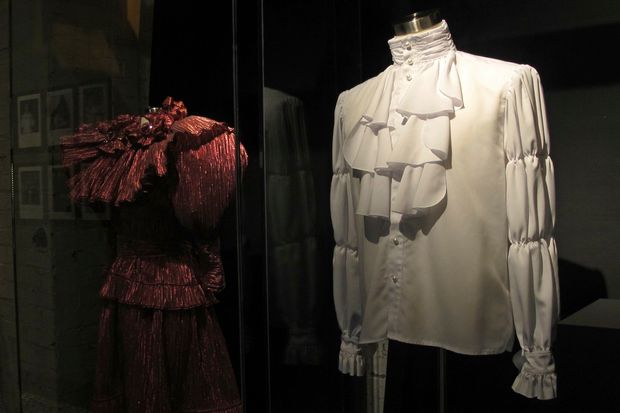
Seinfeld_Puffy_Shirt

From the American sitcom Seinfeld, the Seinfeld puffy shirt on exhibit at the National Comedy Center. Photo courtesy of the National Comedy Center.

The National Comedy Center Archives collects materials that illuminate the comedic process, demonstrate the sociopolitical import of comedy history, and elevate comedy as an artform. We are committed, first and foremost, to providing access to collections. We always acquire, process, and preserve artifacts with exhibition and educational goals top of mind. To that end, the archives team works hand-in-hand everyday with staff in Guest Experiences, Education, Programming, and Technology to activate our collections for the public. The Comedy Center is comprised of more than 50 immersive exhibits that marshal cutting-edge technology and novel forms of interactive storytelling to communicate the story of comedy – very often via primary source archival materials. One of my primary roles as

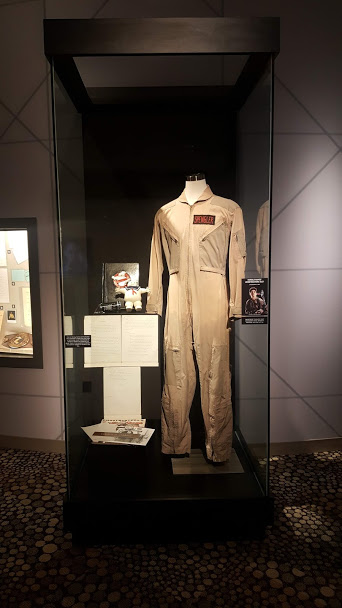
Ghostbusters_Costume

From the movie Ghostbusters, the Ghostbuster suit on display at the National Comedy Center. Photo courtesy of the National Comedy Center.

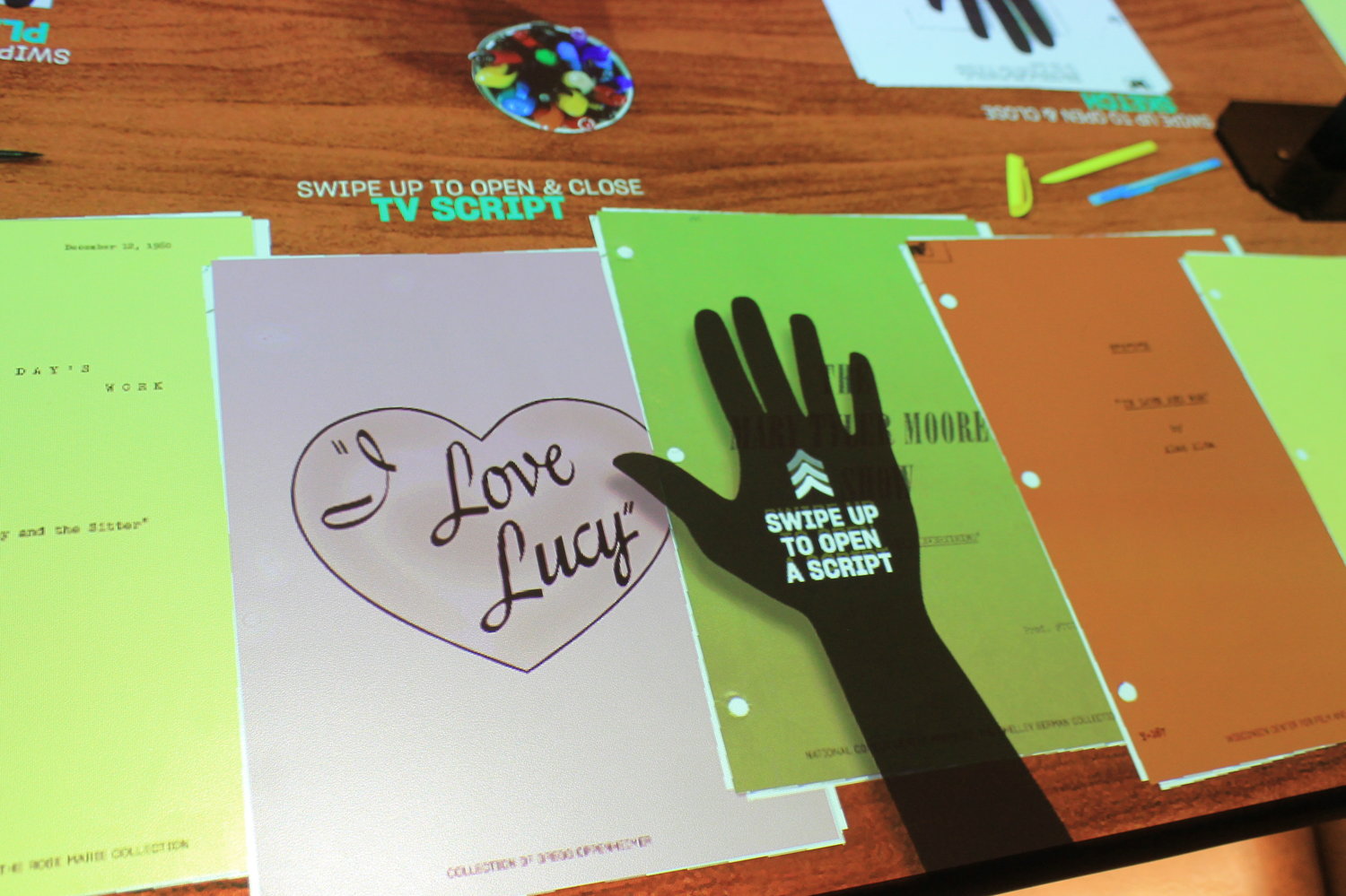
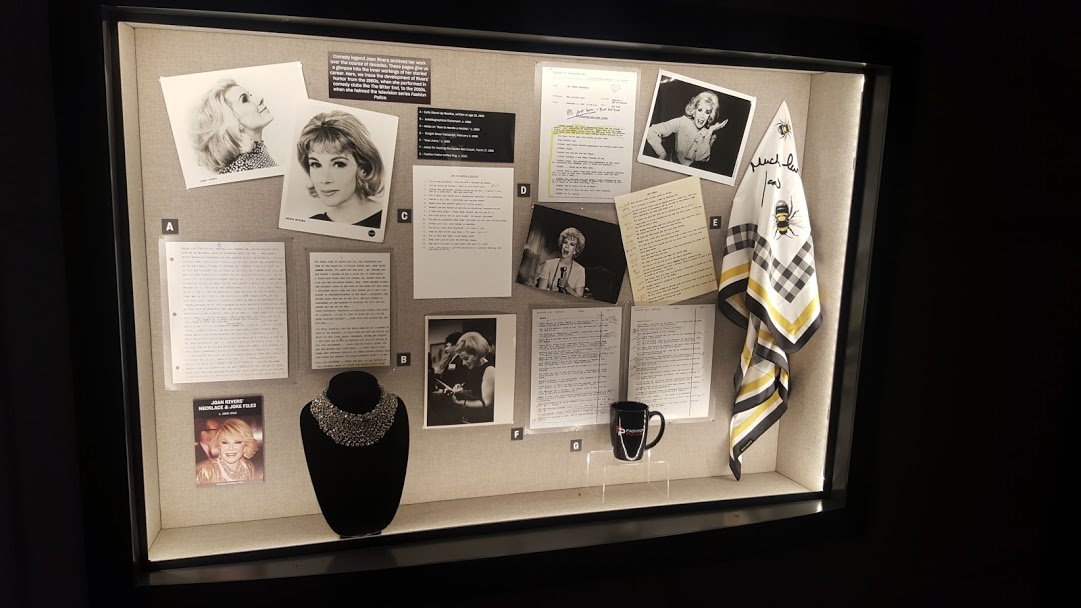
Director of Archives is curatorial: Where and how can archival materials illuminate history for our visitors? That sometimes takes the form of traditional artifact displays inside glass cases (the “Puffy Shirt” from Seinfeld, Harold Ramis’ Ghostbusters suit, Charlie Chaplin’s cane, or Joan Rivers’ joke notes). But, more often, involves activating digital surrogates of archival originals as part of interactive exhibits that involve touch screens, video walls, projections, or other technologically enhanced presentations. To share just one example, our visitors can take a seat at a Virtual Writer’s Desk and “page through” annotated script drafts from comedies like The Muppets, The Mary Tyler Moore Show, or A Funny Thing Happened on the Way to the Forum while the final-draft on-screen versions of the scenes play out beside them. In the past six weeks, due to the COVID-19 closures, we have moved a selection of our exhibit content to a digital platform that brings the museum direct to fans, students, and families around the world. You may enjoy exploring National Comedy Center Anywhere at anywhere.comedycenter.org.

Virtual_Writers_Desk

The Virtual Writer’s Desk on exhibit at the National Comedy Center. Photo courtesy of the National Comedy Center.

Q: Please describe the collections or one of your favorite collections.

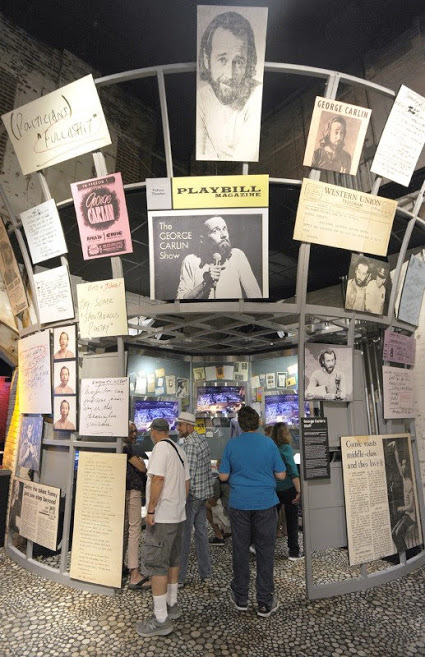
Carlin_Exhibit

The George Carlin Collection on exhibit at the National Comedy Center. Photo courtesy of the National Comedy Center.

Our collections range across the history of comedy, from I Love Lucy to Saturday Night Live, from vaudeville to Internet humor, and across all comedy genres. I have three “favorite” collections: First, the 27,000-piece George Carlin Collection, which we have digitized and made available to visitors via an interactive interface in our galleries. The collection chronicles Carlin’s five-decade evolution as an artist, via his copious handwritten notes, day planners, audiovisual recordings, wardrobe, and more than 40 boxes of creative ephemera. The interactive exhibit showcases his meticulous process in detail, and allows our visitors an up-close look at the creative mind of one of the most influential artists of the 20th century. Second, the Rusty Warren Collection, and accompanying exhibit, honors the contributions of an important feminist comedic artist who levied her talents and brilliant wit to become a leading voice in the sexual revolution of the 1960s. Rusty Warren’s work was so progressive – and so feared – that she was banned from performing on television. Nevertheless, she toured cabarets and nightclubs for over thirty years and made 11 hugely popular comedy albums – 7 of which “went Gold.” Third, the Carl Reiner Collection – which is currently being processed – includes digitized

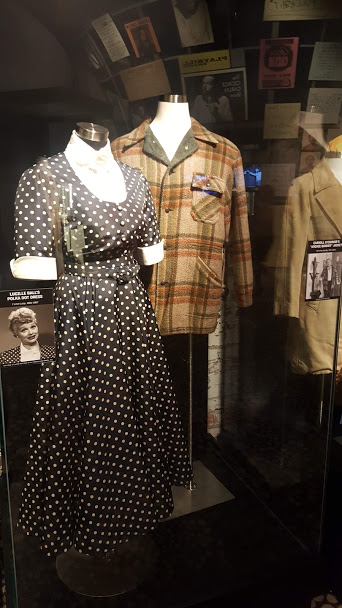
Lucille_Ball_Dress

From the American sitcom I Love Lucy, Lucille Ball’s polka dot dress on display at the National Comedy Center. Photo courtesy of the National Comedy Center.

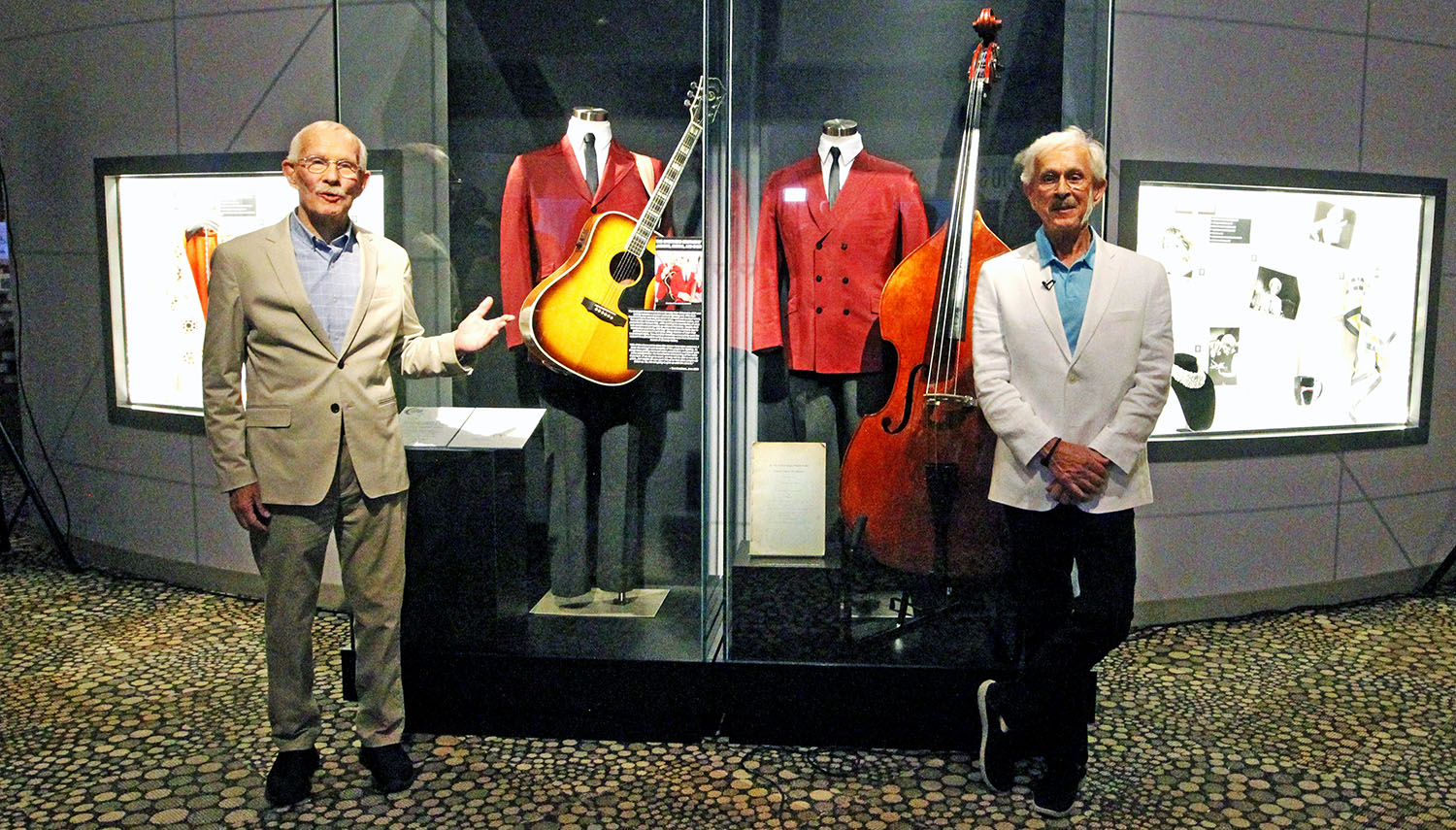
copies of every annotated draft page of the scripts for the seminal sitcom The Dick Van Dyke Show, which Reiner created and wrote. This series was an important pivot point in the history of American television, and set a high watermark that endures to this day. The chance to peer into Reiner’s process via these scripts is like taking a masterclass in the art of comedy writing. In addition to overseeing the processing and preservation of our rapidly-growing permanent collections, I also work closely with artists, estates, and industry partners to curate rotating exhibits of documents, props, and costumes that represent landmark moments in the history of comedy: Lenny Bruce’s trenchcoat, Harpo Marx’s wig, Lucille Ball’s polka dot dress, a “Dundie” from The Office, Carol Burnett’s charwoman costume, The Smothers Brothers’ guitar and bass, Andy Kaufman’s wrestling belt, Eddie Murphy’s Nutty Professor costume, the wedding dress from Bridesmaids, Weird Al Yankovic’s accordion, and so many more.

Smothers_Brothers_w_Exhibit

The Smothers Brothers pose with the Smothers Brothers Collection on exhibit at the National Comedy Center. Photo courtesy of the National Comedy Center.

Q: What are some challenges unique to the collections?

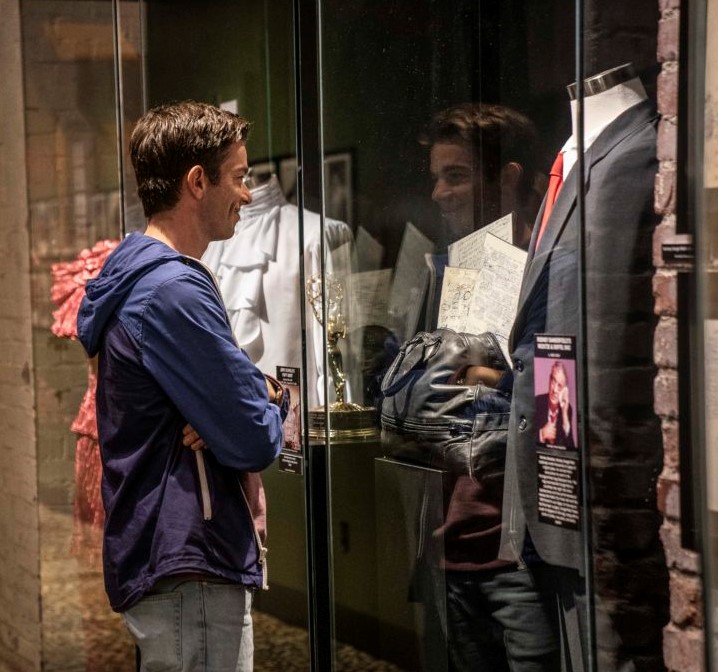
John_Mulaney_Rodney_Dangerfield_Exhibit

John Mulaney views whe Rodney Dangerfield Exhibit at the National Comedy Center. Photo courtesy of the National Comedy Center.

The primary challenge that we contend with is the vastness and variability of comedy as a subject area. The Comedy Center celebrates comedy in all its forms – and across all eras. That approach requires safely housing, preserving, and conserving a broad range of multimedia artifacts, most of which were designed for one-time use on stage – not for decades of stable storage and exhibition. Our team routinely handles manuscripts, photographs, scrapbooks, and documents of all sorts…but also cares for 100-year-old fake mustaches, vaudeville broadsides, cartoonist’s palettes, Grammy Awards, a toupee, acetate discs, costume jewelry, a piano, several motor vehicles, a papier-mâché frog costume, paintings, undergarments, nitrate films, a miniature bicycle, a trick cello, a sledgehammer, and all manner of fragile, irregular, and – oftentimes – very funny objects.

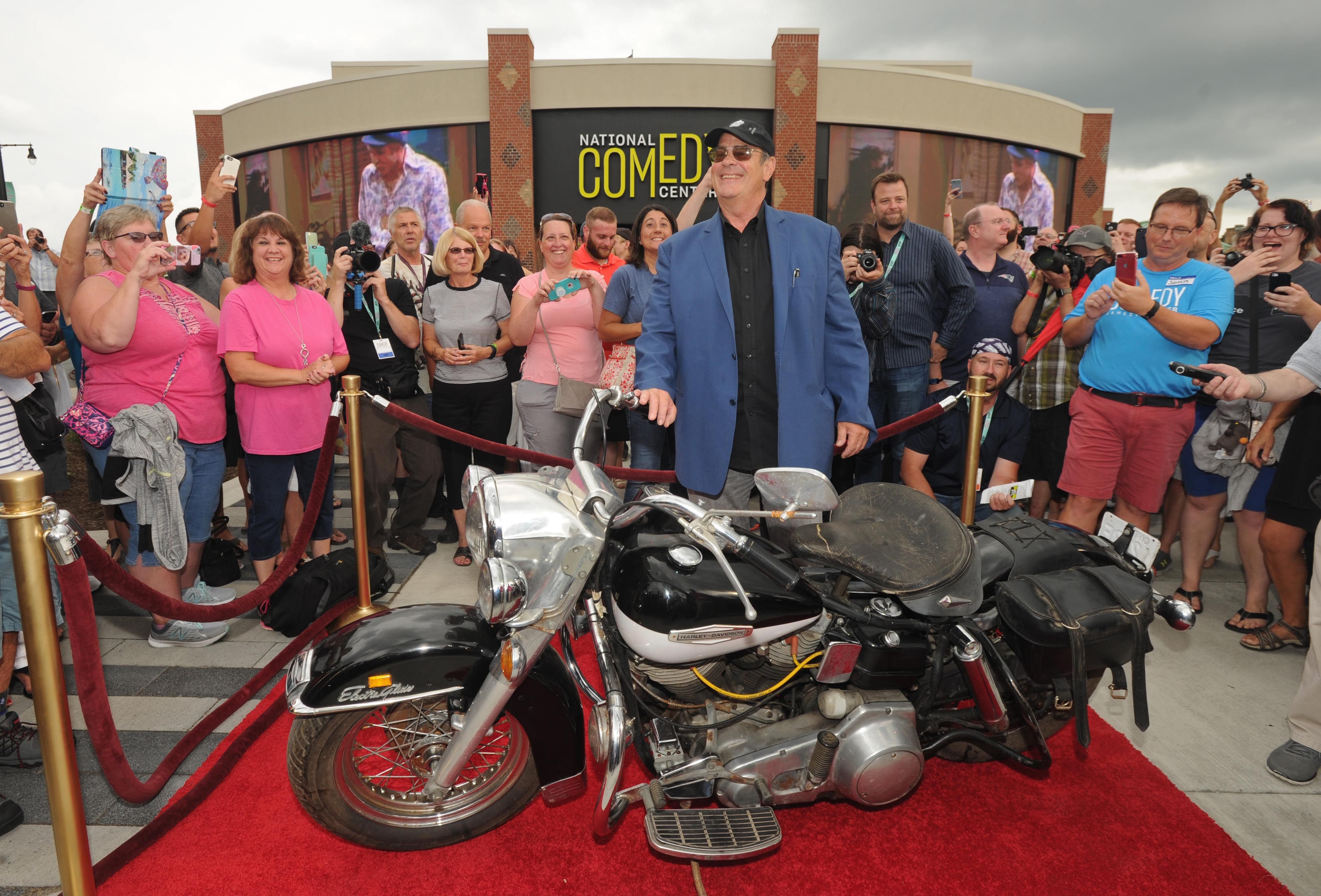
Dan_Aykroyd_Donates_Motorcycle

Dan Aykroyd donates his motorcycle to the National Comedy Center. Photo courtesy of the National Comedy Center.

Q: What is your favorite part of the job?

Part of my responsibility as the National Comedy Center’s Director of Archives is to work directly with artists and their estates to devise the best ways to engage, inspire, and entertain our visitors while educating them about the vital role that comedy has played in shaping our shared cultural heritage. I enjoy every opportunity I have to interact with artists: to discuss their work, to internalize their stories, to strategize together about how to preserve and celebrate their craft for generations to come.

Joan_Rivers_Exhibit

The Joan Rivers Collection on exhibit at the National Comedy Center. Photo courtesy of the National Comedy Center.

Responses and Retrospectives: Sarah Meidl on The Colorado State University Archives & Special Collections Covid-19 Archive

Sarah MeidlThis is the latest post in our series Responses and Retrospectives, which features archivists’ personal responses and perspectives concerning current or historical events/subjects with significant implications for the archives profession. Interested in contributing to Responses and Retrospectives?  Please email the editor at archivesaware@archivists.org with your ideas!

MLIS candidate at the University of Washington and SAA student chapter member Sarah Meidl brings you an interview with Mark Shelstad, Coordinator for Digital and Archives Services at Colorado State University.

COV19-01-2048x381-1-768x143

Mark Shelstad manages the Covid-19 Archive at Colorado State University, a new project that seeks to document the impact of the Covid-19 pandemic on the community of students, faculty, and staff at CSU.

Please see the Society of American Archivists’ press release (drafted by COPA) for more information on organizations documenting COVID-19 in their communities.

Q. When did the Covid-19 Archive project start and what gave you the idea for the project?

A. Our official start date for working at home was March 23rd. And like many colleges and universities out there we were anticipating how the virus might affect the university community. In doing so, we surveyed what other institutions’ documentation efforts, and we took to heart the option for digital acquisitions through web harvesting, and a digital submission form to document the virus’ impact on the University’s community. Submitters can also fill out a questionnaire to share their personal stories about the virus’ impact on their studies, work, and other challenges.

Q. What types of submissions have you received so far?

A. So far, it’s been a little bit on the low side. We’ve received a couple of student video projects which have been great talking about their experiences. One is really well done with two students sharing their experience prior to being sent home interspaced with text messages that they were receiving from the University emergency response team and the county health office. We’ve had a couple submissions of folks who were sent home, the impact of doing remote work and remote learning, and then a lot of images from around campus, and where people self-quarantining.

Q. Are you open to all kinds of digital formats?

A. We wanted to set a low bar for submissions So far they have been the standard JPEGs, PDFs and MP4s. But we’ll do our best to accept the formats as they come in and convert them as needed.

Q. Are you actively processing things or are you waiting until things go back to normal to start the processing project?

A. We will begin making the items available in our digital repository, Mountain Scholar. When a corpus of material has been submitted, a Story map or another online exhibit platform will interpret the materials.

Q. How many people are working on the project right now?

A. Four members of Digital and Archive Services have been involved over the course of the project in developing the digital submission form, metadata creation, and web harvesting.

Q. Are the users creating any metadata for what they are uploading?

A. Yes, users are providing information about themselves, creation of the items, location, and topics. People have been very willing to share this information and self-document. s.

Q. And is this project just for the Colorado State University community or is it open to anyone?

A. As the University Archives, our project is focused on the CSU community. We have talked collecting scope with other archives in the area, and the University Museum of Design and Merchandising, which is collecting masks and clothing. The campus GIS center, the Geospatial Centroid, is running a survey on people’s locations after the semester moved online. We’ve managed to identify portions of this documentation project in a collaborative way.

Q. Will you experience any challenges when you start processing materials? Do you have access to needed software?

A. Submitted items are captured in the cloud, and our digital repository platform is DSpace, so we’ve been able to work in this new environment without many challenges.

Q. Have you had any challenges working from home?

A. Personally speaking, the main challenge has been getting bumped off the VPN depending upon user volume, and making the transition to Microsoft Teams for communication and collaboration.

Q. In addition to this project, are you also working on your regular projects?

A. Yes, we have other projects developed for remote work since we aren’t able to work on physical collections. Namely they involve metadata creation and cleanup, updating finding aids and Wikipedia entries. We also have two crowdsourcing projects underway, one for CSU President Charles Lory, and for interstate water compact attorney Delph Carpenter

Q. Have you managed a similar project in the past where you’re trying to have members of the community upload materials, or is this new ground for the Archives?

A. This is the first round for us, and I’m interested to see what kind of response we get over time. We’re planning to keep the project open, well after the return to work order has been lifted so folks can keep contributing. My sense is that individuals will have an opportunity down the road to reflect on their experiences.

Q. You mentioned having a collection in your digital repository. What is your plan on arranging materials in the repository?

A. We will load them into a Covid-19 collection within our University Archives Community in the repository, with Dublin core metadata supporting their discovery.

Q. Do you see this project as fulfilling the mission of Archives and Special Collections for CSU?

A. Absolutely. These are unprecedented times, and we need to document our individual and shared experiences, ranging from safety protocols, faculty moving their instruction online, staff working remotely, and students who had to leave campus on short notice and transition to online learning. At CSU, it harkens back to a devastating flood in 1997, and I would want to draw upon the oral histories with our emergency response team for comparison.

Q. Do you have any advice for other cultural heritage institutions that may be working on similar projects? Or, lessons learned from your experience so far?

A. I would say jump in. It’s an opportunity for setting collecting priorities and methods, and outreach with potential donors and users. Publicity is also very important, and this project’s selling point is the organic submissions, and getting to tell your story.

Q. How have you been publicizing the event so far?

A. We have used various outlets, such as our campus newsletter and social media outlets, and directly with targeted constituents. A schedule has been developed as periodic reminders for the fall semester.

Q. What do you see as the impact of this Covid-19 pandemic on the profession and on archival institutions?

A. I think there’s a great opportunity for a profession-wide case study to see what efforts were successful, what kind of materials have been acquired, how access and interpretation are being provided, and the impact this documentation efforts has with public policymakers.

Q. Anything to add?

A. In the fall we’d really like to do that oral history with our senior leadership to capture the lessons learned from the pandemic. For students, to have a story-both project for them to drop in and share their experiences, and a digital acquisitions day when they return. We would want to engage with them in physical and digital spaces.

This post was written by Sarah Meidl based on an interview conducted with Mark Shelstad. The opinions and assertions stated within this piece are the interviewee’s alone, and do not represent the official stance of the Society of American Archivists. COPA publishes response posts with the sole aim of providing additional perspectives, context, and information on current events and subjects that directly impact archives and archivists.

Deriving Value from Collections in the Time of Corona (COVID-19)

Deriving Value from Collections in the Time of Corona (COVID-19) was delivered on April 7, 2020 by Margot Note (founder and principal of Margot Note Consulting), Chris Cummings (Founder and CEO of Pass it Down), and Rachael Cristine Woody (owner of Rachael Cristine Consulting).

The webinar was sponsored by the Society of American Archivists’ Committee on Public Awareness (COPA) and is recorded on SAA’s Resources & Toolkits page.

Abstract

Join Margot Note, Chris Cummings, and Rachael Cristine Woody in “Deriving Value from Collections in a Time of Corona,” a webinar brought to you by SAA’s Committee on Public Awareness. The webinar is a call to action for enhancing museum and archives collection programs online through adaption and repurposing of content, reviewing digital usership and digital collection best practices, and capturing the value of your online collections work to broadcast to administrative stakeholders. By combining traditional archival administration with innovative uses of digital collections, archivists can advocate for their collections, enriching their value in a period of uncertainty. The aim of the webinar is to help archivists and museum professionals cultivate their skills to become better promoters of themselves, their repositories, and their profession.

Q&A Section

So much great content and resources were shared during the Q&A that we decided to capture it here for easy reference. Thank you for asking thoughtful questions and for helping us find resources to point people to for some of the questions we couldn’t address fully.

Q. Do you know about 508 accessibility for Pinterest? I’m sure I can look this up too and you might get to it anyway but I want to emphasize to anyone and everyone the importance of accessibility for disabled users.

A. From Bureau of Internet Accessibility: https://www.boia.org/blog/how-to-utilize-and-create-accessible-pinterest-content.

Q. What tools do you recommend to crowdsource or capture COVID-19 materials?

Submitted by the group:

COPA has also just put out a press release documenting some of these efforts.

Q. Do you have any webinars or archives webinar platforms that you would recommend [specific to collection content adaptation and advocating for the value of our collection work]?

A. Rachael Woody just provided an expansion of her topic in her webinar Strategies for How to Capture and Communicate the Value of Collection Work (discussed more below). Additionally, there are a lot of good webinars being offered by peer organizations and companies, such as: Cuseum, CultureConnect, and The National Preservation Leadership Forum. Please let us know in the comments if there are webinars we can add to this list for easy reference.

Q. Who (which organization) created the puzzle? 

A. The Cooper Gallery.

Q. How do you strike a balance between wanting to lift people’s spirits with light-hearted content and coming off as too silly and inappropriate during such a scary time?

A. Evaluate what your current tone and mission is for your organization’s social media presence as consistency in messaging is important. Even if your social tone is on the lighter side, it is important to still be aware of current events and sensitive the hardships people are facing. Be intentional with what item, story, or exhibit you’re sharing and provide context–offer an explanation on why you’re sharing what you’re sharing. Evaluate your tone to ensure it’s in keeping with your intent. Additionally, with the heaviness of current events, people are going to social media for relief and it’s OK to be a provide of relief and enjoyment during this time. In fact, it’s a very valuable thing to offer people. And it’s OK to experiment during this time to find what’s valuable to your audience.

Q. Some people have expressed an understandable sensitivity to posting archival images that don’t display proper social distancing during this time, instead of posting on events (now cancelled) from the past that show crowds of people. Any thoughts on this?

A. Context is key. It’s OK to post these images as long as you provide a thoughtful comment as to why you’re sharing it. For example, a historical photo of a annual parade with a note that says something like: “We’ll sure miss seeing you at the annual parade this year, but we look forward to seeing everyone next year–happy and healthy!”

Comment: Thank you for offering this very useful and informative webinar. Our whole staff in the NMSU Archives & Special Collections is viewing this. Useful to us, as we have just started a blog. https://openstacks.nmsu.edu/

Q. I love all of the fun ideas for engagement with the public! As an academic institution, we also need to emphasize our academic value to our students and our impact on teaching and learning. Any suggestions in this area? Thank you!

A. Yes! Knowing the stress that students and faculty have been under to move everything online–and the access disparities that have been present–think of ways you can help supplement, support, or help adapt collection teaching content for online. Suggestions from the panelists:

  • Proactively reach out with resources that are ready to go.
  • Offer office hours for students and faculty to receive help around using collections for the teaching and learning work.
  • Look at digital content that’s already available that could be repurposed or repackaged into something to help support students and faculty.
  • Take the opportunity to craft lessons plans that can accompany online collections. Consider including lesson plan creation as part of your workflow to coincide with new exhibits and newly online collections.

Q. How are you adapting to the online environment with your online classes with special collections. Can you give examples?

The Rockefeller Archive Center offers resources for crafting primary source-based education. Check out their resource page for primary source unites, workshops, ad projects. The American Alliance of Museums also offers programs and resources in their Repository of Distance Learning.

Submitted by the group:

Q. What are your opinions on posts about working from home? Is there a sensitive way to share about archivists commitment to their work while being cognizant that many people are not able to work right now? Side note, thank you! This has so far been fabulous.

A. Similar to some of the questions fielded already, we encourage you to be honest, provide context as to why you’re sharing, and acknowledge that the current situation has left many unemployed, furloughed, or in precarious work positions; and offer a note of support. Also, keep in mind that for many in our audience the work that we do is often mysterious and interesting, and they’ll appreciate you offering a peek behind the curtain.

Q. How do you recommend getting past internal roadblocks to posting content?

A. Approach it as an experiment and track your efforts to demonstrate the engagement that occurs. As discussed in the webinar, it’s so important to track engagement numbers in order to show the value of the work happening. Also, consider how this might tie into supporting the organization’s income stream and mission. It may also be helpful to point to peers in the field who are on social media as competition among peers is often helpful in inspiring a “Yes” so that your organization isn’t left out. And sometimes it’s easier to seek forgiveness than ask permission. As long as one person in power is supportive, take the opportunity to explore how you can serve your audience in this new way or even add a new audience members.

Q. What advice would you give institutions on how to technically preserve social media posts?

It’s tricky to find a tool that helps to consistent and legally capture digital content and has the technical wherewithal to follow digital preservation best practices. Some digital preservationists still recommend to print it out, taking a screenshot, or converting to a PDF for easier preservation and digital migration. While it seems archaic, paper is still the preferred medium for saving information of value as the digital media landscape is still evolving and therefore very volatile for future duration. Rachael Woody wrote a post on this in 2019: Responses & Retrospectives: Rachael Woody on Myspace and the Precarity of User Content on Social Media Platforms.

Submitted by the group:

Q. I am a lone arranger at a local county archive. During this time many people are taking the opportunity to cleaning out closets, attics, basements and garages. How do we get the message out that our archives is still taking records donations but can’t receive them until after this “Great Pause”!

A. Put out a call to action with instructions. Acknowledge that this is a great time for people to clean out their closets and provide guidelines for what you’re looking for per your collection policy. Then give them a direction. Maybe it’s a form to fill out, a box with a label to send, etc.

Q. What advice do you have for use of images and content that might be otherwise be copyrighted by others?

A. It’s very important to discern if the archives have a Deed of Gift for collections that grant rights and permissions to the organization. There are cases where past practices of archives mean there isn’t a Deed of Gift. To the best of your ability attempt to determine if materials are created by others and seek their permission before you use it. Many archives offer a mechanism for people to contact them if there are items online that they believe they own copyright of.

Q. You mentioned reaching out to engaged community members on platforms like Facebook groups. Can you go into more detail about how you do that? I sometimes struggle with knowing where or when to join in when I see our collections show up on those platforms.

A. Sure. In almost every community, there will be groups set up that showcase historic photos and stories from that community. The best way to begin would be to do an audit of both Facebook and Instagram for any groups that would be relevant to your community. Next, become an active participant and start to chime in with helpful comments and content. We would also recommend that you reach out to the administrator of the group to introduce yourself and your institution and ways you might collaborate.

Margot Note shares: I usually first start out as a “lurker.” I see what interests the group, what they’re talking about, and who are the frequent posters. When you’re comfortable and feel like you have something to share, you can write a short post about your collection, how to access it, and how you think you might help them. Then see what the reaction is. As long as you’re sharing information that would generally help people and not overly promoting something, the responses are almost always positive.

Q. I find posting historic images and videos onto Instagram painfully difficult. Am I just not downloading some key “extra” app that would make it way less frustrating? Maybe even easy?

A. The trick is sending photos, videos, and captions in an email, and accessing them on your phone. You then can post images and cut and paste text. To learn more, check out this chapter written by Margot Note, “#CulturalHeritage: Connecting to Audiences through Instagram” in Engagement and Access: Innovative Approaches for Museums, edited by Juilee Decker, New York: Rowman & Littlefield, 2015. Although Instagram has changed a lot since the book was published, the chapter still offers valuable information on how to curate an account with archival images.

Chris Cummings shares: Anyone that’s done social media for long has felt the frustration of having to post to instagram directly from a mobile device. There are a few great tools that will let you schedule and post to instagram directly from the web. Check out Grum.co or Later for tools that should make your social media life a lot easier!

Q. What platform do you think would be best to start off with, if our institution doesn’t have much of an online presence?

A. Start out with the one you believe would best fit your needs and that you are technically comfortable with. The better suited the platform is to your purposes the more you will use it, and the more effective it will be. That said, we recommend you start by reviewing what the purpose of each social platform is. Instagram is for visual presentation, YouTube is for videos, and Facebook is a hybrid of both, etc. You can also get insight into what a good platform match would be by reviewing what your peer organizations are using and how they are using it.

Connect with the Presenters

Connect with the webinar presenters (and sign up for their newsletters so you don’t miss their content and resource drops!):

Margot Note, Founder and Principal of Margot Note Consulting. Photo courtesy of Margot Note Consulting.

Margot Note, Founder and Principal of Margot Note Consulting. Photo courtesy of Margot Note Consulting.

Margot Note Website: https://www.margotnote.com/
Twitter: https://twitter.com/margotnote
Linkedin: https://www.linkedin.com/in/margotnote/
Newsletter: https://www.margotnote.com/newsletter

Margot Note, CA, CRM, IGP, PMP. Note is the principal and founder of Margot Note Consulting, LLC, an archives and records management consulting business in New York. She’s a professor in the graduate Women’s History program at Sarah Lawrence College and an Adjunct Assistant Professor in the Library and Information Science program at St. John’s University. She’s the author of five books, including her newest Creating Family Archives: A Step‐by‐Step Guide for Saving Your Memories for Future Generations published by the Society of American Archivists.

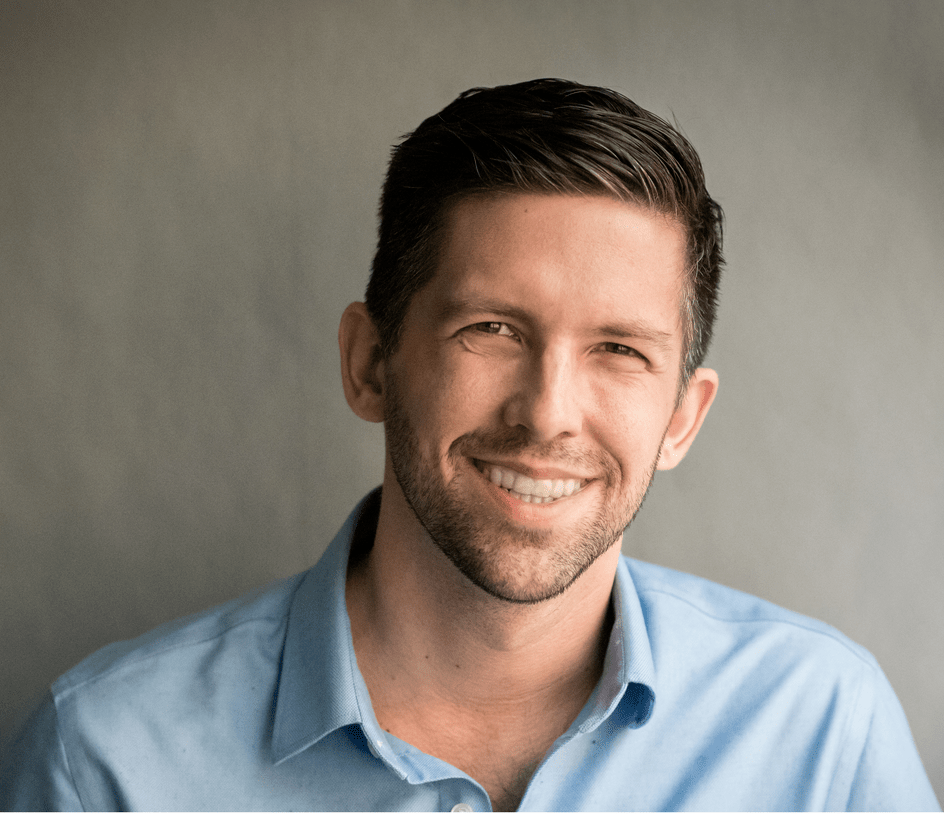
Chris Cummings, Founder & CEO of Pass it Down. Photo courtesy of Pass it Down.

Chris Cummings, Founder & CEO of Pass it Down. Photo courtesy of Pass it Down.

Chris Cummings Website: https://passitdown.com/
Twitter: https://twitter.com/passitdown
Linkedin: https://www.linkedin.com/in/christopheracummings/
Newsletter: https://passitdown.typeform.com/to/A5vBoV

Chris is the founder and CEO of Pass It Down Inc., a digital exhibit builder platform that’s been recognized globally for transforming how cultural institutions and brands engage their visitors. From Cairo to San Francisco, Chris has been invited to speak around the world on the Future of Museums and archives, and is a global pioneer in the field of digital storytelling.  Pass It Down’s been recognized as a leader in experiential marketing and digital exhibits by Coca-Cola, the Consumer Technology Association and Established, Techstars, and is the winner of the 2019 BREW Pitch Contest and $100,000 prize.

Chris is a 3-time CEO, two-time founder, and attorney and a former Collegiate National Champion in Public Speaking. Chris received his JD from the Paul M. Hebert LSU Law Center and has clerked for numerous judges, including the honorable Chief Justice Johnson of the Louisiana Supreme Court. He received a double BA In Political Science and International Relations from Louisiana State University.

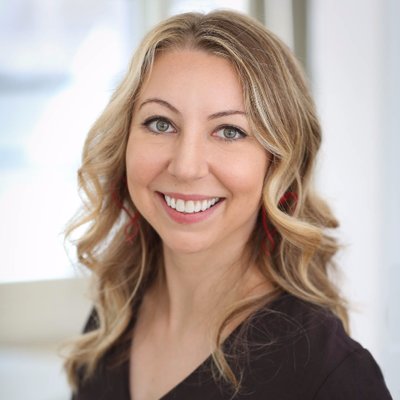
Rachael Cristine Woody, Owner of Rachael Cristine Consulting. Photo courtesy of Rachael Cristine Consulting.

Rachael Cristine Woody, Owner of Rachael Cristine Consulting. Photo courtesy of Rachael Cristine Consulting.

Rachael Cristine Woody Website: https://rachaelcristine.com/
Twitter: https://twitter.com/rachaelcristine
Linkedin: https://www.linkedin.com/in/rachaelcristinewoody/
Newsletter: https://rachaelcristine.mykajabi.com/signup

Rachael Woody is the owner of Rachael Cristine Consulting LLC. After a successful tenure at the Smithsonian Institution and the Oregon Wine History Archive, Woody established her consultancy to teach archives, museums, and cultural heritage organizations how to take care of their collections and advocate for their value. Woody has experienced precariously funded positions first-hand and has proven tactical strategies to demonstrate the value of collection work. As a result of her experience, Woody has dedicated herself to advocating for the value of collection work. She serves on SAA’s Committee on Public Awareness, established the Archivist-in-Residence (paid internship) program at Northwest Archivists, and serves on several salary advocacy committees.

Rachael Woody developed a companion piece to this webinar: Strategies for How to Capture and Communicate the Value of Collection Work. Please see her blog post for more information, a link to download the slide deck, links to resources, and a summary of the Q&A. The webinar is also provided below for ease of access.

Abstract

Archives, museums, and cultural heritage organizations across the world are struggling with the impact of COVID-19.  As public spaces remain closed, archives and museums are challenged with fulfilling their mission while seeking economic relief. Many archives and museum professionals are facing precarious employment as they struggle to prove the value of their work. This webinar is a follow up to the Society of American Archivists’ “Deriving Value from Collections in the Time of Corona (COVID-19)” (view: https://youtu.be/vhK2ww1_ZR8).  Please join me for a deeper dive into strategies for how to capture and communicate the value of collection work. The webinar will offer a framework to define the value of your work, discuss mechanisms for capturing value, and offer strategies for communicating the value of your work to your boss, your board, your fellow staff, and your community stakeholders.

Archives + Audiences: Andretta Schellinger, Historian and Author


QgPHFj_Y

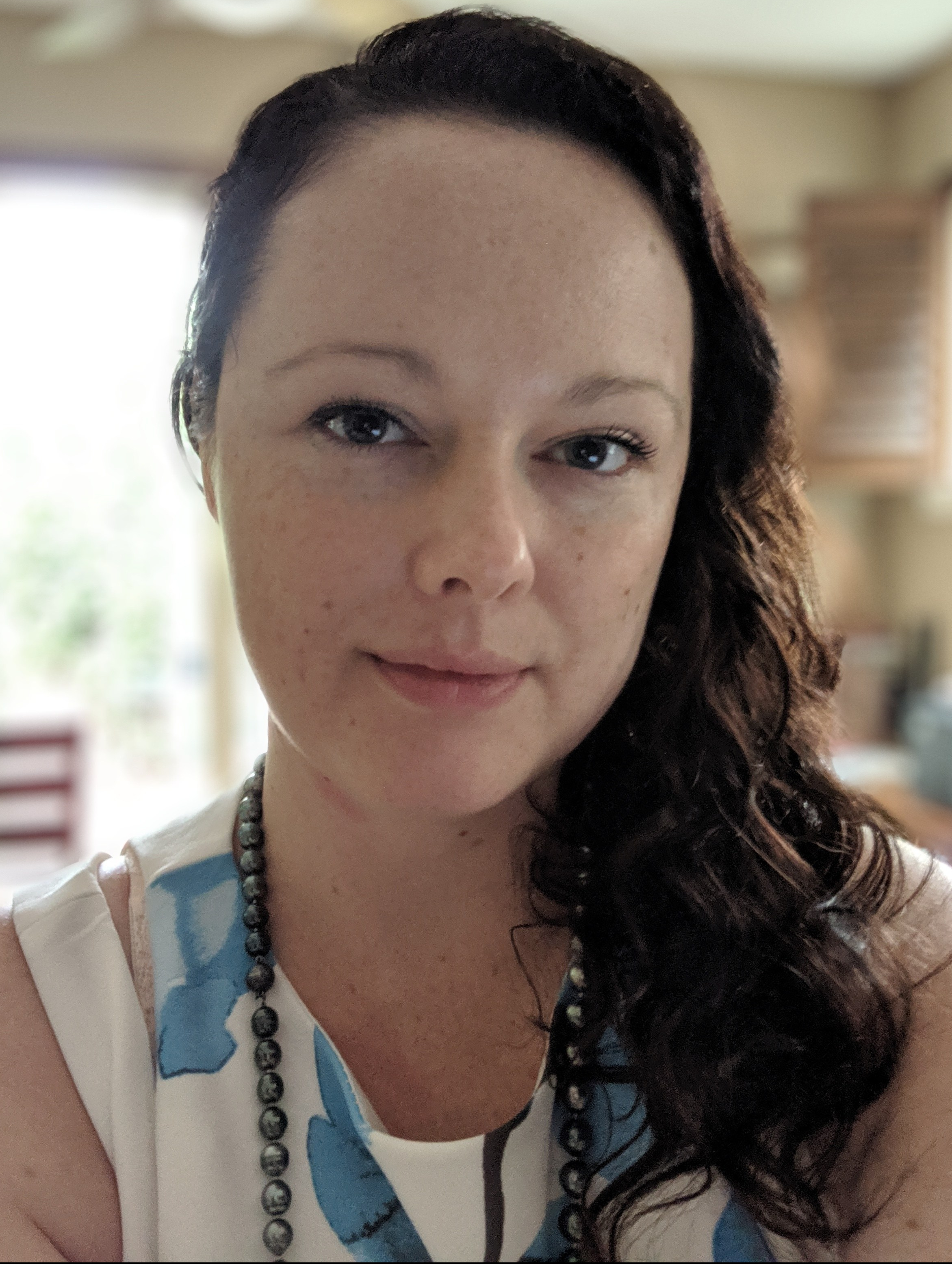
Andretta Schellinger of Schellinger Research. Photograph courtesy of Schellinger Research.

This is the latest entry in our Archives + Audiences series, which features the perspectives of archival audiences – scholars, journalists, filmmakers, artists, activists, and more – for whom archives have been an important part of their life and work.  In this post, we feature COPA member Rachael Woody’s conversation with Andretta Schellinger and her experiences using historical materials to write her books.


Andretta Schellinger graduated from Pacific University with a Bachelor’s in History and Sociology before attending Hawaii Pacific and receiving a Master’s in Military and Diplomatic studies. While in Graduate school, she received an ORISE Fellowship to work in the records room at the Joint POW/MIA Accounting Command on Hickam Airforce Base, now known as the Defense POW/MIA Accounting Agency (DPAA). After leaving JPAC, she used her experience to start Schellinger Research, a company based on the belief that history should be shared through the digital and physical world and actively works to build the bridge between them.

RW: First, tell us a little more about From Knights to Skulls and The Men Beyond the Stones.

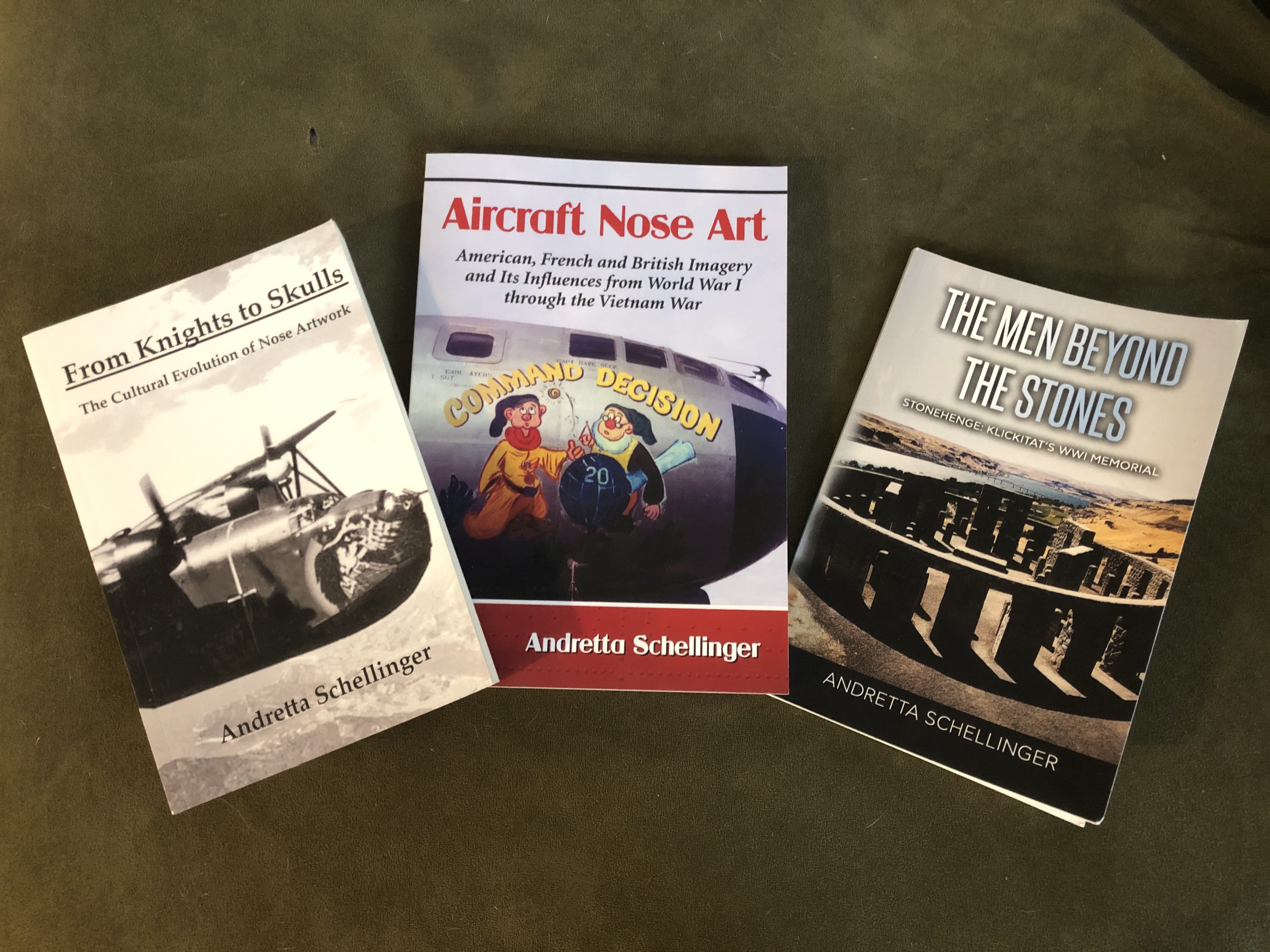
AS: “From Knights to Skulls” is a look at how culture, both military and civilian, affected the artwork, or nose art, that was placed on planes from World War I through Vietnam. It digs deeper than what was painted into the why’s and who of the artwork. While the book is out of publication, McFarland & Co have republished it as “Military Nose Artwork”. The new book is slightly different and updated, as it has a chapter on current conflicts and what the future holds for nose artwork.

“The Men Beyond the Stones” came about due to my never-ending search for information, particularly the who and why of something. I wanted to know who the men were, how they died, and why they were memorialized. It goes deeper than just a snapshot into their lives, as it looks at the creator of the structure, and the one individual who was from the county and died, but was not included.

2020-03-28

Books written by Andretta Schellinger, author and historian. Photograph courtesy of Schellinger Research.

RW: What inspired you to write these books and use historical materials?

AS: “From Knights to Skulls” was my graduate thesis and what inspired me for it was History of Aviation and Airpower, a graduate class I took. I didn’t know what to do my final paper on, and while talking to the professor he suggested Aircraft Nose Art. I was instantly hooked, and during my Artist, Imagery and War I continued with the progression of Aircraft Nose Art. While sadly the professor who introduced me to the topic left the university before I started working on my Thesis, I pushed through and really began to appreciate culture and the way that culture and history are intertwined. Historical documents for that book kind of fell into my lap, especially nose art imagery.

As for “Men Beyond the Stones,” when I first moved to Oregon after living in Hawaii for graduate school, I travelled to Maryhill’s Stonehenge, a fully built representation of what the English Stonehenge may have looked like centuries ago. On the inner circle’s pillars are bronze plaques representing the men who died from Klickitat County during World War I. I wanted to know more about the men other than their name, birth date and death date. Using my knowledge gained in part at JPAC, I started to research. I relied on the military records to give me a good view of what their life was like during service, but for their child and young adulthood I used newspaper articles.

RW: You’ve written several books and articles, can you tell us more about your process and what goes into creating these written works?

AS: When I narrow my focus to a specific topic that I want to research, I make sure to always look for information that was already published. For both of my books, there was not a lot of information published that looked at the things the way I looked at them. For example, there are many books on military nose art, but those that do look at the culture side, tend to skim over that, and focus mainly on the pictures of the planes and the art. Those are great for the general audience, but not what I had questions about.

Or there could be information out there, but not in one location. Like with “Men Beyond the Stones”. There are many websites that briefly touch on the memorial aspect of the stones, but they’re not comprehensive, because the writers were not looking at those specifically, but more as an addendum to their intended focus.

After that I gain the documents I need, be it newspaper articles, military records, or other primary documentation to assist me with my research, I start writing. I am not one of those authors who outlines a book down to specifics and then essentially fills in the outline. Some authors use that method and it works great for them. I am the type that starts typing out what I want to say, with my source material near so I can grab it when I need an answer for something. While it works for me, I do not recommend this technique for everyone.

RW: How do you choose which materials to inform your books?

AS: That really depends on what I am writing about. For information concerning individuals like my current project, or “Men Beyond the Stones” I seek out information about the individual. For projects that are broader or that I haven’t narrowed the focus on, I tend to go broad with the materials and them slim down as I get narrower on my focus. I cannot even begin to count how many resources I started with for “From Knights to Skulls” because I had no idea where it was going to land. As I narrowed down both the culture and art side, I was able to remove sources that were not pertinent.

I believe in including everything that I use, no matter how seemingly unimportant it is, because, especially with “From Knights to Skulls,” it was intended as higher level reading material, and I wanted to give future researchers all of the tools that I had when I wrote it. I do not believe in hiding or leaving things out because ‘I found them’, I am a firm believer in source sharing whenever possible.

RW: Please share a story of one of your great archival finds or a fond memory of an archives visit.


ScanningSetup

Portable scanning station setup with overhead scanner. Photograph courtesy of Schellinger Research.

AS: When I worked for JPAC, I spent a lot of time at NARA scanning military documents for use to help identify remains brought back by our teams. I remember the first time I walked in, bright eyed and bushy tailed thinking I was going to solve all the problems with my laptop and scanner. Only to be told by the archivist, who I later learned had been there for 15 years and became well acquainted with, that I could not bring in my laptop or scanner until I had taken a test. There I was, about to take on the 1500 files that I had requested of them not a month earlier, having to leave the room to take a test. The archivist personally handed me the test with a look, that I could only describe as pity. Awhile later, she handed me my archive license and told me to be careful with the documents. Off I skipped back to my laptop to start processing and scanning the documents.


RW: How have archives helped to inform your work?

AS: In some cases, the archival documents have inspired my work, in that I have found something while searching for something else that has taken me down a rabbit hole. That rabbit hole is usually deep and consists of me having books and documents everywhere in my office. For example, while working on “Men Beyond the Stones” I learned about a unit that I hadn’t heard about before. That has since led me to start researching, and I have a book in process.

Most times, what the archives do for me is to help broaden my subject matter. Sometimes I get hyper focused on one thing, and while reading the documents, I find small branches that can help to not only fill in gaps in my knowledge, and the knowledge I wish to impart in my work, but also to fill out the work itself. One good example is that I hadn’t looked at the use of propaganda as much as I should have when I was working on “Knights to Skulls”, but when I started looking into culture, one thing that kept coming back around was the use of propaganda to manipulate.

RW: Is there something you’re still searching for and haven’t found it in the archives yet? (We know people ;))

AS: I still have some soldiers that I can’t find images for from “Men Beyond The Stones” and while the book is published, I still look to hopefully find that long lost photo. It’s the little voice in the back of my head saying, “you should have looked harder.”

I am currently working on a book about the Lane County Spanish American War deceased, so I am starting to search for those individuals. I doubt there will be many images, but you never know until you look.

RW: Were there any barriers to using or accessing the collections? If so, please tell us about it.


OverheadScanner

A CZUR overhead scanner used to safely scan materials. Photograph courtesy of Schellinger Research.

AS: One of the biggest barriers that I have discovered is the lack of digitization, which is one of the reasons I started Schellinger Research. It is often impractical to fly around the US or even the World to find that one piece of paper that may make or break your writing. Jobs, families, financial constraints all play a part in creating a barrier for some researchers.


For this reason, I’m a big proponent of digitizing and, at the very least, documenting what a collection contains. That way researchers can view the collections from their home, or a local library. I feel this will vastly broaden the collective knowledge available and it will give a voice to those who may under other circumstances be unable to share their resource with the world.

RW: What’s one thing you wish the general public knew about archives?

AS: It’s not just large nondescript buildings that have workers wearing glasses with chains. It’s small archives in the back of museums, it’s cubbies at libraries that are full of documents you can’t check out, it’s in your grandmother’s’ attic (we all have that grandmother who has collected everything about something). Archives can be everywhere and of every size.

Also, archivists don’t just love the material they are processing, but they love sharing it with others. I have had archivists who were giddy with excitement to show me something they found while digging for something I asked for. And in some cases, digging is exactly what happens, because there are not enough days, man hours, or people to process all the archival material that’s being made on a daily basis. Be kind to the archivists in your life, they are the keepers of the materials you may need.

RW: What are some of the reactions you’ve received by writing and publishing these written works?

AS: The reaction from “Knights to Skulls”, and its new incarnation “Aircraft Nose Art” has been quite mixed. Some people love how I got into the culture behind the art, others hate that I didn’t add more images of the planes themselves. Some thought that I did a great job connecting culture to the aircraft art, others felt they could have done it better themselves.

For “Men Beyond the Stones”, the response has been almost universally positive. From people not knowing about the reason Stonehenge is there, to others really appreciating that I looked at it from the service members point of view.

While not all reviews, both positive or negative, are helpful, the ones that are help me to become a better writer, historian, and overall more aware of those around me and how my work affects them.

There’s An Archivist for That! Interview with Susan Malsbury, the Director of the Estée Lauder Companies Archives


Image 1

Photograph courtesy of Susan Malsbury

This is the newest post in our There’s an Archivist for That! series, which features examples of archivists working in places you might not expect.  COPA member Rachael Woody, owner of Rachael Cristine Consulting LLC, brings you an interview with Susan Malsbury, the Director of the Estée Lauder Companies Archives.


Susan Malsbury graduated from Earlham College with a Bachelor’s Degree in English and continued her graduate work at Pratt University, obtaining a Master’s in Library and Information Science and Archives with an Advanced Certificate in Archives in 2009.

Susan’s first archival work was volunteering at the Maine Historical Society in Portland, Maine, where she cataloged glass plate negatives from the Portland Press Herald and mariner maps. In 2007, Susan interned at the Guggenheim Museum and in the Manuscripts and Archives Division at the New York Public Library. Upon the completion of her internships, Susan was offered a project position at NYPL to be assistant archivist on a project to process the 1939/1940 New York World’s Fair records. Susan remained at NYPL for 12 years, becoming a Manuscripts Specialist in 2010, and the Library’s Digital Archivist in 2014. While at NYPL, Susan worked on complex audiovisual collections, such as the Gay Men’s Health Crisis records, and a wide variety of hybrid collections, from publishing house records to artist papers. In 2018, Susan began working at the Estee Lauder Companies Archives as the first ever Manager of Digital Collections and became the Director in 2019.

Susan has lectured extensively on digital archives and is currently the Chair of the Society of American Archivists Electronic Records section.

RW: How did you get your gig at the Estée Lauder Companies (ELC) Archives?

I began working at the ELC Archives in 2018. I had not been actively looking for a new job, but a friend sent the job listing to me and I was intrigued. It was a Manager of Digital Collections position and the role was to build a digital archives program, support the development of a collection management system, and oversee all digitization. I had been at the New York Public Library for twelve years, most recently as Digital Archivist, where I helped build the digital archives program from a project-based approach to a programmatic model. The idea of building a program from the ground up was intriguing and I also thought it would be good to get experience at another institution, as I had spent my entire professional career at NYPL. After a year at ELC, the Director of the Archives left and, after a brief acting period, I assumed the role. It was an unexpected career move but has been an incredible experience to lead a busy corporate archive through what has been a very transformative time!

RW: Please tell us about the Estée Lauder Companies.

Image 2

Ronald Lauder, Estée Lauder, and Leonard Lauder in 1972 at the GM Building, the Company’s global headquarters since 1969. Photograph courtesy of the Estée Lauder Companies Corporate Archives.

The Estée Lauder Companies is one of the world’s leading manufacturers and marketers of prestige cosmetics. The Company was founded in 1946 by Estée Lauder and Joseph Lauder. Estée handled all product development and marketing, while Joseph oversaw finance and operations. The Estée Lauder brand launched with four main products that she sold at beauty salons around New York. The brand grew rapidly and both the Lauders’ sons eventually joined the Company, Leonard Lauder in 1958 and Ronald Lauder in 1964. The family is still very involved with the Company today, including now fourth generation family members.


The Company began creating additional brands in-house on the premise that it was better to make its own competition through separate brands that had distinct brand positioning. Aramis, a men’s fragrance and treatment brand, was launched in 1963. Clinique, the first dermatologist-created, allergy-tested and fragrance-free brand, came soon after in 1968. In 1979, Prescriptives launched as a color authority and was one of the first brands to offer custom blended foundation to match a wide variety of skin tones. The last in-house brand was Origins, founded in 1990 as the first prestige wellness brand that fused natural ingredients with science. After Origins, the Company shifted to fragrance licensing and acquiring already established companies; the first fragrance licensee was Tommy Hilfiger in 1993 and the first brand acquired was MAC Cosmetics in 1994. The Company currently owns 29 brands, including Aveda, Jo Malone London, Bobbi Brown, and Tom Ford Beauty, and is truly a global company with products sold in 150 countries and 48,000 employees worldwide.

Additionally, the Company has had a longtime focus on philanthropy through its Citizenship and Sustainability initiatives. The Breast Cancer Campaign was founded by Evelyn Lauder in 1992 to increase awareness and fund global research, education, and medical services. A little-known fact is that Evelyn Lauder co-created the iconic pink ribbon which has been adopted by breast cancer initiatives worldwide! The MAC AIDS fund was established in 1994 and has raised over $500 million dollars for AIDS organizations through the sale of the Viva Glam lipsticks.

Image 3

A portion of the Archives’ heritage exhibit. Courtesy of the Estée Lauder Companies Corporate Archives.

The Archives was founded in 1991 by Leonard Lauder with the mission to collect, preserve, and make available the rich heritage of the Company and its diverse portfolio of brands. The goal of the Archives is to be the center of research and inspiration for the Company, to drive creativity and innovation, and to foster an appreciation and understanding of the Company’s heritage and development. While the Archives started off as a packaging library from the four core brands, it has expanded to include products from all brands as well as any public facing material or material that informs the consumer experience. We also hold select corporate records and the personal papers of Estée and Joseph Lauder.

The Archives has grown significantly from its initial home – like many archives, a closet in the basement of the corporate headquarters – to a full-floor facility in midtown Manhattan. We also recently opened a second archival processing hub in Long Island City. Our main office in Manhattan contains storage for a quarter of our collection, workspace for product processing, a heritage exhibit, and an on-site digitization lab. The heritage exhibit highlights the founding of the company and four core brands by the Lauders, and showcases key products and marketing innovations. Archivists give heritage tours regularly to new employees or by special request, providing over 100 tours a year.

RW: Please describe the collections.

Image 5

Estée Lauder Crème Base Face Powder, circa 1960. Examples of product photography. Courtesy of the Estée Lauder Companies Corporate Archives.

Each brand has its own collection, and there are three additional collections for corporate records, the Lauder Family, and the Breast Cancer Company. The collections are broken into two main categories: packaged goods (products and packaging) and archival material (everything else). Currently, the Archives contain 75,000 products, 8,000 linear feet of archival material, 20,000 audiovisual items, and over 60 terabytes of born-digital files.

Products and packaging consist of fragrances, color cosmetics, skincare, home goods like room sprays and candles, and even ingestibles (Aveda’s Comforting Tea and Origins’ Peace of Mind gumballs). Our earliest products are from the 1950s and our latest products are ones that have not yet hit the markets. As the Archives receives two copies of each new product from every brand, we’re expanding by two to five boxes of products each week, depending on the season. We currently have an in-house digitization lab where products are photographed according to museum standards; a color chart is used to ensure 100% color accuracy of packaging and makeup shade.

Image 4

Clinique Supplementary Lashes, 1971. Examples of product photography. Courtesy of the Estée Lauder Companies Corporate Archives.

The archival material consists of creative material, collateral, advertisements, education and marketing material, and files related to the Company’s many philanthropic endeavors, much of this increasingly arriving in born-digital form. Additionally, the Archives contains a good deal of special formats like garments, awards, and counter displays. One of my favorite recent acquisitions is the corset that RuPaul wore in the iconic Viva Glam ad! The vast audiovisual assets consist of commercials, tutorials, fashion shows, and media appearances.  We have historically received transfers of material when an office moves or is redesigned or an employee retires. In the future, we plan to develop regular transfer schedules so that we are assured we are getting all material identified as having archival value.

The Archives also runs an Oral History Program, overseen by Marion Jaye, the Company’s first archivist. Marion has conducted 48 interviews with longtime employees, collecting valuable institutional knowledge and stories that truly bring the Company’s heritage to life.

RW: What were some challenges unique to the collections?

One of the biggest challenges is the sheer variety of material types which require separate processes for accessioning, description, conservation, digitization, and access. Two factors that have helped manage these complex collectives are the development of a new collection management system and moving towards a staffing model that encourages expertise by material type.

The Archives uses customized versions of Collective Access for our CMS and our front-end archival portal, allowing users to access our catalog and select digital assets through a beautiful internal website. It was a true team effort to develop cataloging schemas that worked for all the material types in our collection while at the same time ensuring that our controlled vocabulary would be understandable to our user base. The former Director, Adrianna Slaughter, wrote a wonderfully thorough article about this process that everyone should go read! Having a customized system allows us to catalog fields specific to products and packaging, audiovisual, physical archival items, and born-digital files in separate modules that work synergistically in the same system. Collection management fields allow us to track an object’s provenance, and – for physical material – the condition, collection use, and availability and quality of digital derivatives.

We also have a large amount of legacy data in spreadsheets and files from past digitization projects on hard drives. Over the last year and a half, I have been vetting the quality of the metadata and standardizing legacy metadata so that it can be imported into the CMS. The audiovisual spreadsheets were an excellent candidate for this treatment; following my audit and remediation, we now have over 6,500 catalog records that can now be reconciled with a physical audiovisual object and/or a digital derivative, and then pushed to our front-end website for viewing by our users.

Image 6

Audiovisual catalog record with media player on the front-end website. Courtesy of the Estée Lauder Companies Corporate Archives.

Another challenge is that, as a corporate archive, we can never close a collection for research. Processing projects require an additional level of strategic planning to ensure that material remains accessible to our users. Sometimes this can create unexpected opportunities to advocate for the Archives. Archivist Laura Donovan recently finished processing the MAC Cosmetics collection and has hosted research appointments at our Long Island City processing hub. These users have loved seeing a processing project in action, and a visit really drove home the scope of our archival work. It is one thing to describe the size of a collection, and quite another to walk into a room where all record cartons are on full display, neatly labeled and arranged on shelves.

RW: What is your favorite part of the job?

I have a few favorites, but the biggest is that I work for a Company that truly values its heritage and thus the Archives. You can see this firsthand in this fun video when the Estée Lauder brand had their spokesmodel, Karlie Kloss, intern at the Archives for a day. There’s often a challenging tendency in archives to have to constantly justify your existence; but at ELC, we are given the resources we need to focus on archival processing, provide reference services, host tours, and support special initiatives. These special initiatives include supporting media opportunities, creating educational programming for employees, and co-curating pop-up and permanent exhibits. No two days are ever the same and that makes the work tremendously exciting. It’s also exciting to see brands use the Archives for product development. Archivist Chelsea Payne, who oversees most reference requests, has seen an increase in brands requesting to see examples of refillable cosmetics as the Company seeks to make more sustainable packaging.

Personally, building out the front-end archival website has been an incredible project to work on and one of my proudest professional accomplishments thus far. The site will launch to ELC employees in June after a two-year development project that began last fall. I have learned a tremendous amount, from application development to designing an archives system for users who may be new to archival research. We decided to forgo the traditional bio/history note and instead created a chronology feature where chronology events were categorized by the following fields: Business, Events, People, Products, Regions, Events, and Philanthropy. Users will be able to select multiple categories and export those results to a PDF or an Excel file which provides more value to our users than a narrative history. I was also able to harness what I learned at NYPL to build out functionality to provide access to born-digital material directly through our site, including automatically capturing original files names as a metadata field.

Image 7

An example of a collection’s page. Courtesy of the Estée Lauder Companies Corporate Archives.

This past winter, I ran two user testing phases and have been meeting with stakeholders across the company to demo the site and highlight points of collaboration. Unexpectedly, these meetings have provided wonderful opportunities to build visibility and highlight the Archives work. I previously mentioned that the Archives is in a transformative time. When our site goes live, it will provide all our employees worldwide with access to the Archives, previously only available to New York City-based employees. It is an exciting time to make a truly global archive for a global company.

Responses & Retrospectives: Toward Collective Change, A Response to Precarious Labor Practices and a Roadmap to Creating Ethical Grant-Funded Positions

This is the latest post in our series Responses and Retrospectives, which features archivists’ personal responses and perspectives concerning current or historical events/subjects with significant implications for the archives profession. Interested in contributing to Responses and Retrospectives?  Please email the editor at archivesaware@archivists.org with your ideas!

Sandy Rodriguez is an archives administrator with a background in audiovisual archives, digital repositories, and digital preservation. Her experiences as a contingent worker of color have shaped her views on labor ethics, identity, and power. She imagines a world where we can each show up as our full selves to build connections and shape perspectives that work toward collective justice.

Ruth Kitchin Tillman writes, quilts, and spends her workdays stitching together technical systems. Her research and service agendas focus on improving the working experiences of new professionals, from her EADiva website to technical onboarding to labor conditions. She envisions a world where human flourishing always comes before the bottom line.

If you started working in archives or libraries in the last 10 years (or even before that) you know the drill:

  • See a promising job post come by on a listserv;
  • Notice that it’s term-limited and possibly grant-funded;
  • Wonder about the salary, which is almost never posted, and whether it has health insurance;
  • Perform a mental cost-benefit analysis based on location, how badly you need work, and whether you can pull off a move with no reimbursement;
  • Choose whether or not to apply;
  • Repeat.

Some of us have taken the jobs. At times it’s a great stepping stone toward secure work. More often, it leads to years of moving and churn, forcing. For others, family responsibilities and stable employment elsewhere have delayed or even ended our preferred careers because we simply can’t afford the risk.

We want to change these norms and expectations. By publishing “Do Better” -Love(,) Us:  Guidelines for Developing and Supporting Grant-Funded Positions in Digital Libraries, Archives, and Museums, we provide principles, guidelines, and conversation that we hope will guide that shift.

Ask for What You Need

Our group came together in early 2017, inspired by Stacie Williams’ DLF Forum 2016 keynote “All Labor is Local” and our own experiences as workers, as grant reviewers, and as people who wanted the best for our peers. We identified grants as an early focus, not because they’re the only source of precarious labor, but because funders set requirements which applicants and recipients must follow.

We guided our work by the principle “ask for what you need.” Is it better for a funder to support 5 jobs which create poor working conditions or 3 which ensure workers have equitable salaries and critical benefits such as health insurance? Instead of encouraging a climate of lowballing in an attempt to get funded and destructive positions for more workers, we want funders and institutions to focus on what’s actually necessary to make a good position.

Treat Colleagues with Respect

It’s not just about the money/benefits. Within the profession, we all have responsibilities to each other. Building on the Student Collaborators’ Bill of Rights, we made sure to address ways in which these positions should treat the workers in them as our colleagues in creating the outcome of the grant. These range from crediting workers to ensuring that they receive orientation about institutional knowledge on the project’s history and adequate supplies.

Respecting colleagues also looks like treating each other as people with a past and future. The excellent open letter from the UCLA archivists spells out ways in which precarious working conditions affect the whole life of the worker, as well as the ways in which it harms the operations of the institution. Although the letter came out well after our initial draft and first revision, we took inspiration from it in our final revisions.

Our Process

The principle “ask for what you need,” shaped the group’s process as well. We would determine what the next step should be, figure out how to make it manageable, and ask everyone to share in the process. For example, we first knew we needed to track down all the existing best practices for labor in LAM and adjacent fields. Even if they were dated, we might find inspiration on what to do… or what not to do. Next, everyone in the group committed to read one (most were 2-5 pages) and report on highlights at the next call. The momentum moved us forward quickly, so that our first draft was done in about 6 months.

The work was somewhat interrupted as we first sought feedback at the 2017 DLF Forum and determined that an IMLS National Forum grant could be an opportunity to get comments on this work but expand it much further. The draft provided a starting point for our Collective Responsibility Labor Forum. After the second meeting of the forum, which has separate outcomes, we regrouped with the original writers and sought feedback from the forum participants: how have our perspectives changed? What new voices have we heard?

What Comes Next?

Releasing a document doesn’t make the change happen. Endorsing a document doesn’t put it into practice. The situation won’t change unless all of us are willing to work together on it. We want this to be a roadmap. We want it to be something you can point to when defending a choice. We want funders to take these factors into consideration.

Change starts with normalizing conversations and challenges about labor. Let’s talk about the things we tacitly accept at work and their impact on workers. Let’s put ourselves on the path to a more equitable future by building connections we’ll need for the collective pressure that’ll get us there.

This post was written by Sandy Rodriguez and Ruth Kitchin Tillman. The opinions and assertions stated within this piece are the author’s alone, and do not represent the official stance of the Society of American Archivists. COPA publishes response posts with the sole aim of providing additional perspectives, context, and information on current events and subjects that directly impact archives and archivists.


Archives + Audiences: Cecelia “Cece” Otto Performs Historical Concerts with Vintage Music

CeceOttoSuffrageChair01_hr-819x1024This is the latest entry in our Archives + Audiences series, which features the perspectives of archival audiences – scholars, journalists, filmmakers, artists, activists, and more – for whom archives have been an important part of their life and work.  In this post, we feature COPA member Rachael Woody’s conversation with Cece Otto and her experiences using historical materials to create her concert programs featuring vintage music.

Cecelia “Cece” Otto is a classically trained singer, composer, international best-selling author and historian who has performed in venues all over the world both as a soloist and in ensemble. In 2013, she completed her cross-country musical journey An American Songline, performing 30 concerts of historic vintage music on venues along the Lincoln Highway. Cece then went on to create other historical programs such as The Songs of World War I, and is currently touring with a program about the women’s suffrage movement and developing a concert program about Prohibition. She lives in Portland, Oregon, and has written books and recorded albums based on her research.

RW: First, tell us a little more about American Songline. What led you to create it and what is its purpose?

CO: An American Songline® is an ongoing project dedicated to preserving and sharing the story of America through unique, experiential musical performances — some have called it “Hamilton in reverse.” I combine music and history to talk about important points in American history in a concert program, and people of all ages not only enjoy the music, but are also educated as well.

As a classically trained singer and composer, I was doing auditions for opera companies all over the US. But when the economic crisis of 2008 arrived, many artists like myself found funding was cut, ensembles greatly reduced in size. I thought about what I really wanted to do (sing, write music, travel), and the words “singing travelogue” popped into my head. I then thought about all of the amazing roads that network this country and the history that lies underneath them. Many of our roads and highways from the early 20th century had been in use long before that, and there was so much history there. I then saw that one of the earliest cross-country highways, the Lincoln Highway, was turning 100 years old. With the heydays of the highway being from the 1910s-1930s, I knew there were many great songs about the road that told stories, and also that there was more there that I could find with more research.

RW: What inspired you to use historical materials to create your programs?

CO: When I was in the preliminary stages of doing research for my inaugural Lincoln Highway program, I was living in Chicago. I first looked at used bookstores and sheet music stores in the Fine Arts Building where I often met with my voice coach. One afternoon I went through stacks of sheet music looking through all of the songs, and I have this vivid memory of touching this music and wondering how many times people had gathered around the piano to sing this song together before it showed up in this store.

cece2_Shirleah-Kelly_3kx2k-1-682x1024There’s such a wealth of music from the Tin Pan Alley era (c. 1880-1940), and it’s often overlooked. Even when I was teaching music history to undergraduate students, we didn’t touch much on American popular music from this period. We don’t have accurate sales counts, but we know billions of pieces of sheet music were sold in the 1910s. Radio didn’t exist yet at this time, and recordings, vaudeville, and silent films could be expensive, so the main form of entertainment for many people was to sing and play music themselves.
For the Lincoln Highway program, I was able to work with archives in several states to obtain copies of concert programs from venues along the original 1913 route. It was fascinating to see what they were programming at this time. We tend to think of classical music as a static genre, but different songs were performed in recitals than are heard now. I researched some of these songs and found even more history that brought out local communities along the way, and I knew I could give a fun and meaningful concert for people as I traveled along the route.

RW: You’ve created and performed several musical programs based on historical materials. Can you tell us more about your process and what goes into creating these programs?

CO: After a performance in a library, I was talking with their head programmer and she noted this big centennial that had just occurred in their community. I then started to think about big events that would be happening nationally in the next few years, and the next step in the timeline was to then create a World War I program. Suggestions from other venues came in, and it was easy to create custom programs to fit important themes as well as what was in a place’s collection.

Creating these programs is a combination of research and audience feedback. Once people heard what I was doing, they would reach out to me with song ideas and suggestions. People were even sending me sing-along booklets and sheet music! They knew that even if I didn’t perform the music, I’d give it a good home and/or get it to a place where it would be preserved.

RW: How do you choose which songs to form your program?

SLG_4720-3Kx2K-683x1024CO: It can be tough to choose songs sometimes depending on the theme of the program. Suffrage music is documented in writing – we have the lyric books they would sing from at meetings and protests, but sheet music for songs (both traditional and popular) has been a little more elusive. Meanwhile, there were over 14,000 songs written about World War I alone!

There are few things I think about when creating a program: 1) Vocal range and meter – Is this something I can physically sing, and is it the same tempo as all of the other songs I’ve chosen so far? If the songs sound too much like each other (i.e., all slow or fast songs), it sounds the “same” to most people’s ears and the audience will lose interest quickly. 2) Relatability – Will modern audiences be able to relate to this song? Before each song is sung I usually do a brief explanation and share some history about the song so listeners can hear it as it was intended all of those years ago, but if it requires too much explanation and/or talks about things people won’t understand, I’m not likely to perform it live. 3) A story arc – Songs that tell a good story and/or offer a different perspective on the topic of the show are crucial. While each song tells its own story, I look at the bigger picture to see how the song will fit in an entire program. I find there’s a flow that appears with these songs that makes sense, and it’s like putting a puzzle together.

RW: Please share a story of one of your great archival finds or a fond memory of an archives visit.

CO: I had the opportunity to explore all of the sheet music and music concert programs in the archive of Yellowstone National Park, and it was fascinating. There was a whole subgenre of American popular music that I didn’t even know about until I was looking through their collection! The oldest park in the United States has an amazing musical heritage; so many lodges entertained people when they came to the park on vacation over the decades, it’s a revered place in our culture and I loved learning about it through those songs and stories. I could have spent days listening to the cassette tapes alone!

RW: How have archives helped to inform your work?

CO: The archives I’ve worked with have been an invaluable tool to my research and process for bringing this history back to life. Because of the sheer quantity of music that existed in the late 19th and early 20th centuries, I always keep finding “new” songs that haven’t seen the light of day in a long time and/or have no existing recordings. Recordings (when available) are also an important tool in regard to seeing lyric variations as well as hearing how a singer originally sang the song. Even if I’m not able to perform them, the poetry gives a window back in time that helps me think about how to perform and talk about these songs.

RW: Is there something you’re still searching for and haven’t found it in the archives yet? (We know people ;))

CO: Ha! I like hearing this. 🙂 When I was putting together the women’s suffrage program, I stumbled upon a poem called “One Hundred Years Hence” which was put to music and first performed in 1875. The poem speaks of what the world would look like 100 years after women got the right to vote, and after I read it I felt a mixture of emotions because so much of the poem had not come true. It made me think about what a 21st century audience would think; would they laugh, cry, or both? I tried locating the original sheet music to this song and had no luck finding it, so I actually had a female composer who was a friend of mine write new music to the poem. It gives it a new interpretation, but I’d love to find the sheet music and see what the original musicians performed.

RW: Were there any barriers to using or accessing the collections? If so, please tell us about it.

CO: Yes, I sadly have run into problems with collections before. There are of course certain issues when it comes to public domain materials and copyrights, but there’s so much music that is in the public domain from this era it can and should be accessible for everyone. I have run into incomplete digital scans and/or sheet music copies, where the front and back covers are there, but the inner pages have been omitted, flipped around, or they are sometimes in other pieces of music. I’ve also seen digital scans of songs where they only scanned the chorus of the song and not the verses (i.e. usually the catchy part that everyone remembers), which is frustrating as it’s omitting a part of the song that should be included for future records. Even if it’s culturally insensitive words, disclaimers can be included to note that the materials contain words and ideas which were appropriate for the time, but are inappropriate now.

RW: What’s one thing you wish the general public knew about archives?

CO: I wish they knew how much has been amassed and painstakingly preserved in our culture by archivists and librarians. (And lovingly preserved at that!) As Americans, we grew up learning that modern ideals are more favored in our culture, and that the past should stay hidden. That what’s in an archive are just dusty books, photographs, and some important documents to big points in history. But that couldn’t be further from the truth. There so many everyday items, depending on the collection, and those letters and scrapbooks I read and looked through were more meaningful than the big stuff. It shows how much alike we all really are, no matter what century it is. This concert program in a scrapbook may look like a list of songs to most people, but to the person who saved that piece of paper it was an important event for them. It’s like us saving a ticket stub from a concert.

RW: What are some of the reactions you’ve received by performing these history-based programs?

CO: The reactions to the programs have been extremely positive nationwide — people of all ages love the songs and the stories and they love being immersed in an experience that “takes them back in time.” The programs have been an excellent vehicle for talking about more sensitive subjects like war and human rights, and after the show people have shared with me how a song in the program made them think differently about history, American culture, and their own life experiences. Older folks adore hearing these songs being sung again, as it brings back good memories, and I have even found kids and teenagers like this music. We all yearn for a good melody, and when many of the children hear these songs for the first time they are often singing along to the chorus by the end of the song.

Many people I think are also genuinely surprised at the variety of music and the sense of humor the songs have from this era. The sentimental love songs tend to get more airplay in movies and television today, while the funny songs full of jokes and innuendo might be forgotten. Audiences think that people from 100 years ago were very prim and proper, but they had all of the same thoughts about life and were just as informal as we are today. I think that’s what really bonds the audience with the material in the end: the knowledge that people in the distant past felt and thought pretty much the same as we do, and that we have a lot more in common with our forebears than we realize. There’s something about hearing that conveyed in a song that makes it so meaningful. Music brings people together, and so does their shared past, and to combine those things into one fun, memorable and educational experience is such a privilege. I look forward to continuing my work for years to come, and to uncovering more great stories to tell and more great songs to sing from our country’s history.

Cece Otto is currently touring the United States with her Centennial of Suffrage program. To view up to date program offerings please visit An American Songline®. You may also find more videos of her performances via her YouTube Channel.