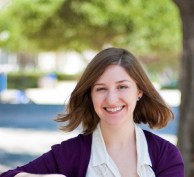
Archival Innovators: Valerie A. Metzler, Independent Archivist/Historian

This is the latest post in our new series Archival Innovators, which aims to raise awareness of the individuals, institutions, and collaborations that are helping to boldly chart the future of the the archives profession and set new precedents for the role of the archivist in society.

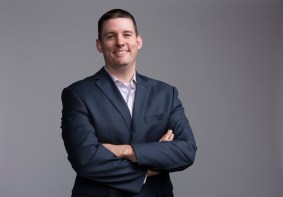
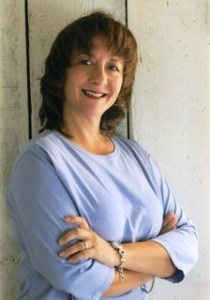
Valerie Metzler

In this installation of Archival Innovators, SAA Committee on Public Awareness (COPA) member Sami Norling interviews Valerie A. Metzler, independent Archivist/Historian. On hearing from Valerie that she believes herself to be the first full-time private practice archivist in the U.S., we couldn’t pass up the opportunity to learn more about her career, and to feature Valerie as an Archival Innovator!

SN: Valerie, could you start by telling us a bit about yourself and your path into the archives profession?

VM: I was halfway through college as a psychology major when I realized that, while the subject was interesting, I thought I might not like it as a career. I looked at what courses I liked best—English and History—and chose the latter and thought I might work in a museum. This was 1974 and I barely knew the word “archives.” But, when an internship at the State Archives of Pennsylvania became available my senior year, I hopped the train three days a week and worked there as a 3-credit course. I loved it!

My first job in the field was as an archives technician at the U. S. Army Military History Institute (MHI, now USAHEC, the U.S. Army Heritage and Education Center). In this role, I worked with personal papers and oral history interviews of members of the Army and their families from Revolutionary War to the present. Because MHI was a public repository, I helped researchers from around the world. During this time, I maintained memberships in the Mid-Atlantic Regional Archives Conference (MARAC) and SAA. After taking courses in paper and photo conservation, I then became the in-house conservator at MHI.

After seven years at MHI I sought to expand my expertise and went to MARAC and SAA conferences to make connections for jobs. The position I ended up in certainly fit the bill in providing new experiences to expand my knowledge of the field—it was a brand new archives with a well equipped in-house conservation lab, and a business archives. I wanted something different—and I got it!

After starting my new job, I missed the interaction with the public more than I realized I would, and I missed working with personal papers. The good news was that by living in Chicago, I had the benefit of joining the Chicago Area Archivists and the Chicago Area Conservation Group and by doing so, networked with professionals far more than were present back home in Carlisle, Pennsylvania.

SN: Was there a specific project, event, or other development in your career or the archives profession that inspired you to strike out on your own as an independent archivist? What were the steps that you took early on to establish your independent practice?

VM: It was the networking in the Chicago area that led me to start my own business. I kept hearing about families, historical societies, and businesses large and small who wanted to preserve their history. And, while there were several employed archivists who moonlighted as consultants, they could never devote the time and hands-on assistance that these projects needed and still keep their day jobs. I decided to enter into full-time private practice as a freelance archivist, not just a consultant. I did do consulting work, but the majority of my work was (and remains) the hands-on establishment of archives and training of staff to maintain the archives after I have gone.

Early on, I realized that to remain completely independent, I should never devote full time to one project, i.e. instead of being a contract archivist always chasing the next gig, I took on any jobs that came my way and staggered my days or even hours among my various clients. That has remained my operating procedure these 34 years in private practice. Neither did I limit my work to just archives. Since 1985, I have also conducted oral history interviews and edited them and have done a variety of historical research for clients, including genealogy. I also teach in lecture and workshop settings.

One significant early step in establishing myself as an independent archivist was to find a name for my business. I never liked the “Metzler Associates” model, especially when you knew it was only one person! And, I wanted a name that clearly stated what the business was rather than some contrived invention. I figured that most folks were unfamiliar with the specifics of what an archivist does, so I had better not confuse them with a cutesy name. So, I followed the “Valere Metzler, Attorney-at-Law” model and came up with Valerie Metzler, Archivist/Historian (VMAH).

SN: Having worked as an independent archivist since 1985, you must have had the opportunity to contribute to some pretty interesting projects, and worked with a variety of archival materials and collections. What have been some of your favorite projects?

VM: My favorite projects are those which include all three aspects of my work. A good example of that is when a family business asks me to establish their archives, conduct oral histories with founders, and research their family history. Without naming the 500 clients of VMAH over these years, my favorites are those which take me into subject area new to me. Also, I love to travel, so the ones that take me far afield–especially to other countries–are definitely on the top of my list.

SN: The Committee on Public Awareness was formed in 2014 to assist SAA Council and SAA members in promoting the value of archives and archivists to a variety of communities and the broader public–something that the field as a whole has struggled with for some time. As an independent archivist, have you ever struggled in communicating this value to potential clients or project partners?

VM: I would have to say that I have not struggled much in communicating the value, since I can only think of two potential clients who contacted me in 34 years who did not move on to hire me.  Sadly, to my knowledge, those two never did get an archives started.

SN: Do you have any tips, or have you developed an elevator speech to communicate the value of your skills as a professional archivist?

VM: I have not perfected an elevator speech but always give the person who asks what I do (followed by the inevitable variations of, “What??”) all of my attention and answer to the questions they pose.  Also, this point is not exactly about my skills, personally, but I always urge folks to consider public repositories over keeping historically valuable items in their own homes where they may be lost to fire or the whims of future generations.

SN: Is there anything else that you’d like archivists and archival students to know, or tips that you’d like to share about building a career as an independent archivist?

VM: Join all of the professional member associations that you can afford and attend their conferences—and volunteer for positions within those organizations.


Do you know an Archival Innovator who should be featured on ArchivesAWARE?  Send us your suggestions at archivesaware@archivists.org!

“What Do Only You Know?”: A Conversation with Davia Nelson of the Kitchen Sisters (Part 3)

Since September 2018, Davia Nelson and Nikki Silva of The Kitchen Sisters have featured archivists in their series The Keepers. In December, Committee on Public Awareness chair Caryn Radick spoke with Davia Nelson. This post shares the final Part 3 of that conversation (see Part 1 here and Part 2 here). Remarks have been edited for length and clarity from a transcript of the original telephone interview.

CR: Recently, archivists have started doing podcasts. What advice would you give them about communicating about their work?

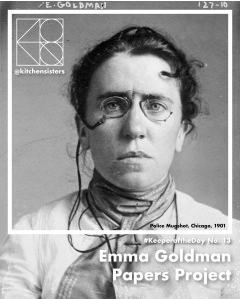
Keeper of the Day, No. 13 The Emma Goldman Papers Project. Photo courtesy of the Emma Goldman Papers

DN: I love the thought of archivists and librarians podcasting. I think it’s a great idea. I hope more and more people do.  I think people are hungry for great podcasts. I think that librarians and archivists have a huge community of listeners and a waiting audience. So I urge all of you to think about it. I think that finding the oral medium — you don’t want to go too long. If you find yourself wanting to host one, think about really saying the most important things, I mean finding your voice. I think so many archivists have such great personalities and are great storytellers. So really honing who you are, what your voice is, really making good judgement calls. When you put something in a case to show the public, you’ve really thought a lot about what’s going to go in that case and what’s going to resonate and why it’s important, and I think the same thing is true for a podcast. Just because you have it doesn’t mean it’s going to be a fascination to the rest of the world, or maybe the rest of the world doesn’t understand why they should be fascinated and then that becomes the job.

I think just kibitzing back and forth is fun. I think people would have a good time doing it. And I think that often times people don’t have enough time to get to tell stories and speak, but I think you want to go lean, better to leave people wanting more than feeling like this is going on too long. We’re always working with those constraints, and we are always trying to discipline ourselves. And keep it lively—use a lot of different kinds of materials and different voices. One person going on for a really long time is hard. And highlighting the treasures in your collection or highlighting the things that you feel are injustices that you want to bring to the fore, highlighting each other.

We always ask, “What do only you know?” That’s what led us to some beautiful stories with archivists.

CR: It’s a good question. I know that I’ve come across papers where you would find yourself saying “I’m going to go to so and so’s office and just tell them what I found because I can’t be the only person on the planet who knows this.” And it’s always a pleasure when you can connect somebody new and in the wider world outside of the archival community to that kind of material.

DN: Oh, we live for that moment.

CR: Sometimes you just find random things in places that you don’t necessarily expect to find them, and as you know, it can send you down a complete rabbit hole.

DN: So many times we think we’re working on a story about X, but we find a piece of archival audio and it leads us completely down a new road, and I always feel bad for the story that got abandoned. But you know, I think it’s just the truth, and for us, as I told you, the “always relied on the kindness of archivists” was going to be in 2001. So here it is.

CR: I was going to ask which episodes of The Keepers moved you the most.

DN: Well, I think the interview with Mary Schuler Dieter [Pack Horse Librarian] because she was starting … she’s lost a lot of her memory. She remembered so little of the present but she could go back to the past and it was a voice … Rolling Stone reviewed that story—who would have guessed that Rolling Stone would review it, like we were Amy Winehouse with a new record. They reviewed that story and they talked about her voice sounding like someone beyond time, and it took three and four members of her community going to her to help us record that. I found her on the telephone, but she could not tell me where she was, and I wound up calling the city government of her town to try and help me find this woman who I’d been talking to … the whole community became galvanized and during the course of the interview she broke out weeping … the poverty and the hard times that she lived through, it all roared up in her, but she persevered to tell the story and I think that interview was the one that tore me apart the most.

But I’ll tell you, being with the hip-hop archive, being with all those young people at Harvard—so many of them people of color, kids who just, they were there at Harvard, but they didn’t really feel like they’ve quite belonged at Harvard, and there was the hip-hop archive and they were in there doing these fellowships and these studies, and these investigations. And in these papers and this research were the rigor and the commitment and that feeling of place. That was another just profound discovery, and the power of an archive to bring an 18-year-old out of some community where they had so little growing up, and to give them a feeling of place and belonging and purpose and their own history being honored. That was just stunning.

CR: That’s great … I think that’s what we hope to do.

DN: Well, in our book you do it, we cannot thank … When Nikki came to the Society of American Archivists [conference] last year, that was one of the first forays for the project and she just came back so ignited and we still have that well of material that we’re drawing on, and it helped shape the whole vision of the project. We’ve continued to go to various archivist gatherings and do presentations and talks and recordings there, and we hope to continue to work with the community in the coming year. We’re 44 Keeper of the Days into a year-long project. So I hope people will contribute and follow them and appreciate all the people that we’re trying to highlight and pay homage to.

CR: I was going to ask how you choose your keeper of the day.

DN: We have this epic notebook, a big binder where we log all the calls that come in or transcribe all the emails—there’s hundreds of them that we’re pulling from—and people we meet at a party, people that we know, you walk into a library and you meet someone, the museum knows we’re doing this project. They reach out to us. Lawrence Ferlinghetti is turning 100 in March, and someone told us about the Urban Forester of San Francisco who every year on Lawrence Ferlinghetti’s birthday walks to all the sites that were primary in Lawrence Ferlinghetti’s life and he reads a Lawrence Ferlinghetti poem at every site as he makes the pilgrimage to City Lights Bookstore. And then this year on the occasion of Lawrence’s hundredth birthday, he’s going to plant most likely an olive tree and it will become Lawrence Ferlinghetti Day in San Francisco. So now we know what we will be doing on March 24th as Keeper of the Day. It happens spontaneously and it happens pre-planned. People are on the hunt for us. Sometimes we find the story, sometimes the stories find us, right?

Feel free to suggest please. Send us emails or call The Keeper hotline,  415-496-9049, or go to kitchensisters.org and you can suggest there.

CR: What’s next for the Kitchen Sisters?

DN: We’re doing a slew of Keeper stories. We have probably 10 in progress right now. We are doing a collaboration with SFMoMa on a big project that’s going on here that involves stories of urbanization and gentrification. We’re doing stories in collaboration with Wendy MacNaughton, the graphic novelist [recently featured in ArchivesAWARE], and with Laurie Anderson. We have collaborated with Wendy and we’re going to do one about her, we’re going to make a Keeper out of her stories of the San Francisco Library that she did from [her book] Meanwhile in San Francisco and then Frances McDormand, the Academy Award-winning actress, is going to host our hour-long Keeper special.

CR: Wow. She’ll be our celebrity spokesperson?

DN: She has been the host of two or three of our Hidden Kitchen specials, and she is sort of our muse.

Your community has been so supportive. I would just like to say in closing: thank you to the Society [of American Archivists], to all of you for the work you do and for being open to us and supportive and igniting us. You all launched the series. So thank you for that.

CR: Thank you. I think that our Committee on Public Awareness does a lot, but somebody like the Kitchen Sisters taking this on does a lot more to help spread the word.

DN: Well, it’s great. We could collaborate together. We always say collaboration is queen. What a pleasure and an honor. Thank you so much.


To suggest Keepers of the Day, call the Keeper Hotline at 415-496-9049 or go to http://www.kitchensisters.org/keepers

Visit this page to support the work of the Kitchen Sisters.

“Say Everything Out Loud”: A Conversation with Davia Nelson of the Kitchen Sisters (Part 2)

Since September 2018, Davia Nelson and Nikki Silva of The Kitchen Sisters have featured archivists in their series The Keepers. In December, Committee on Public Awareness chair Caryn Radick spoke with Davia Nelson. This post shares Part 2 of that conversation (see Part 1 here, final Part 3 forthcoming). Remarks have been edited for length and clarity from a transcript of the original telephone interview.

CR: Could you describe the research process when you put together an episode of The Keepers?

DN: It’s epic. We try to gather … everything. We have a lot of mottos of the Kitchen Sisters. One of them is “say everything out loud”—say what you’re looking for, say what you’re working on, so we will say it to each other. There’s four of us here at the Kitchen Sisters—Nikki and myself, Nathan Dalton, and Brandi Howell—and we’re all working on these stories together, each of us taking a different aspect of it, but we’ll get one idea or one name and then we’ll just dig in. We’ll go “Okay, well, I wonder who might have archival interviews.” Let’s say the pack horse librarians—so we’ll start digging into all the universities, all the libraries, all the historical societies, anybody who’s an archivist or librarian or a keeper that might intersect with that story. You always pray that there are these oral histories done before you that you can then glean from and add to your piece, and we’re always imagining when we’re recording that the Kitchen Sisters of the future will come along and take our material and turn it into the next generation of story.

PackHorse1-WPAPackHorseLibrarianLineUp

Pack Horse Librarians. Photo courtesy of University of Kentucky.

So we always are slating our interviews at the top … saying who we are about to interview, what the date is, what story it’s for.  So we often have the voices of dead archivists and librarians woven into our stories because they slated those tapes for their library and we’re always hoping people will do that thinking of the future. It also makes for such more interesting stories than us setting that up in a traditional narrated way. Our stories rarely have narration, rarely have our questions in, so we’re always looking for all kinds of people to tell other people’s stories. Are any of the grandchildren alive? Are any of the children alive? Who has written articles? Who was a neighbor of a pack horse librarian? Who worked with the WPA, who was part of relief efforts in Eastern Kentucky? Who lived in that Hollow?

We just sit there and think as broadly, deeply, and widely as we can and do a huge reach. We’re in conversation probably for every story with at least 20, 30 people, maybe more, to find what we’re looking for.

CR: What kind of challenges have you faced getting material for the podcast?

DN: Sometimes, like when we wanted to get tape of Henri Langlois, the MoMA had it in New York, but I think we had to deal with an archive in Italy to get permission to get that MoMA recording. Sometimes you’re crossing institutions and cultures and [figuring out] who can actually give you the go-ahead. In a way it’s funny—when we started doing this work, all archives were basically open. Nikki and I began in the late ’70s and you could just go to the National Archives and Library of Congress and Smithsonian and basically plug into a tape recorder and make copies of all these phenomenal recordings that they have there, and all early Kitchen Sisters stories are based on these forays we did into the archives where stories were revealed to us because of what we uncovered. Now everything is so much more protected and so much less available. I worry about the privatization of history … the same way that water sources are getting privatized and people are trying to take away … I feel like so much of this is the rights of humanity to know its history, and I worry about young people, if they’re not allowed to have history. We’re trying to reach across generations to make people fascinated with cultures and histories and heritages that they might not know about. And having access to this living material is so essential for that and honors people whose stories aren’t told usually.

CR: Have your perceptions of archivists changed as a result of work on this series, and if so, how?

DN: My reverence—I would say our reverence—has just … I didn’t know that it could get higher, but it’s that much higher. We really have just seen archivists go to the mat for protecting books, for protecting information, for making sure that things aren’t buried, making sure things are available free to the public. Librarians have turned libraries into community survival centers, people have so expanded what those things mean. They are the keepers of their community. I would also say it takes a certain kind of personality to have the patience, the tenderness, and the vigilance to spend a lot of time just protecting, guarding, preserving. But it’s also a kind of … I want to say … not snappy, snippy,  but it’s a … they won’t suffer fools, let’s put it that way.  A lot of opinions in the archival community, a lot of righteousness.  They work hard and they have a vision, they have standards. It’s a moral group.

CR: Sometimes people want to … call out what they see as being problematic or what they need to do to preserve the archives and move things forward.

DN: Well, they know the history, they know the consequences. A lot of archivists and librarians and historians and keepers are ahead of the culture and are impatient. They’re saying to everybody else, “What are you waiting for? Come on,” and so if they see something they feel is unjust or not right [they’ll say it]. I feel like with so much of social media, the whole culture in this time of Trump has turned the culture into a “calling out” culture. And I think that’s unfortunate all the way around. I think there’s a way to really call attention to important things. We did the whole series because we think archivists and librarians are the leading edge and our heroes, and are some of the nation’s. I don’t think they get enough attention and enough credit, and [I think they] should be revered and known and appreciated, and tell great stories, and are sitting on some great stories and material. Grace and kindness and patience with each other in the culture—I would ask for that across the board. That’s just my opinion.  I think people are working really hard. Everyone’s working really hard, but there are also disgusting things going on and that has to be called out too, so okay, I get it, I get it.

[Stay tuned for Part 3 of Caryn’s interview with The Kitchen Sisters’ Davia Nelson!]


To suggest Keepers of the Day, call the Keeper Hotline at 415-496-9049 or go to http://www.kitchensisters.org/keepers

Visit this page to support the work of the Kitchen Sisters.

“We’ve Always Relied on the Kindness of Archivists”: A Conversation with Davia Nelson of the Kitchen Sisters (Part 1)

Since September 2018, Davia Nelson and Nikki Silva of The Kitchen Sisters have featured archivists in their series The Keepers. In December, Committee on Public Awareness chair Caryn Radick spoke with Davia Nelson. This post shares Part 1 of that conversation, which will be published in three parts. Remarks have been edited for length and clarity from a transcript of the original telephone interview.

The Kitchen Sisters. Photo by Patrick Bolger

CR: Why did you decide to do a series featuring archivists and keepers?

DN: We had meant to do the Keepers series right after we did The Lost and Found Sound series which was at the turn of the millennium. Lost and Found Sound was about how sound shaped history, and about history shaped by sound, vanishing voices, sound on the verge of extinction, endangered sound, and rare recordings.

We did them every week for a whole year and so many of them were archivally based and we worked with so many historians and archivists and librarians. They just dug out all these rare recordings and things that only they knew about and we realized we felt that archivists and librarians were some of the unsung heroes of the country and we wanted to do the series then. We were going to call it We’ve Always Relied on the Kindness of Archivists. Then 9/11 happened and instead of going into the archivist project we did the Sonic Memorial project, which was archiving in lower Manhattan and telling those stories and involved, again, so much archival audio and rare recordings and the work of the archiving community. Then it got put aside for all those years when we did the Hidden Kitchens series and then The Hidden World of Girls, and The Making Of. . . . Then, the new president was elected and we began to see a lot of the government websites getting pulled down, especially in regards to climate change and science, and we watched the archival community spring to action and the librarians become activated, and we thought “These are the people who are committed to the truth and to history as it happened, and to facts, and to nurturing their community, and being protectors of the free flow of information and ideas,” and we said to ourselves “Remember how we were always going to do The Kindness of Archivists?” Only now the times called for a different title and it became The Keepers. It’s been long in the coming is what I would just say, and it’s a light that we wanted to be shining for over a decade.

CR: What keepers or collections have you learned about that surprised you?

DN: Well, it’s surprised us that the whole series started with The Hip-Hop Archive and Research Center at Harvard. We were just developing the series and coming up with the ideas; our little byline on it is “stories of activist archivists, rogue librarians, curators, collectors, and historians. Keepers of the culture and the culture and collections they keep,” and then  “guardians of history, large and small, protectors of the free flow of information and ideas, individuals—sometimes we say eccentric individuals—who take it upon themselves to preserve some aspect of our cultural heritage.” And we were starting more in that place of thinking about all the people fighting for the constitution, the Bill of Rights, climate change, all those archival areas, but immediately people just wanted [to know about] the cultural work archived and expressed equally and all the communities whose voices hadn’t been heard. Whose work is archived, whose work is preserved, who is in those archives? And it was someone at NPR—they had just hired their first hip-hop critic there and I met him in the halls at NPR—he said, “Why don’t you think about going to the hip-hop archive at Harvard?” I’d heard about it somewhere years ago, about Dr. Marcyliena Morgan who was archiving hip-hop way back when, like a decade ago. I’d always meant to profile her for the Hidden World of Girls, but with him saying that, it moved us to Harvard because the juxtaposition of hip-hop and Harvard caught our ear. (Story: Archiving the Underground: The Hiphop Archive at Harvard)

Also at the same time we learned that Lenny Bruce’s daughter had been archiving Lenny Bruce for all these years, but in her house, and this archive was getting older and frayed and was beyond her capacity to keep in the way that it should be preserved. We stumbled onto that story that the daughter of Hugh Hefner and the daughter of Lenny Bruce were working together to preserve this archive and bring it to Brandeis University. (Story: The Lenny Bruce Collection)

For stories that just boomed out … I had read this piece in The New Yorker about Henri Langlois and the Cinémathèque Française, which was one of the earliest and most profound film archives in the world. It’s been in France since the ’30s, and he was at the center of all political controversies. They stopped the Cannes Film Festival because of him one year. He archived thousands and thousands of films across the transition from silents to talkies, and his archive became one of the centerpieces of this series and that really surprised me. And it’s still going today. [Story: Archive Fever: Henri Langlois and the Cinémathèque Française]

Probably the most startling story that we’ve been come to in this path is the Pack Horse Librarians of Eastern Kentucky, this WPA program that got women with a horse or a mule during the heart of the Depression … Their coal country was really undergoing a massive change that was industrializing in a way that was throwing a lot of people off the workforce. Eleanor Roosevelt among others had this thought to employ women if they had a horse or a mule and a pillowcase or a saddle bag, and they started getting books to Kentucky. They would ride up on these circuits through the hollers into the way-out back remote communities of Eastern Kentucky, where there was really high illiteracy, and bring books and magazines.  Those women with their grit and their pillowcases and their commitment—that they were able to feed their families was so remarkable. (Story: The Pack Horse Librarians of Eastern Kentucky)

I think we found the last living pack horse librarian too, and that was probably the most moving part of the whole series so far for me. She’s well in her 90s and living in a home in Kansas.

CR: Yes, I heard that podcast and it was pretty incredible.

DN:  I love that as the books and magazines fell apart they would then make scrapbooks out of them. That was really extraordinary, so enterprising, so scrappy these women, which dovetails so much for us because we’ve done a whole series called The Hidden World of Girls and the women they become, and that story could have fit in all aspects of what our work centers around—unknown histories, little-told stories, voices of people whose stories seldom make it into the mainstream media.

[Stay tuned for Part 2 and Part 3 of Caryn’s interview with The Kitchen Sisters’ Davia Nelson!]


To suggest Keepers of the Day, call the Keeper Hotline at 415-496-9049 or go to http://www.kitchensisters.org/keepers

Visit this page to support the work of the Kitchen Sisters.

There’s an Archivist for That! Interview with Rich Schmidt, Director of Archives and Resource Sharing, Nicholson Library/Oregon Wine History Archive

This is the latest post in our There’s an Archivist for That! series, which features examples of archivists working in places you might not expect.  COPA member Anna Trammell, University Archivist and Special Collections Librarian at Pacific Lutheran University, brings you an interview with Rich Schmidt, Director of Archives and Resource Sharing at the Nicholson Library/Oregon Wine History Archive at Linfield College.

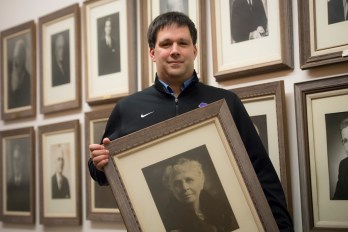
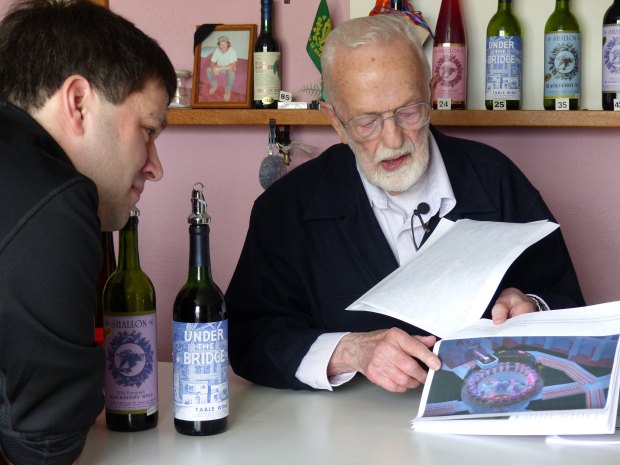
Rich Schmidt, Director of Archives and Resource Sharing

Rich Schmidt, Linfield College director of archives and resource sharing, poses with a photograph of Frances Ross Linfield. Mrs. Linfield’s donation in 1922 helped secure the school’s future and gave McMinnville College its new name.

AT: How did you get your job?

RS: I was hired at Linfield in the summer of 2011 as the Director of Resource Sharing, essentially running Interlibrary Loan. I have a background in digitization – and had worked closely with the archives in a previous position – but never had officially worked in the archives. Just after I started, Linfield hired Rachael Woody as the school’s first-ever full-time archivist and officially launched the Oregon Wine History Archive (OWHA). After about a year, she and I both had our legs under us – we’d hired and trained students in our departments and implemented new software and workflows. Rachael needed help growing the archives from that point, and I had time available to help.

The timing just worked out well. I had no background in wine, either, so the first couple years were like climbing a waterfall. So much information, so many people and dates and terms. But I loved it. Rachael was a great teacher and she and I worked really well together. We spent the next few years figuring out what exactly we wanted the archives to be, adding collections and making connections in the community. When Rachael moved on in 2017, the school entrusted me to keep the archives going, and so far so good. It’s busy, exhausting, fun and pretty exhilarating. I should mention that in addition to the OWHA, I’m also in charge of Linfield’s school archives, as well. So a lot of materials from wildly disparate places.

Rich Schmidt (left) interviews Paul van der Veldt at Shallon Winery in Astoria, Oregon, on March 30, 2017.

AT: Tell us about your organization.

RS: The Oregon Wine History Archive is dedicated to preserving and sharing the Oregon wine story. Wine in Oregon goes all the back to the Oregon Trail days, as there are stories of pioneers bringing vines across the country. There were farmers making table wine through all those years, often just enough for themselves and their neighbors, occasionally enough to sell a little. Never anything that you would consider an industry.

Prohibition – Oregon’s was the second-longest in the country, behind only Utah – wiped out most of the state’s winemaking, and the 30 years after Prohibition saw a few wineries spring to life across the state, mostly making table wine or fruit wine. In the mid-1960s, a group of young winemakers saw potential similarities between Oregon’s Willamette Valley and Burgundy, and set out to see if they could grow cool-climate grapes akin to the famous French region. From this handful of farmers, the industry very slowly grew. The well-known Burgundian varietals Pinot noir and chardonnay were the grapes of choice. Small snippets of international recognition came in the late 1970s and early 1980s, but the industry still numbered fewer than 50 wineries and none of them were wildly successful.

A number of factors – including technological and educational advances, joint marketing efforts, success at national and international competitions, dogged determination, and just making really good wine – led to the industry finding solid footing in the 1990s, and then exploding in the 2000s. Thirty years ago there were around 50 wineries in the state; 15 years ago there were about 250. Now there are nearly 800, and more are coming seemingly every week.

We were founded in the midst of that, so we’re documenting an industry that is seeing amazing growth and establishing itself on the international market. Oregon has become known for Pinot noir, enough so that the International Pinot Noir Celebration is held every July right here on Linfield’s campus. Many of the industry’s founders are still around and living in the area, so we’ve been able work directly with them and their collections. This is such a huge benefit for our students, who are all undergraduates doing graduate-type work with our collections.

studentsontour_2015

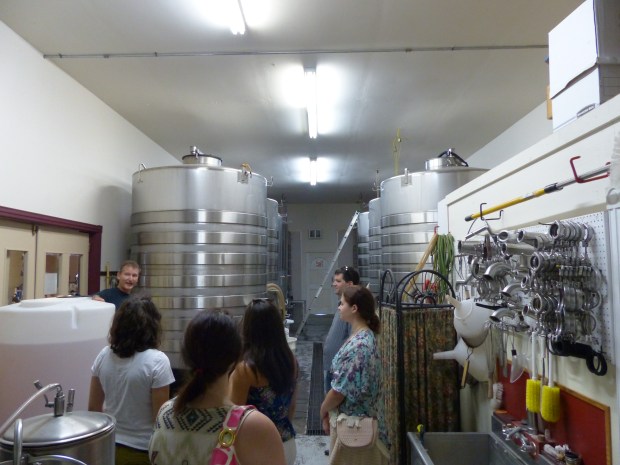
Linfield students Maia Patten (’16), Anna Vanderschaegen (’18) and Camille Weber (’16) join Rich Schmidt and Rachael Woody on a tour of Chateau Bianca Winery in Dallas, Oregon on July 20, 2015. Winemaker Andreas Wetzel (far left) gives the tour.

AT: Describe your collections.

RS: We were founded with the idea of being a traditional archive – that is, a brick and mortar space to collect materials. So that’s part of what we do. We house approximately 35 collections containing photographs, tasting notes, harvest records, grape sales documentation, awards, correspondence, journals and everything else you might expect to find. Wine is especially interesting because, while the end product is glamorous, all the processes that go into it are not. In most ways it’s just like farming any other crop, except you have to wait for your crop to turn into wine. So we have records that focus on the farming, records that focus on the winemaking, records that focus on the sales and marketing. Not to mention wine labels and statistical surveys and angry letters from consumers.

We also have a good collection of wine books and journals, some pertinent to Oregon and some with an international focus. For a young archive about a fairly young industry, we have a nice, diverse group of collections that show a nice cross-section of Oregon wine history. Due to the fact that the industry is still young and growing rapidly, and the fact that many wineries are family businesses passed from generation to generation, we realized early on that we couldn’t count on regularly receiving physical collections from the industry. If we were going to make an bigger impact, we’d have to archive in a different way, which led us to oral history interviews.

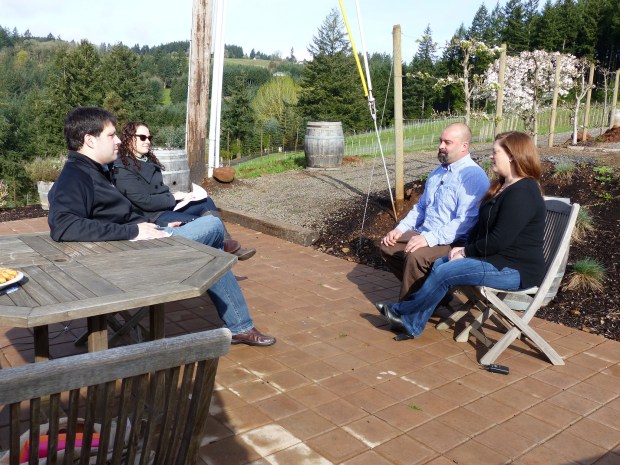
Rich Schmidt (right) interviews Remy Drabkin at Remy Wines in McMinnville, Oregon, on May 9. 2017.

There are so many people involved in the industry – some for 50 years, some for two years, some in farming, winemaking, sales, marketing, consulting, not to mention sommeliers and restaurateurs – that we realized we could let people tell their stories and really have an impact. This allowed us to make connections and gather stories from throughout the state and throughout the industry. The grape-growing geography of Oregon is spread from Portland all the way down to Ashland, and all the way over to Baker City. A huge amount of land spread out over a large state. Gathering oral history interviews from as many people as we can, in as many locations and roles as we can, has allowed us to maximize our resources and tell the biggest story we can.

We’ve conducted or gathered more than 250 oral history interviews already, and we’ve barely scratched the surface. But it’s been an amazing way to learn about the industry, its people, places, history, stories, past, and future. Our students research our interviewees’ backgrounds and come up with questions, then handle the cameras, microphones and post-production. Some even conduct all or part of the interviews. It’s an amazing experience for them.

From left: Rich Schmidt, Rachael Woody, Andrew Beckham and Annedria Beckham. Andrew and Annedria Beckham own Beckham Estate Vineyard in Sherwood, Oregon. Rich Schmidt and Rachael Woody interviewed them about their Oregon wine story on March 24, 2015.

AT: What are some challenges unique to your collections?

RS: We like to say that our archive is full of stories, not facts. Industry data from before the past 20 years is difficult to find, so questions about who was the first/biggest/best/most expensive almost always need to be hedged. Again, we’re looking at an industry that’s roughly 55 years old, so you’d think we’d be in better shape! But the early winemakers and grape-growers were concerned about a lot of things, very few of which dealt with keeping detailed statistics about every move they made. And much of the early numbers that were kept, of course, didn’t survive to make it into our archive. So we have a lot of stories, a lot of guesses, a lot of assumptions, and not a lot of hard truths. And honestly, that’s usually ok. Why let facts get in the way of a good story?

As the industry has grown, though, there’s a lot of interest in what the early grapegrowers tried, and whether it might work again with modern technology and practices. A side effect of the rapid growth of the industry is that competition has never been tighter. There are 500+ wineries in the Willamette Valley, mostly making really good Pinot noir. Many make between 5,000 and 20,000 cases of wine per year. What differentiates you from your neighbor, then? Many young winemakers are looking to the past to see if there’s a different clone, different varietal, different method that might make them stand out, and so there’s more of a push for facts now. We’re working with the early grapegrowers on gathering the data we can and making it available for the next generation of the industry.

For our physical collections, our challenges usually have to do with condition of materials. Many have been housed in barns, trailers and other unsuitable places, so we deal with vermin, bugs, water damage and all the other glamourous problems that archivists talk about over drinks. My students get a crash course in archival cleaning and processing less-than-pristine materials. At least they have great stories to tell their families and friends. Right now, it’s only me and five undergraduate students working in our archive, so each of them have to take on a much bigger role than you might expect. They are truly amazing. The archive couldn’t function without dedicated students, some of whom have an interest in archives work and some who have an interest in working in the wine industry. Work in the OWHA for a few years and you will meet a huge number of people in the industry and see many of the sites and potential jobs. How cool is that?

Linfield student Mitra Haeri (’14) uses a laptop and a portable scanner to digitize images in the back of a van at the Doerner family home in Douglas County, Oregon. The Oregon Wine Board funded this trip through a grant, allowing Linfield to spend a week in the Rogue Valley and a week in the Umpqua Valley, the two main grape-growing areas in southern Oregon.

AT: What is your favorite part of your job?

RS: I’m lucky because I really like what I do. I love working with students who are so eager to learn and improve what we’re doing. Our website (https://oregonwinehistoryarchive.org/) is student-created and much of the content has been added by students. All the physical processing is done by students, as is a large part of the oral history interview process. So I love that part of my job – training, coaching, mentoring, and then watching what they can do. I think a lot of schools are hesitant to give students that much responsibility and freedom. And there are times when it’s a challenge. But with the right training, oversight and motivation, I think people would be surprised what students – even undergraduates who can’t legally drink wine yet – can do. They take a real ownership of our space, our collections and our image. They conduct themselves professionally and take great pride in their work. And the experiences they’re having, the skills they’re learning, the people they’re meeting… it’s truly priceless experience. And a big part of that is another favorite part of my job – the people in the industry itself. The Oregon wine industry has a reputation as a friendly, collaborative, welcoming industry, and in our case it has certainly been true. I have to imagine trying to do what we’re doing for certain industries would be like pulling teeth. But we’ve been welcomed with open arms. People in the industry are busy – incredibly busy – and yet willing to make time for us, whether it’s to answer questions or sit for an interview. They love working with our students and talking about the past, present and future of the industry to students who may be a part of that future. I can’t overstate how wonderful the industry is to work with. And they recognize the importance of what we’re trying to do, and they’re thankful for it. It’s incredibly rewarding. Meeting people in the industry, hearing their stories, tasting their wine… it’s an amazing way to learn about Oregon wine.

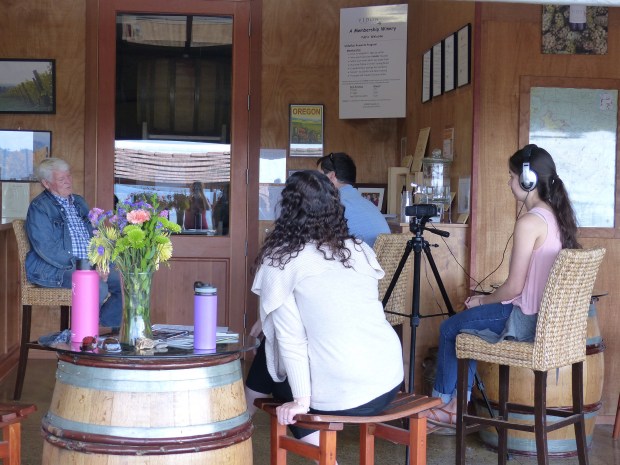
From left: Don Hagge, Rachael Woody, Rich Schmidt and Shelby Cook. Don Hagge, a former NASA engineer who now owns and operates Vidon Vineyard in Newberg, Oregon, answers questions during an oral history interview with Rich Schmidt on August 3, 2016.

Stay tuned for future posts in the “There’s an Archivist for That!” series, featuring stories on archivists working in places you might not expect. If you know of an archivist who fits this description or are yourself an archivist who fits this description, the editors would love to hear from you—share in the comments below or contact archivesaware@archivists.org to be interviewed for ArchivesAWARE!

Keeping ArchivesAWARE: News and Highlights

The news cycle moves at such a rapid pace these days that it can be easy to miss the media’s increasing coverage of archives and archivists.  That’s why we’re launching our new series Keeping ArchivesAWARE: News and Highlights, a recurring roundup summarizing the latest archives-related news stories, features, commentaries, announcements, and projects that have caught our eye, with links to the original sources.  Such media coverage can be an invaluable tool with which to communicate the power of archives and archivists’ vital role in society to a wider public audience.  We hope you enjoy this first entry in the series, and that you’ll share your favorite stories widely!

A team at the University of Oregon recently launched The March, a digital exhibition about the making of filmmaker James Blue’s documentary of the same name chronicling the 1963 March on Washington for Jobs and Freedom.  The exhibition is a collaboration among Professor of Rhetoric David A. Frank, the University of Oregon Libraries, and the Jordan Schnitzer Museum of Art, with support from the Andrew W. Mellon Foundation.

Conflict studies professor Stephen Badsey writes in the Washington Post about director Peter Jackson’s new documentary They Shall Not Grow Old, which features digitally restored film footage and audio recordings from the Imperial War Museum documenting the British army on the Western Front during World War I.  Badsey notes that “the Jackson project’s implications for the future of historical documentaries are immense.”

Nora Caplan-Bricker writes in Harper’s Magazine about the Documenting the Now project, the Internet Archive, and the immense complexities and challenges of preserving social media movements and other documentation of our contemporary moment when such content lives solely on the internet.

Bethany Anderson, University Archivist at the University of Virginia, writes in The Conversation about the recent crop of articles on the “discovery” of a “lost” Sylvia Plath story at Indiana University’s Lilly Library.  Anderson notes how the media frequently overlook the fact that such gems can only be “discovered” by researchers because archivists have painstakingly worked to preserve and make them available in the first place – as was the case with Plath’s “new” story, which had in fact been publicly accessible for years thanks to archivists at the Lilly.

Biographer Robert Caro writes in The New Yorker on “The Secrets of Lyndon Johnson’s Archives,” about his early experiences conducting archival research at the LBJ Presidential Library for his now-seminal multivolume biography of the 36th U.S. President, with plenty of references to how archivists were an integral part of his research process.

SAA has launched Archives In Context, a new podcast that highlights “archival literature and technologies, and most importantly, the people behind them.”  The first season, which includes seven episodes, can be listened to on the Archives In Context website, Google Play, Spotify, and iTunes.  We’re excited to dive in!

The International Council on Archives’ Section of Professional Associations will be hosting the second annual Film Festival on Archives and Records Management at the ICA 2019 Annual Conference (October 21-25, Adelaide, South Australia), focusing on the theme of advocacy.  Have you or your institution produced a film that communicates the value of records and archives?  Be sure to submit it for entry to the festival!

Archivist and historian Alyssa Ballard was profiled in the Ukiah Daily Journal on her work at the Mendocino County Historical Society in California.

File this one under “things we find utterly delightful”: The City of Greater Sudbury Archives has created an interactive educational game called Grandma’s Attic to help “teach students of all ages the difference between libraries, museums, and archives.”

Have some interesting archival news items or highlights you’d like us to share?  Email us at archivesaware@archivists.org and we may include it in our next Keeping ArchivesAWARE roundup!

Responses and Retrospectives: Alexandra Bisio on “Tidying Up with Marie Kondo,” KonMari, and Archival Appraisal

This is the latest post in our series Responses and Retrospectives, which features archivists’ personal responses and perspectives concerning current or historical events/subjects with significant implications for the archives profession.

In January, Netflix launched its new reality show Tidying Up with Marie Kondo, based on the bestselling book The Life-Changing Magic of Tidying Up: The Japanese Art of Decluttering and Organizing. The show is just the most recent iteration of Marie Kondo’s work, which has been adapted into a lifestyle blog and, surprisingly, a manga. Kondo also published an illustrated companion to her first book in 2016.

The original book introduced the “KonMari Method” of organizing to American audiences. Kondo, who has been passionate about tidying since she was a child, was a well-known personal organizer in Japan before enjoying international success as a lifestyle guru.

Kondo’s method, which is heavily influenced by Shinto practice and “places great importance on being mindful, introspective, and forward-looking,” provides those besieged by clutter with a simple rubric to begin a new life free from the mental noise of material overload. At its core, her method “encourages tidying by category – not by location – beginning with clothes, then moving on to books, papers, komono (miscellaneous items), and, finally, sentimental items. Keep only those things that speak to the heart, and discard items that no longer spark joy. Thank them for their service – then let them go.”[1]

While the American response to Kondo’s 2014 book was unabashedly positive, particularly among interior design and lifestyle bloggers, the show has sparked an unusual amount of vitriolic backlash against its host, especially among the book-loving set.

Reacting to Kondo’s advice to pare down paper records, be more discerning about family photos, and set a limit on book collections to thirty volumes, Twitter was especially vicious, with one user going so far as to  declare her a “monster.” The Washington Post’s books section even published an article by book critic Ron Charles entitled “Keep your tidy, spark-joy hands off my book piles Marie Kondo.

Many on the web were quick to defend Kondo, and point out not only the gross overreaction to her advice, but the racist and classist undertones of the criticism levied against her as well.[2]  For me as a person whose name can be followed by the letters MLIS, however, there was one thread of tweets that flew above the rest:

https://twitter.com/DuncanAlexandra/status/1084859546512822274

https://twitter.com/DuncanAlexandra/status/1084861802201210881

https://twitter.com/DuncanAlexandra/status/1084862394915061760

While Duncan’s point about deaccessioning in general libraries is a wonderful defense of Kondo’s method with regard to books, I would like to point out to her that archives don’t keep everything they are given in perpetuity either, but rather have our own methods for trying to discern what in our holdings really “sparks joy” and what actually has little archival value.

Like homes of the clutter-besieged participants on Tidying Up, our buildings only hold so much material, and we must be just as discerning about the things we keep. As archivist Mark Greene pointed out in “A Brief and Opinionated History of Archival Appraisal Theory to 2005,” appraisal theory has long been a prominent part of archival discourse. “Writers on appraisal have given us (in rough chronological order),” he writes, “’moral defence of archives,’ cost/benefit analysis, primary/secondary and evidential/informational values, appraisal based on record type, the ‘black box,’ documentation strategy, ‘total archives,’ institutional functional analysis, macro appraisal, social use, functional requirements, risk analysis, and the ‘Minnesota Method,’ to name only the most prominent.”[3]  This ever-expanding canon is meant to guide archivists in making decisions about what to keep and what to discard methodically, and with regard to an agreed upon set of best practices. No collection being alike, however, we acknowledge as a profession that some of these decisions will be made based more on professional judgement than an application of infallible rules.

In many ways, Kondo’s method of tidying up is not unlike these theories. Her method gives people who are overwhelmed by the material objects in their lives guidelines to start making measured decisions about what they do and do not need. Though Kondo makes suggestions as to how many of a particular type of item people should keep (the thirty volume rule for books simply being the number of books she keeps in her own house, not an absolute for everyone), her method leaves room for the judgement and needs of the person applying it. On her show, she never forces anyone to get rid of anything, she merely facilitates the act of letting go.

I find nothing professionally problematic with the KonMari method, and, hopefully, knowing that even archivists and librarians aren’t opposed to tidying sets even the most anxious mind to rest. However, if, as an archivist, I was going to advise someone who was interested in applying Kondo’s method to their own collections of papers, photographs, and books, but was worried that doing so might lead them to destroy what could potentially be a valuable resource for research someday, I would give them my own complementary rubric to ease their concern. Instead of asking if the materials “spark joy,” they could instead ask:

  • Why do you value the material?
  • Is the material unique, or could similar items be found elsewhere because the material was mass-produced?
  • Does the material speak for itself, or would you have to explain its meaning if taken out of the context in which it was created?
  • Who, specifically, might be interested in the material besides you or your family?
  • How do you think this material might be used by people in the future?

I would like to emphasize that, at the end of the day, personal belongings are just that. Very few of us think about the detritus of our lives with posterity in mind, and people should be empowered to hold on to things that are meaningful to them, and rid themselves of material sources of stress without fear.


[1] “What is the KonMari Method?” KonMari Media Inc., accessed January 28, 2019, https://konmari.com/pages/about.

[2] Kerri Jarema, “The Marie Kondo Books Debate Has Classist & Racist Undertones that Can’t Be Ignored,” Bustle, entry posted January 2019, accessed January 28, 2019, https://www.bustle.com/p/the-marie-kondo-books-debate-has-classist-racist-undertones-that-cant-be-ignored-15796044.

[3] Mark A. Greene, “A Brief and Opinionated History of Archival Appraisal Theory, to 2005,” Society of American Archivists: Fundamentals of Acquisition and Appraisal Pre-Readings, posted November 7, 2016, accessed January 28, 2019,  https://www2.archivists.org/prof-education/faa-pre-readings.


Alexandra Bisio

This post was authored by guest contributor Alexandra Bisio, Lead Processing Archivist in Special Collections and University Archives at the University of Oregon. Alex earned her MSLIS in Archives Management and MA in American History from Simmons College, and her BA in American History from Santa Clara University. Before joining SCUA at the University of Oregon, she served as the Associate Archivist of the Jesuit Archives: Central United States in Saint Louis, Missouri, and the Archivist for the Critical Theory Archive at the University of California, Irvine.

Interested in contributing to Responses and Retrospectives?  Please email the editor at archivesaware@archivists.org with your ideas!

“Giving Voice to Archivists”: An Interview with Geof Huth and Karen Trivette, hosts of the podcast “An Archivist’s Tale”

Geof Huth and Karen Trivette are the husband and wife team behind An Archivist’s Tale, a podcast featuring “archivists in conversation with archivists, discussing their work and passions and how they care for the historical record and present the storied past.” Geof and Karen have had a remarkably productive year since releasing their first episode on February 10, 2018, with 47 episodes available as of this writing and more on the way. In this post, COPA member Chris Burns flips the script and interviews the interviewers, asking Geof and Karen why and how they created this podcast and what they have learned along the way. [Full disclosure: Chris was a guest on Episode 7: There’s an Archivist for You.]

an archivist's tale logo (2018-02)Chris Burns: Where did you get your idea and what inspired you?
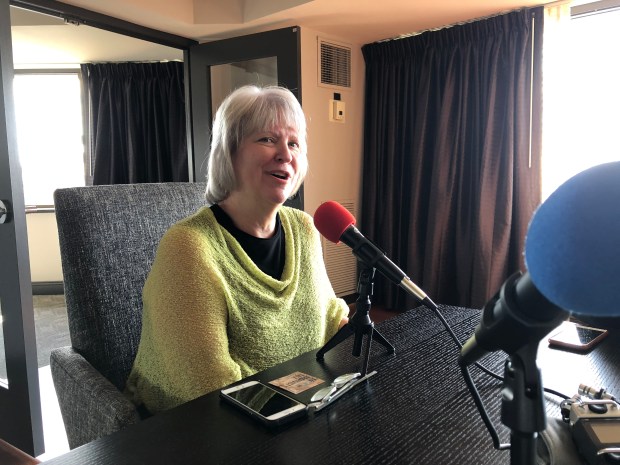
Geof Huth: I had the original idea to do the podcast, which was inspired by the convergence of a few facts of my life at the time. First, my daughter (the almost famous Erin Mallory Long) has had a podcast for years, one focused on the television show Friends. Truth be told, I’ve barely listened to that show, since my interest in Friends is deep enough but not nearly as deep as my daughter’s.

For the last couple of years, I’ve had two other realities in my work life: I have spent at least 30% of my time working on my feet as my records management unit arranges and describes about 12,000 cubic feet of old court records (old meaning back to 1674), and the physical process of merely arranging such volume had left me with lots of empty air time in my head. Atop that, I accepted an additional position as Chief Law Librarian, which required me to drive three hours from Manhattan to New York’s Capital District and then back at least once a month to be with my unit based there. My life had become filled with empty air, and I always have to fill empty air, so I began to listen to podcasts (almost exclusively political ones—maybe not a good idea) to fill that space.

One day (January 10th, 2018), while listening to podcasts as I drove back to Manhattan on the New York State Thruway, I said to myself, “If Erin can do a podcast, then I can too, and I’d love to have deep talks with archivists about their work.” (Well, maybe not exactly those words.) After driving a few miles, I thought, “Wait, I’m married to an archivist! Karen and I should do this together, and an additional voice will make it more interesting.” Not to mention she has a beautiful voice. As soon as I arrived home, I began chattering to Karen about this idea, and we began to draw up a plan for the podcast.

In case it’s not clear, Karen and I are married. That helps us run the podcast because we can discuss issues as we walk places or have dinner or sit on the couch.

Karen Trivette: Geof was the chief inspiration behind my involvement in the podcast. That said, I felt I had an interesting career path or paths (academic and professional) and wanted to share them with others in the field. More so, I always enjoyed hearing how others came to the field of archives management and learning what drives them to stay engaged with and impassioned by the work. I love what I do for a living and love the fact that others do, too; the details are mesmerizing!

We struggled initially with what to entitle the program; after much give and take, we arrived at “An Archivist’s Tale,” since that’s what we wanted to elicit from the conversations. I must admit, I was influenced by the PBS television series, “A Chef’s Life” when I came up with this title; I love how Chef Vivian Howard introduces each episode and thought it would apply well to our endeavor.

Chris: How do you decide who to interview and what do you ask them?

Karen: We have two standard formal questions we ask each subject; first, we ask, “What is your archivist origin story?” Or, “How did you become an archivist in the first place?” It is truly amazing how very different everyone’s story is… I must give credit where credit is due: Bob Clark, Director of Archives at the Rockefeller Archive Center, and the first person we interviewed, proposed telling his own archivist origin story. We adopted the language immediately and it prompts nice introductory content.


Bob Clark shares his archivist origin story in Episode 2: The Document Whisperer.

From there, we usually have many other questions from the subject. Usually, the exchanges flow quite naturally and conversations develop organically as we go along. The second fixed question is posed about two-thirds to three-quarters the way through each interview, the question being, “What keeps you passionate about the work you do?” Again, the responses never cease to amaze and inform. They have actually caused me to rethink my own motivations and inspirations to do the work I do day in and day out.

Geof: Choosing who to interview is a strange balancing act having much to do with availability. We began with well known archivist friends of ours who were planning to visit New York City. Being based in Manhattan is a boon to us, since so many people come here for work and pleasure. But we are not always in New York, so when we travel—to conferences or for fun—we reach out to archivists to schedule conversations where all of us will be.

What we are really looking for is diversity—of everything: type of work, location of work, ethnicity, race, gender, anything we can think of. Yet we’ve not always been successful finding interviewees who could talk about specific topics. We’ve been turned down by the archivists in public libraries we’ve reached out to, and the one community archives we contacted did not respond to our request. We are a good venue for the voices of archivists, but we are also certainly not the big time, so we don’t always expect a yes.

Beyond diversity, we have developed some themes, areas we focus on. One has been the Archives Leadership Institute, which I attended in the first year and Karen attended this year, ten years after me. I’ve been present at ALI for most of those years and helped run it for the last six. Because of our connection to ALI, we have recorded a number of interviews with people who have attended, run, or taught at ALI, including the entire steering committee I served on.

We also look for people working on special projects or working in an interesting niche that’s not quite archives but which is archives enough for us. It’s important to note that our focus is not on famous archivists but on archivists in general. Some people think they are not important enough to interview, so we tell them why we want people to hear their voices—why we want to document all kinds of archivists and all kinds of archives and records work. Our tagline is “Giving Voice to Archivists,” and that is truly our goal. We want archivists to tell our shared and diverse story.

Chris: What are some the unexpected things you’ve discussed with your archivist guests?

Geof: Maybe the first thought that comes to mind here is how I’m surprised when archivists know something I didn’t imagine an archivist would know, such as you, Chris, knowing of my poetry writing professor Hayden Carruth. It makes sense that you did, since his papers are in your university’s collection, but it is still a surprise.

I’m amazed by what I learn about the people we talk to. Who knew Stacie Williams was a Sconny (or what a Sconny was until she told me)? Why didn’t I know that Vin Novara was formerly a professional musician, which then made sense he worked at a repository focused on music? I’m surprised by how deep conversations reveal facts about people I know well, but facts they may not have otherwise mentioned.


Stacie Williams explains what a Sconny is in Episode 22: The Patterns of History.

Sometimes, I’m startled by my own reaction to guests, such as when I went into a passionate oration about IBM’s importance to our understanding and management of knowledge because it has been willing to play the long game—having spent generations thinking about and improving information management, often in ways that have helped archives.


Jamie Martin talks with Geof and Karen about using archival objects to demonstrate IBM’s long-term commitment to developing speech recognition technology in Episode 6: If You Don’t Start Crawling, You’re Never Going to Win a Sprint.

And the podcast has changed my thinking, as the conversations have taught me more about archives. For instance, I used to be fairly rigid in my thinking about archivists doing oral histories. I wasn’t against our doing that work, because I saw the value of it; I simply didn’t see it as an archives’ function. But now I accept archivists as the initial creators of records, and I think about how other meta- or para-archival activities (as I varyingly call these) add information to our stores of knowledge, and I accept that archivists can be the best people to do this work.

Karen: The most unexpected element for me is the fact that some archivists need permission to speak to us. Some archivists could not even get their supervisors or institutions to grant permission at all, while other archivists are asked to limit what they say. I find this disappointing given archivists’ mission to make information accessible.

Chris: What’s something fun that you’ve learned?

Karen: This is a difficult question to answer! It’s like selecting your favorite child…every subject brings something amusing to the table and the fact that it is a fun field to be a member of makes our exchanges full of enjoyable experiences. I’m always entertained by folks’ academic and career trajectories and the enjoyment they relay in their stories. How people arrive at their archives destination, and where they want to go further, entertains me to no end!

Geof: Just talking to people is enjoyable. Every guest makes me laugh or think or pontificate. I tend to become excited by the intellectual work of archivists and by the ability of archives to deepen and extend human knowledge. That might not sound like fun to many, but sometimes when you hear me on the podcast you can hear that I’m at the edge of my seat with excitement. It’s the way I am. I’m filled with passion about our work, which is why we have a question about passion. For me passion is purpose—as it propels us forward even as it draws people to our work.


Elizabeth Myers talks about believing in the integrity of the work and in the integrity of the historical record in Episode 42: This Mysterious Process by Which.

Chris: What advice do you have for archivists who are considering producing a podcast?

Geof: Have a plan. We sat down and figured out what we were going to do first. We essentially worked out a business plan that didn’t consider money at all (except for initial costs) but focused on management and promotion. That gave us a foundation to build upon. We began this adventure knowing what we wanted to do.

The corollary to that is to be willing to change or abandon that plan at any time. Not everything works out, so we have had to change plans. We originally wanted to release an episode every week, but we ended up with so much content that we have been a weekly show since our second episode. Now, our guests have to wait a month or six weeks for their episode to “air.”

Karen: Know your equipment! I have a fraction of the understanding Geof has regarding our equipment and I am slowly getting more knowledgeable and comfortable with it. We keep things fairly spare and mobile as far as the equipment goes and it still pushes my comfort boundaries.

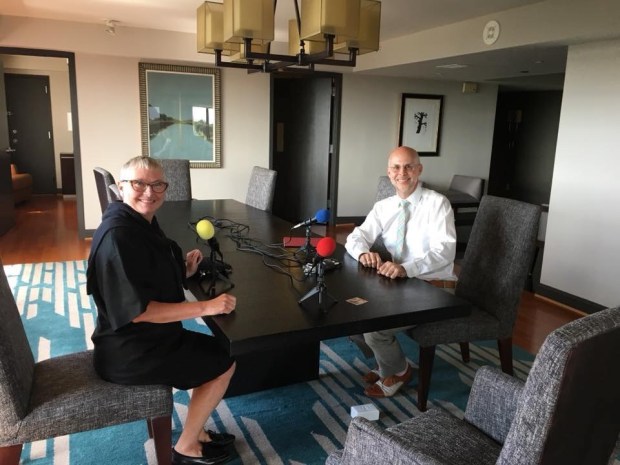
karen trivette and geof huth of an archivist's tale, photograph by tanya zanish-belcher (washington, dc, 2018-08-14)

Geof and Karen and their mobile recording studio.

Chris: What’s next?

Karen: We are always seeking interview opportunities and we’re lucky to have so many of them. That said, we also make opportunities happen as often as possible. For example, we recently traveled internationally for the International Council on Archives section on University and Research Institutions annual conference, held in Salamanca, Spain. We decided early on to invite speakers and organizers to be interviewed. We were lucky to engage with Dr. Shelley Sweeney and Mr. William Maher. Our equipment is minimal so taking it with us, even across the ocean, is easy! Another opportunity we’ve identified is aligning interviews with professional development outlets. For example, there are a few SAA-DAS certificate training courses soon to be offered in the Austin, Texas area; I am thinking about taking these courses so we’ve considered trying to arrange to interview Dr. David Gracy while there.

Geof: We have plans. We have been trying for months to schedule a recording with two archivists we know who are married to each other. This will give us two pairs of married archivists together on the podcast (counting Karen and me as the second pair), so we’re thinking that setting up such pairings might be another theme for us. We might call these “A Couple of Couples of Archivists,” or something like that—and maybe peer a little into the workings of marriage from an archivist’s perception. And we want to record episodes in every state in the union and in more countries. We want to have reach. We want to have more reasons for people to listen to the interesting archivists we talk to.


Kerri Anne Burke talks about meeting her archivist husband, Alan Delozier, at an Irish studies conference in Episode 43: 2X2: Our Retention Period is Permanent.

We want people to listen to archivists, so we promote every episode we create. We owe that to our guests. On October 20th, 2018, we reached and exceeded 5,000 hours of listening. Certainly, that is a small number in the real world, but good enough in the archives universe.

We view ourselves as a media company (which is how we identify ourselves on Facebook), and so we try to act like a company, if a tiny one. We have stylish square business cards, and we add content besides links to episodes to our social media feeds so that people are reminded of us. We post an almost daily archives quotation. We post dispatches from archives conferences we attend. And I have started writing short essays (1,000 words or so) on archives and posting links to them on our feeds. I’d planned this writing as a personal way to think concisely and publicly about archives, and we thought it would be helpful to associate these with our podcast.

Responses and Retrospectives: Rachael Woody on the Decline of History Majors and Its Impact on Archives

This is the first post in our new series Responses and Retrospectives, which features archivists’ personal responses and perspectives concerning current or historical events/subjects with significant implications for the archives profession. Interested in contributing to Responses and Retrospectives?  Please email the editor at archivesaware@archivists.org with your ideas!

This post was written by archivist and COPA member Rachael Woody as a response piece to the recent articles published in November and December 2018 stating that the History major (as well as the majority of other Humanities majors) have reached a “crisis” level of decline.

The decline of students who pursue humanities education and the noted decrease of those who seek history undergraduate degrees has been a concern since the Great Recession of 2008. It’s recent resurfacing as a crisis in late-November and early-December 2018 is a direct result of Benjamin Schmidt’s report, “The History BA Since the Great Recession: The 2018 AHA Majors Report,” published by the American Historical Association in its series Perspectives on History (November 26, 2018).

In Schmidt’s report[1] the history degree has seen the steepest decline among humanities degrees since 2008. Schmidt notes that the decline began due to the economic reality post-2008, but warns that this is not a temporary shift. He states, “That the declines have continued among students who entered college well into the economic recovery shows that the shifts are not just a temporary response to a missing job market; instead, there seems to have been a longer-term rethinking of what majors can do for students.”[2] He continues with indicating that related subjects that make up the majority of humanities’ degrees are also seeing long-term signs of decline.

Schmidt and others[3] attribute this decline in large-part to be related to the inaccurate perception that there are fewer career options paired with concerns of less earning potential. In terms of “fewer career options,” there are actually substantial statistics out there that prove persons with history degrees are employable across a broad spectrum of jobs. The claim of less earning potential is viewed as more accurate when comparing the history degree against STEM fields; however, recent studies are showing that history majors earn more than other humanities fields, including English, psychology, and sociology.[4]

So, what else could be contributing to this steep decline in the humanities? When interviewed by The Atlantic last August, Schmidt states his frustration with old tropes being “trotted out” to explain the crisis: student debt, postmodern relativism, and vanishing jobs. To the job aspect Schmidt emphasizes a critical difference in our collective understanding of why students aren’t majoring in humanities:

“Students aren’t fleeing degrees with poor job prospects. They’re fleeing humanities and related fields specifically because they think they have poor job prospects.”

But it’s not just about jobs. To think so would inaccurately simplify what is amounting to a critical, evolutionary shift in how we perceive the humanities.

In response to Schmidt’s report, Jason Steinhauer published a Time.com article on December 6, 2018, “Fewer Students Are Majoring in History, But We’re Asking the Wrong Questions About Why.” Steinhauer recalls successful cases of history degrees rebounding at Yale University and also at Villanova University, where he is director of the Lepage Center for History in the Public Interest. When Yale noticed a decline in history majors (historically one if its most robust degrees), they asked students about it. In response the students indicated that it went beyond perceived job prospects and earnings—they wanted a logical path to follow (through the degree and out of it) and a cohort. Interestingly, these are also the hallmarks of STEM programs. STEM has evolved as an educational program to provide a variety of pathways students can follow towards a degree and a career, cohorts are formed that build in support and community, and there are clear and direct entries into a variety of jobs.

From these recent articles there are two main calls to action:

  1. The perception of job prospects and earning potential for history (and humanities) degrees needs to be critically evaluated. In addition to gathering and publicizing statistics, an effort needs to be made to show clear and definitive pathways into a variety of careers that provide livable wages.
  2. The way history is offered in academic institutions needs to evolve in order to attract and retain students. A restructuring of how the subject is taught, the introduction of support and communities, the ability to specialize in non-Euro- and U.S.-centric histories, and the regular interaction with history (primary resources) as if it were a lab should be pursued.

Why is this important to archives and archivists?

The importance of the decline of history programs within academic institutions is two-fold for the archives’ profession:

  1. If the decline of history degrees continues it will greatly impact the pool of interested and qualified applicants into the archives profession. This could lead to the atrophy of the profession as a whole and impact the overall care and management of archives across the United States.
  2. If there are fewer history departments, history classes, history students, and history professionals, then there will be fewer people who access and use the archives regularly. Archives being used less will have a compounding effect that can lead to a decrease in resources for the care and maintenance of those archives.

The abandonment of the history degree is being tied to the perceived lack of its financial and societal value. It is not a big leap to then assume that institutions tied to the study of history—archives and museums—are also decreasing in perceived value.

We have some related problems to consider.

It’s no secret that many archivists are struggling within the profession. The recent Wars/SAA Salary Survey and resulting 2017 SAA Annual Meeting panel presentation revealed some depressing statistics on the health of the profession. If you’re thinking, “We love our jobs and aren’t in it to make money,” you’re right about one thing: We aren’t in it to make money. However, the assertion that we love our jobs is complicated by the documented and concerning levels of mental (and, I would argue, physical) health issues archivists have developed as a result of their employment in the profession.

There’s also the, in my opinion, unethical predominance of unpaid internships and their inherent classism, the lack of availability of livable-wage entry-level jobs for graduate students, and the atrophy of mid-career jobs that are directly contributing to the overall devaluation from within the profession to address. From 2000[5], 2010[6], and 2015[7], SAA has published three separate articles in American Archivist studying the issue of the entry-level job market graduates face and revealing that inadequate salary is the number one or two reason archivists leave the profession. Across all three articles (spanning 15 years) these statements repeatedly occur:

  • Given cost of living, professional experience, and job scope, less than half of respondents indicated that their salary was “enough”
  • Due to the higher number of temporary and part-time positions paired with the evaluation that archivist salaries are insufficient in the majority of cases, many are leaving the archives profession
  • Two of the three studies (2000 and 2010) directly state that salary is one of the top reasons given for leaving the profession

Given that the cost of education to become an archivist is only increasing, it is understandable that many looking to join or who have recently joined the profession are alarmed at archivists’ relatively low salaries. And this isn’t just a problem for recent graduates, though much of what could be stated is only anecdotal as there’s not been an SAA census since the 2006 A*CENSUS.[8] Much has changed in the last 12 years, from technology becoming an integrated part of archivist’s jobs to the continued impact of the 2008 recession.

5 things we can work on right now. 

Both issues—the decline of history majors and the atrophy of the archives profession—are rooted in the fundamental belief that those things are no longer as valuable as they used to be. While either point can be argued, that doesn’t change the actions that can and should to be taken:

  1. Reduce the cost of education (debt) and/or increase the entry-level archivist salary so that the return on investment (ROI) increases
  2. Increase the perceived and actual value of archivists by paying commensurate salaries, paying interns, and ceasing the practice of temporary positions in place of permanent positions
  3. Frequently and voraciously speak to the value of the study of history, archives, and archivists
  4. Find ways to increase the intangible benefits of the job to increase the job satisfaction and overall health of archivists as people
  5. Be better as a profession about gathering statistics more frequently and take steps to implement improvements stated in the census reports[9]

In the end, we are in this job because we value history. I’m a big believer on change coming from within. If, through our conscious actions we can become better at valuing archives, our fellow archivists, and ourselves, we can return value to the profession.  By upholding the value of archives and archivists from within the profession, we can influence external audiences and how they value archives and archivists.

————————————————

[1] Schmidt’s report relies on data provided by the National Center for Education Statistics’ Integrated Postsecondary Education Data System (IPEDS), with the most recent data available from 2017.[2] Benjamin M. Schmidt, “The History BA Since the Great Recession: The 2018 AHA Majors Report,” Perspectives on History (November 26, 2018), accessed December 8, 2018.

[3] Paul B. Sturtevant, “History is Not a Useless Major: Fighting Myths with Data,” Perspectives on History (April 1, 2017) accessed December 8, 2018.

[4] Data provided by the University of Texas System and analyzed by Schmidt in an August 23, 2018, post.

[5] Elizabeth Yakel, “The Future of the Past: A Survey of Graduates of Master’s-Level Archival Education Programs in the United States,” American Archivist 63:2 (Fall/Winter 2000), 301–321.

[6] Amber L. Cushing, “Career Satisfaction of Young Archivists: A Survey of Professional Working Archivists, Age 35 and Under,” American Archivist 73:2 (Fall/Winter 2010), 600–625.

[7] Matthew R. Francis, “2013 Archival Program Graduates and the Entry-Level Job Market,” American Archivist 78:2 (Fall/Winter 2015), 514–547.

[8] Victoria Irons Walch, Nancy Beaumont, Elizabeth Yakel, Jeannette Bastian, Nancy Zimmelman, Susan Davis, and Anne Diffendal, “A*CENSUS (Archival Census and Education Needs Survey in the United States),” American Archivist 69:2 (Fall/Winter 2006), 291–419.

[9] The author notes that there were recommended actions provided “A*CENSUS (Archival Census and Education Needs Survey in the United States),” American Archivist, that were not (noticeably) implemented; such as the call for conducting surveys every 10 years.

————————————————

This post was written by Rachael Cristine Woody, a member of The Society of American Archivists’ Committee on Public Awareness (COPA). The opinions and assertions stated within this piece are the author’s alone, and do not represent the official stance of the Society of American Archivists. COPA publishes response posts with the sole aim of providing additional perspectives, context, and information on current events and subjects that directly impact archives and archivists.


Archival Innovators: Doug Boyd, Director of the University of Kentucky’s Louie B. Nunn Center for Oral History

This is second entry in our new series Archival Innovators, which aims to raise awareness of the individuals, institutions, and collaborations that are helping to boldly chart the future of the the archives profession and set new precedents for the role of the archivist in society.

Doug Boyd, Ph.D.

In this post, COPA member Vince Lee brings you an interview with Doug Boyd, Ph.D., Director of the Louie B. Nunn Center for Oral History at the University of Kentucky Libraries.  Dr. Boyd is a recognized leader regarding oral history, archives, and digital technologies. He recently managed the Oral History in the Digital Age, which was funded by the Institute of Museum and Library Services.  Boyd currently leads the team that envisioned, designed, and is implementing the open-source Oral History Metadata Synchronizer (OHMS) system, which synchronizes text with audio and video online.  He holds a PhD in folklore and ethnomusicology from Indiana University and previously served as the manger of the Digital Program for the University of Alabama Libraries, Director of the Kentucky Oral History Commission, and Senior Archivist for the oral history and folklife collections at the Kentucky Historical Society. He authors the blog Digital Omnium: Oral History, Archives and Digital Technologies, is the co-editor of the book Oral History and Digital Humanities published by Palgrave MacMillan in 2014, and Boyd is the author of the book Crawfish Bottom: Recovering a Lost Kentucky Community published in August 2011 by the University Press of Kentucky.

VL: Please describe your innovative project.

DB: In 2008 I designed a web application called OHMS (Oral History Metadata Synchronizer) to enhance access to online oral history by connecting a text search of a transcript or an index to the corresponding moment in the audio or video.  OHMS is a 2-part system that includes the OHMS web application and the OHMS viewer.  The web application is where you do the work of synchronizing a transcript or indexing your interview.  When indexing an interview you create linkable segments that include a range of metadata fields that include the following fields: segment title, description, partial transcript, keywords, subjects, GPS coordinates, as well as hyperlinks which can be used to link the user to related web resources, or link the user to photographs.

The second part of OHMS is the OHMS Viewer.  The viewer was designed to interact with a local CMS and can be incorporated in free systems such as Omeka or WordPress just as simply as it is integrated into more complex systems such as CONTENTdm, Islandora, or Blacklight. OHMS was designed to provide an affordable option for enhancing access to online oral history and it has transformed our workflow at the Nunn Center.  Prior to launching OHMS, the Nunn Center was averaging 300-500 interviews that were being accessed each year.  Today, Nunn Center interviews are being accessed online an average of 10,000-12,000 times per month.  In 2011 the Nunn Center received a national leadership grant from IMLS to make OHMS open source and free.  In 2014, OHMS was released to the public, and at this time, there are over 500 individual and institutional OHMS accounts in over 35 different countries.

VL: Where did you get your idea and what inspired you?
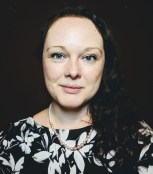
DB: Prior to working at the University of Kentucky I managed the digital program at the University of Alabama.  During this time I thought a great deal about web usability and design, as well as the user experience working with digital library/archives platforms at the time, especially with regard to archived oral histories.  Prior to my experience at the University of Alabama, I was the Senior Archivist for the oral history collection at the Kentucky Historical Society and had grown frustrated with the discovery and usability challenges posed by archived oral history (and all time based media).  Most oral history interviews are not transcribed, which creates a great deal of challenges for both the archivist and the user.  The result was that the rich interviews in our oral history collections were mostly going undiscovered and ignored.  I began thinking about possibilities.  The digital program at the University of Kentucky had experimented with time-coded access to online oral history, but this required manual markup of a transcript.  OHMS grew out of my obsession with enhancing access to archived oral histories, but also to create empowering opportunities for more sustainable workflows in the archive.

VL: What worked? What didn’t work? Were you surprised by the outcome or any part of your experience?

DB: Developing OHMS was definitely an iterative process.  Keep in mind, we originally designed OHMS to work only with the Kentucky Digital Library, our primary access point at that time.  Also, initially OHMS only worked for synchronizing transcripts.  One of my favorite innovations of OHMS was when we designed the indexing feature.  Indexing really has been transformative for us, and now for so many individuals and institutions.  It provides an option for enhancing access to untextualized oral histories when transcription was not a financial or practical reality.  Last year the Nunn Center put over 900 indexed interviews online.  If we had transcribed all of those interviews, it would have cost the center over $250,000, which of course we would not be able to afford.  We would have only been able to provide online access to about 75-100 interviews that year.  One of the overarching goals for OHMS from the beginning was to create more sustainable workflows that were both effective and efficient, and that has clearly worked very well.

What did not work? The original plan was to have the OHMS Viewer be a plugin for 3-4 popular content management systems.  Once we really sat down at the table to talk about this it became abundantly clear that we would never be able to maintain and grow that approach after the grant ran out.  While this meant that the OHMS viewer was not as integrated as it could have been with a select few content management systems, it meant that there were fewer dependencies, making the OHMS Viewer portable enough to interact easily with any system.

VL: What would you do differently?

DB: Automating account setup far earlier in the development journey.  It was not until this last development cycle that we automated the account setup process.  Manual setup of each account was fine in the very beginning when there were few OHMS accounts beyond our internal use at UK.  It was such an honor to interact with so many wonderful oral history projects around the world.  However, there came a point where I was manually setting up 10-20 accounts each week.  Automating account setup had been on the development roadmap for several years, however, it kept falling down as a priority.  I would always ask questions such as “do we make OHMS bilingual, or do we make things easier on me.”  The last year or so automation became essential as so many account requests were coming in. While this does make things easier on me, it really is an important step toward sustainability.

VL: What tips do you have for budding innovators?

DB: It sounds cliché but do not be afraid to experiment.  The original version of OHMS was created and launched for $10,000 using internal funds (not a grant).  While $10,000 is an incredibly large amount of money, for a digital project, this is extremely affordable.  We found an creative programmer, drew up many designs on napkins and moved forward with development.  Also, think about sustaining your innovation early in the process.  While we did receive an IMLS National Leadership Grant, we had already created and implemented OHMS several years prior to getting the grant.  All of our development since the 2011 grant has been internally funded.  You can do magical things with a grant, what you cannot always do is sustain the work once the grant has run out.  I am pretty proud that we have designed OHMS to be sustainable whether there is a grant in play or not.

VL:  Did you get media attention? How did that happen?

DB: We have received wonderful attention.  In a way, this attention was not driven by OHMS, but by the enhanced discoverability of the oral history material being delivered via the OHMS Viewer.  Often the media is first drawn to the contents of the interviews, and then they have the “a-ha” moment where they realize how amazing the interface is.  Additionally, I have lectured a great deal about OHMS, which has raised general awareness of the tool within the oral history and archives community.  I have spoken about OHMS throughout the United States, in Australia, China, the UK, and several countries in Europe.  When I go on the radio, or when I narrate our podcast The Wisdom Project, I will give OHMS a brief mention.  I will say something to the effect “You can listen to these interviews in their entirety using our magical search system called “OHMS,” a system we developed at the Nunn Center.” While this sounds self-promotional, it is intending to raise general awareness and plant seeds.  While media attention is important, it is vitally important to raise general awareness of OHMS among the audience that OHMS is serving, so I get as excited about a mention on a student blog, or in The Signal (a blog published by the Library of Congress) than I do about articles in the Chronicle of Higher Education or a mention on NPR.

Boyd working with a colleague on an oral history interview in OHMS.

VL:  Do you have a collaborator? If so, how did you find them?

DB: Definitely.  Internally, our team at the Nunn Center and University of Kentucky Libraries have been critically important.  Eric Weig, Mary Molinaro, Kopana Terry, Danielle Gabbard, and Michael Slone have all played essential roles in making OHMS a practical reality.  When you are at an academic institution working on a project like OHMS development, the Deans of University of Kentucky Libraries (Terry Birdwhistell and Deirdre Scaggs) continue to be essential collaborators.  Jack Schmidt was the original programmer who we contracted to write the original code.  Externally, each programmer who has worked on OHMS has been an essential collaborator, especially Shawn De Cesari who worked for the company we contracted to rewrite the code during the IMLS grant.  Recently, we have worked closely with AVPreserve on the development of OHMS and this collaboration has proven incredible with regard to helping me shape the vision and development direction of OHMS.   In each case, programmers who have worked on OHMS have been so much more than just work-for-hire programmers, each one bought in to the mission and vision of OHMS and have always delivered far more creatively than they were being paid for.

The other collaborators who are critical to mention are those early adopters of OHMS who continue to give amazing feedback about development and usability priorities.  Institutions like the Richard B. Russell Library for Political Research and Studies at the University of Georgia and the Brooklyn Historical Society were critical early on in the process.  These institutions took a chance on OHMS early on and gave profoundly important feedback early on.  More recently, working with organizations like Oral History in the Liberal Arts, the students and faculty at West Chester University, as well as the Academy of Motion Picture Arts and Sciences have been important on the development of OHMS as a pedagogical tool (more on that later) as well as shaping my work in adding the bilingual aspects of OHMS.

Finding collaborators is about recognizing the opportunities and proactively empowering those collaborators to feel part of the process, part of the team. Now, our collaborators are broadening out to other institutions, such as Indiana University, who have begun to collaborate on the development of OHMS and help take the system to the next level.  Indiana University recently contracted AVPreserve to add Avalon capability to OHMS, which has been transformational on many levels.  I am very excited about seeing what comes next with regard to collaborators on development.

VL: Did you have institutional, administrative, or financial support for your project? How did you go about securing that support?

DB: As mentioned above, I initially funded development using some Nunn Center endowment funds that had accumulated over a few years prior to me coming to the University of Kentucky.  The Deans and Associate Deans at the University of Kentucky have always been open to experimentation and they all gave me the space to move something like OHMS from the idea phase into actuality.  Having their trust was essential to securing the initial internal funding.  Externally, we did receive an IMLS National Leadership Grant in 2011.  This was a critical development as it provided the support needed to rewrite the entire code and rethink OHMS as a system that people outside of the University of Kentucky could use.

VL: What’s next?  Either for this project or a new development?

DB: I have received a Fulbright Research Grant to spend 6 months in Australia to work with the National Library of Australia.  The NLA created a system similar to OHMS.  The Fulbright grant is a way for us to collaborate in a substantive way on how we can work together to elevate both systems and explore international standards for enhancing access to online oral history. We are moving in to the next active development stage where some exciting things are happening.  Most importantly, when I return from Australia, the top priority is to establish an institutional consortium that will help guide and sustain OHMS development moving forward.

VL: What barriers or challenges did you face?

DB: Of course, the major barriers are always funding and available resources.  Again, I am proud that we have been able to sustain the work of OHMS long after the IMLS grant was complete, but major paradigm-shifting development will need more grants. Upon completion of the grant there were some aspects of OHMS hosting and minor development that fell to programmers at the University of Kentucky Libraries.  We have very talented IT staff, but OHMS hosting and development had to be absorbed and balanced with many competing (and sometimes conflicting) priorities.  We have since moved hosting and development to AVPreserve, which has been an incredible experience.  We have expedited development and OHMS is no longer a conflicting/competing priority for the UK Libraries IT staff.  This really was a great move on so many levels.

Of course, OHMS is no longer something that only serves the Nunn Center.  Since there are OHMS accounts in over 35 different countries, I need to think about OHMS accounts and users on an international scale when making even small development decisions.  Last year some of our international partners reported that the OHMS Viewer was not effectively searching characters utilizing diacritics.  As a result, we had to shift some priorities around.  While this is neither a barrier nor a challenge, it is an exciting shift in focus for me to have to think so broadly about our development roadmap.

VL: Were you able to leverage help from students, interns, or grad students for technological or experiential aspects of the project?

DB: Absolutely.  We have a full team of student indexers at the Nunn Center who have provided incredibly valuable feedback on OHMS development, as well as on the resources and tutorials that we have created on using OHMS.

VL: Are there plans for implementing this project in curricula or as a resource to faculty/students?

DB: Absolutely. First, the Nunn Center’s collections are now accessed on a massive scale.  As designed, OHMS has enhanced discovery and usability, and as a result, faculty and students are using oral histories in the classroom on a much larger scale.  However, there has been an unexpected shift in how OHMS is being used in the classroom.  Even before OHMS had been released publicly to other institutions, I started using the back-end of OHMS in the classroom.  Specifically, students were assigned indexing projects in my graduate and undergraduate classes.  After the first semester, I very quickly realized that OHMS could be utilized as a powerful pedagogical tool.  Since then, we have collaborated with several professors at the University of Kentucky, as well as at Universities around the country who are designing entire courses around using OHMS to work with oral history in the classroom in powerful and effective ways.  The Going North and Philly Immigration projects at West Chester University, the Jewish Kentucky project here at the University of Kentucky are some higher profile examples, but smaller scale classroom initiatives are popping up around the country allowing the archives to engage faculty and students in new ways. Additionally there have been several recent journal articles in the Oral History Review focusing on OHMS as a pedagogical tool, as well as the article “Connecting the Classroom and the Archive: Oral History, Pedagogy, and Goin’ North” featured in Oral History in the Digital Age.

VL: How did you use this project as a catalyst for getting different groups to talk to each other (cross-generational, cross-cultural, etc.)?

DB: OHMS has transformed access to our oral history collection at the Nunn Center.  In 2008 we had 300-500 interviews being accessed annually.  Now the number averages 10,000-12,000 each month. This level of access has perpetuated a renewed interest in oral history at my institution.  The Nunn Center is currently maintaining over 50 interviewing initiatives at any given moment, which has connected us to new communities around Kentucky, as well as working with communities and individuals on a national and an international scale.  We used to work only with projects on the state-level, however, now we have projects all over the United States, as well as in Haiti, India, Pakistan, as well as a current interviewing project in Ecuador.  This volume of oral history is, by definition, catalyzing connection.  Much of this success is due to the success of OHMS and our commitment to enhancing access to our archived oral history interviews.

VL: What was your institution like before you joined? Does your institution have a history of supporting innovation in archives?

DB: The Special Collections Research Center in the University of Kentucky Libraries has had a history of experimentation and early adoption.  One of the things that drew me to the University of Kentucky in 2008 was the fact that I knew I could work very closely with the digital program.  So I came in to a context that was supportive and curious.

VL: What was your strategy for shifting the culture of your institution to be open to your innovative projects?

DB: Honestly, I did not have to do much beyond earning the trust and confidence of leadership.  I was able to recognize a problem—major discovery and usability challenges to accessing oral history—and articulate a potential solution.  I am a big believer in creating a “proof of concept” which is what we had when we built the initial version of OHMS.  Once leadership saw OHMS in action, there was very little convincing that was needed at that point.