
There’s an Archivist for That! Interview with Samantha Bradbeer, Hallmark Archivist

This is the second post in our new “There’s an Archivist for That!” series, which will feature examples of archivists working in places you might not expect.  To continue this new series, COPA member Rachel Seale, Outreach Archivist at Iowa State University, brings you an interview with Samantha Bradbeer, archivist and historian at Hallmark Cards, Inc.

SBradbeer Interview Photo 1

Samantha Bradbeer, Courtesy of Hallmark Cards, Inc.

Samantha Bradbeer has served as the archivist and historian for Hallmark Cards, Inc. since 2011. Prior to Hallmark, she was an assistant librarian at the Ike Skelton Combined Arms Research Library on Ft. Leavenworth, KS and interned at the Smithsonian National Museum of Natural History.

She is a Certified Archivist (CA), and holds a Bachelors of Arts in Anthropology (BA) from the University of Kansas and a Masters in Museum Studies (MA) from Johns Hopkins University.

Samantha is an active member of SAA’s Business Archives Section and ICA’s Section on Business Archives, and serves as the vice-chair of the Kansas City Area Archivists.

RS: How did you get your gig?

SB: I began my career at Hallmark almost seven years ago. At Christmastime 2010, a friend recommended that I apply, as she felt that the job announcement was kismet. We both felt that it was written just for me, as I met all the requirements to a tee and have been a brand supporter for years. Some of my fondest childhood memories are of visiting Hallmark Gold Crown stores for cards and Keepsake Ornaments with my parents, and, as if there was serendipity involved, I even saw some of my first Hallmark purchases stored in the Hallmark Archives during the interview process. As luck would have it, Hallmark hired me on Valentine’s Day 2011.

Since then, I have been responsible for preserving and sharing Hallmark’s corporate and product history with employees, business partners, special guests, media and the greater Kansas City community. I am able to do so by answering research requests, creating exhibitions, providing tours, recording oral history interviews and responding to guest speaker opportunities. I am also responsible for arranging, cataloging and storing the collections.
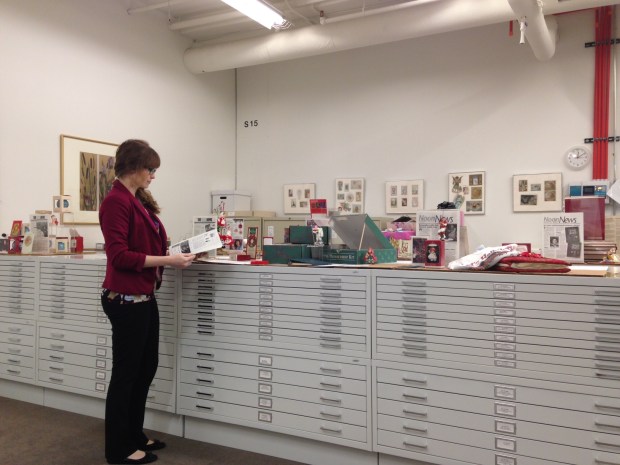
SBradbeer Interview Photo 2

Samantha prepares several displays for the 2017 Keepsake Ornament Club Convention (Courtesy of Hallmark Cards, Inc.).

RS: Tell us about your organization.

SB: The Hallmark Archives is located inside Hallmark’s worldwide headquarters on the southern edge of Kansas City, Missouri.

The significance of our holdings stem from Hallmark founder J.C. Hall’s encouragement for a high level of quality and creativity and a longstanding tradition of support for the arts. Hall began assembling our antique card collection, one of several collections we hold, in the 1950s in the interest of creating an accurate and varied record of the historic development of the greeting card industry, and our company’s major product line.

The Hallmark Archives has since served a dual role in that – in addition to serving the entire corporation and outside organizations as a source for industry history, holiday origins and graphic design trends  – it also serves Hallmark by supporting current product development. Hallmark artists and writers often reimagine past designs based on current marketplace trends or anniversaries. For example, Hallmark is currently celebrating the 100th anniversary of gift wrap, and several vintage gift wrap patterns from the Hallmark Archives are currently in stores to mark the occasion.

RS: Describe your collections.

SB:  The collections housed in the Hallmark Archives provide a visual and historical representation of greeting card history, industry and printing technologies, and serves as the repository for materials documenting Hallmark corporate, family and product history.

  • The design collection includes advertising, chromolithographs, folios, original artwork, prints, progressive proof books and rare books from the 17th to 19th centuries.
  • The historical collection includes Victorian-era greeting cards representing holidays and everyday, as well as advertising and trade cards, handmade or folk art, playing cards, postcards, scrapbooks and salesman’s sample books.
  • The corporate collection includes Hallmark advertising, audio visual materials, correspondence, photographs, publications and oral histories from 1910 through today.
  • The product collection includes greeting cards and other products manufactured and sold by Hallmark from 1910 though today.
  • The masterworks collection includes samples of original Hallmark product art dating from the 1950s through today.

Unique items in the Hallmark Archives include medieval manuscripts, two examples of the world’s first printed Christmas card and Victorian-era Valentine puzzle purses.
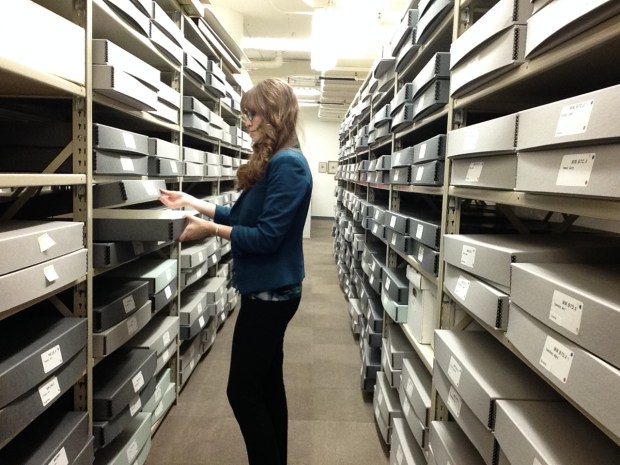
SBradbeer Interview Photo 3

Samantha adds original artwork to the masterworks collection (Courtesy of Hallmark Cards, Inc.).

RS: What are some challenges unique to your collections?

SB: Hallmark has created millions of products since 1910, and the Hallmark Archives has stored and preserved a sampling from every year and holiday or occasion. It can be challenging at times to select which products to keep, but luckily our complete set of employee newsletters and product catalogs provide insight into the full product line, when needed.

Although our retention schedule automatically sets aside most products, many departments keep their records as working files for years, even decades. We recently started relocating some of these records to the Hallmark Archives, as the departments needed additional working space. Retired employees and fans of the company have also donated other products and records, and, like many archives, we have a backlog of materials to still process and properly store.

As technology has improved, we have also been digitizing our collections gradually. Most of our materials are digitized when our employees and business partners request them, but, as time allows, we have also scanned entire collections, including our masterworks collection of over 40,000 samples of original Hallmark product art dating from the 1950s through today. With that being said, an extremely small portion of our corporate records – including audio visual materials stored on now obsolete formats – has been digitized. I hope to start digitizing more of these records, especially as we are sharing more and more of our company history online and in the media.

RS: What is the favorite part of your job?

SB:  Over the past 100 years, Hallmark has partnered with dozens of well-known and influential artists, writers, celebrities and politicians. Many of whom – including Winston Churchill, Walt Disney, Dwight D. Eisenhower, Grandma Moses and Norman Rockwell – built personal relationships based on mutual respect and admiration with our founder. I grew up reading about these icons, and having the opportunity to see their original artwork and read their personal letters still gives me goose bumps.

I love to display these materials and other unique items from the Hallmark Archives as often as I can at the Hallmark Visitors Center, so employees, local residents and visitors to Kansas City can see a glimpse into our collections and company history.
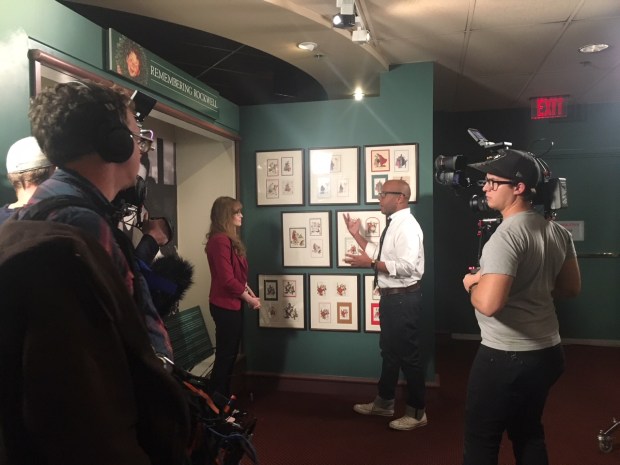
SBradbeer Interview Photo 4

Samantha shares the history behind J.C. Hall and Norman Rockwell’s friendship and business partnership with Hallmark Channel’s Home & Family talk show host Ken Wingard (Courtesy of Hallmark Cards, Inc.).


Stay tuned for future posts in the “There’s an Archivist for That!” series, featuring stories on archivists working in places you might not expect. If you know of an archivist who fits this description or are yourself an archivist who fits this description, the editors would love to hear from you—share in the comments below or contact archivesaware@archivists.org to be interviewed on ArchivesAWARE!


There’s an Archivist for That! Interview with Anne L. Foster, Yellowstone National Park Archivist

This is the first post in our new “There’s an Archivist for That!” series, which will feature examples of archivists working in places you might not expect.  To launch this new series, COPA member Rachel Seale, Outreach Archivist at Iowa State University, brings you an interview with Anne L. Foster, Archivist at Yellowstone National Park.

Anne Foster.resized

Photograph of Anne L. Foster. (Courtesy of Anne L. Foster).

Anne L. Foster has served as Yellowstone National Park’s Archivist since 2010. Prior to that, she was the University Archivist at the University of Alaska Fairbanks, Traveling Archivist for the Montana Historical Society, NHPRC Fellow in Archival Administration at Fort Lewis College in Colorado, and Assistant Archivist at the Sharlot Hall Museum in Arizona. She is a Certified Archivist (CA), Digital Archives Specialist (DAS), and holds an Masters in Library Science (MLS) from the University of Maryland.

RS: How did you get your gig?

AF: As an undergraduate history student at nearby Montana State University in my hometown of Bozeman, Montana, I used to see flyers advertising an internship in the archives at Yellowstone. While I couldn’t take advantage of the program at the time (I was working three other jobs to pay for school), the fact that archives was a potential career for a history major and that someplace I loved like Yellowstone had one stuck with me. For the next fifteen years, through graduate school and several other archives jobs, I would periodically check and see Yellowstone was hiring. And then, on one random check—they were! I’d just been tenured and promoted at my academic repository, but finally, my dream job was available.  All those other jobs were probably a good thing, though, because they gave the skill set needed to step in as the first professional archivist in Yellowstone and tackle one of the largest backlogs in the National Park Service.

Processing room during our Archives Blitz grant project

Processing room during the Archives Blitz grant project (courtesy of Anne L. Foster).

RS: Tell us about your organization.

AF: The Archives is part of Yellowstone’s Heritage & Research Center (HRC), which also houses the Park’s museum collection, herbarium, and research library.  The HRC is part of the Yellowstone Center for Resources, which is tasked with managing all those things that make Yellowstone so special like the thermal features, wolves and bears, and the scientific research that guides management decisions. While we are part of the National Park Service, we are very fortunate to also have Yellowstone Forever, our philanthropic and educational partner. Yellowstone Forever actually started life in the 1930s as the Yellowstone Museum and Library Association, so our collections have long been a key part of their efforts. Most people think of Yellowstone as the place for geysers and wildlife—and we are–but the Archives is the place where we document those special features and our efforts to preserve them, which to me is something special.

HRC

Entrance to Yellowstone National Park Heritage and Research Center (Courtesy of Anne L. Foster).

RS: Describe your collections.

AF: Like many archives in the U.S., we are both an institutional repository and a collecting institution. Our institutional records are government records and we are subject to federal records laws and guidelines. There are actually two types of records within the government collection: resource management records and administrative/historical records. All national parks keep resource management records. Parks are created to manage a resource or resources and as long as that resource exists, we need to keep records pertaining to those resources to help inform future management decisions (these records are considered “permanently active” as long as the resource is active).  Unlike other national parks, however, we also retain our permanent administrative and historical records like Superintendent’s correspondence, planning documents, partnership agreements and other records that don’t pertain quite so directly to resources. For other parks, those records are sent to the National Archives. Yellowstone is fortunate to be one of the few Affiliated Archives of the National Archives and Records Administration (NARA). This means that the records become part of NARA’s collection, but so long as we meet their standards for preservation, security, and access, we can keep them in our location. This makes it easier for our researchers, both staff and the public, to access our history in one place.

Our third category of collection is our donated or manuscript collections. These materials range from Park visitors’ photo albums, diaries, and scrapbooks through the research of scholars and  scientists who donate their data for future comparative or longevity studies to records of businesses who have operated in the Park over its nearly 150 years. In fact, our Yellowstone Park Company (YPC) records, the main Park concessioner for the first 100 years, is our most accessed collection because it includes payroll records. The YPC hired hundreds of college kids every summer and, apparently, that summer was so memorable that the employees would spend the rest of their lives talking about their summer in Yellowstone. Now, we’re getting those employees’ kids and grandkids coming in to find out what Grandma or Grandpa really did in Yellowstone.

Archives stacks

Yellowstone National Park Heritage and Research Center Archives stacks (courtesy of Anne L. Foster).

RS: What are some challenges unique to your collections?

AF: People love Yellowstone, so much so that there isn’t much about the Park that they aren’t interested in.  This makes archival appraisal a bit challenging—the most routine things truly have the potential for historical value.  Our NARA-approved NPS records schedule, for example, classifies most supply records as temporary. Of course it does—why would one need records for equipment once that item is used up or sold? But, we get queries regularly from people who have purchased former Park vehicles (buses, boats, snowmobiles) and want to know all about their item, down to paint formulas and the names of Rangers who drove them; it’s frustrating not to be able to answer their questions. At the same time, we can’t possibly keep everything.  So, it comes down to a rigorous and often detailed appraisal process.

We can have some unique preservation challenges as well.  Some of our most interesting records are logbooks–bound books used to record eruption data, visitor comments, or deep thoughts about wilderness. But, many of the logbooks are kept in less than optimal locations during creation—backcountry cabins, rock cairns on top of mountains, or next to erupting geysers.  By the time they are filled and transferred to the archives they can be nibbled, rained upon, or even somewhat eaten away by the acidity of geyser spray. During the 1988 fires, the Park’s historian actually flew with a fire crew in a helicopter to several backcountry cabins in order to rescue the logbooks (fortunately, all of the historic cabins were saved). Today, we have a more regular transfer of the logs to help cut down on damage and make use of digital duplication in cases where the damage is significant or potentially harmful to other items.

RS: What is the favorite part of your job?

AF: The location; it is magical to go to work in Wonderland and even more extraordinary to be the keeper of the documentary record for the world’s first national park. That feeling is shared by my coworkers as well as our visitors and researchers—it makes for a lot of enthusiasm and interest in the Park’s history. Every day is different and that makes for interesting and challenging work. There’s a huge amount of variety to my day: the types of records, the archival functions, and the research questions are as varied as Yellowstone’s landscape.

Stay tuned for future posts in the “There’s an Archivist for That!” series, featuring stories on archivists working in places you might not expect. If you know of an archivist who fits this description or are yourself an archivist who fits this description, the editors would love to hear from you—share in the comments below or contact archivesaware@archivists.org to be interviewed on ArchivesAWARE!