There’s an Archivist for That! An Interview with Caitlin Oiye Coon, Archivist at Densho

This is the newest post in our There’s an Archivist for That! series, which features examples of archivists working in places you might not expect. In this article, COPA member Angie Piccolo interviews Caitlin Oiye Coon about their job as Archivist at Densho.

How did you get your gig?

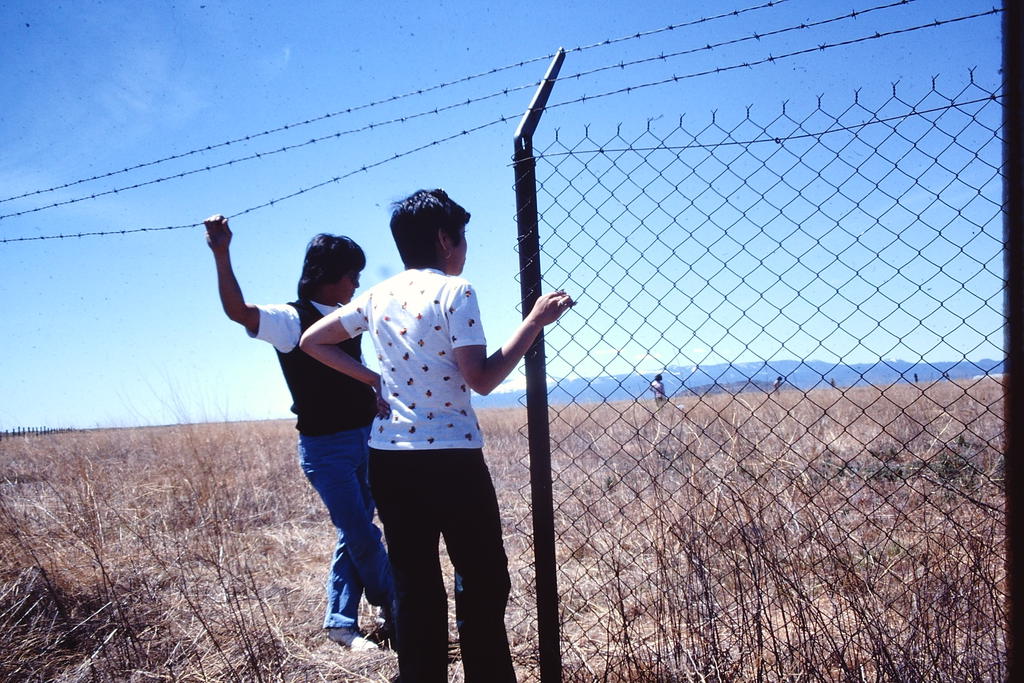
Caitlin Oiye Coon: In 2011, I was an early-career archivist in Seattle. I had written my graduate thesis on collective memory and the preservation of Japanese American incarceration photographs. In that project, I referenced Densho quite a bit. When I saw that Densho was hiring an archivist I knew I had to apply. The position combined my love of archives and my own personal connection to the incarceration. My dad’s family spent 1942-1946 incarcerated at Tule Lake. I grew up hearing stories from my grandma about her experiences there as a young woman. Luckily Densho hired me, and 12 years later I am the Archives Director and still excited to go to work every day.
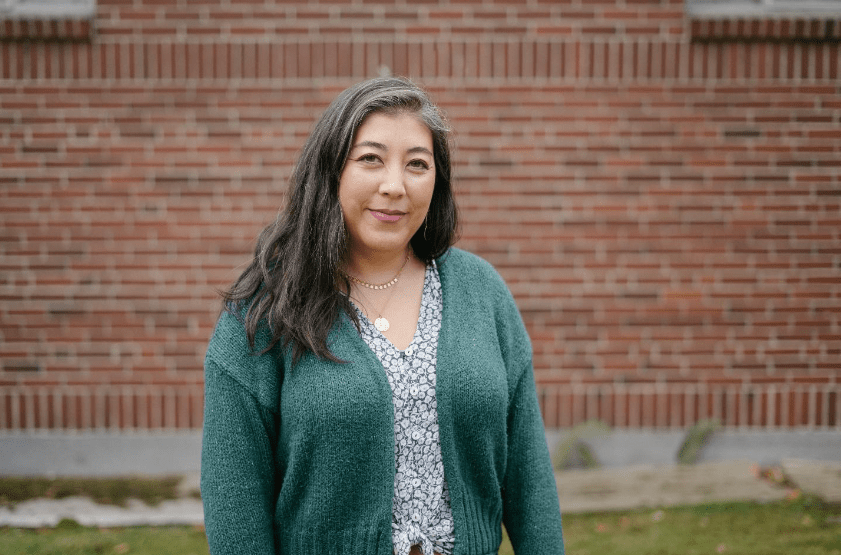
Tell us about your organization

COC: Densho is a community-based archives and cultural heritage organization based in Seattle, Washington. We started out as a volunteer-led oral history project, recording stories of the World War II incarceration of Japanese American. We have spent the last 29 years interviewing survivors and their descendants, digitizing family collections, and creating educational content, all made available to the public online.

Describe your collections

COC: From Densho’s founding, our focus has been on providing access to all of our collections through digital platforms. All of our oral history and archival collections are freely available online in the Densho Digital Repository (DDR).

The DDR has over 1,000 oral histories and over 400 collections of digitized archival materials (photographs, letters, newspapers, documents, art, and ephemera) that range from one to thousands of objects. The focus of our mission is the Japanese American incarceration but we believe you cannot understand it in a silo, so our collections cover the broader experience from immigration to present day activism. 

We are a post-custodial archives; we digitize materials and then return them to the original donors. This has been a great model for us because families can share their stories through the DDR but can hold onto the physical materials that mean so much to them. We also partner with many organizations who hold archival materials related to the Japanese American incarceration; providing technology, knowledge, or labor for smaller organizations and functioning as a secondary repository for larger organizations.
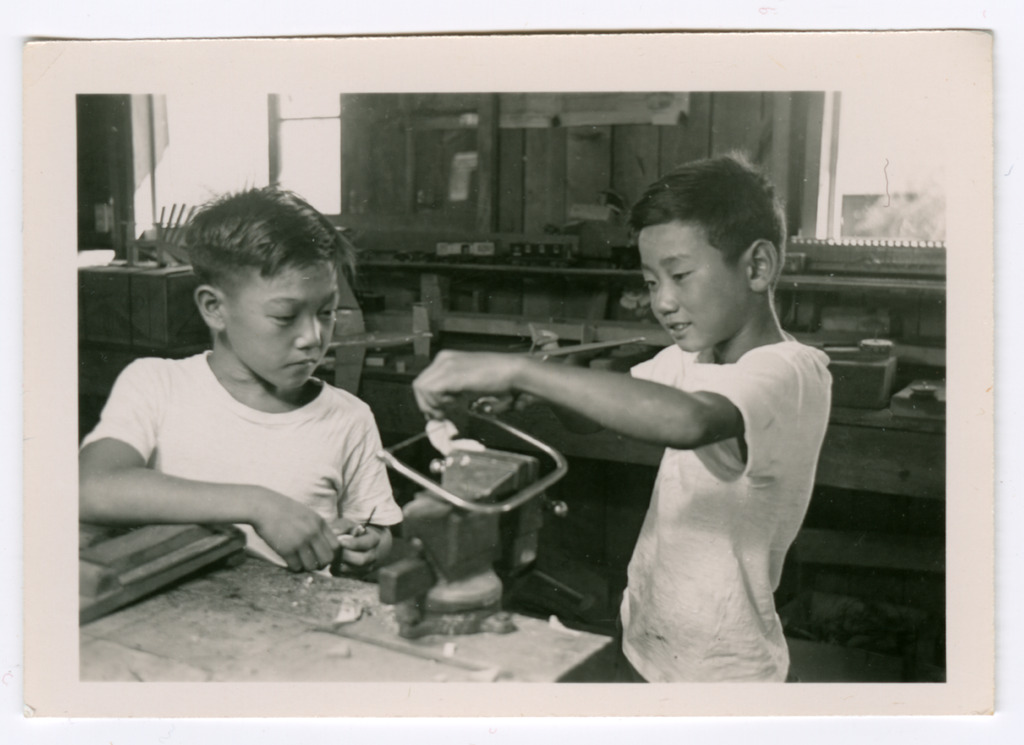
Boys woodworking in Poston incarceration camp
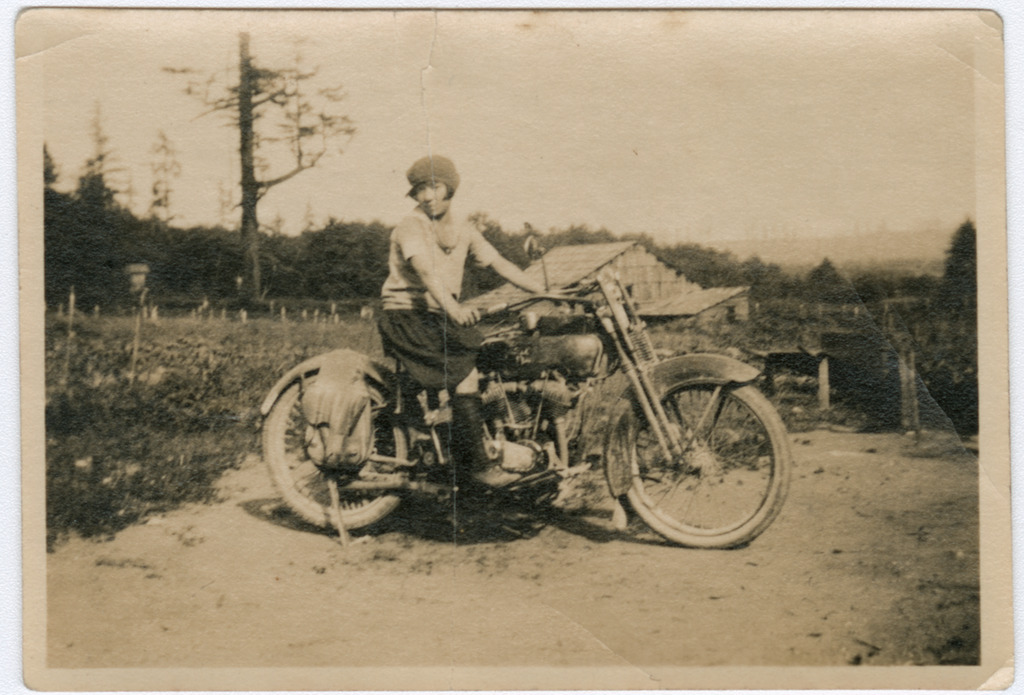
Japanese American woman on a motorcycle
Pilgrims at Tule Lake

What are some challenges unique to your collections?

COC: Our biggest challenge comes from us being a completely digital platform and post-custodial archive. Over the years we have developed a good rhythm with the digitization process but it still takes a lot time. So, we are constantly working through a backlog of collections that cannot be viewed until they are published in the DDR.

What is your favorite part of your job?

COC: I love a lot about my job but I think the part that resonates the most with me is the connection to the community. We get to engage with so many families who were directly impacted by the incarceration. They all have different stories and they are fascinating to hear. Knowing that the community trusts us with those stories is gratifying.
There’s an Archivist for That! An Interview with Chloe Pfendler and Chris Doan, Archivists for Silicon Valley Archives

This is the newest post in our There’s an Archivist for That! series, which features examples of archivists working in places you might not expect. In this article, COPA member Claudia Willett interviews Chloe Pfendler and Chris Doan about their jobs as Archivists for the Silicon Valley Archives (SVA) at Stanford University.

How did you get your gig?

In 2022, through the Hohbach Program Endowment, we were both hired to process the historical records and materials documenting the history and development of the Silicon Valley region of California. Harold Hohbach was a patent lawyer and real estate developer who was passionate about the legacy of technological and scientific innovation that is synonymous with the area we know as Silicon Valley. He donated money to help support the Silicon Valley Archives program at Stanford, which included funding for two processing archivist positions. We entered our roles with professional backgrounds that include experience in working with historically diverse archival collections and processing a variety of formats.

Tell us about your organization.

Silicon Valley Archives (SVA) is a sub-unit within Stanford University Library’s Special Collections Manuscript Division. The goal of SVA is to acquire and promote collections that document the industry and impact of Silicon Valley, as well as the history and the culture of this geographic region. We have the unique opportunity to work with an entire team (which includes the curator for Science and Technology, Business, Henry Lowood, as well as a curatorial assistant, historian, and exhibits coordinator) by aiding in their efforts to make the history of science and technology in Silicon Valley an engaging and educational experience for students, researchers, and the general public. 

Describe your collections.

Our collections are pretty diverse! They run the gamut in terms of formats – lots of obsolete computer media and hardware, as you might imagine, but also various forms of audiovisual media, photographs, objects, organizational files, personal papers, etc. The history of Silicon Valley is multifaceted, and since coming onboard, we have processed several collections with content that showcases this, such as innovation in the early stages of electrical vehicle design and production seen in the Robert Wing EV Collection and the John Newell Collection; cultural influences as found in the activities of the San Francisco non-profit Point Foundation, which was an evolution of Stewart Brand’s Whole Earth Catalog project; and social concerns as reflected in the Computers, Freedom, and Privacy conferences that were organized in the Bay Area during the early days of the World Wide Web.

Images from the John Newell collection on the history of electric vehicles, M0963, Top: Electric Automobile Association of California newsletter; Bottom: Deborah MacArthur’s electric race car for the Alternative Vehicle Regatta held in New Hampshire, 1975

What are some challenges unique to your collections?

Given the “tech” nature of many Silicon Valley enterprises, these collections tend to be media-dense. For example, we could be dealing with energy emittance captures taken on 

Polaroid film during the 1980s from the inside of an electron device, cassette tapes of regional conferences on elements of text encoding, or boutique software from a defunct startup that might require emulation. We also encounter a lot of computer hardware and “born digital” materials. This all brings up issues and challenges surrounding the preservation and access of these types of materials, some of which are dependent upon obsolete technologies, software, and very technical processes. 

What is your favorite part of your job?

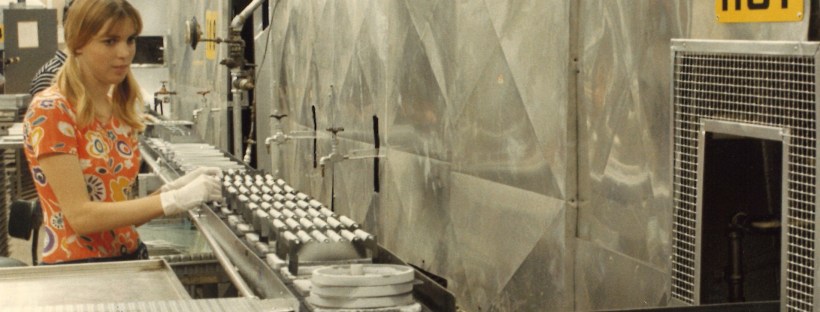
We both find working with the material exciting in various ways, especially all the new information you tend to learn as a by-product of processing a collection. Many of our collections concern the historical origins of industries that have had a far reaching, global effect, and it’s been very interesting to dig deeper into some of these stories. One example of this is learning about the hidden labor that exists in technology industries, particularly the production and assembly line workers who were typically women and other people from marginalized communities. For researchers interested in this particular kind of Silicon Valley history, collections containing company in-house produced photographs can be a rich source of information. We also enjoy the opportunity to work with our SVA exhibits coordinator from time to time to help promote the archives and give the public a closer look at our collections.

There’s an Archivist for That! An Interview with Rebekah Valentine, Lead Archivist for the Dianne Feinstein papers

This is the newest post in our There’s an Archivist for That! series, which features examples of archivists working in places you might not expect. In this article, COPA member Claudia Willett interviews Rebekah Valentine about her job as Lead Archivist for Senator Dianne Feinstein’s papers at Stanford University .

How did you get your gig?

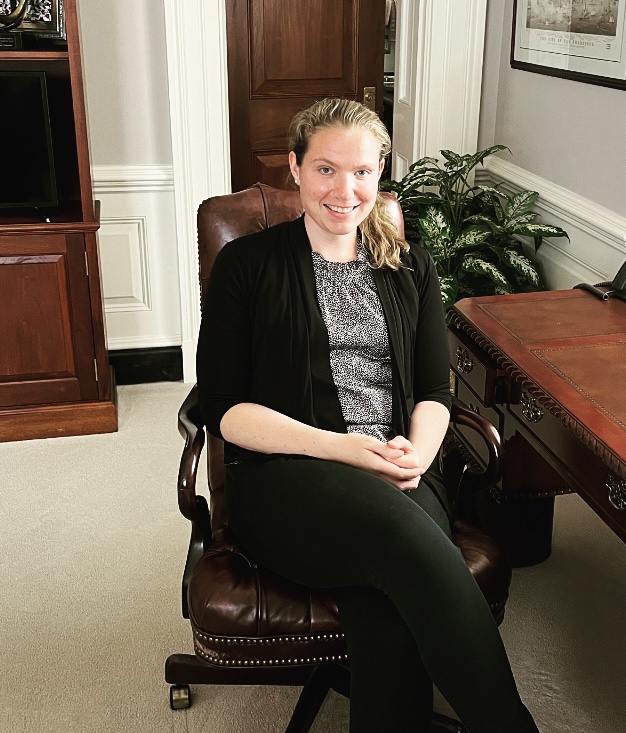
Rebekah in Senator Feinstein’s Capitol Hill office chair

My interest in congressional papers began with my summer internship with Senator Patrick Leahy’s office.  After graduating with my MLIS from the University of Maryland, he hired me to be his archivist assistant. This position led to me becoming Senator Feinstein’s archivist. I am now continuing to lead her archiving project at her chosen university.

Tell us about your experience working as an archivist in a Congressional office.

Being a congressional archivist has been one of the most rewarding and also the most challenging experiences in my career thus far. Most members do not have archivists, and those that do tend to hire them near the end of their career. As a congressional archivist, I spent most of my time surveying the collection, creating inventories, and supporting congressional staff with archiving their records. I was also responsible for closing the archival portion of the office and ensuring that the Senator’s records were sent to her chosen repository.

Describe your collection.

 The collection consists of about 5,000 linear feet of analog records, 2,000 memorabilia items, and 7 TB of digital files. The records consist of a hodgepodge of legislative, press, constituent relations, administrative, photographs, correspondence, audio visual materials, and the personal/official records of the Senator. Constituent mail was my archiving team’s favorite material to process. We found it interesting to see what issues the people of California cared about most and even found some letters from a couple of well known people.

What are some challenges unique to Congressional collections?

I think the sheer volume of congressional collections and all the different types of records is one of the biggest challenges. There is a lot of personal and sensitive information in many different parts of the collection, and it is challenging to navigate access and use. The digital records bring several challenges with the unique databases and file types the Senate used over time, which causes preservation and access issues. The Internet Quorum, a constituent mail database, has been especially challenging for repositories that have congressional collections.

What is your favorite part of your job?

One of the best parts of my job is finding hidden treasures in collections. These treasures can be fun articles written about the Senator, letters written to the Senator by high level officials, and her artwork sketched out on scraps of paper. It is also great to see other members of the teams’ excitement when they find cool things in the collection as well. 

One of the best parts of my job is finding hidden treasures in collections. These treasures can be fun articles written about the Senator, letters written to the Senator by high level officials, and her artwork sketched out on scraps of paper. It is also great to see other members of the teams’ excitement when they find cool things in the collection as well. 

There’s an Archivist for That! An Interview with Donna Wojcik of the New Mexico Farm and Ranch Heritage Museum

This is the newest post in our There’s an Archivist for That! series, which features examples of archivists working in places you might not expect. In this article, Donna Wojcik talks about her job as Research/Archivist/Oral Historian for the New Mexico Farm and Ranch Heritage Museum.

Headshot of Donna Wojcik

1. How did you get your gig?

I started volunteering at the New Mexico Farm and Ranch Heritage Museum when it opened in 1998, serving as a greeter and oral history transcriber. I became a full-time staff member in 2001 as a receptionist/oral history transcriber. In 2012 I assumed the responsibility for the oral history program as the Oral Historian.  In 2018 I was tasked with archiving twenty-five years of photos and paper items, with my title reclassified as Research/Archivist.  In 2023 I became responsible for the library/archive, which is now called the Resource Room, continuing to identify and document photos, slides, and paper items in the archive and oversee our resource library.

2. Tell us about your organization.

We are a 47-acre facility that connects the present generation to the history of farming and ranching in New Mexico with a goal to inspire a deeper appreciation and understanding of the state’s rich heritage.  We create exhibits and programs that enable others to understand and learn from the past to enrich their present lives and help them shape a better future.  Public access to our Resource Room is by appointment and provides access to our oral history collection, Ancestry.com, livestock brand books, rare books, and books on a wide variety of subjects related to New Mexico history, culture, and arts.

Bookshelves of archival material.
Archival shelving with boxes for media.

3. Describe your collections.

My responsibility is rare books, research books, maps, ledgers, and our collection of over 400 oral history interviews each containing a recording, abstract, and literal transcript.  I am also tasked with creating/managing our institutional archive, which documents twenty-five years of events, exhibits, educational activities, outreach, and staff.

4. What are some challenges unique to your collections?

I was given the directive to “create an archive” so I am literally building one from scratch.  I have nine wonderful volunteers who help me to accomplish this goal.  We have sorted and identified over 3,100 photographs from boxes that date back to 1996 and are in the process of scanning these items and entering everything into a database.  I think that the biggest challenge for me is to be comfortable deciding what should be kept and what can be removed.

Examples of journals including El Palacio, The New Mexico Stockman, and The Western Historical Quarterly

5. What is your favorite part of your job?

My favorite part of the job is creating something that will last for years to come and knowing that I have been a part of it from the beginning.  I enjoy teaching the public about oral history and enjoy helping them with livestock brand research. I love working with volunteers and recognize that I could not do my job without their help and dedication.

Celebrating International Design Day with Architecture, Arts and Design Archivist Harold Housley

This is the newest post in our There’s an Archivist for That! series. In this post, Harold Housley, Archivist for Architecture, Arts and Design at Arizona State University Library, describes the uniqueness and challenges of Design and Architecture Collections and offers his interpretation of the International Design Day theme, Suspended in Transition. This interview was conducted by Committee on Public Awareness (COPA) member Claudia Willett.

Claudia Willett: Let’s start with a brief introduction of yourself to the readers.

Harold Housley: I’ve worked for Arizona State University (ASU) Library since 2007, currently as Archivist for Architecture, Arts and Design. My previous experience includes working as an archivist for the National Park Service. I am a member of the Academy of Certified Archivists and SAA. I earned a Master of Arts in History from Arizona State University and a Bachelor of Arts in History from the University of Arkansas-Little Rock.

CW:  Can you talk about your role as Archivist for Architecture, Arts and Design?

HH: I am responsible for overall management of Design and the Arts Special Collections, which is primarily an architectural archives and manuscript repository. The collection developed in the 1970s and 1980s out of interest by School of Architecture faculty members in collecting primary and secondary sources on two prominent architects important in Arizona history, Paolo Soleri and Frank Lloyd Wright. The opening of a new building for the College of Architecture and Environmental Design in 1989 created the space to develop and expand the collection to include architectural drawings and files from prominent architects such as Victor Olgyay, a pioneer in climate-responsive architecture, and Blaine Drake, a former Frank Lloyd Wright apprentice and key figure in post-World War II modernism in Arizona.

Desert Cabana (1939), rendering from the Blaine Drake Collection, Design and the Arts Special Collections, Arizona State University Library

The collection has evolved over the years to include textual records, architectural drawings, presentation boards, and project files that document desert-sensitive design and the development and evolution of mid-century and modern architecture in the Southwest. The greater Phoenix area has a rich history of significant mid-century modern architecture and the presence of the architectural school at ASU has helped the library to acquire the drawings and papers of architects such as Alfred Newman Beadle and Will Bruder.

CW: Can you describe your organization and the collections?

HH: ASU Library has a wealth of archives and special collections resources grouped under Distinctive Collections and Archives, the Labriola National American Indian Data Center, and the Senator John McCain Papers Project. Design and the Arts Special Collections falls under Distinctive Collections and Archives, which also includes Rare Books and Manuscripts, the Child Drama Collection, Greater Arizona Collection, Chicano/a Research Collection, Black Collections and University Archives. The Labriola National American Indian Data Center has both primary source materials (photographs, oral histories, manuscript collections) and a large collection of books, journals, and Native Nation newspapers. The Senator McCain Papers Project processes and manages the papers of longtime Arizona senator and former presidential candidate John McCain.

CW: International Design Day is April 27 and the theme is ‘Suspended in Transition’. How does this theme apply to your work or experience with design collections?

HH: I find this theme very relevant to my work as an archivist and probably many other archivists would agree that traditional ways of acquiring and managing collections are in transition and need to evolve to meet the challenges of the present and future. I think other aspects of the theme are also relevant to archivists, such as that the pandemic has fostered the proliferation of new methods of collaboration and communication and created an opportunity to explore alternative ways of doing our work.

CW: Can you talk about some challenges unique to your collections?

HH: The large number of oversize items usually found in architectural collections definitely creates storage challenges. The variety of records found in architectural/design collections means you need to have both traditional archival shelving to accommodate paper records and photographs but also lots of flat filing cabinets for drawings.

Reference also presents some interesting challenges beyond dealing with large-format materials. For example, the access point for many researchers looking at a specific building is the address, which is often not listed in a finding aid. So I have found it useful to have separate drawings inventories that provide those item-level details that help in reference but may not be included in a collection finding aid.

CW: What is something you wish more people knew about Architecture and Design collections?

HH: There are some real “hidden treasures” in architecture and design collections. Examples include designs for buildings that, for one reason or other, were never built. It is fascinating to imagine what a completed building may have looked like. I also really enjoy looking at houses that architects design for themselves. Residential design projects usually involve the architect and client working closely together to bring a design into reality. But when the architect does not need to cater to the wishes of the client, I think there is more freedom to explore a particular theme or experiment in a style without having to answer to an outside client.

House designed by Alfred Newman Beadle for himself and his family, Beadle House 6 (1954), Phoenix; from the Alfred Newman Beadle Collection, Design and the Arts Special Collections, Arizona State University Library

Architecture and design collections, because of their strong visual appeal, have the ability to connect with everyone. Most architectural collections found in archives are a blend of personal papers and business or professional records, so you have documents, such as correspondence,  that are typically found in other types of manuscript collections. But you also have lots of very eye-catching materials that are works of art, such as full-color architectural renderings. So even if someone has no prior knowledge of or experience using archives, they can appreciate the value of what they are looking at. 

There’s an Archivist for That! An Interview with Camri Kohler of the PBS Utah

This is the newest post in our There’s an Archivist for That! series, which features examples of archivists working in places you might not expect. In this article, Camri Kohler talks about her job as the Archivist for PBS Utah.

1. How did you get your gig?

While I was in grad school at the University of Utah, I worked part-time as an AV archival project assistant at the Marriott Library, specializing primarily in U-matic tapes. Then once I graduated with my MLIS, AV specialists in the library science field were pretty rare, and I was already familiar with U of U assets. PBS Utah is owned by the university, and they were hiring their first full-time archivist as I was finishing school. The archivists of the Marriott Library and I still work together all the time.

2. Tell us about your organization.

PBS Utah was originally KUED. When Brigham Young University’s PBS station went private, we became the only PBS station in the state, so we changed our name. We’ve been making wonderful nature, music, human interest, local, and historical programming since 1957 and we have wonderful weekly episodic programs like The Hinckley Report, Utah Insight, and This is Utah.

3. Can you describe your collections?

Our collections are both analog and digital, ranging from 1” reels to ProRes digital files and everything in between. We have multiple formats and instantiations for all of our programs, including Figure it Out! which are exercise videos produced in the 70’s along with an on-set pianist, and Family Circle, a panel discussing the pros and cons of women in the workplace. We also have documents, photos, and music preserved as assets to those programs.

4. What are some challenges unique to your collections?

Because Digital and AV archives are still such a new priority, the community is small. I’m not just the only AV archivist in the building, I’m the only archivist. I don’t have anyone to share the workload with, or to plan with, or innovate with. It can be a lot of pressure, particularly because few people in the production environment have a good understanding of what my job entails. 

5. What is your favorite part of your job?

I love finding the fun, niche programs we made in the past! They say a lot about the times in which they were created and it’s values and interests. Making those programs accessible digitally, bringing them into the present, is so gratifying!

There’s an Archivist for That! An Interview with Andrew Weymouth of the Washington State Fair Archives

This is the newest post in our There’s an Archivist for That! series, which features examples of archivists working in places you might not expect. In this article, Andrew Weymouth talk about his work with the Washington State Fair.

Please tell us a little about yourself

My name is Andrew Weymouth and I am currently in the final year of my MLIS degree at the University of Washington. I work as the Digital Pedagogy Specialist for the University of Oregon’s DREAMLab, where I am currently building an online curricular toolkit for faculty and students to learn about digital scholarship services. I am also excited to begin working as an archivist for the Murray Morgan Papers with the Tacoma Public Library’s Northwest Room, whom I have been busy collaborating with throughout the fall on a Visual Resources Association Foundation grant in order to assess, digitize and promote the incredible Richards Collection. Finally, I am working as research assistant for Hannah Palin and Annie Dwyer at the University of Washington’s Moving Image Archive and Comparative History of Ideas departments, respectively. I come from a background in design, writing and radio and I decided three years ago to move up from Oregon to Tacoma, WA in order to finish my higher education and apply some of those skills towards archiving, instructional design and digital exhibit making.

How did you get into archives?

I have always had a pretty compulsive interest in history but my first real interaction with archives would be through working on a Portland, OR based radio show called 100 Tacks for the community radio stalwart, KBOO. I wrote and produced the show, which focused on the industrial, agricultural and social history of Oregon and found myself frequently visiting the Multnomah County Archives to inform the work, so much so that some librarians and archivists there eventually became interviewees and contributors to the program over time. While professional obligations eventually pulled

me away from this project, I have remained in contact with archives across the Pacific Northwest and I have been lucky enough to gain experience with a wide variety of materials, formats and subjects.

How did you get the position as the Assistant Archivist at the Washington State Fair (WSF)?
I applied for the position through a posting on Archives Gig in the Spring of 2020. Although I didn’t have any contacts in the organization, I think my background in design was of interest to the WSF graphic designer Patty Herman, who I would later work under.

Strange enough, I was able to bring my experience creating the radio show into the interview process. One of the larger projects I wrote and produced was on the story of a twenty foot tall, animatronic bear made out of prunes which was created for the 1905 Lewis and Clark Exposition in Portland. The whole creation was in service of promoting the Oregon prune, which, at that point, was attempting to unseat the California raisin, and we know how that panned out. This interest in fairs, local history and agriculture may have also helped me secure the position.

Tell us about the Washington State Fair

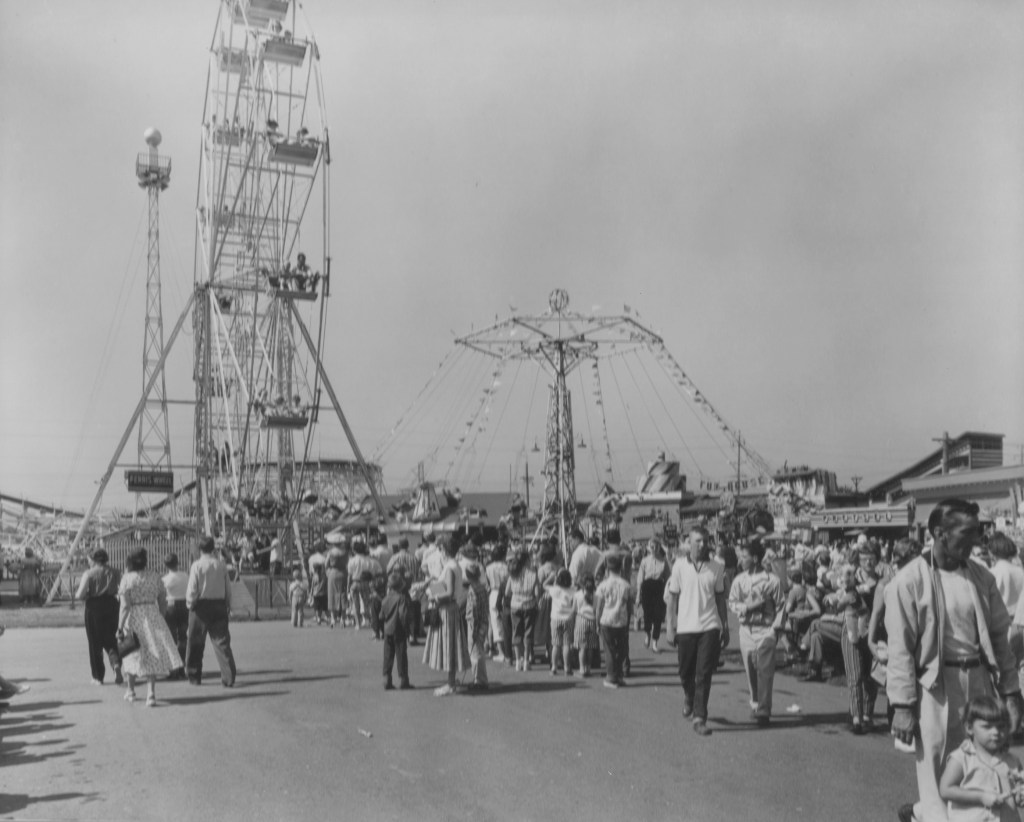
The Washington State Fair, previously known as the Puyallup Fair for the Tacoma suburb where the grounds are located, has been operating in one form or another since 1900. The fair has always been focused primarily on agriculture and livestock, holding popular competitions on mainstays like produce weighing and judging everything from horses to rabbits. There has also been a consistent feature on folk art, canning, lumber and horse racing which people regularly travel across Washington to participate in.

Because I was so new to Tacoma when I started working with the WSF, I was completely unfamiliar with the fairground’s use as a Japanese American internment site during WWII. Known technically as the The Puyallup Assembly Center or euphemistically as Camp Harmony, the fairgrounds were intended as a temporary holding place for Japanese Americans before being transferred to larger, more remote internment camps in Idaho, California and Wyoming. That said, poor planning and extended confinement led to dangerous and unsanitary conditions for the over 7,000 Washington State citizens retained there over time.

Could you describe your collections?

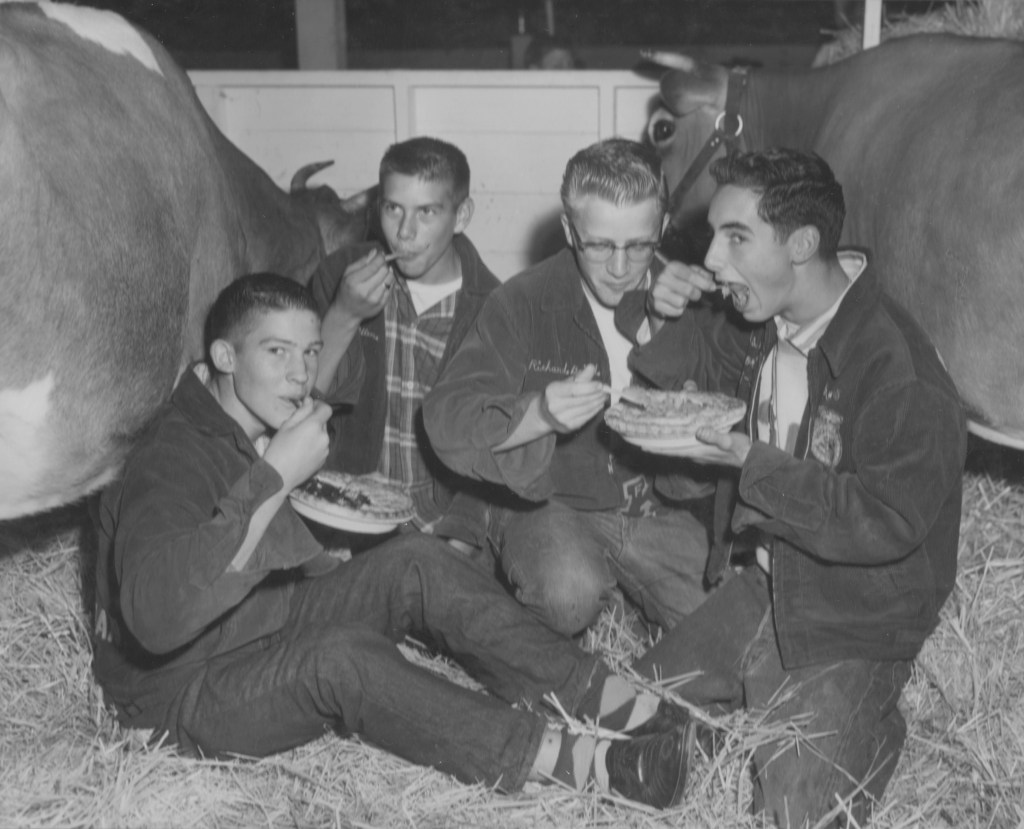
Although there were initially plans to process some moving image records, I only had a chance to work with the visual collections during my time with the WSF. For the most part, the subject matter for the collections was amazingly consistent from 1920 to 1980. Every year had jam and needlework competitions, petting zoos with intrigued/ terrified children, fireworks, pie eating and every imaginable variety of clown.

What are some of the challenges unique to your collections?

As I mentioned above, I began working with the WSF just as the pandemic was graduating from a concern to a real threat. I was able to work with the institution for a few productive months by picking up materials and working on them remotely, but it ultimately became a logistical impossibility as everyone began to realize that the fair was not going to take place that year. Like many working with archives during this time, I was furloughed from the position not very long after beginning to work on the collection. That said, I was able to attend the 2020 SAA conference almost immediately afterwards, and it was incredibly beneficial to connect with others in the field, as so many of us struggled to stay afloat during this historic moment.

What is the favorite part of your job?

I am fascinated by nineteenth and twentieth century fairs, expositions and lyceums. These events merge community, industry, agriculture, politics and religion and reveal incredible insights into a community’s shared values, fears and aspirations.

What advice do you have for aspiring archivists?

One kind of silly hurdle which kept me from pursuing my MLIS degree for too long were negative experiences with institutional gatekeepers who over-emphasized the technical aspects of library science. While I am currently developing my skills around web design and coding, and will continue to in the future, I am fully aware that these skills will never be my strongest assets that I can lend to future projects, and that’s ok!

If anyone reading this also comes from more of a storytelling background, there is still absolutely a place for you in archiving. You will still have to struggle though learning these platforms which may be completely second nature to others, and you may be the least proficient person with these tools during future meetings. This is all in service of being able to clearly communicate your digital storytelling, UX and instructional design concepts with more technically minded collaborators in order to create the best possible work for your archive.

There’s an archivist for that! Interview with Mott Linn, Chief Librarian of the National Security Research Center (NSRC) at the Los Alamos National Laboratory (LANL).

This is the newest post in our There’s an Archivist for That! series, which features examples of archivists working in places you might not expect. In this article, Mott Linn talks about his role leading one of the world’s larger scientific research archives.

Mott, thanks for talking with us. Please tell us a little about yourself.

ML: My BA is from the University of Delaware, I have master’s degrees in history (University of Wisconsin – Madison), librarianship (Drexel University), and nonprofit management (Clark University), and my doctorate in library management is from Simmons College.  I am also a Certified Archivist. 

My first archives job was with the Philadelphia Flyers and after that I created the NHL’s video library.  I spent 10 years at Clark University in charge of their archives before 10 years leading the collection services half of their library.  I am now the Chief Librarian of the National Security Research Center (NSRC) at the Los Alamos National Laboratory (LANL). 

How did you get into archives? 

ML: By replying to a blind ad in a newspaper (how times have changed!). 

Today, the archival profession’s biggest problem is having too many archival education programs training far too many people to be archivists, who then have great difficulty finding jobs; this is our profession’s great tragedy.  When I started my career, the opposite was true: there were very few education programs.  The good news is that over those decades the quality of archivists has improved; back in the 1970s a major goal of SAA was to do just that.  Because of that, SAA started offering workshops, began publishing manuals and books, established the standards process, and created the Academy of Certified Archivists. 

So, it was not unusual back when I was first hired that I had no training to work in an archives.  However, I did have considerable experience doing research in archives.  Furthermore, I had played, refereed, and coached ice hockey, which meant I had the desired subject expertise for my first job. 

How did you get your current job? 

ML: A headhunter contacted me.  They hired me because not many archivists also have the managerial experience that I have; for example, at the time I was overseeing a $2 million dollar budget.  It also helped that I had overseen the collection of a famous scientist, Robert Goddard, the father of modern rocketry.  

Tell us about your organization.

ML: LANL is a United States Department of Energy laboratory.  It was created during World War II as part of the Manhattan Project to design the first nuclear weapons.  Los Alamos is now one of the largest science and technology institutions in the world and conducts research in a wide array of scientific fields.  It is located in the beautiful mountains of northern New Mexico, which is a wonderful location for outdoor activities. 

Could you describe your collections?

ML: The NSRC collects scientific research materials related to the nation’s defense.  I dare say that we have one of the largest archives in the US.  For comparison, we have a larger collection than most, if not every one, of the presidential libraries.   

We house both a large number and a wide array of materials.  For example, we have over 3 million radiographs, almost a million aperture cards, and a half million engineering drawings. 

Despite our size, the NSRC is only a couple of years old.  Previously, the materials that make up our collection were either in records management or being held by the various LANL lab buildings.  Since we are a new archives, we are still expanding our collections and have been growing our staff. 

Although our collections are used for historical research, they are more heavily used by the lab’s scientists to further their research.  For example, a scientist recently found the results of a series of experiments from years ago that their lab was planning to conduct.  Because we found the previous results, we saved the lab millions of dollars since they did not have to conduct the experiments again.  It is great to both save the US taxpayers money and find the data that our scientists want. 

What are some of the challenges unique to your collections? 

ML: Depending on where our acquisitions are coming from, they might have to be tested for hazardous materials.  Another facility that had created an environmental disaster recently sent us hundreds of boxes. Those boxes were tested.  

In addition, there is the red tape dealing with security and safety regulations.  For example, because of national security reasons, every person on my staff and each of our customers need to have security clearance. 

What is the favorite part of your job? 

ML: I was hired to turn the NSRC into a properly functioning archives.  Additionally, I really like recruiting new archivists to add to my team and helping my staff improve themselves with professional development activities. 

What advice do you have for aspiring archivists? 

ML: First, since too many people are being trained to be archivists, I would ask if they are up to doing the needed training with the possibility of not being able to find a job afterwards.  As I said, there are too many archival education programs training too many archivists; that so many of them cannot find jobs is tragic. 

Second, if they still want to be archivists, when earning your master’s degree, create a backup plan via your choice of classes.  For example, somebody getting a library degree could also take a few cataloging and metadata classes, thereby creating the possibility of getting cataloging jobs. 

Third, expect to continue to grow professionally after graduation because professionals are expected to keep up with improvements in their field.  This is all the more true because of the stiff competition for archives jobs.  You could earn a second master’s degree, go to conferences, and/or take some workshops in an area that you want or need to know more about. 

The most important part of that is becoming a Certified Archivist.  Most professions, such as doctors, lawyers, appraisers, records managers, and accountants, have a way of both certifying who is competent to practice that profession and a method of recertifying who continues to have that competence as that profession evolves.  The Certified Archivist designation serves that purpose in the archives profession.  So, prove your competence to yourself and others, including employers, by becoming a Certified Archivist. 

THERE’S AN ARCHIVIST FOR THAT! INTERVIEW WITH ASHTON WINGATE, THE DIGITAL ARCHIVIST OF THE NAACP LEGAL AND EDUCATIONAL DEFENSE FUND, INC.

Ashton Wingate, Digital Archivist of the NAACP Legal and Educational Defense Fund, Inc.

This is the newest post in our There’s an Archivist for That! series, which features examples of archivists working in places you might not expect. COPA member Rachael Woody, owner of Rachael Cristine Consulting LLC, brings you an interview with Ashton Wingate, the Digital Archivist of the NAACP Legal and Educational Defense Fund, Inc. (LDF).

Ashton Wingate currently works for the NAACP Legal and Educational Defense Fund, Inc. (LDF), where he preserves the organization’s 80 year history in the fight for racial justice, equality and an inclusive society. To learn more about Wingate, please visit his website.

RW: Please tell us a little bit about yourself.

AW: On the professional side… I am fairly new in my position, I joined LDF in January of 2019. Previous to becoming a Digital Archivist, I was a librarian in the D.C. Public Library system leading early literacy outreach/programming. My time at the D.C. Public Library taught me a lot and I highly encourage every information professional to work in a public library for at least a little bit of time to understand the power and responsibility of our profession. I am a board member of the National Home Library Foundation and the board treasurer for the Archives Roundtable of Metropolitan New York. Personally, I spend most of my time with my fiancé and our two dogs in our cozy Brooklyn, NY apt which has become MUCH “cozier” during quarantine. I have interests in music, sports, craft beer and cult films. In the past I’ve done radio and podcasting so I’m possibly looking to start that back up if I can find time. I have a small side hustle doing graphic design and building websites for friends and family. If you’re looking to spruce up your personal/professional brand hit me up!

RW: How did you get into archives, or why archives?

AW: After I graduated from undergrad, I spent the first nine months selling cereal for Kellogg’s. Worst job ever! Nothing wrong with Frosted Flakes but I didn’t take the job as seriously as I should have and I am definitely not a salesman. After that didn’t work out, I spent the next 8 years or so in communications for a variety of non-profits and government organizations in Washington, D.C. Eventually, I hit a wall and just wanted to do something different. I saw the advertisement for the Department of Library and Information Science at Catholic University on the train and something just told me to check it out. Looking back on it now, I think access to information is just so big for me. It is probably one of the biggest civil rights issues of our time and I just wanted to be a part of that in some way. Keeping people informed and allowing everyone an equal opportunity to understand more about the world around them is key.

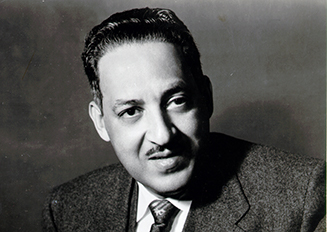
Thurgood Marshall was an influential leader of the civil rights movement. He also had a profound contribution to the NAACP and his legacy lives on in the pursuit of racial justice. 
Thurgood Marshall founded LDF in 1940 and served as its first Director-Counsel. He was the architect of the legal strategy that ended the country’s official policy of segregation. Marshall was the first African American to serve on the Supreme Court on which he served as Associate Justice from 1967-1991 after he was successfully nominated by President Johnson. He retired from the bench in 1991 and passed away on January 24, 1993, in Washington DC at the age of 84. Civil rights and social change came about through meticulous and persistent litigation efforts, at the forefront of which stood Thurgood Marshall and the Legal Defense Fund. Through the courts, he ensured that Blacks enjoyed the rights and responsibilities of full citizenship. 

RW: How did you get your gig at the NAACP-LDF?

AW: Fate? I’m not really sure. I know many people can relate but it’s not easy getting a job in this field especially as a new graduate. Whether it’s the unrealistic expectations/job descriptions or the (sometimes) low pay, it’s difficult to find the right opportunity. I knew that I wanted to move to NYC so that narrowed things down, from there it was a mixture of luck and perseverance. I applied for A LOT of jobs; my heart wasn’t set on just archivist. I was on every job board, every website, contacting friends of friends… I never thought it was going to happen, especially not an opportunity like the one at LDF. I’m eternally grateful to my boss and LDF leadership for taking a chance on me and I can’t imagine working anywhere else or doing anything else with my skills and expertise.

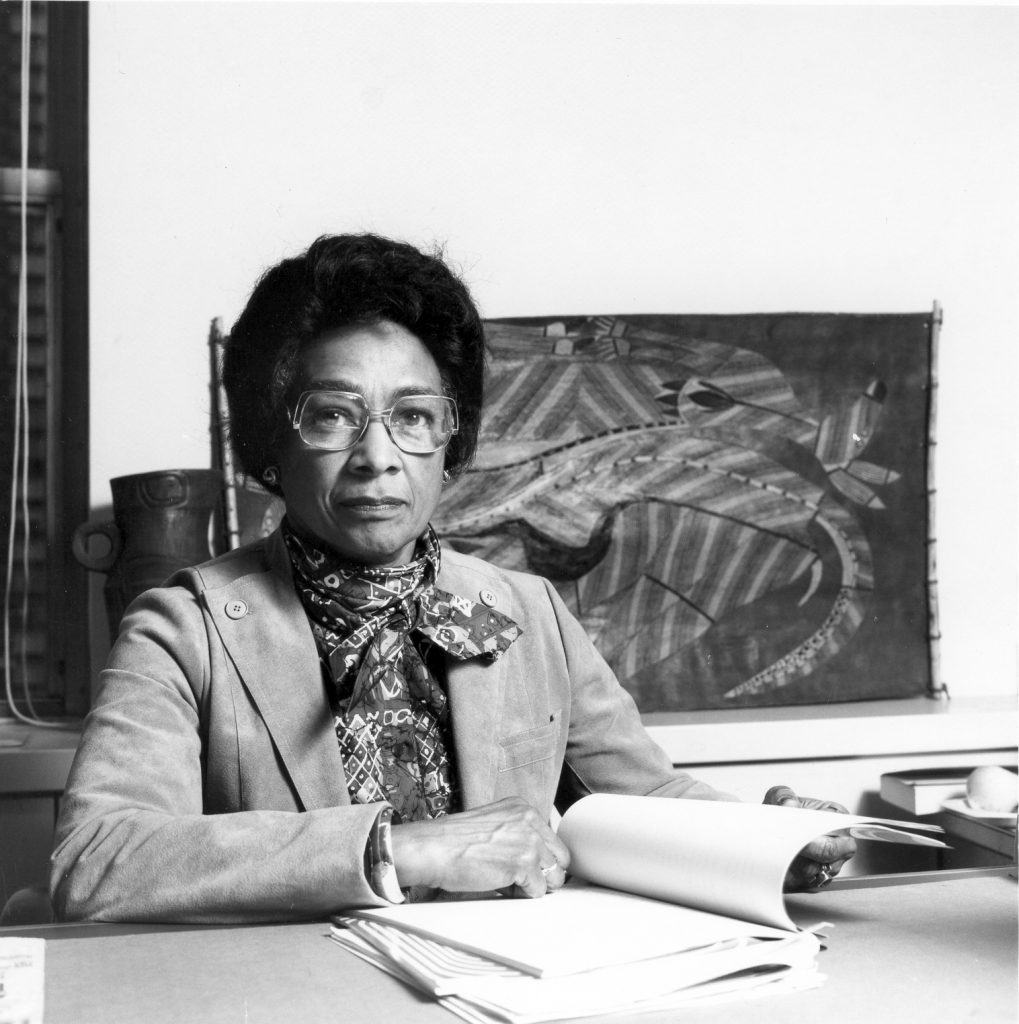
“Our Division is committed to the principle that minority group citizens must be empowered to work for their own liberation. Our role is to heighten their consciousness of their legal rights and to assist them in developing strategies to make bureaucracies accountable,” Jean Fairfax stated in a 1972 report to funders. The NAACP Legal Defense & Educational Fund’s (LDF) Division of Legal Information and Community Service was created in 1965 by Fairfax, who served as the Division’s director until her retirement in 1984.

RW: Please tell us about your work at NAACP-LDF.

AW: The way that I have come to describe our work is that we add historical context to the ongoing conversation about race and its relationship to justice, politics and society. We are tasked with preserving the 80-year history of the country’s most prestigious legal organization fighting for racial justice. From Brown vs. Board of Education to representing Muhammad Ali and Martin Luther King, to the current moment we’re facing as a country… it is a daunting task. We are a team of three serving an organization of almost 200 people. We answer reference questions, maintain collections of physical and digital legal and social science research resources, manage records retention and physical box storage as well as work strategically to ensure that each and every legal, policy, educational and community organizing effort is informed by the organization’s rich history. We are a unique archive but we are tackling some of the same problems as others including document management, data governance, training staff and getting buy-in on archival best practices/priorities and of course dealing with budgets and constantly presenting the value proposition for how archives fits within the organization’s mission and vision.

Right now, we’re in the midst of what we’re referring to as an “archives modernization”. With incredible support from LDF leadership and from generous donors, we’ve undergone an evaluation of our current archival structure, policies and procedures which has given us a roadmap going forward on where to invest our time and funding. We plan to update our workflows and processes, strengthen our technological infrastructure, procure new software for e-discovery and box management as well as identifying high priority physical and digital processing projects and work towards sharing our collections publicly through an online research portal containing information about LDF’s 6,000+ cases from 1940-present day. As a law firm, we have yet to open our collections up to the general public due to concerns over privileged and sensitive legal information.

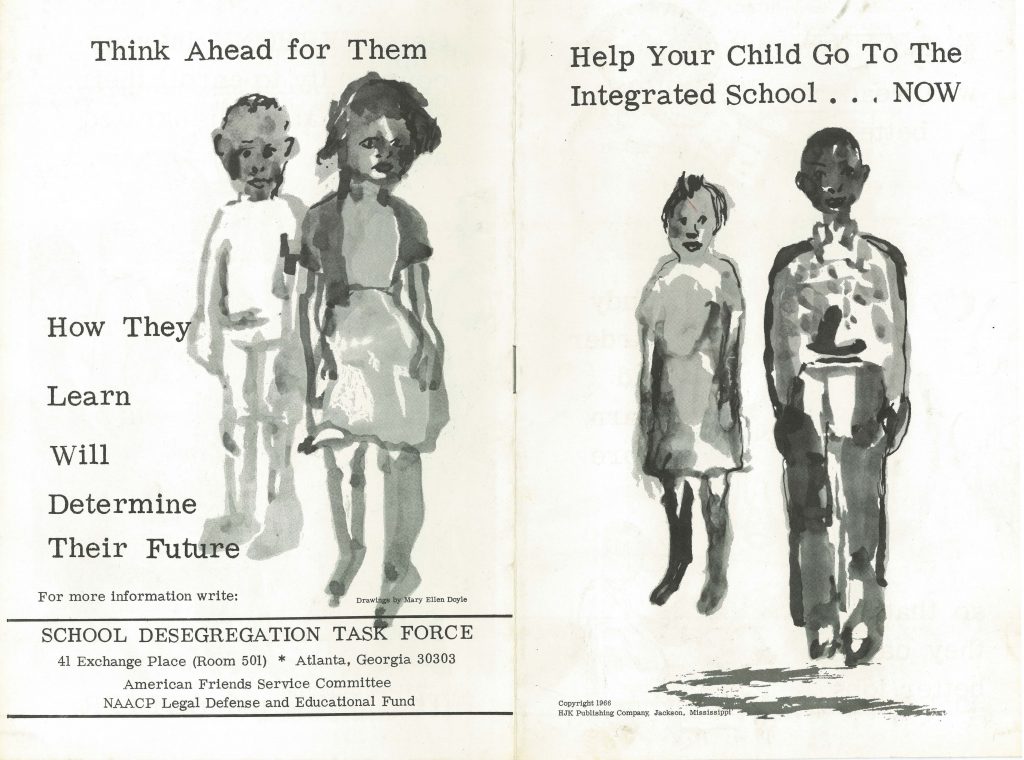
The School Desegregation Task Force was a core program of the Division in the mid-1960s, with Fairfax serving as the project administrator. In a 1967 memo to funders, LDF Director-Counsel Jack Greenberg explained the aims and impact of the task force: “The opportunity for equal education for Negro children was finally at hand, but the problems incident to its realization were overwhelming. The Legal Defense Fund joined with the American Friends Service Committee to create a School Desegregation Task Force which operated in hundreds of local communities, especially in rural areas, in nine southern states.

RW: Please describe the collections or one of your favorite collections.

AW: The core of our collection is pleadings, research, and correspondence related to thousands of cases LDF has litigated. Our holdings also include photographs, videos, policy files, publications, fundraising materials, administrative records, and documentation of LDF’s sustained efforts in community organizing and social science research. We have over 250 boxes of physical material at the Library of Congress and over 10,000 boxes in storage between our New York and DC locations in addition to an ever-increasing amount of digital records.

LDF’s second Director-Counsel Jack Greenberg describes LDF’s ability as an organization to “bridge the gap” among the laws that govern our society, the enforcement of these laws, and the everyday people who are impacted by these laws and practices. He highlights LDF’s focus on not only setting legal precedent, but creating substantive social impact to improve the lives of African Americans.

RW: What are some challenges unique to the collections?

AW: One of the biggest challenges is the fact that we cannot share the information publicly with any level of ease. The majority of our collections is case material and cannot be released publicly without thorough review for privileged and sensitive information. Another challenge is just our relative youth as an archival institution. The archives at LDF was created in 2014/2015 and the majority of our collections have not been processed or digitized. It makes it difficult to fully gain an appreciation or understanding of LDF’s work and impact over the past 80 years. We are steadfast in our mission to work through the backlog of physical material and we’ve highlighted important cases and collections that we will be processing for the next three years. Because we are essentially a non-profit law firm and our retention and document management hasn’t been as strong as it is now, there is a lot of LDF material outside of the archives at other universities, repositories and still hiding in people’s basements! In the past, members of our litigation staff have been transitory, and they’ve taken their papers with them. A long-term goal for us is to track down these collections, take note of where they are and make efforts to accession them into our collections if the current steward cannot or no longer wishes to preserve them.


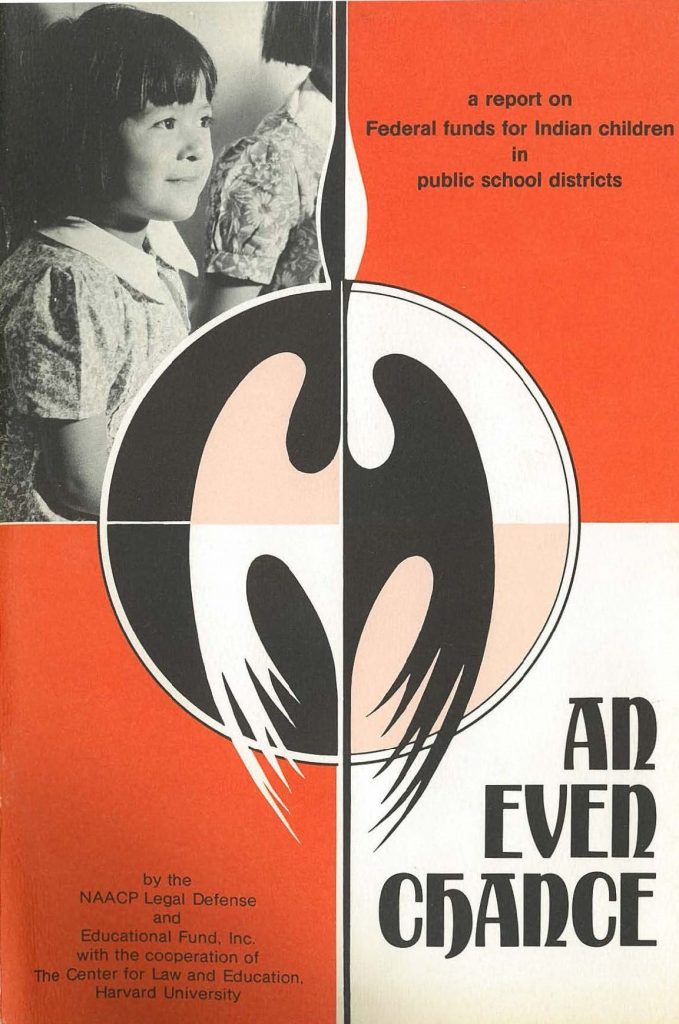
Phyllis McClure, author of An Even Chance,  introduces the research as having a “familiar theme:” the misuse of Federal education money intended to benefit poor and minority children. According to a 1971 LDF annual report, “the impact of this report on Governmental agencies responsible for the education of Indian children has been stunning. The facts revealed in the study present a shocking record of disregard of the rights of Indians guaranteed them by treaties, laws passed by Congress, and laws of individual states. The report opens the way, based on facts, for action to correct wrongs inflicted upon Indian children and their parents.”

RW: What’s your favorite part of the job?

AW: My favorite part of the job is just knowing the importance of my work to the organization’s larger mission and the way in which we are all working together at LDF to meet this moment in time that is so important for civil rights and racial justice.

RW: What advice to you have for aspiring archivists?

  1. Believe in yourself! Shake the imposters syndrome as best you can.
  2. Advocate for what you need to do your job well.
  3. Join a board or professional network to continue to make connections and see different aspects of our field.
  4. Do whatever it takes to get the job done. Specialization is nice and important in some ways but to me there’s no difference between an archivist, a digital archivist, a librarian or a records manager… everyone on our team is doing all of that because that’s what the job calls for.
  5. Be visible in your organization. As a department, don’t hide in the archives, get out there and offer your services wherever there is opportunity for collaborative work. Share your successes. As an individual, just try to be seen. I always try to find some way to be helpful to leadership so they know they can depend on me. I also try to be vocal during meetings so that people know I’m there.

RW: Is there anything else you’d like to share with us?

It is our organization’s 80th Anniversary, keep your eyes out for the launch of our timeline covering 80 years of groundbreaking legal milestones in the fight for civil rights. It was a heavy lift for our department digging up archival information on over 100 cases as well as biographies on important figures and finding ways to relate the historic moments to the work we’re doing today. It’s something we’re proud of and it is coming soon! Check this link for more information: https://80th.naacpldf.org/

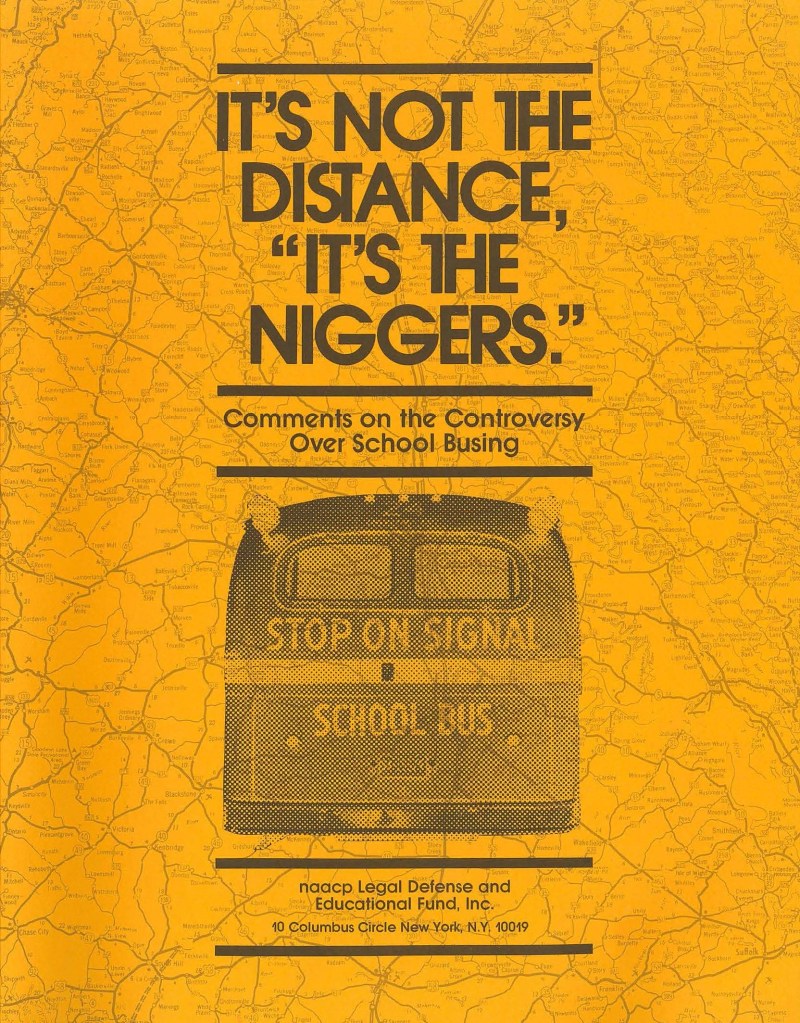
It’s not The Distance, “It’s the Niggers.” Comments on the Controversy Over School Busing, May 1972, attempted to “bring facts and reason to bear on the current hysterical and politicized discussion about busing,” said Fairfax. The report found that “busing for integration…has not required a major reallocation of scarce funds and has usually been accepted once plans have been implemented.”

Also, I want to put in another plug for the Archives Roundtable of New York. It is an awesome organization; membership is super affordable, and we do our best to make sure we’re contributing to the archivist community in a real way. We’ve just launched a mentorship program and a skill-share and we have office hours every other Tuesday where members can call in and talk about whatever is going on professionally. We also have an open call for submissions to our quarterly publication the Metropolitan Archivist and a call for proposals for a virtual symposium that we’re holding as part of our Archives Week event this fall. More information can be found at www.nycarchivists.org.


While the LDF collections are closed, the archives does accept external inquires on a case by case basis. You can email your request to this address: archives@naacpldf.org.

THERE’S AN ARCHIVIST FOR THAT! INTERVIEW WITH ANNETTE LA RUE FROM ELECTROMAGNETIC TATTOO AND ADAM JEFFERY FROM THE BALTIMORE TATTOO MUSEUM BY ALLISON TERMINE

This is the newest post in our There’s an Archivist for That! series, which features examples of archivists working in places you might not expect. Allison Termine, brings you an interview with Adam Jeffery, the Tattooer, Collector of The Baltimore Tattoo Museum (est. 1999) and Annette La Rue, Tattooer, Collector from Electromagnetic Tattoo in Chesapeake, Virginia.

Interviewer: Allison Termine, I’m a trained Librarian, Archivist and Collections Manager, learning Taxonomy and Ontology. Capturing the essence of nostalgia in my life has always led me to activities, professional and personal, where I had the opportunity to observe, record, preserve, display, learn and organize primary and secondary material of history.

Image by Annette La Rue of Paul Rogers.

INTRODUCTION

The pioneering style in the trade of tattooing is called Americana. Knowledge of this trade was passed down orally by August “Cap” Coleman, 1884-1973 and Franklin Paul Rogers, 1905-1990, the for-father’s, what remains is tattoo ephemera and an oral tradition that lives on today through those they taught. Important historical artifacts of modern electric tattooing exist in various collections who are archivists in their own right. It is a treat to interview two artists and collectors of the Tattoo Trade to learn of a niche subculture through its remnants / ephemera. Just like other collected historical archives, provenance of the Tattoo Trade is based on oral dissemination and the now primary objects that were used to apply the final product were secondary to them and therefore have become a nostalgic link to the past. Such object items are; the tattoo machines, drawings on fragile tracing paper, business cards, pictures, adapted furniture for the tattoo sitting, banners, and flash to name a few. These accidental archivists, interviewed are artists and collectors and are what I consider boots on the ground archivists. A term that describes the importance of gathering material in the present time, which they have done throughout their career in the Tattoo Trade.

*To discover an in depth history of the origins of Americana Tattooing visit:
http://www.tattooarchive.com/index.php and
https://selvedgeyard.com/2009/07/21/forefathers-of-american-tattooing/.

Image by Annette La Rue. Pictured is a Paul Rogers original tracing paper flash from “Sailor Eddies” Shop in Camden, New Jersey 1971. With additional acetate stencil rubbing of a “Cap” Colemans’ drawing reworked by Sailor Jerry.

Our first interview is with Annette La Rue of Electromagnetic Tattoo, Chesapeake Virginia. Find her shop owned by her and her husband Steve Tiberi, also a tattooer and collector on Instagram @electromagnetictattoo, @annettlelarulex, and @tiberitattoo.

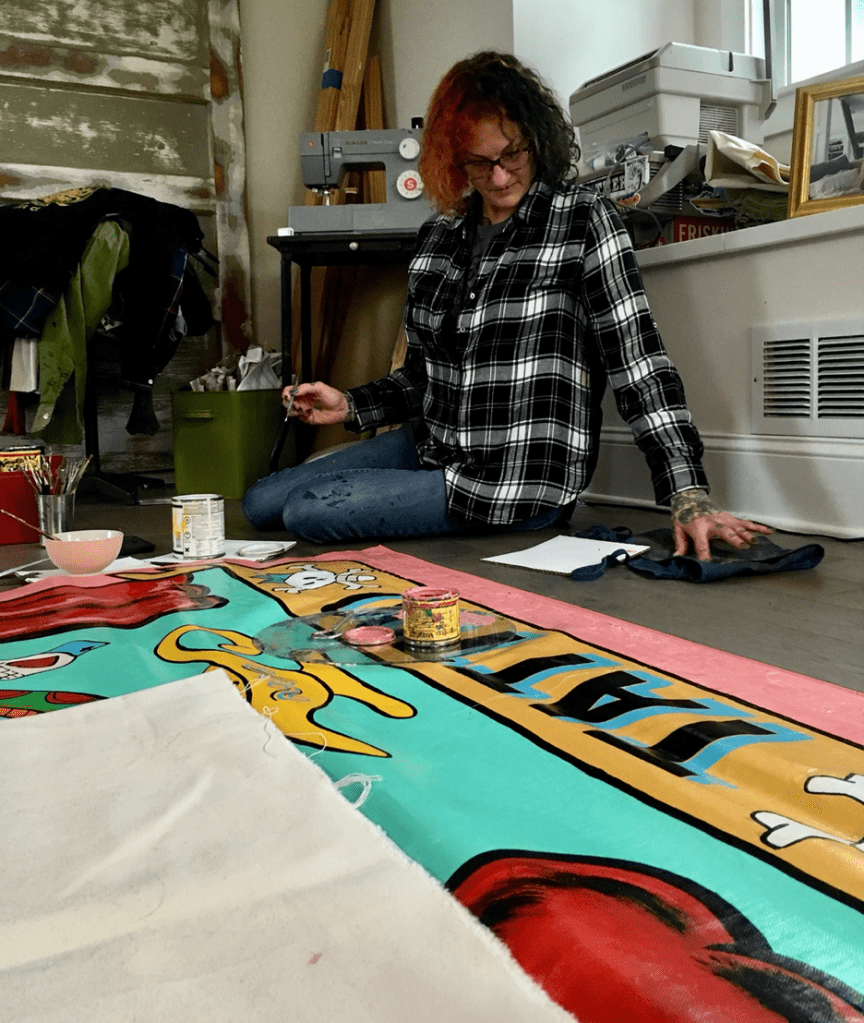
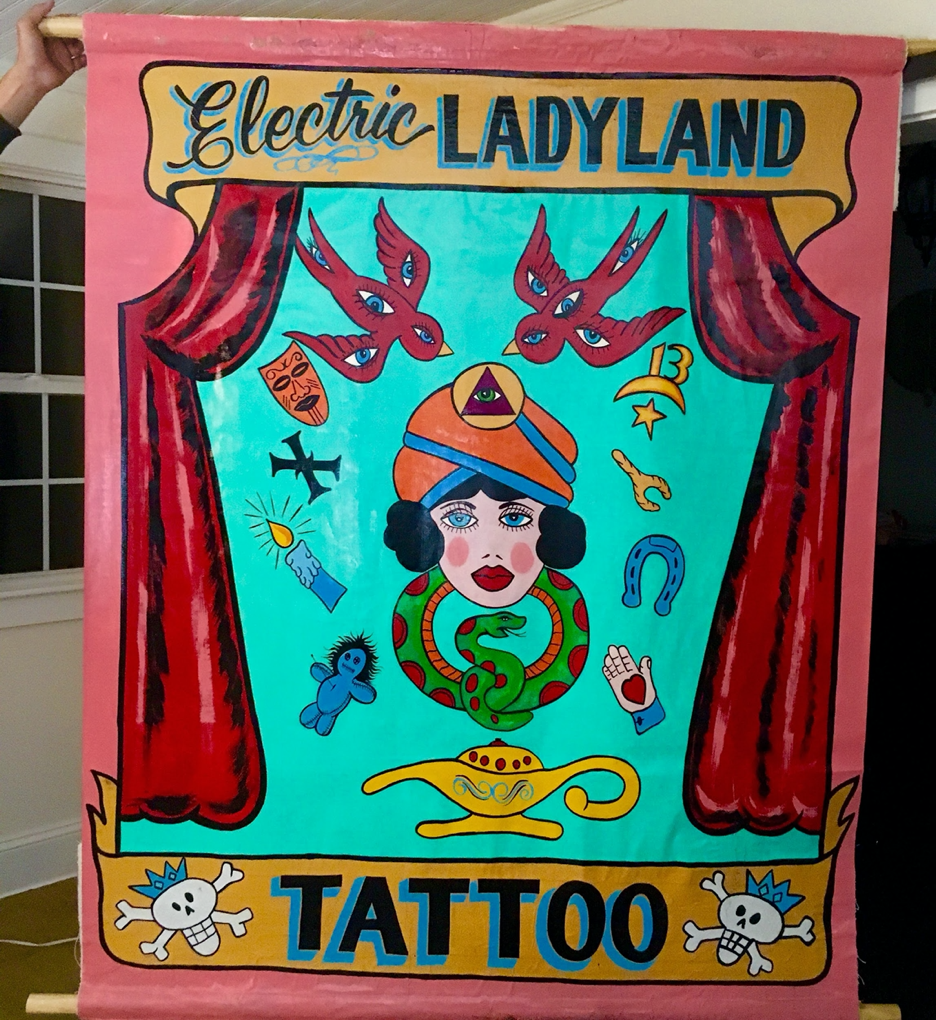
Image by Allison Termine. Annette La Rue and I doing conservation work, on a banner made by her friend, Ernie “Ernie the hat” Gosnell, of her former tattoo shop in New Orleans, Louisiana. Electric LadyLand.

Q: As a Tattooer of 30 years can you tell me about the history of Americana Tattooing?

Americana style tattooing means a bold colorful style consisting of bold thick outlines, solid black shading and bright solid colors. Americana tattooing was popular among sailors and circuses at the turn of the century. Most tattooers traveled with the circus or went to busy Navy port towns. It was seedy and frowned upon to have ink on your skin until the late 90’s into the 2000’s.

Image by Allison Termine. The Electric LadyLand banner made by, Ernie “Ernie the hat” Gosnell, of Annette La Rue’s former tattoo shop in New Orleans, Louisiana.

Q: As a collector of your trade what drove you to save ephemera of the tattoo trade throughout your career? (Your perspective then and now).

I was fascinated with older tools and designs because they connected me to the old ways. Kind of like a bridge to the heroes of yesterday. I felt a little “magic” in those tools. It made me feel like I had a link to the past and it made me proud to have possession of the tools of the trade. Now it’s just more stuff and I’m selling and trading my collection for things I can actually use. I want the younger tattooers to have those objects so they can feel like I did. To own historical tattoo pieces is like instant “cred” for anyone who has it. If you have money, you can be a collector. When I was buying you had to track someone down, go to their shop or house and beg them to sell you things. Now it’s on ebay and craigslist, too easy to get.

Q: Can you tell me about the significance of early tattoo machines and how the knowledge of building them was passed on and evolved through the years?

At the time there was no significance to old tattoo machines; they were simply a tool to make money. Tattooers would travel and visit each other and learn different ways to build machines. Most machine builders have their own style or frame configuration. They would mail parts and write about the secret trick they had to make to make their machines better. There was a lot of friendly competition between tattooers. Some builders got famous and some were more obscure. Machines from the old times are very valuable today. When the old guys died a lot of families were embarrassed about the line of work and tons were thrown out, leaving a few for younger tattooers to scourge to find them. Good builders would invite younger ones to come build and learn. You could spend the day or a few weeks with a builder and get secrets and tips while making your machine. A smart person would go to everyone’s house they could and did blend all the knowledge and make it on his or her own. This is significant because the younger generation needed to know the tips of the trade in order to keep machines up and running and it also helped the young guys to progress using old ways.

Q: If the collected ephemera of Americana Tattooing is the result of a trade learned orally, could you tell us about how the forefathers of Americana Tattooing influenced this particular style that remains “timeless” and how it has lasting power today over all other styles of tattooing being applied to skin?

I believe Americana style remains timeless because the designs were timeless. From the 1800’s to the late 1990’s an eagle looked like an eagle. A rose was a rose. You could tell what it was in two seconds. That is what makes it timeless. Today’s tattoos are trendy and you can tell if someone got it in their 90’s or early 2000 or 2010 or 2020 because of the design. They may seem more personal now but they aren’t. People get the same bad trendy design over and over, thinking they are “custom” and they don’t realise we tattooed that same design 40 times that month. Most timeless designs can be changed with different colors or leaves or background etc. Modern designs have not much room to change, as customers want it to look the same.

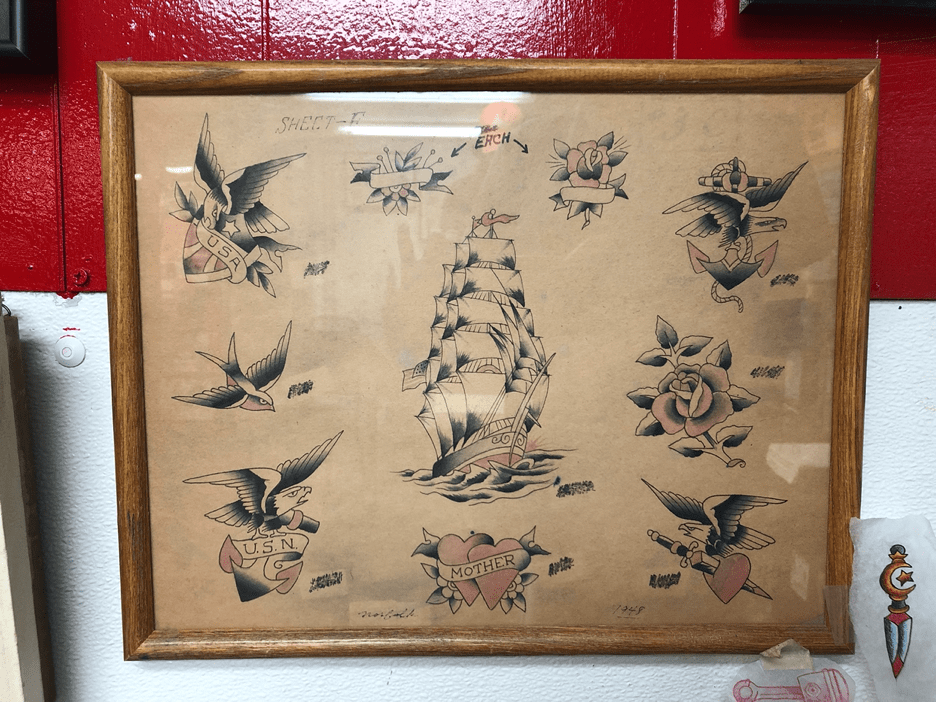
Image and caption by Annette La Rue. Pictured is a “Cap” Coleman original flash with signature and date, 1948. The significance of owning this sheet of flash is that 72 years ago “Cap” Coleman was in the next town over applying these very designs. This is my favorite piece in my collection and probably priceless.

Q: What is your favorite part of knowing you are an accidental archivist?

My favorite part of knowing I’m an accidental archivist is just knowing I can make young tattooers as excited and happy as I was when I started collecting. Of course these items all increase in value every year. It is the younger Tattooers having interest in keeping this history alive that I find interesting.

Our next interview is with Adam Jeffrey of The Baltimore Tattoo Museum. You can find Adam on Instagram @adamjeffreytattooer, and @thebaltimoretattomuseum.

Q: What are the types or formats of tattoo ephemera that were saved and what makes them significant? For example; how did a single piece of torn tracing paper with a pencil drawing become deemed “to save”, or a business card from Paul Rogers.

At The Baltimore Tattoo Museum we hope to explore the history and artifacts of modern tattooing in the Americana style. When it comes to the types of ephemera we collect that makes them significant are varied. For example, from some artists the art itself was secondary to their abilities to apply tattoos or build and tune tattoo equipment. So there are varying reasons we try to collect the many things we have. Some are significant to the tattooers of our area and the designs of a given town, for example, shipping and navy type tattoos in Baltimore, as it is a major east coast port. In other cases it might be the little inventions they crafted to make their everyday tasks a little easier like, retrofitting an old dental type chair to create better access to an area of skin to be tattooed. In other cases it’s their amazing ability, these untrained artists had to create very well drawn and thought out lasting style designs that even years later folks still would like to have applied to their skin.

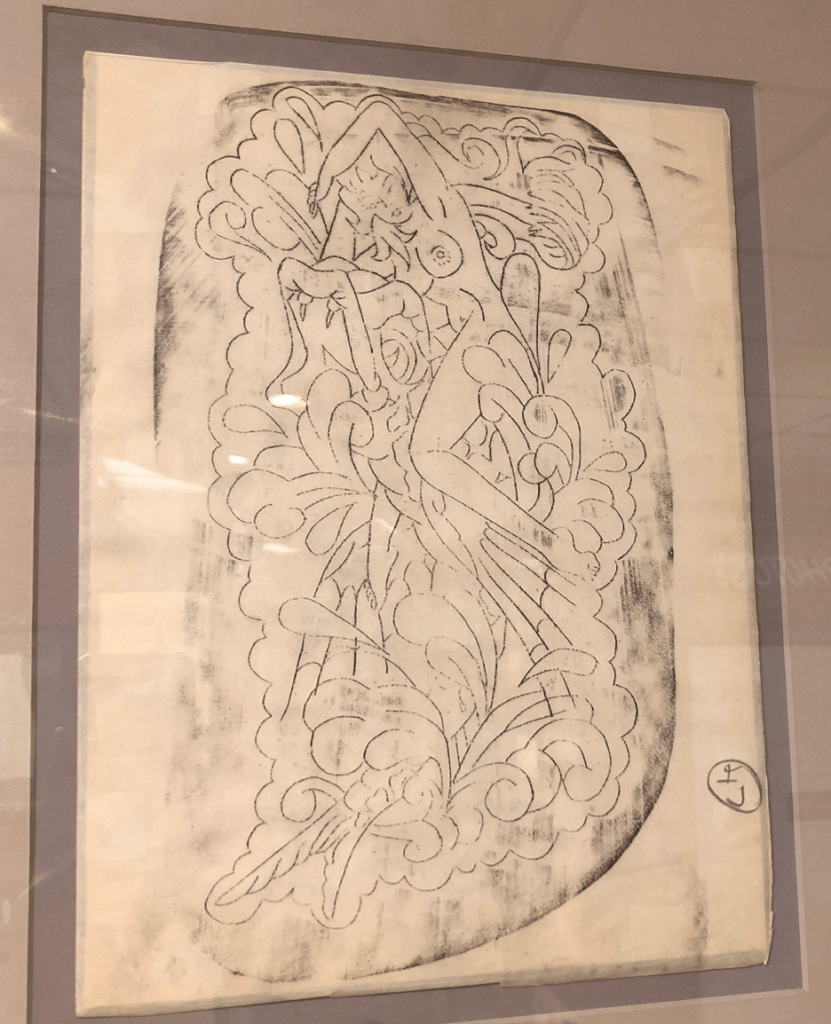
Image and caption by Adam Jeffrey from The Baltimore Tattoo Museum. Pictures is a rubbing of an acetate stencil made by Paul Rogers and sent in the mail to Ernie Carafa to share the design to make money. Back then, designs were common and people liked them that way. Uniformity with subtle differences to make it each artist’s own with various colors or background elements.

Q: If the collected ephemera of Americana Tattooing is the result of a trade learned orally, could you tell us about how the forefathers of Americana Tattooing influenced this particular style that remains “timeless” and how it has lasting power today over all other styles of tattooing being applied to skin?

Like us at Baltimore Tattoo and Museum and the majority of tattooers, still apply tattoos with the same electromagnet style tattoo machine they’ve always used. There are even modern makers making the same style frames that were being made in the turn of the century. As well as the same hand motions and application styles that were handed down to get the pigment under the skin, to have a good outcome to the tattoo once it’s healed. Also, the way the machinery is set up and tuned, to make precise lines and shading etc.

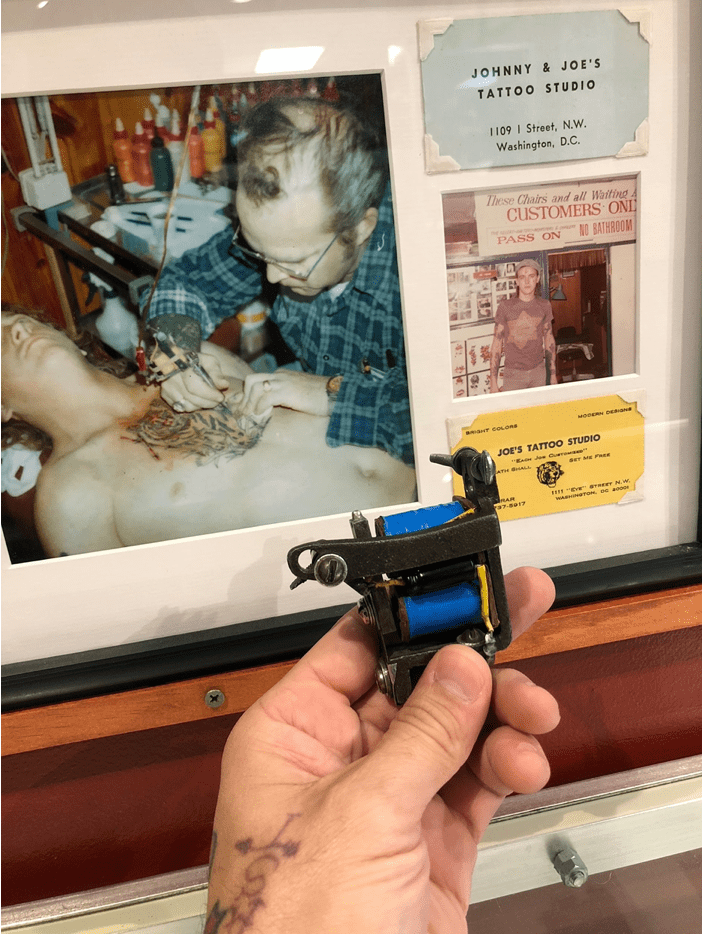
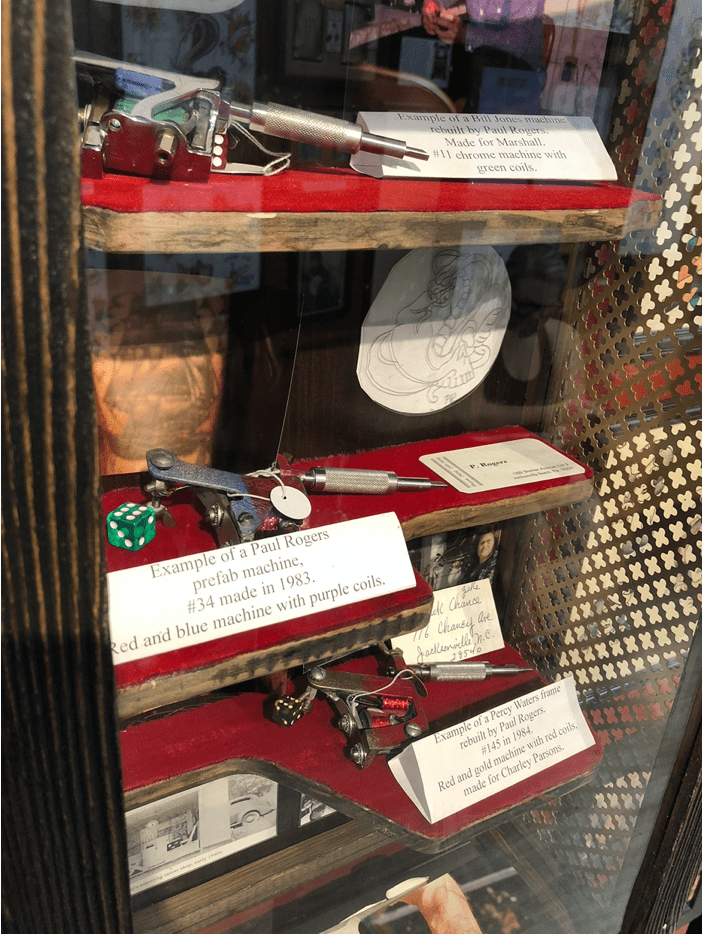
Image and caption by Adam Jeffery from The Baltimore Tattoo Museum. Pictured is a Joe Farrar machine built for Johnny Walker who tattooed with “Cap” Coleman of Norfolk, Virginia, and Sailor Jerry Collins in Honolulu, Hawaii. The machine is a Percy Waters model #7 from the 1940’s-1950’s era, that Farrar rebuilt to serve as a shader. Pictured in the right-hand corner is Joe’s tattooing and business card from their DC location.

Q: Can you tell us of one of your favorite collections?

I personally love our collection of Paul Rogers tattoo machines acetate stencils and flash. Most of it came from the collection of Charley and Sandy Parsons who are two of my mentors and were close friends with Paul who tattooed from the late 1920s till the late 1980s. Paul was an innovator and all around crafty artist making his own equipment, mixing his own colors and a designer of tattoos. The total package and to boot a good person as I am told.

Image and caption by Adam Jeffery from The Baltimore Tattoo Museum. Displayed are Paul Rogers machines, acetate stencils made by Paul and a photo of a tattoo he did.

Q: What are some challenges unique to the collections?

The largest challenge is that prior to the 2000s Tattoo memorabilia was just old stuff or junk so a lot of it was thrown away or lost to time as tattooing was nowhere near as common as it is currently. So honestly, there isn’t as much of it to be had as one might think as well the prior you get it thru can be hard to deal with as it has become more popular. Prices have gone up and you are getting it second and third hand now so the provenance of it isn’t easy to establish.

Q: What is your favorite part of knowing you are an accidental archivist?

My favorite part of being an accidental archivist is interacting with other collectors who have been collecting for a long time, their knowledge helps me place dates and times on artists, machines and flash that I’ve had questions about. It can be an awesome community.