
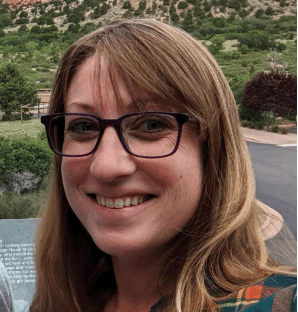
This is the newest post in our “So You Wanna Be An Archivist,” series, where archivists and other information professionals describe their path to the profession. In this article, COPA member Angie Piccolo interviews Kathryn Hoogendoorn about their path to becoming the Digitization Specialist for the United States Holocaust Memorial Museum in Washington D.C.
Q: Please describe your current position.
Kathryn: I am the Digitization Specialist for the United States Holocaust Memorial Museum in Washington D.C. Basically, I am a program manager for digitization of paper and object digitization. It is a large cross-office effort that requires extensive communication and logistics with all of our divisions.
Q: What drew you to the profession?
Kathryn: I think aspirations toward access and education of the general public were my biggest draws to the profession, as well as the cool stuff you get to see! I have always had a special place in my heart for historical documents and books.
Q: Can you describe your education background and work experience?
Kathryn: My route into archives is circuitous at best. In the beginning, I had wide-eyed dreams of being a chemist and I hold a BS in Chemistry. I have always been an avid collector of antique books but I never thought I could combine my hobby and degree. One day, I happened upon a historical library where I struck up a conversation with a conservator and realized I could! As I pursued conservation, my mentor suggested a Masters in Library and Information Science (MLIS). to start as an archivist and obtain certification in conservation. That sounded like a great plan, so I obtained my MLIS. I loved being an archivist so much, I never went back for my certifications.
Through the years, my career has taken me from working with the archival collection for long term preservation to focusing on digitization and digital access. I have worked as an archival assistant, a lone arranger for a corporation, a paper digitizer and now I am the lead for a digitization program focused on digital access. Digitization provides a rewarding, hands-on approach to the collection and how it is used in real time.

Q: What skill has been the most valuable in your career?
Kathryn: Picking just one skill is difficult, but flexibility and the ability to turn an idea into real work have been very valuable.
Archives are at the whim of many outside forces including budgets, Federal direction and donors. It’s important to be able to change priorities or workflows without letting it disrupt your sense of passion for the work.
Taking an idea like “these departments should work together to achieve a goal” may be easy to say, but difficult to articulate on paper and to implement. This is a project management skill that has been highly valuable in my career.
Q: What advice would you give to someone trying to enter into this field?
Kathryn: A passion for access, history, preservation and curiosity are key to being in this field. You won’t make millions, but you will have a very rewarding career.
I always advise students going into archival studies to look at their bachelor’s degree and go for a secondary interest like education, science or public administration. These degrees do not prevent you from obtaining your archives related Master’s degree, but they do provide a foundation of skills and knowledge that will be invaluable.
Ask around. Archivists love to share!
Consider the digital side of archives. It may not sound as glamorous, but we have a really great time and there are constantly new developments making the work more and more interesting every day.


 ArchivesAware