A COPA Guide to SAA 2017

Capture

Just one month to go until the annual conference in Portland!  As you plan your conference schedule, take a look at the Committee on Public Awareness (COPA)’s guide to all things public awareness-related at SAA 2017: https://archives2017.sched.com/committeeonpublicawareness.

To make it even more digestible, we’ve broken down the Sched list into the top 5 things you should check out.

1.) Be sure to catch our 2nd annual Advocacy Forum on Thursday at noon!  Our timely topic is “Archival Advocacy and Awareness Amid Social/Political Upheaval.”  This talk will be moderated by COPA chair Sami Norling and the Committee on Public Policy (COPP) chair Dennis Riley.

2.) Chat with us during our COPA office hours in the Exhibit Hall on Friday.  We’ll be there from 8 – 8:30 am and 12:30 – 1:30 pm.  We’ll be collecting your Federal Funding Impact Stories, ideas for Ask An Archivist Day 2017 (October 4, 2017), nominations for inspirational archives speakers and stellar collections, and soliciting contributions to this very blog!

3.) Still not sure what COPA does?  If you arrive early, join us for our meeting on Wednesday at 2:00 pm.

4.) Staying late?  Take advantage of all of The Liberated Archive sessions, happening throughout the day on Saturday.

5.) Finally, look at all of that green in the middle of our schedule.  There are so many great sessions highlighting archival outreach to the community this year.  You’re sure to find one which fits your particular public outreach interest.

See you in Portland!

Share Your Federal Funding Impact Story!

CapitolImage_620

On Thursday, March 16, 2017, President Trump sent an outline of his proposed FY 2018 budget to Congress, to be followed by a more detailed proposal in the spring. The budget, known as “America First: A Budget Blueprint to Make America Great Again,” proposes a $54 billion increase in defense and public safety spending that is offset by equivalent cuts in discretionary non-defense programs. Included in those cuts are reductions in, or the total elimination of, funding for federal agencies with a history of supporting cultural heritage organizations and projects.

Share Your Story!

The proposed budget eliminates funding for the following agencies with a history of supporting archival and other cultural heritage projects:

  • Institute of Museum and Library Services (IMLS)
  • National Endowment for the Humanities (NEH)
  • National Endowment for the Arts (NEA)

The proposed budgets for other agencies with archives-related programs have not yet been released. These include:

  • National Archives and Records Administration (NARA)
  • National Historical Publications and Records Commission (NHPRC)
  • Library of Congress
  • Smithsonian Institution

Although this budget originating from the Oval Office is only a proposal, with Congress ultimately controlling appropriations, this proposal serves as a reminder to cultural heritage professionals in archives, libraries, and museums that it is always important to advocate for our institutions and those sources of funding that are so crucial to the work that we do.

During the lengthy appropriations process to come in the House and Senate, we should focus our advocacy efforts on the appropriations subcommittees with jurisdiction over the programs that affect SAA members and the institutions that employ them. By sharing examples of the positive impact of federal funding for the arts and humanities with representatives in both the House and Senate, we as a profession can hope to affect the decisions made regarding these federal funding agencies.

As archivists, librarians, and museum professionals, we know how our collections, institutions, and local communities have benefited from grant funding from these federal agencies. We collect statistics about the work we accomplish under these grants, but we also know that the impact goes far beyond numbers alone.

Consider: Did your federal grant-funded project empower K–12 educators to teach with primary sources, connect family members through genealogical records, or inspire a community art project?  Did a federal grant enable your institution to create jobs, contract with an external vendor, or carry out a project that had a fiscal impact on your institution? It is these stories of direct impact, whether personal or fiscal, and at all levels–within your institution, your local community, or even on a national scale–that speak to the true value of federal grant funding for the arts and humanities.

Personal impact is powerful. Please share the details of your federally funded project and the story of its impact. Access the online submission form at the following link:

Share Your Story!

Submitted stories will be published online by the SAA Committee on Public Awareness, and promoted by the Society of American Archivists through their website and social media channels. We hope to gather stories representing all types of archival repositories, and in all 50 states and the District of Columbia, so please consider sharing your story–no impact is too small when it comes to advocating for federal support for the arts and humanities! Please check back regularly to ArchivesAWARE and the main landing page for the Federal Funding Impact Story initiative on the SAA website to read and share stories of impact.

NEH        NHPRC

IMLS

NEA

Header image courtesy of the Library of Congress.

An Interview with the lead authors of “Recommendations on Federal Archives and Records Management Issues” for the Trump Transition Team


In December, a document outlining Recommendations on Federal Archives and Records Management Issues was submitted to the Trump Presidential Transition Team by the Council of State Archivists (CoSA), the National Association of Government Archives and Records Administrators (NAGARA), the Regional Archival Associations Consortium (RAAC), and the Society of American Archivists (SAA). The document was authored by the CoSA/NAGARA/SAA/RAAC Joint Working Group on Issues and Awareness. Chris Burns, SAA’s Committee on Public Awareness (COPA) representative to the Joint Working Group, interviewed three of the primary authors of this document, Jim Corridan (Indiana Archives & Records Administration), Dennis Riley (New York State Archives), and Barbara Teague (Kentucky State Archives, retired), to talk about the document and its importance as a policy, advocacy, education, and awareness tool.


Where did the idea of this document come from? Have there been similar efforts in the past?

Barbara Teague: – There was a jointly authored transition document in 2008, that was primarily focused on criteria for a new Archivist of the United States but also addressed other issues of importance. Back then there was a  meeting of  CoSA, NAGARA, SAA representatives with two people from the Obama transition team. This year, Dennis Riley and Kathleen Roe did an initial draft , starting from that 2008 document. However, some of the issues in the 2008 document were focused on issues in the Bush  administration.

Dennis Riley: We started with the 2008 position paper and tried to reframe it and make it more applicable to 2016. We looked at SAA issue briefs and joint statements from the Joint Working Group that had been released and picked out issues that might fit here. We put a lot into the first draft, and then the group edited it down. Funding issues are perennial issues, so those were easy to put into the draft. We took a broad approach in the initial draft.

Jim Corridan: NARA has caught up on declassification in a big way since 2008. Great strides were made in many ways in the last 8 years. Records management compliance and statutory responsibility continue to show improvement, so we didn’t have to talk about this as much as in 2008.

Dennis: The 2008 document focused on specific problems. The 2016 one is a broader approach, addressing common issues that any administration should be aware of: adequate funding, adequate resources for NARA/NHPRC, etc., the necessity of good record keeping by public officials. It is less about legacy issues from the previous administration.

Jim: A new issue was the TPP (Trans-Pacific Partnership). SAA has opposed the copyright provision in the TPP, so  we included that, as well as the importance of government officials using government email to do government business.


Why was it important to write this and pass it on to the Trump transition team?

Barbara: It wasn’t requested, because transition teams look at the big agencies, they don’t necessarily look at archives issues. It is always a good idea to take the chance to emphasize the importance of archives and records management in government.  With this administration, there are going to be a lot of people who hadn’t been in government before. The goal was to make ourselves and our expertise available.

Jim: It is an education piece as well as policy, to assist those new to office in understanding the role of government records

Dennis: No one else is going to speak on behalf of these issues if archivists do not. As a government archivist, I believe the foundation of good government begins with good records and archival practice. How many officials at all levels keep getting tripped up by poor email habits? This is an opportunity to educate those in government or coming into government  about their responsibilities. We, as representatives of archival agencies, have a responsibility to say something, and to say it often. Other lobbying groups are pushing their agendas, we need to push ours.

Barbara: It is an advocacy and awareness tool. It has been published on all our websites,  as well as passed along to the transition team. We are also planning to share it widely, as  part of a greater conversation about how government  record keeping is central to our democracy.


What is the value of having the document come from all four organizations?

Dennis: The more consensus we have as professional representatives, the better. Agreement that these are the core issues that are important and important to our members adds weight to the final product.

Barbara: It comes out of our joint working group, having more statements come through that group helps gets all of the organizations on the same page, thinking about common issues. The group is only three years old, and we are still learning our role as a group, when to do a joint statement and when to do a statement  from an individual organization.


How did you make decisions about what to include in the document?

Jim: Dennis did a great job of starting with that 2008 version that we sent to the Obama Transition Team. We added current issues and other things that were missing, and deleted information that was no longer relevant, as we refined the the document. We benefited from input from our Joint Working Group, as well as the CoSA and NAGARA boards, SAA Council, and the RAAC Steering Committee.

Dennis: There was some difficulty discovering relevant background information that was available online, whether it has to do with funding (what are the challenges), or declassification (what is the status).

Jim: At one point, there were two sections that were extraordinarily long. We had to think about  the audience, not as archivists. A transition team member or transition staffer who may not make it through the first page is the likely audience.

Barbara: The Joint Working Group group is fairly new, and we learn a little more with each new document. We will come out of this most recent joint statement with a more clearly defined process for working more quickly on completing joint statements.

Dennis: This was an opportunity for the organizations to figure out how to communicate in a cooperative way.

Barbara: RAAC (Regional Archival Associations Consortium) brought a new perspective, as a recent addition to the Joint Working Group


What are a few of the highlights?

Dennis: The Executive Summary was more of a CoSA product. The original draft of the Executive Summary had a couple of bullet points but came back from CoSA in a less rough state.

Jim: In it, we succinctly say what we’re hoping to accomplish. Set the premise for each of the things we think are important.

Barbara: If something did pique their interest, there is a table of contents, so they could quickly get to that section.


What do you think a document like this can accomplish?

Jim: Educating the transition team and advisers. Maybe more importantly, we intend to send this to the Congressional committees that have oversight over NARA. It might prompt some support for particular issues. It will be more broadly utilized.

Dennis: This is just the beginning of making use of  this document. It’s a public policy agenda for the next four years. These are the important issues. We should exercise the voice that we have. If we don’t speak up, we definitely won’t have an impact.

Jim: It is important to try to set a positive and proactive agenda with the administration.

Barbara: We always need to educate any President that’s coming in. Not all of our members are familiar with these issues, so this is a good education tool showing concerns and positions to all members of these organizations that they can use as needed. Any archivist around the country can use this in discussing public policy issues

Dennis: We started the drafting process a month before the election.

Jim: The only substantive change was that it was addressed to Trump and not Clinton. We see this as a constructive engagement with the administration.


Since this blog is focused on raising the awareness of archives, how do you think this document does that and could it serve as a model for communicating about archival priorities in other settings?

Barbara: It is a really good model for state government, I doubt most state archivists  use a written transition briefing when a new governor is elected. We generally have meetings, and focus more on face to face, as opposed to sending something written, since we have access to state officials. State and local governments could use this as a model, to get important government issues before newly elected officials.

Dennis: This sets a tradition, since we have done this formally for two transitions now, in 2008 and 2016. It lay groundwork and expectation that this is what we as professional organizations need to do. It is an opportunity to engage with elected officials and to ensure that archival and records management issues don’t get lost in the transition. It is also an example of what our group members could be doing with elections at every level. How are we, as individual members, engaging our elected officials? Do I as an individual member feel empowered to send this to my newly elected representative? We are organizations of members. As such, members need to feel empowered to use this product to engage with their representatives.

Barbara: We didn’t do much with the 2008 document. We could use this as a tracking document to see how things are progressing, to follow the archives and records management agenda


Is there anything else you would like to add?

Barbara: Nancy Beaumont is the one who pulled the document together at the end. She never lets us compliment her (don’t let her edit out a compliment again!), but she does a great job keeping everyone on track, while helping us keep the big picture in mind.

 

I Advocate, You Advocate, We Advocate…with the Advocacy Toolkit

GeorgeC

This post was authored by guest contributor Christine George, Archivist and Faculty Services Librarian, Charles B. Sears Law Library, SUNY Buffalo Law School


Advocacy is a tricky thing. Sure there are definitions for it, but it seems like it means something slightly different to everyone. If you want proof, check out the Steering Shares on the Issue & Advocacy (I&A) Roundtable’s blog. One of the questions each I&A Steering Committee Member answers is “How would you define advocacy?” Each and every one of us has a different answer. Not drastically different, but each comes from a different perspective. Though the Steering Shares are only from the current I&A leadership, I feel fairly confident that past leadership also had varied perspectives.

One of the things to come out of those varied perspectives is the Advocacy Toolkit. Created by I&A’s 2013–2014 leadership, the Advocacy Toolkit was meant to pull together resources on advocacy for archives and archivists. In its own words:

A large part of advocacy involves convincing financial and political stakeholders of the value that archives add to a given community, and all related efforts need be supported by evidence. The resources listed, which also serve as access points to more resources, contain the types of quantitative information and qualitative narratives that help make the case for archives. This list is not exhaustive; rather it is a starting point for those looking for facts, arguments, and compelling reasoning to lend weight to their advocacy efforts. The resources linked here do not indicate endorsement, but offer some templates which can be used to formulate advocacy efforts.

The Toolkit has been updated by subsequent I&A Steering Committees. Over the years, the Advocacy Toolkit hasn’t caught on. We wanted to change that in a big way when we decided to tackle the latest update. To start, the Advocacy Toolkit got a new home. Beginning in 2016, we moved the Advocacy Toolkit and the I&A blog to our new website. Then we reached out to the Regional Archival Associations Consortium (RAAC) to help us expand the Advocacy Toolkit.

Step 1 of this collaboration is to evaluate what we have and plan out how to move forward. To do that, we need your help. Yes you. Chances are that if you haven’t already had to advocate for yourself or your collections you will have to at some point. We’d like your feedback on what we have and what you think might be missing. Please take a few moments and review the Advocacy Toolkit and then go and take our survey available at https://www.surveymonkey.com/r/T9XZ97Y. The survey will be open until THIS MONDAY, 5/16/16. If you have questions about the survey, or thoughts beyond the survey, feel free to contact us at archivesissues@gmail.com.

Archives Awareness on the Redesigned SAA Website

SAA_homepage

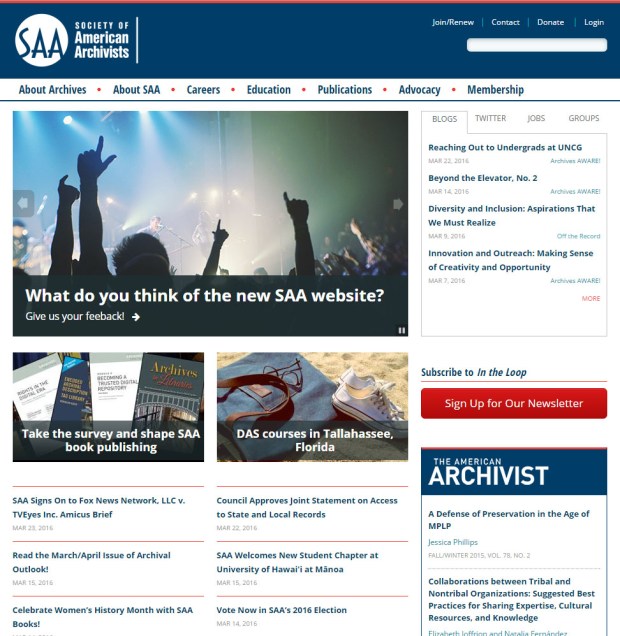
After many months of planning and development, the Society of American Archivists launched a redesigned website last week. Coordinated by SAA staff members, the new website reflects the work of many SAA constituent groups, including the Committee on Public Awareness (COPA) and the Committee on Advocacy and Public Policy (CAPP).

saa-strategic-plan-goals

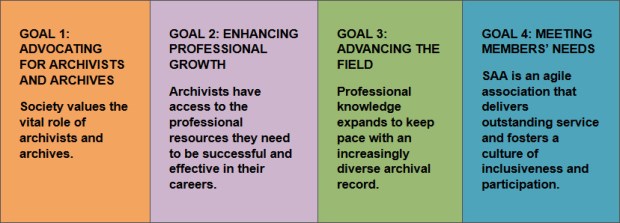
The four main goals of SAA’s 2014-2018 Strategic Plan.

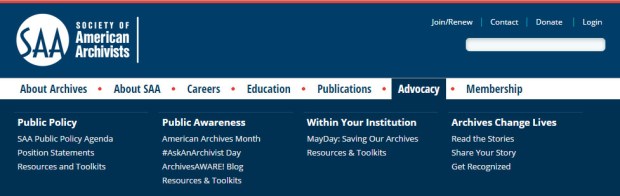
As a reflection of SAA’s current Strategic Plan, which prioritizes Advocating for Archivists and Archives as Goal #1, “Advocacy” is now prominently featured on the website’s main navigation bar. In this context, SAA defines “Advocacy” as not only the shaping of public policy that impacts archives and archivists, but also includes the act of raising public awareness of archives collections, institutions, and professionals.

Advocacy Banner

Advocacy links available directly from the main SAA page navigation bar.

Over the past year, COPA has worked to compile the many resources that lived throughout the former SAA website–on various sub-pages, constituent groups’ micro-sites, and external pages like this WordPress blog–and make them available in one centralized place on the redesigned website. These can now be found under “Resources & Toolkits” under Public Awareness.

The current list is just a starting point, with new additions to be added as they are identified. We welcome suggestions for additional Public Awareness resources and tools. They can be shared in the comments below, or e-mailed to archivesAWARE@archivists.org. As the ArchivesAWARE! blog was developed as a forum for sharing and discussing awareness-raising tools, tips, and experiences, we also welcome guest authors who want to highlight their resources on this blog, as a more dynamic compliment to the static Resources & Toolkits list!

Feedback

Just as the Advocacy and Awareness pages will continue to evolve, so will the entire website continue to expand–and the SAA office is eager for feedback. Take the survey and share your thoughts over the next few weeks!

Highlight: Advocating Business Archives Toolkit

Grimwood_NominatingCommittee
This post was authored by guest contributor Scott Grimwood, System Manager of Archives, SSM Health Care


Most archivists acknowledge the importance of raising awareness of archives and their value to individuals, organizations, and society as a whole–especially in regards to major stakeholders and decision makers. For business archivists, this reality cannot be denied: effective advocacy is often directly related to a business archives’ (and archivist’s) continued existence within that organization.

Any business archives exists at the discretion of the business it serves and is at risk of being shut down if it is not seen as adding value to the organization, or as they say in the business world, providing adequate return on investment (ROI). This can be very difficult for business archivists since ROI is measured by how much money you either earned or saved the company.

In 2014 the Business Archives Section (BAS) of the Society of American Archivists put together the “Advocating Business Archives Toolkit” as a central resource to its members, as a place where they could find extremely helpful information on and examples of successful advocacy. Because advocacy and awareness is vital to the to the entire archives profession, BAS encourages all archivists to utilize this valuable toolkit.

BAS

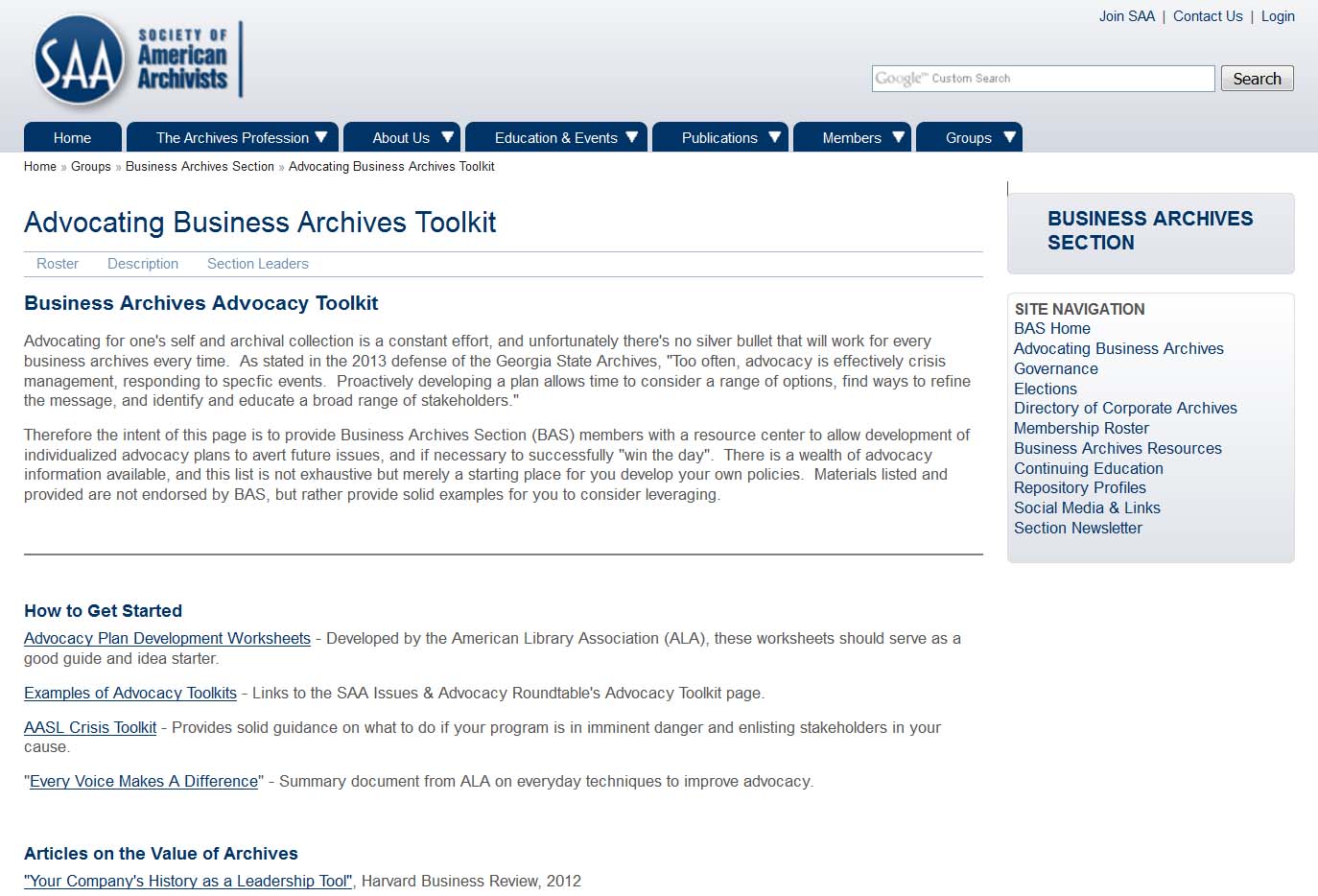
BAS Advocating Business Archives Toolkits screenshot, Society of American Archivists website

The Advocating Business Archives Toolkit has a wealth of information broken down into seven categories:

  • How to Get Started,
  • Articles on the Value of Archives,
  • BAS Member Recommendations & Success Stories,
  • Elevator Speech Examples,
  • Helpful Sites,
  • SAA Training Opportunities on Advocacy, and
  • Tips & Tricks.

The resources come from a wide variety of sources including external sources such as the American Association of School Librarians, American Alliance of Museums, and the Harvard Business Review.

The goal of the Toolkit is to provide archivists with the basic information to create and implement an advocacy program, and it does an excellent job. While the information from outside sources is very helpful, by far the best information comes directly from the experience of business archivists. Nothing beats a practical idea that has been tried and tested.

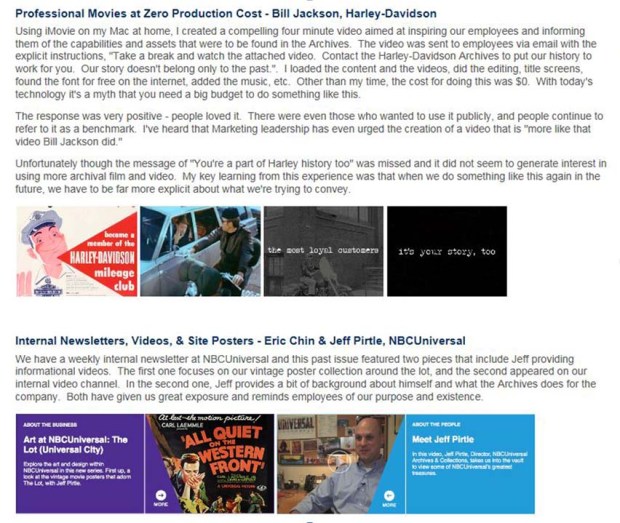
Most of the “archivist-tested” advocacy materials can be found in the “BAS Member Recommendations & Success Stories” and “Elevator Speech Examples” sections. The information and examples in both can be thought-provoking and inspiring, especially if you are looking to increase your advocacy efforts. Even if you do not work in a business setting, the motivations behind each example will be familiar to all archivists, and you’ll find many ideas that you can use as starting points to create an effective advocacy plan and individual projects and programs to raise awareness of your archives in your institution/organization/community.

Screenshot 2

Portion of the BAS Member Recommendations & Success Stories section of the BAS Advocating Business Archives Toolkit

While there can never be a single source for anything, the Business Archives Section’s “Advocating Business Archives Toolkit” comes pretty close when it comes to archival advocacy. It is worth your time to check out the toolkit and see what it contains that can be of help to you!

Share your favorite source of archival advocacy ideas in the comments below, or contact the ArchivesAWARE editors to contribute a guest post! Read more about the submission process on the About page, then contact the editors at archivesaware@archivists.org.

Welcome to ArchivesAWARE!

DWC_sm
This post was authored by guest contributor David Carmicheal, State Archivist, Commonwealth of Pennsylvania and Chair, SAA Committee on Public Awareness (COPA)

Yet another archival blog? Really?! Who has time for one more? We hope you have time because this might just be the most important archival blog you ever read. Really.

If you’ve hung around archival conferences and listservs for the last few years, or even had drinks with a few archival colleagues in the past month, you’ve probably heard the familiar lament: ‘My archives is misunderstood. No one knows what I do. My work is important but my institution keeps cutting my budget.’ But over the past couple of years the groans have been joined by a more exciting sound: the voices of archivists who are determined to do something about public perceptions of archives.

There have always been archivists who have a passion for archival outreach, and we all know individuals who are great at spreading the message that archives change lives, but lately those lone voices seem to be growing into a groundswell, an entire chorus of archivists working together to harmonize their message and express the value of our work in ways that a lone individual cannot. This blog intends to be an outlet for those who want to join that chorus. People like you. So, you should

Read this blog. Want to learn how to better express the importance of archives to colleagues, friends, or even strangers? Want to learn tips and techniques to help you make the case for archives to your boss or your board? Can’t quite get the hang of that elevator speech? Keep your eye on this site. You should find plenty of good advice here.

Write for this blog. Had a great outreach success or an advocacy disaster? Share it here. We’ll all learn from each others’ triumphs and failures. Care to talk about upcoming events related to outreach, advocacy, or awareness? This is your place.

Share this blog. Do you have friends or colleagues who might like to read  this blog or write for it? Maybe even some non-archivists who have experience or expertise in public relations or outreach? Share the link!

If you join us in this venture—if we work together to share our experiences and build new skills in advocacy and awareness building—this could easily become the most important archival blog we’ll ever read. Are you ready to join the chorus?

Want to join the conversation on ArchivesAWARE? The editors are always looking for additional content! Read more about the submission process on the About page, and contact the editors at archivesaware@archivists.org.