Recent Society of American Archivists Statements

The Society of American Archivists (SAA) has made a concerted effort to respond to each new affront to archivists and cultural heritage workers as well as to share resources to support impacted archivists. To amplify and encourage wider distribution of this information and to raise awareness of the organization’s stance on current events, this post will collate recent updates from SAA leadership (as of March 19, 2025).

SAA Response to AOTUS Removal Urges Advocacy

The leadership of the Society of American Archivists (SAA) is alarmed by the dismissal of the Archivist of the United States on February 7, 2025. We believe the removal of AOTUS with no stated cause does harm to our nation and its people. The Society wants to reassure our colleagues across the profession that we continue to support the mission of the National Archives and Records Administration (NARA) to preserve and provide access to the essential records of the federal government.


As archivists, we adhere to a set of core values that champion accountability and social responsibility and promote preservation, access, and use. Protecting the integrity of the federal record and affirming the work of those who care for it aligns with our professional codes and responsibilities.


SAA will continue to monitor the situation at NARA and will actively work to support NARA workers and archivists across the United States. In the meantime, we want to remind you that your voice matters; please take a few minutes to contact your legislators today.


It’s all in the details. When advocating, use statistics and facts to help support your claims. Tell your representatives and senators why the safekeeping of government archives is essential to a free and healthy democracy. Call or write to them to share how national archives change lives.

Some examples include:

  • preserving and promoting our nation’s foundational documents, 
  • giving veterans access to their personnel records to secure benefits, 
  • connecting with your family’s history, 
  • teaching students about the history of the United States, and 
  • studying and understanding the human experience. 

SAA will continue to support our NARA colleagues by contacting policymakers directly about the importance of government archives and records management. We appreciate the voices of the many SAA members who have reached out to us over the past few days and stand with you as partners in advocacy.


SAA Condemns Widespread Firing of Archivists and Cultural Heritage Workers

The Society of American Archivists condemns the decision of the White House to terminate substantial numbers of archivists and cultural heritage workers at the National Archives and Records Administration (NARA), the National Park Service, and other government agencies.


All federal employees who work with archives serve a vital function for the United States. The White House’s staffing decisions, which compromise the livelihoods of thousands of individuals, jeopardize the preservation and access to the evidence that safeguards individuals’ rights, documents government actions, and ensures transparency. The actions can be seen as threatening the independence of NARA, thereby creating a risk that public servants can evade accountability. Federal archives are foundational infrastructure for a democratic society and should serve their non-partisan function without political interference.


SAA strongly urges Congress to assert their prerogatives, retain Congressionally authorized staffing levels, and preserve Congressionally legislated agency independence.


SAA Council extends our support and solidarity to impacted workers. The Council is actively working to determine how best to support federal archival workers during this time. We welcome impacted workers to contact SAA regarding how we can best provide support: president@archivists.org.


SAA Statement on Media Reports Concerning Records Destruction

According to multiple news reports, USAID workers have been ordered to destroy or burn records, including classified records. Current reporting indicates conflicting information on whether the agency is in compliance with the Federal Records Act, which governs records from executive branch agencies.

With the many current federal actions targeting the reduction and elimination of federal agencies, the Society of American Archivists notes that such actions increase the risk of non-compliance with the Federal Records Act across federal agencies. Federal statute (44 U.S. Code § 3105) and regulations require agency heads to prevent the unlawful or accidental removal, defacing, alteration, or destruction of records. The swift shuttering of USAID raises questions as to the proper disposition of that agency’s records, including ensuring permanent records are transferred to the National Archives and Records Administration (NARA). Furthermore, SAA supports all federal staff in their effort to uphold the rules and statutes governing the management of records and archives.

Federal courts have been asked to intervene on this and other White House efforts to undermine records management and archives activities. SAA will continue to monitor these developments.

We encourage SAA members and all who care about the importance of government archives to contact their elected members of Congress with the following key messages:

SAA has created a list of resources for federal workers available on the SAA website Resources for Federal Workers.
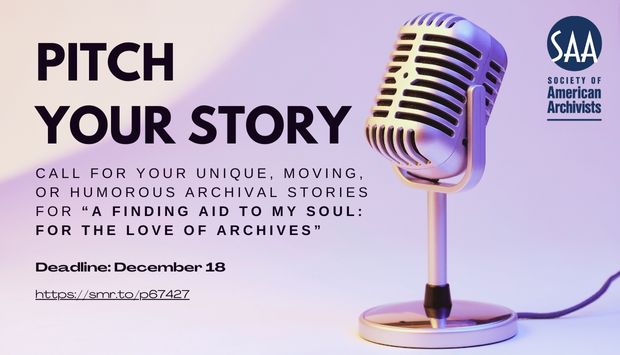
Call for Submissions: “A Finding Aid to My Soul: For the Love of Archives.”

SAA’s Committee on Public Awareness (COPA) is pleased to announce the return of its storytelling event with a special 2025 Valentine’s Day edition, “A Finding Aid to My Soul: For the Love of Archives.”

When did you decide that you wanted to be an archivist? What was your first encounter with an archives? How did you handle a challenge in your work? What is a unique, serendipitous, moving, mysterious, special, or humorous experience you’ve had as an archivist? We want to help you share your story!

The Event

During “A Finding Aid to My Soul: For the Love of Archives,” archivists from a variety of institutions and experience levels will share 5-minute true, personal stories of their connections to archives they have encountered. The virtual event—on Friday, February 14, from 12:00 to 1:00 p.m. CT—will be hosted by award-winning storyteller and educator Micaela Blei (The Moth, Risk).

Who Should Submit

We’re looking for a wide range of voices to share their experiences. Absolutely no storytelling or performance experience necessary. Bonus: Micaela will be available to support you as you practice your story. 

You may think that your story is not “dramatic” enough. We beg to differ! We want to hear stories with high stakes as well as small, intimate stories of the work you do and the personal ways it connects to your life. If it matters to you, it will matter to us, too. (If you need some inspiration, listen to selections from past “Finding Aid to My Soul” events on the Archives in Context podcast.)

Please note: If you participated in the Master Storytelling Workshop in October, we especially invite you to submit!

How to Submit

Submit your story for consideration. In 100 to 200 words, tell us about your archives story. (No cliff-hangers, please! Summarize the whole story.) Great pitches will include what happened, what changed for you (or the world!), and what was at stake.

Story submissions are due by December 18.

Selected storytellers will be notified in January.

From the Vaults — Public Relations and Marketing for Archives: An Interview with Peter Wosh

This series celebrates all the great information that exists in ArchivesAWARE!

This interview originally published on May 2, 2016, is one of the most popular posts on the blog. 


Wosh2011

 Among the resources in SAA’s advocacy toolkit is Public Relations and Marketing for Archives: A How-To-Do-It Manual (2011), edited by Peter Wosh and R. James and co-published by SAA and Neal-Schuman Publishers, Inc. Today we bring you an interview with Peter Wosh, Professor of History and Director of the Archives/Public History Program at New York University. In this interview with David Carmicheal, Peter revisits the book and discusses the ways it relates to current advocacy efforts.

David: What prompted the book in 2011? Was there an event that brought advocacy to SAA’s attention?

Peter: Back when I was publications editor for SAA [2007-2013] the Publications Committee regularly scanned the literature to identify gaps, and we discovered that SAA’s last real advocacy book had been published in 1994 (Advocating archives: An introduction to public relations for archivists, by Elsie Freeman Finch).  Our scan of journals also showed very little literature about advocacy. There was much more archival writing on technical topics. Then, too, by 2011 archivists had become much more conscious about how central to our work advocacy is and how we need to spend more time on it. So the time was right for that book.

How do public relations and marketing relate to advocacy? Are they the same thing?

They relate, but I think of advocacy as a much broader concept that incorporates marketing and public relations. The public relations and marketing book focuses on how archives relate to user communities—primarily external communities—and how to make your archives more visible by using new technologies. This kind of marketing doesn’t include, for example, political advocacy. Advocacy includes internal audiences, which marketing and PR don’t generally consider.

When we decided to revise the Archival Fundamentals series (Archival Fundamentals III is due to be published in 2017) we thought it important to include a specific volume about Advocacy (being authored by Kathleen Roe) because the publications board thought it was so vital to what we do and had to be more encompassing than marketing and PR.

Advocacy versus marketing—do archivists favor one over the other?

I think they are more comfortable serving more traditional research communities and are still in the process of developing tools to promote themselves and their place in their particular institutions. To some extent archivists are also still hesitant to enter the public sphere of debate when archival issues come to the fore, though that is getting much better. I think it’s hard to mobilize the archival community around issues. Professional associations like SAA and CoSA take a stand on key issues, but I wonder how many people really take a personal responsibility to advocate. Advocacy needs to be sustained and ongoing and not just crisis management. We are better at responding to threats, but successful advocacy is being there all the time and promoting yourself in a constructive way 365 days a year.

How do we turn archivists into advocates?

Advocacy isn’t built enough into archival training and education. Archivists are good at standards and best practices and applying rules and regulations, and that has been the emphasis of our education and professional literature to a great extent. We don’t necessarily need individual courses in advocacy but every course should incorporate advocacy—how does what you’re learning in this course helps you express the importance of what archivists do. It needs to become part of our everyday lives.

Do you have an advocacy success or failure in your career that is instructive?

When I was at the American Bible Society I would ask myself what are the big issues facing the organization I work for and can I put together historical background papers to send to the Vice President or others that might show them the value of the archives. They responded well to my taking existing information and packaging it in a way that was meaningful to them.

When I was an Archdiocesan archivist it was a time when making church records open was a new idea, and many officials were nervous about who might be using the records. I would send them user reports (not just statistical) that included stories about how lives were touched by the archives. By talking about the range of users I was able to demonstrate that making the records available was actually supporting their larger mission to help parishioners and people in general.

I would say, finally, that just doing your job strategically is a form of advocacy. Doing the job well communicates the value of what we do in a quiet way.

Advocacy and Outreach Opportunities at the Archives*Records 2020 Annual Meeting

Last week was the start of the SAA Annual Meeting with the Teaching Primary Sources Unconference kicking off the Pre-Conference activities. Here is a list of some recommendations for awareness and advocacy sessions and creative outreach.

Please note, there is a mix of live, recorded, and on-demand sessions. Make sure to visit the schedule and view session descriptions to see which category a session or meeting falls and whether you need to register for a session.

Wednesday, July 29

College & University Archives Section

Join the Section to continue discussion on the various topics we’ve had at our weekly “coffee chats”, including collecting COVID stories, working and managing remotely, combating systemic racism at our institutions, and our plans for returning to campus. We’ll split into breakout sessions to explore these topics further. But first (after our business meeting), we’ll hear from Katie Howell, who developed a rapid response collecting initiative to document COVID-19 on the campus of UNC Charlotte.

Students & New Archives Professionals Section

Join SNAP for a brief business meeting as we present updates on section projects and advocacy work from the past year and introduce new steering committee members. 

Friday, July 31

Archives Management Section

Look, I Made a Hat: Agility in the Archives
Archives managers are required to don many hats (as it were) in addressing a range of challenges and moving quickly to implement solutions. After conducting some section business, we will transition to presentations on incredibly timely topics: Budgeting, Personnel, and Advocacy.

Monday, August 3

Storytelling Workshop with Micaela Blei

A powerful story has the potential to connect us to our own experiences, pull a community together, and engage new audiences with our work. In this master class storytelling workshop led by two-time Moth GrandSLAM winner (and former Moth director of education) Micaela Blei, you’ll learn “what makes a story work” and the connections among narrative performance, research, and teaching, as well as brainstorm and craft stories of your own.

The workshop is structured to make the online experience as engaging and welcoming as possible—using a webinar format and then an optional small-group discussion structure to allow you to take part in the workshop at the level that will best serve you. 

Registration is required and there is an additional fee of $49.00 to attend.

Wednesday, August 5

Keeping Archives Relevant in a Dizzying Digital World

Join Preservica customers and staff as they explore together the evolving impact of digital archives, celebrate user projects and stories, and discuss innovations in archival practice.

Thursday, August 6

Plenary 1

In addition to hearing our current president, Dr. Meredith Evans speak, this session includes Jodie Foley and Tempestt Hazel. Jodie Foley is the Montana State Archivist at the Montana State Historical Society.

Tempestt Hazel was the 2019 recipient of the J. Franklin Jameson Archival Advocacy Award from the Society of American Archivists. She is a curator, writer, and founder of Sixty Inches From Center, a Chicago-based arts publication and archiving initiative that has promoted and preserved the practices of BIPOC and LGBTQIA+ artists, and artists with disabilities across the Midwest since 2010. Focusing primarily on reframing cultural archives and institutional collections, her exhibitions and projects have been produced with the University of North Texas, South Side Community Art Center, Terrain Exhibitions, the Black Metropolis Research Consortium, the Smart Museum of Art, and the University of Chicago, among others.

2B – Archival Outreach in the New Normal: Using Digital Platforms to Teach Primary Sources

Learn about the National Archives and Records Administration’s (NARA) longstanding partnership with Internet2 and the Presidential Primary Source Project and the teaching series they have done, completely online. They will share tips for presenting in this medium and discuss methods for regaining audience attention and making the session more interactive.

In addition, learn more how NARA has moved its adult programming to online platforms. They will discuss how to host these kinds of sessions with members of the general public and how to manage registrations, digital platforms, and advertising.

3A – From the Margins to the Center: Foregrounding Underrepresented Communities and Revitalizing Mainstream Collections

This session examines how different approaches to foregrounding marginalized groups and individuals have revitalized established collections at three archival repositories.

3B – Showing Up: Community Engagement Events Toward a Better Cultural Record

This panel will explore the centrality of community partnerships in the diversification of the archival record, featuring programs that have hosted grant-funded community engagement activities to create and collect documentation of historically underrepresented groups.

Friday, August 7

4B – Reframing History: Opening Up Archives to Artists

This panel will highlight the Chicago Archives + Artists Project organized by Sixty Inches From Center and feature visual artists, curators, and writers who have collaborated with archivists, librarians, and other collection caretakers for their research-based creative practices to commission new artworks and curate exhibitions.

Hop into History: Archives and Alcohol in America

Grab a drink, and pull up a stool at the virtual hotel bar for a storytelling session featuring archivists who are working to document various aspects of alcohol history in the United States. Whether your drink of choice is beer, wine, bourbon, or cocktails, we’ll share some stories from our collections that might make you think a little differently the next time you take a sip!

Saturday, August 8

S04 – Ambition, Advocacy, and the Future of Storytelling

Orchestra and radio archivists describe how they pitched forward-thinking projects that break storytelling out of its traditional mold. Participants then break into groups to imagine, share, and learn what the future role of archives will and can be. Practical tips and challenges related to technology, project implementation, and advocacy will be shared.

S11 – Community Collections as Digital Collections

L.A. as Subject (LAAS), Chicago Collections Consortium (CCC), and the Recollect community in Australia and New Zealand will address the lessons learned and future visions in achieving a truly collaborative and reciprocal network. Although they are separate and independent entities, LAAS, CCC, and Recollect developed coinciding missions to collaborate with a diverse set of community archives in order to openly share collections and strengthen the profession through more comprehensive knowledge sharing.

S12 – Connecting to Communities: Outreach at the Missouri State Archives

 In this session archivists from the Missouri State Archives will share their experiences with tours, special events, speaker series, and grant programs. The focus is on creating sustainable, diverse programs to reach a broad range of patrons.

S29 – Love Can’t Turn Around™: Evidences of the Belief in the Power of Our Collective Social Experiences as Sites of Pleasure, Purpose and Politics

The Blackivists™ are a collective of trained and credentialed African-American archivists based in the Chicagoland area who address the needs of people interested in creating and preserving personal, community and “non-traditional” archives. The Blackivists™ collaborated with Honey Pot Performance on a series of programs for the Chicago Black Social Culture Mapping Project, which exists to preserve Chicago’s black social cultural lineage through fun and informative experiences focused on a Chicago based cultural art form: House music.

S35 – Project STAND: Highlights and Hurdles of a National Project on Social Justice and Archives

Project STAND, is a consortium of 70 colleges and universities that has created an online resource centralizing primary sources relating to student activism in historically under-documented and minoritized communities. This session will focus on its creation, highlights, and hurdles, and the role of the archivists to build relationships with marginalized communities, provide tools for documenting activism, and advance archival collections. Speakers will discuss the website and collection highlights, the Archiving Activism toolkit, and the symposia conducted in 2019/2020.

S36 – Protocols 101: How to Start the Conversation at Your Institution

This session explores the future of Indigenous collections stewardship for the 21st century archivist. Following the conference theme, it asks participants to consider how archivists can leverage creativity to make positive changes to collections care and access amidst institutional constraints.

S39 – Remaining Relevant: Changing the aesthetic of archives through collaboration and creativity

This interactive session is opportunity to not only hear what this institution is doing to change the profession, but engage in constructive and collaborative brainstorming with a variety of professionals to incorporate new strategies to better provide access and awareness to collections.

S42 – Setting a New Standard: Practical Applications and Uses of Standardized Measures and Metrics

Presenters will discuss implementation of the  SAA/RBMS Standardized Statistical Measures and Metrics, approved by SAA in 2018, and suggest ways to use statistical data to impact internal operations and advocate for your institution. General recommendations for data collection and application will also be provided. 

Tuesday, August 11

Reference, Access, and Outreach Section

As a part of the 2020 Annual Meeting of the Society of American Archivists, the Reference, Access, & Outreach (RAO) section will host its 8th annual Marketplace of Ideas. The Marketplace of Ideas takes place in conjunction with the annual RAO business meeting, and offers participants a chance to learn more about creative instruction, outreach, and reference programs piloted by colleagues. 

Thursday, August 13

Committee on Public Awareness

Come meet the members of the Committee on Public Awareness, hear about our activities over the past year, and learn about our plans for next year!

Know of other outreach- and advocacy-related sessions, events, and general happenings taking place over the course of ARCHIVES*RECORDS 2020 that didn’t make our schedule? Tell us in the comments below, or let us know which of these and other annual meeting events you are most looking forward to!

Advocacy and Outreach Opportunities at the Archives*Records 2019 Annual Meeting

This week is the start of the SAA Annual Meeting. Here is a list of some recommendations for awareness and advocacy sessions and activities.

First things first — stop by the Committee on Public Awareness (COPA) table! We’ll have a table in the conference registration area.

  • Saturday afternoon, 3:15 – 4:30 PM the Kitchen Sisters will be at the table playing clips from their podcast!
  • The Archives in Context podcast team will be at the table Sunday from 8:00-10:30 AM and 3:00-5:00 PM to record your elevator speech!
  • Elevator speech postcards – get them while they last!
  • Crafting Your Elevator Speech puzzle – a repeat of last year’s puzzle, be part of the team that puts it together!

Storytelling Workshop with Micaela Blei

Learn how to tell your story—and tell it well! In this introductory COPA-sponsored workshop, you’ll work with two-time Moth GrandSLAM winner (and former Moth director of education) Micaela Blei, PhD, to find stories that you want to tell, learn strategies for delivering riveting stories, and feel great doing it.

“Sing Out, Louise! Sing Out!” The Archivist and Effective Communication

This session includes panelists providing strategies for effective communication, examples of communication fails, and includes Q&A so attendees can share experiences too.

Are you ArchivesAWARE? Teaming up with SAA’s Committee on Public Awareness to Create a Stronger Archives Community

COPA members share successful initiatives and then engage with audience to brainstorm outreach strategies, solutions to outreach obstacles, and how we can better engage with communities that may have barriers to accessing archives.

Community Connections: Unleashing the Potential of Programs and Services Aimed at Underserved Stakeholder Communities

Archivists who oversee labor and social justice collections share their collaborations, programs, and services that have reached beyond the usual academic or institutional stakeholders and discuss the impact of reaching out to underserved communities.

Get With, or at Least On, the Program: Crafting Session Proposals for Archives-Related Sessions at Non-archives Conferences

Panelists from this session share the history and accomplishments of the Society of Southwest Archivists’ new committee, the State Partnerships and Outreach Committee.

What’s Your Elevator Speech?

The Archives in Context podcast team and the Committee on Public Awareness (COPA) are joining together to record your elevator speeches at this year’s annual meeting in Austin, Texas.

COPA will have a table in the registration area with a Crafting Your Elevator Speech puzzle. Stop by to work on the puzzle and to record your elevator speech with the Archives in Context team for inclusion in a forthcoming episode. The podcast team will be at the COPA table on Sunday, August 4 from 8:00-10:30 AM and 3:00-5:00 PM.

We want these recordings to sound like real conversations, so we’re also looking for your help creating some conversation scenarios.

Three ways to participate:

  1. Contact the Archives in Context team at Chris.Burns@uvm.edu ahead of time to set up an interview or to pitch a scenario (doesn’t have to occur in an elevator).
  2. Stop by the COPA table in the registration area on August 4 between 8:00-10:30 AM or 3:00-5:00 PM.
  3. Can’t make it Austin but want to participate, record your own elevator speech and send it to the email address above.

A Finding Aid To My Soul

This year’s show will be hosted by two-time Moth GrandSLAM winner (and former Moth director of education) Micaela Blei. Featured storytellers: Arielle Petrovich, Katie Moss, Travis Williams, Katie Dishman, Joyce LeeAnn Joseph, Cliff Hight, Kira Lyle, Tanya Zanish-Belcher, Leah Harrison, and Joanna Black.

Blowing Off the Dust: How to Move Your Archives from the Basement to the Public Square

This interactive session is about how to partner with your public radio and includes best practices for pitching to public radio, how cultural institutions and public radio complement each other, and information about a current collaboration between an archive and public radio.

Archival Value: Tales of Professional Advocacy

This session features professionals from a variety of archival settings who share how they advocated for themselves, their staff and students, and their colleagues to get administrative support for the resources they  needed.

Know of other outreach- and advocacy-related sessions, events, and general happenings taking place next week that didn’t make our schedule? Tell us in the comments below, or let us know which of these and other annual meeting events you are most looking forward to!


Advocacy and Outreach at the Annual Meeting

Gearing up for the SAA Annual Meeting next week in DC? If you’re looking for opportunities to raise awareness about and advocate for archives, or to learn about innovative outreach initiatives to spark your own outreach efforts, then the annual meeting is definitely the place to be. For the second year, SAA’s Committee on Public Awareness (COPA) has put together a custom schedule to highlight the wide variety of sessions, meetings, and events that feature outreach- and advocacy-related content. View the schedule here, and be sure to add some of these offerings to your custom schedule! Some highlights include…

Carpe Media! Communications and Media Training for Archivists
This limited-enrollment, full-day workshop during ARCHIVES*RECORDS 2018 is tailored to archivists and record managers with a goal of instilling in participants the confidence to be better communicators. Workshop leader Jason Steinhauer, who is well-grounded in the unique elements of the archival profession, provides attendees with tips and tools to bolster public outreach; stimulate public interest in archives, history, and the humanities; and implement strategies to reach STEM-driven media and audiences by applying the principles of the emerging field of history communication to your own work. Though enrollment for this workshop is closed, you can look forward to hearing from SAA, COPA, and workshop attendees about the results of the workshop–including a recap post to be published on ArchivesAWARE!

Archives on the Hill Event
Archivists take on Capitol Hill in this advocacy event that begins with orientation and training in the morning and culminates in Hill visits that pair experienced advocates with those who want to learn. Speak up in support of federal funding for archives! For more information on this event, read this post by the Committee on Public Policy (COPP) Chair, Dennis Riley, on the Off the Record blog.

Information Tables
COPA will be joining other SAA appointed groups and related archival organizations at the informational tables on the Mezzanine Level of the conference hotel. Stop by the COPA table to learn about a variety of outreach-related initiatives including the ArchivesAWARE blog, #AskAnArchivst Day (OCTOBER 3, 2018), Federal Funding Impact Stories, and plans for a SAA Speakers’ Bureau, among others.

A Finding Aid to My Soul…
COPA presents “A Finding Aid To My Soul,” an open-mic storytelling session celebrating the diversity and commonality of the archivist experience. Storytellers will have five minutes to share true stories about their unique, moving, serendipitous, mysterious, special, and often humorous encounters in the archives (no props, please). Sign up in advance or during the conference for a chance to share your story, or simply sit back and enjoy the tales of your colleagues in what promises to be an engaging and entertaining event. There will even be a few special guests. A panel of judges selected from the audience will determine the top storytellers and prizes will be awarded. For more information about this new and unique annual meeting event, read last week’s ArchivesAWARE blog post by COPA Chair, Chris Burns.

Know of other outreach- and advocacy-related sessions, events, and general happenings taking place next week that didn’t make our schedule? Tell us in the comments below, or let us know which of these and other annual meeting events you are most looking forward to!

Giving It a Try: #AskAnArchivist Day


This post was authored by guest contributor Caryn Radick, Digital Archivist, Special Collections and University Archives, Rutgers University Libraries, and current member of SAA’s Committee on Public Awareness (COPA).

In late September, my colleague and I declared this would be the year that Rutgers Special Collections and University Archives would participate in #AskAnArchivist Day! Although most of our social media outreach happens on Facebook and Instagram, taking part in #AskAnArchivist Day would would give us a ready-made opportunity to expand our social media reach further into the Twittersphere.

How we prepared:

Given our late declaration, we had to scramble. We decided to do the following:

  • Reach out to our libraries’ communications office about our participation to see if they could offer suggestions and/or support.
  • Leverage our Instagram presence by preparing posts that could go on Twitter throughout #AskAnArchivist Day using Later.
  • Look for “fun/interesting facts” to post about Rutgers’ collections throughout the day, but to set “office hours” for our participation.

The results of those decisions helped us prepare the day:

  • The communications office offered suggestions (like making videos) and promoted the chat on the Rutgers University Libraries web page and through social media.

  • Using Later let us schedule some posts, in case we got pulled away from our Twitter account during non-office hours.
  • We enjoyed gathering the fun/interesting facts, particularly making a video demonstrating how our dumbwaiter works.

During the office hours (1-2:30) we spent a lot of time interacting on Twitter, but most of our tweeting was with other #AskAnArchivist Day participants. Questions from researchers or people interested in archival life were few. This “are we just talking to each other”? observation came up on Twitter as well. I’d be curious to know which archives have high non-archivist engagement and how they achieve it.

After the session was over, we compiled some quick statistics about the day on Twitter. Our preliminary tally indicated we got about 150 likes and 13 new followers. We later learned that we had made the “What’s Trending” section of the Rutgers Today newsletter (with a tweet about President Obama’s chair from when he attended Rutgers’ commencement).

We also had three of our items posted on that day shared in the Upworthy Story about strange objects found in archives.

Lessons learned from #AskAnArchivist Day:

  • Figure out what you want to achieve and frame your day in a way that supports it.  For example, if our goal was to gain more Twitter followers and share info about our collections, we were successful. If we intended to interact with researchers and people who want to know more about being an archivist, then it was less fruitful.
  • Start planning early! This allows more time to decide upon and gather images, videos, and facts to share.
  • Think about your set-up for monitoring Twitter. We had multiple screens open and were working on two computers. Sometimes we got a little lost in the toggling, but having two people offering different perspectives was useful.
  • Vary the breadth of objects and media you plan to share. It is tough to predict what will generate the most likes and retweets, so mix it up.
  • Get a good sense of your Twitter statistics (number of followers, averages likes and retweets, etc) prior to #AskAnArchivist Day. This provides a good baseline for comparison.
  • Promote the event through other social media channels. We did this for about a week before the event and it seemed to generate interest.

What lessons have you learned from #AskAnArchivist Day? If you’ve participated for multiple years, what changes have you made since you started?

#AskAnArchivist Day 2017 Summary


This post was authored by guest contributor Anna Trammell, Archival Operations and Reference Specialist at the University of Illinois Archives Research Center/Student Life and Culture Archives, and current member of SAA’s Committee on Public Awareness (COPA).


#AskAnArchivist Day was once again a huge success, allowing archivists from across the country to communicate directly with the public about their work. #AskAnArchivist was trending in the United States from 10:00 am to 1:00 pm with 8,927 total tweets on October 4 from 4,077 unique users. An additional 759 tweets appeared on October 3 and 1,595 on October 5 (at last count). While the total number of tweets using #AskAnArchivist on Wednesday was down from last year, the number of unique users and hashtag use before and after #AskAnArchivist Day was up significantly.

The top tweet received over 2,300 retweets and 6,300 likes.

https://twitter.com/KevinIsHistory/status/915605700381958144

Other top tweets highlighted specific items,

https://twitter.com/j_vvsm/status/915627211507482624

provided a behind-the-scenes look,

and answered (almost) every preservation question.

#AskAnArchivist Day not only provided a forum for archivists to interact with the public, but it also encouraged dialogue between archivists. These top tweets are just two examples of these discussions:

https://twitter.com/ireashiamonet/status/915580855631990784

https://twitter.com/frecklewars/status/915594679772745730

Members of SAA’s Committee on Public Awareness used #AskAnArchivist Day to ask members of the profession about their outreach activities,

special visitors,

surprising archives positions,

https://twitter.com/NickPavlik/status/915593645222449153

and how they’d describe an archivist in 5 words.

For more #AskAnArchivist Day tweets, check out SAA’s highlights.

What was your favorite question on #AskAnArchivist Day? How did you promote #AskAnArchivist Day at your institution? Any suggestions for archivists wanting to participate for the first time next year? Let us know in the comments!

Thank you to all who participated in this year’s #AskAnArchivist Day and helped make it a success!

Gearing Up for #AskAnArchivist Day

IMG_2250

The members of SAA’s Committe on Public Awareness (COPA) have gathered in Chicago this week to review and rework our work plan for the next year. With #AskAnArchivist Day fast approaching (it’s this Wednesday, October 4th, in case you missed the announcement), we’re dedicating a chunk of time today to get ready our favorite day of the year.

Last year, the COPA members and SAA staff had fun creating promotional memes for the annual event…

…so we’re creating a few more today for a last promotional push.

Follow the official hashtag, #AskAnArchivist, on Twitter–we’ll keep sharing our memes (the good, the bad, and the ugly) up until the big day. And it looks like University of Chicago Special Collections is getting in on the meme fun this morning as well…

Think you can top these #AskAnArchivist Day promotional memes? Share yours on Twitter today and tomorrow to build up momentum heading into Wednesday!

Don’t worry, we’re not spending our entire in-person meeting creating memes. We’ve also come up with a number of questions that we plan to ask throughout the day on Wednesday so that COPA can join the conversation and hear about your archival outreach successes…and failures.

We’ll be asking/prompting:

“What’s an archivist?” elevator speech in 140 characters or less. Go!

What has been your favorite outreach event that brought people to your archives?

Any collections or repositories you’ve heard of that made you say “There’s an archivist for that?!”

…so get your answers ready, and be prepared for more questions coming from COPA! We’ll be using an added hashtag, #ArchivesAWARE, to make it easy to follow our questions.

See you Wednesday!

#AskAnArchivist Day 2017 participants list


October 4th is Ask An Archivist Day!

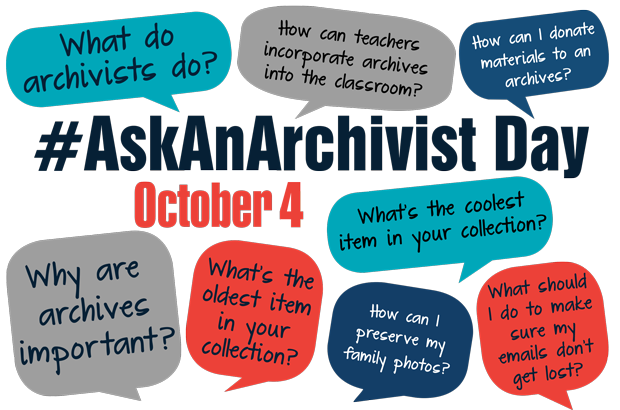
AskAnArchivist_GIF_2017What Is #AskAnArchivist Day?

It’s an opportunity to:

  • Break down the barriers that make archivists seem inaccessible.
  • Talk directly to the public—via Twitter—about what you do, why it’s important and, of course, the interesting records with which you work.
  • Join with archivists around the country and the world to make an impact on the public’s understanding of archives while celebrating American Archives Month!
  • Interact with users, supporters, and prospective supporters about the value of archives.
  • Hear directly from the public about what they’re most interested in learning about from archives and archivists.

How Does It Work?

On October 4, archivists around the country will take to Twitter to respond to questions tweeted with the hashtag #AskAnArchivist. Take this opportunity to engage via your personal and/or institutional Twitter accounts and to respond to questions posed directly to you or more generally to all participants.

Questions will vary widely, from the silly (What do archivists talk about around the water cooler?) to the practical (What should I do to be sure that my emails won’t get lost?), but each question will be an opportunity to share more about our work and our profession with the public. Visit SAA’s Storify that summarizes the 2016 #AskAnArchivist Day to get more examples of questions and answers. Last year generated thousands of questions and answers, some of which have been Storified:

Between now and October 4:

PROMOTE #AskAnArchivist Day among your users and constituents via your institution’s website, Twitter account, blog, newsletter, and any other mediums available to you. Click here for the public announcement (and feel free to pick up language from it for your own promotions). Memes are a great way to drum up excitement and are easily created through an online meme generator. Check out examples of last year’s promotional “Philosoraptor” memes here and here.

For additional inspiration on what your promotion of #AskAnArchivist Day might look like, check out what your peers did last year:

And see our Storify of marketing from a previous #AskAnArchivist Day, as well as these great examples of museums’ promotions of #AskACurator Day:

Examples of possible Twitter promotion:

  • Happy #AskAnArchivist Day! Our archivists are waiting for YOUR questions. Tag us at @TWITTERHANDLE and use #AskAnArchivist.
  • Archivists at @TWITTERHANDLE are gearing up for #AskAnArchivist Day on October 4! Literally—documents and photo boxes stacked and waiting!

ENCOURAGE the public to use #AskAnArchivist and your institution’s Twitter handle (e.g., @smithsonian) when asking questions so you won’t miss any that are intended for you and so we will be able to track questions and answers to measure overall participation.

TALK to your staff and colleagues to develop a plan for responding to tweets throughout the day.  Will one person respond to all tweets?  Will you share the task? Will individuals sign up for time slots and let the public know who will be available when?

Here’s one example:

  • During #AskACurator Day, one person at the Indianapolis Museum of Art was selected to monitor both the general hashtag and tweets sent directly to @imamuseum. When direct questions came in or interesting general questions were posed via the hashtag, the designated monitor sent the questions to participating curators via email. The curators (and their archivist!) replied with their answers, and the monitor posted all answers from the @imamuseum Twitter account. (See the Storify of the IMA’s participation in #AskACurator Day for results.)

CREATE an institutional Twitter account if you don’t already have one. #AskAnArchivist Day and American Archives Month are both great opportunities to start one! Click here to get started.

And if an institutional Twitter account is not an option for you, answer questions from your personal Twitter account! If your institutional affiliation and job title are not already listed on your profile, be sure to add that for the duration of #AskAnArchivist Day.

If you plan to participate, please email SAA Editorial and Production Coordinator Abigail Christian with your Twitter handle so we can create a list of participants.

TWEET and GREET! Take advantage of this opportunity to join with archivists from around the country to talk to and hear directly from the public on October 4.