IMLS Restores Competitive Grant Funding

Earlier this month, as a result of the hard work and conviction of 21 State Attorneys General in the State of Rhode Island v. Trump case, the Institute of Museum and Library Services (IMLS) restored grants previously impacted by Executive Order 14238.

Summary

President Trump’s March 14, 2025, executive order directing seven congressionally created agencies, including the IMLS and the Minority Business Development Agency (MBDA), to cut their operations and expenditures to only those explicitly required by statute. Twenty-one U.S. states, which received hundreds of millions of dollars in grants and funding from the curtailed agencies and worked closely alongside those agencies on matters of commerce and education, alleged that Trump’s executive order violated the Administrative Procedure Act, the Appropriations Clause, and separation of powers. (State of Rhode Island v. Trump)

Why It Matters

  • This decision impacts all states, not just the 21 states involved in the case.
  • The IMLS awarded $266 million in grants to museums and libraries in 2024.
  • IMLS can fulfill its congressional mandate and fund the grants.
  • The Grants to States program helps small and rural libraries provide services for its patrons.
  • It challenges state’s legislatures attempting to apply similar funding cuts.

Everyone has their story about what archival research impacted them, what library services helped them, and what museum experiences fostered their curiosity. Each person’s reason for caring about libraries is well worth advocating!

Action

Now that you have the information take action to continue the momentum of this judicial success!

Start with a thank you!
If you live in New York, Rhode Island, Hawaii, Arizona, California, Colorado, Connecticut, Delaware, Illinois, Maine, Maryland, Massachusetts, Michigan, Minnesota, Nevada, New Jersey, New Mexico, Oregon, Vermont, Washington, or Wisconsin, you can thank your Attorney General for their work on this case and tell them why it matters to you.

Not sure what to say? Keep it simple!

Dear Attorney General [last name],
As a constituent I feel so proud of your hard work on behalf of libraries, archives, and museums across the country.
This is important because [impact/story].
Again, thank you so much for commitment and advocacy on this issue.

Let other elected officials know this matters to you!
Write to (or call if that is your thing!) your other elected officials to tell them about this great success (especially if your state did not participate in the case), why it matters to you, and share that you hope to see them support future efforts to block similar infringements on integral agencies!

Not sure what to write? Keep it simple!

Dear [legislator/official],
As your constituent, I wanted to bring an important issue to your attention. [1-2 sentence summary].
This is important because [impact/personal story].
Please [call to action].
Thank you for your time on this issue.

Share your story!
The funding and staffing cuts for the IMLS resulted in massive problems for organizations depending on these grants. Projects were left in various states of completion, staff were put on leave or terminated, and the future of acquisitions, discovery, and use of materials were put at risk. If you were impacted by any of the federal reduction in force or eliminating budgets, this is the time to share that story! Engage your community by writing to newspapers and contacting outlets. Examples of federal impact stories can be found here.

This work is far from over but we can and should celebrate every victory along the way! Stay tuned as FY 2026 appropriations are still uncertain. Be ready to use your voice to advocate for yourselves, each other, and the profession!

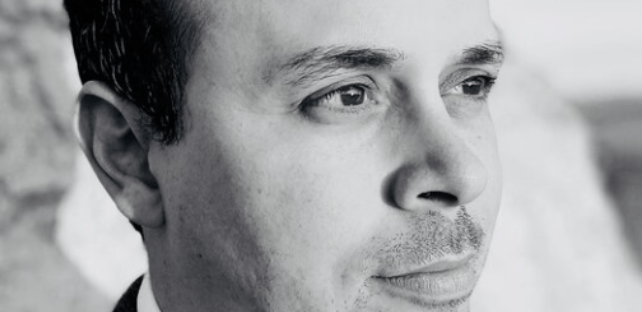
Close profiles of a man in a suit jacket and shirt

Community Stories: The Impact of the IMLS

This interview with Thomas Padilla was conducted at the end of May 2025.

Because the status of IMLS, as well as many other federally funded institutions, continues to be in flux, while every attempt was made to keep details as current as possible, we anticipate there will be changes, even shortly after publication.

1. Tell us a little bit about yourself and the work you do. 

I am a librarian, community builder, and technologist who has worked in a number of different kinds of organizations (e.g., academic libraries, national libraries, research library consortia, global nonprofit digital libraries). A good deal of my work has focused on fostering community capacity around responsible computational development and use of memory organization collections – think AI, data science, digital scholarship and so on. That work has entailed significant commitments to local, national, and international advocacy. 

These days I wear a couple of different hats. I am the founder of a consultancy called Bristlecone Strategy where I work with partners in cultural heritage, higher education, and government. I also work as the Public Interest AI Strategist for the Authors Alliance. With Authors Alliance specifically, I work on a Mellon Foundation supported project called The Public Interest Corpus. This is an effort to develop a practical, community-vested startup plan that provides a path for multi-organizational development of library, archive, and museum collection corpora that support public interest AI research and development as well as computational research more generally.  

2. Can you explain your work on IMLS Matters? (What inspired you to start it? What was your hope for the project?)

Like many working in libraries and higher education, I have found the last few months to be quite challenging. The Trump Administration is implementing a premeditated, comprehensive assault on our communities. Disciplinary researchers and students are being attacked. Librarians are being attacked directly and indirectly through things like proposed changes to Public Service Loan Forgiveness that rely on an ideological litmus test. The financial stability of our organizations is being attacked through attempts to revoke tax-exempt status and drastic, damaging reductions to indirect cost rates

As we know, the Trump Administration is also working to eliminate the sole source of Federal funding dedicated to libraries and museums. Thankfully a number of court cases are starting to weaken this part of the the administration’s effort to dismantle our country’s public interest information infrastructure. As a result, Institute of Museum and Library Services Staff (IMLS) have begun to return to office and some grants have been restored. Optimism about this change in status must be tempered by the fact that the Trump Administration has already filed an appeal. Optimism must be further tempered by the fact that the Trump Administration’s fiscal year 2026 budget request includes proposed elimination of IMLS, the National Endowment for the Humanities and the National Endowment for the Arts. 

Some might argue that private philanthropy can fill the Federal funding gap for libraries, but that is simply not the case. Private philanthropic funding tends to be project or initiative based while Federal funding scales to all States and Territories, supporting a combination of operating costs and project-based costs. Significant portions of funding that appear to people throughout the country as State-funded efforts are actually funds that have long come to States via Federal funding from IMLS. 

Ending IMLS would be a multigenerational disaster.

My heart breaks for all the library school graduates going into a world without IMLS funding and those kinds of opportunities to allow them to take their careers to the next level.

Anonymous Federal Employee

On April 1, I started IMLS Matters, as a place for community members affected by the attack on IMLS to share stories of how IMLS matters to them. Rather than create another direct advocacy effort – both ALA and EveryLibrary had those bases covered – I thought it would be useful to create a space that fosters solidarity among our community using one of the oldest technologies we have – our stories. I hoped that pooling our stories would strengthen us as we work to fight while also creating a collective resource that helps communicate the impact of the attack on IMLS to a broader public. 

Within a couple of weeks more than 50 stories were submitted to the site from ~20 traditionally “red” and “blue” States. These stories help prove the non-partisan value of libraries and the work they do to advance an informed, thriving public. 

The attack on IMLS is an attempt to relegate our communities to a knowledge ecosystem that is forced to toe the line with the current administration’s often regressive prerogatives. It has been deeply disturbing to see the Trump Administration force removal of books from military libraries corresponding with 20 Library of Congress Subject Headings including but not limited to: Affirmative Action, Allyship, Anti-Racism, Critical Race Theory, Diversity in the Workplace, Gender Identity and so on. 

The stakes of actions like this become clearer when we consider what is being promoted in opposition to each of the above subject headings. What is the opposite of affirmative action? What is the opposite of allyship? What is the opposite of anti-racism? 

One can easily imagine that the administration would like to extend this kind of knowledge manipulation throughout the country. We cannot let that happen. 

Without IMLS, I fear that libraries won’t be able to afford the connectivity they need without significant cuts to other library services.

anon.

3. What has been the reaction/responses to the project? (From readers? From submitters? Your reaction to all of the responses?)

The response to IMLS Matters has been overwhelmingly positive. Some have shared that they shed tears while reading the stories. My sense is that those tears represent firm resolve to defend our community and the communities we serve. 

I think of committing effort to things like IMLS Matters as an attempt to “cast a spark in the dark”, which always feels a bit scary. 

Will people see the spark before it is lost to the night? Will they reach to grab it, cup it in their hands, and steward the spark from a flame to a fire that provides a measure of safety in difficult times? Time has shown that people have seen the spark and are using it to light lamps across the country. I feel good about that. 

Behind each IMLS grant is a story — that leads to more stories.

anon. (Kansas)

If you would like to read more about IMLS Matters, Katina Magazine kindly provided an opportunity to highlight some of the prevailing IMLS Matters story themes (e.g., catalyzing local impact, strengthening state library systems, ensuring knowledge preservation and access) in “No Longer Serves the Interest of the United States”: The Terminated Work of the Institute of Museum and Library Services

4. In this political environment, do you worry about bad actors trying to disrupt the gathering of these testimonies? 

The past few years have taught me to be less worried about bad actors, and focus instead on being prepared. When we worry endlessly about bad actors they win. We are better served by making sure we are prepared to do the work we need to do. 

5. Again, given the political climate, what steps have you taken to help protect anyone who shares their views? Are submitters able to do so anonymously? 

Good questions. The primary strategy I’ve adopted is to be open about my intent to publicly share these stories and to also allow anonymous submissions. I am deeply aware that it feels dangerous at this time to share, and each individual has a different threat calculation that they need to weigh as it pertains to their work, life, and wellbeing. For those able to do so, I encourage you to share your story at IMLS Matters. I encourage everyone to follow ALA’s advocacy work and voice their support for libraries to their representatives.

Recent Society of American Archivists Statements

The Society of American Archivists (SAA) has made a concerted effort to respond to each new affront to archivists and cultural heritage workers as well as to share resources to support impacted archivists. To amplify and encourage wider distribution of this information and to raise awareness of the organization’s stance on current events, this post will collate recent updates from SAA leadership (as of March 19, 2025).


SAA Response to AOTUS Removal Urges Advocacy

The leadership of the Society of American Archivists (SAA) is alarmed by the dismissal of the Archivist of the United States on February 7, 2025. We believe the removal of AOTUS with no stated cause does harm to our nation and its people. The Society wants to reassure our colleagues across the profession that we continue to support the mission of the National Archives and Records Administration (NARA) to preserve and provide access to the essential records of the federal government.


As archivists, we adhere to a set of core values that champion accountability and social responsibility and promote preservation, access, and use. Protecting the integrity of the federal record and affirming the work of those who care for it aligns with our professional codes and responsibilities.


SAA will continue to monitor the situation at NARA and will actively work to support NARA workers and archivists across the United States. In the meantime, we want to remind you that your voice matters; please take a few minutes to contact your legislators today.


It’s all in the details. When advocating, use statistics and facts to help support your claims. Tell your representatives and senators why the safekeeping of government archives is essential to a free and healthy democracy. Call or write to them to share how national archives change lives.

Some examples include:

  • preserving and promoting our nation’s foundational documents, 
  • giving veterans access to their personnel records to secure benefits, 
  • connecting with your family’s history, 
  • teaching students about the history of the United States, and 
  • studying and understanding the human experience. 

SAA will continue to support our NARA colleagues by contacting policymakers directly about the importance of government archives and records management. We appreciate the voices of the many SAA members who have reached out to us over the past few days and stand with you as partners in advocacy.


SAA Condemns Widespread Firing of Archivists and Cultural Heritage Workers

The Society of American Archivists condemns the decision of the White House to terminate substantial numbers of archivists and cultural heritage workers at the National Archives and Records Administration (NARA), the National Park Service, and other government agencies.


All federal employees who work with archives serve a vital function for the United States. The White House’s staffing decisions, which compromise the livelihoods of thousands of individuals, jeopardize the preservation and access to the evidence that safeguards individuals’ rights, documents government actions, and ensures transparency. The actions can be seen as threatening the independence of NARA, thereby creating a risk that public servants can evade accountability. Federal archives are foundational infrastructure for a democratic society and should serve their non-partisan function without political interference.


SAA strongly urges Congress to assert their prerogatives, retain Congressionally authorized staffing levels, and preserve Congressionally legislated agency independence.


SAA Council extends our support and solidarity to impacted workers. The Council is actively working to determine how best to support federal archival workers during this time. We welcome impacted workers to contact SAA regarding how we can best provide support: president@archivists.org.


SAA Statement on Media Reports Concerning Records Destruction

According to multiple news reports, USAID workers have been ordered to destroy or burn records, including classified records. Current reporting indicates conflicting information on whether the agency is in compliance with the Federal Records Act, which governs records from executive branch agencies.

With the many current federal actions targeting the reduction and elimination of federal agencies, the Society of American Archivists notes that such actions increase the risk of non-compliance with the Federal Records Act across federal agencies. Federal statute (44 U.S. Code § 3105) and regulations require agency heads to prevent the unlawful or accidental removal, defacing, alteration, or destruction of records. The swift shuttering of USAID raises questions as to the proper disposition of that agency’s records, including ensuring permanent records are transferred to the National Archives and Records Administration (NARA). Furthermore, SAA supports all federal staff in their effort to uphold the rules and statutes governing the management of records and archives.

Federal courts have been asked to intervene on this and other White House efforts to undermine records management and archives activities. SAA will continue to monitor these developments.

We encourage SAA members and all who care about the importance of government archives to contact their elected members of Congress with the following key messages:

SAA has created a list of resources for federal workers available on the SAA website Resources for Federal Workers.

Archival Innovators: An Introduction to CORDA’s Newest Initiative, the Facts+Figures Website

This is the latest post in our series Archival Innovators, which aims to raise awareness of individuals, institutions, and collaborations that are helping to boldly chart the future of the archives profession and set new precedents for the role of archivists in society. In this installment, COPA member Claudia Willett interviews four members of SAA’s newest committee, the Committee on Research, Data and Assessment (CORDA), who provide an update on the Committee and one of its newest initiatives, the Facts+Figures website. Jennifer King and Erin Passehl Stoddart are co-chairs of CORDA and Dennis Meissner and Chris Marino serve on the Facts+Figures team that led the redesign of the website.

What is CORDA?

The mission of the Committee on Research, Data and Assessment (CORDA) is to elevate awareness of archives by making central the role that research, data and assessment play in our ability as archivists to tell the story and show the impact of archives. There are many ways to increase awareness of archives – and one of the most powerful ways is to reveal trends and increase awareness through understanding data. How does CORDA elevate the importance of research and innovation, you might ask? CORDA provides access to significant and useful data and research about SAA, American archives, and their users that evidence the value of archives for society and help us improve our services to SAA members and to our consumers. The Committee supports research and creates, gathers, and preserves data by directing and engaging in these areas of activity:

●  Providing SAA members with standardized tools for gathering and analyzing data;

●  Providing a repository or portal for data and other research outputs;

●  Providing training on gathering, analyzing, interpreting, and using data; and

●  Providing up-to-date and reliable basic facts and figures about archives and archivists

Rounding out our charge is the task of asserting a research agenda to help guide research, assessment and data going forward.

Since establishment in 2019, CORDA has established and manages the SAA Dataverse; the SAA Facts and Figures website; training for archivists to conduct research; and an inclusively developed research and innovation roadmap to frame the profession’s work going forward. Accomplishing the above in a fairly short period of time has been made possible through the exceptional work of our committee[1].

Tell us about the Facts+Figures [F+F] microsite.

Facts+Figures (F&F) is designed to provide users with quick and simple access to information resources important to archivists or their constituencies. The resources on the site share the common quality of being derived from data – data compiled or created by archivists as a result of their research, data about archivists and archives from external agencies, and tools to enhance archival practice resulting from research data.

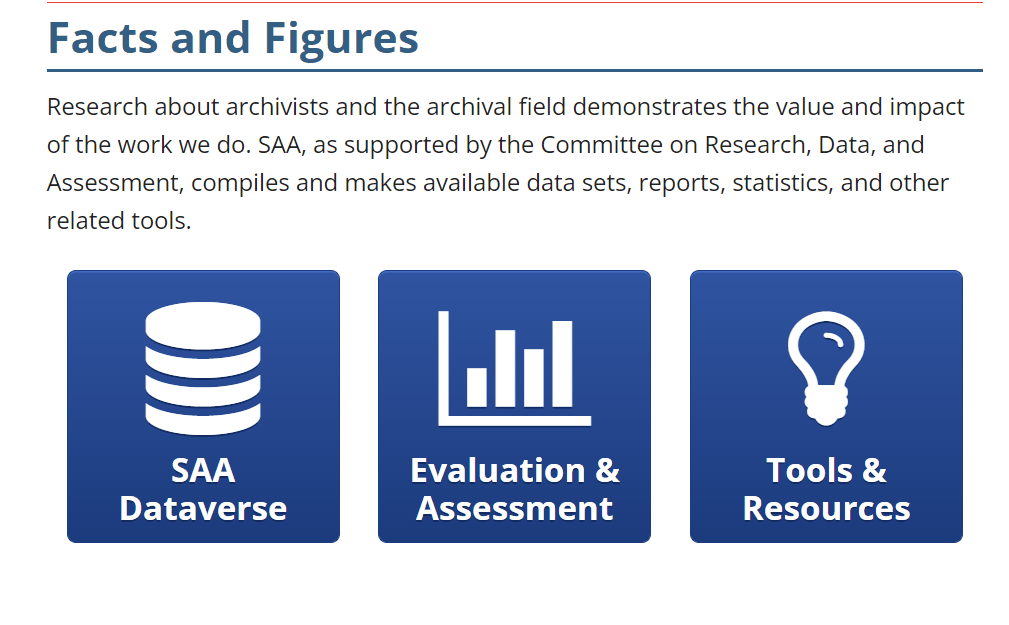
The newly redesigned F+F site is divided into three content channels: SAA Data Repository (SAA Dataverse), Evaluation + Assessment, and Tools + Resources. The Data Repository supports the deposit and reuse of datasets for purposes of fostering knowledge, insights, and a deeper understanding of archives and archivists. The page contains a search bar that enables users to search across the Dataverse and learn about the submission procedures and collection development policy. The Evaluation + Assessment channel may include at-a-glance dashboards, charts, graphs, reports, fact sheets and quick guides that support advocacy, explain archives and archivists to external entities, and provide insight into the functions of archivists and their repositories. The Tools + Resources channel may include software recommendations to perform tasks, how-to instructions and guidelines, checklists, best-practice guides, and self-assessment tools to employ data in support of advocacy efforts and in assessing archival impact.

Unlike the Facts and Figures page that preceded it, the reimagined F+F will be actively curated by CORDA and is a dynamic resource that will be augmented with new content items on a continuing basis. It will be a resource for archivists to turn to for quick information to aid them in advocacy efforts, to help them benchmark their performance against peers, and to adopt or adapt tools to make their work easier or conform better to best practices.

Do you see a role for data as an archival advocacy and awareness tool?

Yes! It is hard to imagine a more powerful storytelling tool than data. In fact, it is that desire that drove the creation of CORDA. In his SAA presidential address, “Bare Necessities,” Dennis Meissner argued that SAA must “concentrate on gathering, evaluating, and presenting the real quantitative and qualitative evidence that supports all the compelling narratives and theoretical arguments about the value of archives. We need this evidence because we have struggled for many years with the challenge of demonstrating the ‘value’ of archives via anything resembling objective measures.” He proposed that SAA form a Committee on Research and Evaluation (CORE), with a goal “to provide access to compelling data about American archives and their users that speak to the value of archives for society and that also help us improve our services to our consumers.”

In addition to archivists, who might benefit from these resources?

Funding, policies, and cultural heritage priorities are better informed when decision-makers have access to regular and reliable research, data and assessment. Future-thinking, forecasting and change initiatives grounded in facts and figures will best ensure that society values archives, and plans for the ongoing protections required to promote archival stewardship.

Research, data and assessment is also critical for auditing our efforts as repositories. Efforts like A*CENSUS I and II, and RepoData are more meaningful when data is gathered regularly and enables longitudinal analysis. Social reform is often made possible when decision-makers are confronted with incontrovertible data. As archivists, collections and records serve an evidentiary role and can impact decision making and analysis.

Management of archival resources requires short-term and long-range planning, and both always benefit from access to data. The need for data to underpin short-term and long-range planning is intensified during times of political instability, climate change, and interrogation of the racialization of memory work. Archivists, along with other professions in the cultural heritage fields, need centralized infrastructure for their assessment, data and research efforts, as well as an idea of how those efforts might be complementary efforts in a broader research framework. CORDA hopes that archivists will be inspired to see resources aggregated into a more coherent whole and inspired to help address gaps and all demand factual accounting of archival efforts.

What are the next steps for F+F?

Continue to build out and organize content for quick and simple access! Every archivist has their “go-to” resources that aid them in explaining their value, promoting themselves and their missions, and understanding their impacts and potential. We want to harness that knowledge and share it with the wider community. To contribute content to F+F, visit our microsite and click “suggest new content.”


Additional Resources

Dennis Meissner and Chris Marino, “CORDA’s New Facts+Figures Microsite Shares Data and Resources with Archivists” Society of American Archivists website

Erin Passehl Stoddart, Emily Lapworth, Maggie Hughes, Jane Fiegel, “Share, Preserve, and Reuse: The SAA Dataverse Invites Data about ArchivesArchival Outlook Society of American Archivists, March/April 2022, p. 12.


[1] CORDA committee members, past and present: Nancy Beaumont (SAA Executive Director) Mary Biddle, Sarah Buchanan, Paul Conway (Chair), Julia Corrin (Education Committee Liaison), Courtney Dean, Jasmine Jones (Council Liaison), Jennifer King (Chair), Amanda Hawk, Cristina Horak, Gwendolyn Higgins, Carli Lowe, Chris Marino, Sarah Pratt Martin, Dennis Meissner, Nance McGovern (Ex Officio), Jacqualine Price Osafo (SAA Executive Director), Ricky Punzalan (Council Liaison), Erin Passehl Stoddart (Chair), Jennifer Wachtel (Education Committee Liaison).

Ask An Archivist: An Interview With Bridgett Pride

Join us as we celebrate American Archives Month by Asking An Archivist! Inspired by #AskAnArchivistDay, we sat down with five archivists to ask them about what they do—from “what is an archivist?” to “What’s the most creative public use you’ve seen with your collections?”—and explore daily challenges, successes, and everything in between.

Stay tuned because we’ll be sharing one full interview per week starting on #AskAnArchivistDay on October 13!

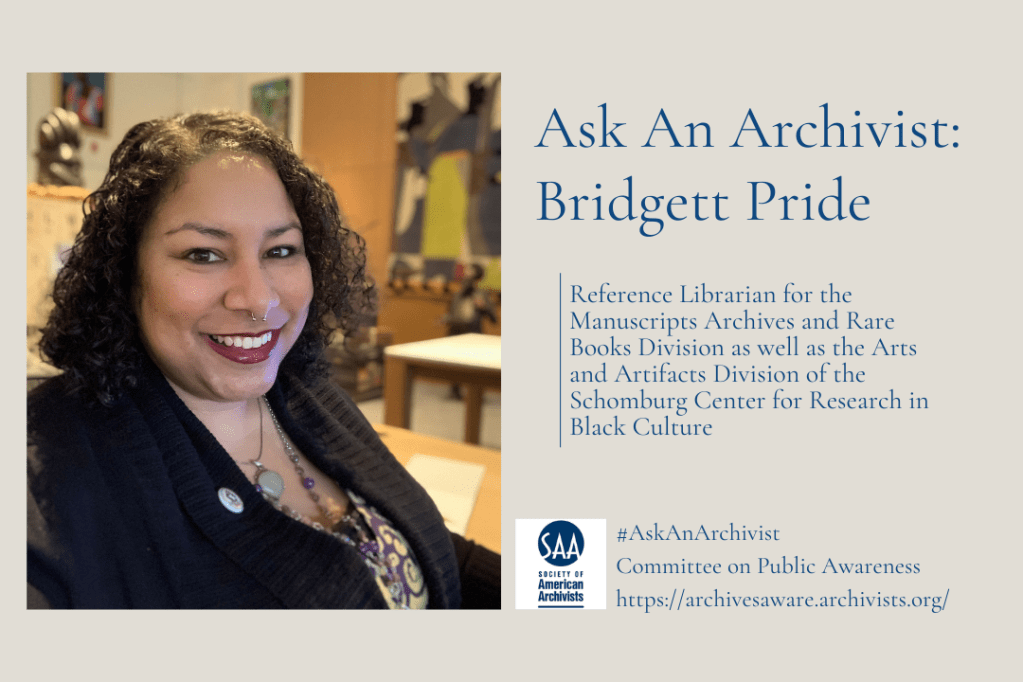
This is the title card for an interview with Bridgett Pride by COPA member Rachael Cristine Woody.

For 2021 #AskAnArchivistDay and our fist installment of this mini-series, we’re excited to share an interview with Bridgett Pride, Reference Librarian for the Manuscripts Archives and Rare Books Division as well as the Arts and Artifacts Division of the Schomburg Center for Research in Black Culture. Rachael Cristine Woody of the Committee on Public Awareness sat down with Pride (virtually) for a video interview on Friday, June 25, 2021 to talk about becoming an archivist, the stereotype of archivists as gatekeepers, and more.

Bridgett Pride is a part of the inaugural class of fellows Rare Book School for Cultural Heritage, focusing on Black collections and zine making. Bridgett received her MLIS, and a MA in History from Simmons University in 2018. She was a part of the Diversity, Equity, Race, Accessibility, and Identity in LIS (DERAIL) forum, and served as the 2018 project manager. Bridgett was awarded the 2018 Kenneth Shaffer Outstanding Student Award for student leadership. She studies American women and their intersectional identities with gender, race, and class in the 19th and 20th centuries.

Video Interview

Transcript

Pride [0:00:03] Hi my name is Bridgett Pride, and I am the reference librarian for the manuscripts archives and Rare Books division, and the art and artifacts division of the Schomburg Center for Research in Black culture.

Woody [0:00:20] Thank you. And our first question for you is how slash why did you become an archivist, what’s your origin story?

Pride [0:00:30] So I wanted to become an archivist, because I was a literature major and then a history major, and I was always very frustrated by the complicated nature to which I’m doing any type of research was when I was looking for Black voices, particularly the voices of Black women who are also Queer so basically I was looking for myself. And so I decided that the best way to solve that problem was to make sure that those voices were elevated and accessible. And so I went to library school to do that and do that every day now at the Schomburg Center.

Woody [0:01:25] I love that answer. Thank you. Second question for you. How do you engage your audiences?

Pride [0:01:33] As the reference librarian of two research divisions of a public library but an archive within a public library, I have the wonderful opportunity to get to teach. So I have classes that come in from a New York from Philadelphia from New Jersey, who are curious about learning about the Black diaspora.

And so that is truly one of my favorite parts of my job is getting to work with. First time researchers, whether they’re in the fourth grade, they’re college students, or their graduate students and getting to teach people the magic of the archive what is inside and watch their faces light up when they find out that they are allowed to be there and encouraged to be there, and just unveiling all there is to learn, and all of the different topics that can be covered within an archive, and so just being the bearer of such wonderful news and introducing people to how to access that type of knowledge is just such a fun thing to get to do and can be really engaging because you can do that in so many different ways.

I’ve had the great pleasure to be able to do that during the pandemic virtually, I’ve done it in person, and just making connections with first time learners in whatever way is the most accessible to them at the time.

Woody [0:03:16] I particularly love that because traditionally archivists, the stereotype is like gatekeepers, you know, keeping it keeping the treasures behind closed doors, and how you’ve described your role and the work that you’ve been doing, it’s like you were throwing those doors wide open, get them off the hinges.

Pride [0:03:36] Yeah, like the Archivist for everyone, and like the fact that I work in a public library makes it so much easier. Like, it’s against the mission to say no. So really having the opportunity to roll out the red carpet. And like come hang out with us, whether that’s like at a public program where we’re singing and dancing like on Langston Hughes ashes or if we’re in the reading room engaged in study. There’s so many different ways to engage.

Woody [0:04:15] My third question for you. What’s the best or most creative public use you’ve seen with your collections.

Pride [0:04:23] For this I have to shout out my colleague Katie out to Tubman, who is the Director of our Junior Scholars Program. And so she works with students from elementary school to high school, where they engage in group study of materials at the Schomburg Center. And every year they produce some sort of project or exhibit. And this past year, the students engaged and creating this means that documented their study of the autobiography of Malcolm X.

These young scholars blew my mind with these thoughtful pieces that they had created, from reading Malcolm X’s edits of his autobiography that we hold, and really connecting with him on a personal level. By being exposed to his papers at the Schomburg. And they created a digital exhibit which anyone can look at.

It’s called, “By any means necessary,” and is available on the Schomburg Center website and just watching these young people and how they processed, like some heavy topics, and these revolutionary ideas is just fascinating to me. And just the fact that we have programs like that in an archive where young people are encouraged to come and engage in this way is so important, and I would love to see more activities like this happen in archives.

Advocacy and Outreach Opportunities at the Archives*Records 2021 Annual Meeting

The SAA Annual meeting begins next week, though on-demand sessions were available starting Monday, July 26, and SAA section meetings have already started earlier in the month. Below is a list of sessions about awareness, advocacy, and outreach.

Please note, there is a mix of live, recorded, and on-demand opportunities. Make sure to visit the schedule for specific times for live sessions and to view session descriptions to see which category a session or meeting falls and whether you need to register for a session. Unless noted, all events are included with your annual meeting registration.

On-demand sessions available now!

S12 – Outreach and Fundraising in the Time of COVID: How to Engage Your Donors and Keep Events Going When You Can’t Meet in Person

Four panelists demonstrate how they managed to reimagine their outreach and programming to keep their donors and funders engaged during the pandemic.

Live Q&A for this session on Thursday August 5th!

S13 – Outreach and Online Access Innovations from Smaller Institutions

Lightning talk speakers discuss innovative project and outreach ideas—from exhibit formats to walking tours—and online access initiatives—from developing important content partnerships to unusual funding opportunities.

Live Q&A for this session on Friday August 6th!

Monday, Aug. 2

Storytelling Workshop Master Class

This is the 3rd year we have had two-time Moth GrandSLAM winner (and former Moth director of education) Micaela Blei facilitate a storytelling workshop for archivists. Separate registration and fee ($49) for this workshop where you will learn:

  • What makes a story work,
  • The connections among narrative performance, research, and teaching, and
  • How to brainstorm and craft stories of your own.

The workshop is aimed at budding storytellers as well as seasoned bards looking to refresh their skills. It is structured to make the online experience as welcoming and engaging as possible, using a webinar format followed by an optional small-group discussion structure so that you can take part in the workshop at the level that will best serve you.

Stories from the 2019 event, including one from Micaela herself can be found on Season 3 of the Archives in Context podcast. To learn more about Micaela, check out this ArchivesAware! interview from 2019.

Like last year, we will hold our related storytelling event, Finding Aid To My Soul, in October and it will be online. So stay tuned for more information this fall!

Tuesday, Aug. 3

Elevating the Value of Your Archive in an Ever Changing Digital World

This is a meeting for the digital preservation community, hosted by Preservica, and open to all.

Build a Bridge to Stand: Making the Ask Even in Uncertain Times

This 120-minute workshop, led by members of SAA’s committees on Public Awareness (COPA) and Public Policy (COPP) and featuring members of the Issues and Advocacy Section and the Regional Archival Associations Consortium (RAAC), explores a process-focused approach to advocacy. Attendees will participate in round-robin-style breakout sessions and walk away with personalized strategies.

Thursday, Aug. 5

Live Q&A: S12 – Outreach and Fundraising in the Time of COVID: How to Engage Your Donors and Keep Events Going When You Can’t Meet in Person

Join presenters from this on-demand session for a 20-minute live chat/Q&A. We recommend that you view the session before joining the live chat.

Friday, Aug. 6

Live Q&A: S13 Outreach and Online Access Innovations from Smaller Institutions

Join presenters from this on-demand session for a 20-minute live chat/Q&A. We recommend that you view the session before joining the live chat.

Conversation Lounge: Archival Advocacy in Challenging Times: What’s an Archivist to Do?

Laura Millar, author of A Matter of Facts: The Value of Evidence in the Age of Information, along with Chris Burns, past chair and current member of the Committee on Public Awareness, and Bryan Whitledge, co-chair of the Committee on Public Policy, will explore the topic of archival advocacy amidst a global pandemic, the equity movement, political and social unrest, and climate change.

Join the conversation to learn what you can do to make the public understand why archives matter and how you can advocate and become an influencer with decision-makers.

Know of other outreach- and advocacy-related sessions, events, and general happenings taking place over the course of ARCHIVES*RECORDS 2021 that didn’t make our schedule? Tell us in the comments below, or let us know which of these and other annual meeting events you are most looking forward to!

Advocacy and Outreach Opportunities at the Archives*Records 2020 Annual Meeting

Last week was the start of the SAA Annual Meeting with the Teaching Primary Sources Unconference kicking off the Pre-Conference activities. Here is a list of some recommendations for awareness and advocacy sessions and creative outreach.

Please note, there is a mix of live, recorded, and on-demand sessions. Make sure to visit the schedule and view session descriptions to see which category a session or meeting falls and whether you need to register for a session.

Wednesday, July 29

College & University Archives Section

Join the Section to continue discussion on the various topics we’ve had at our weekly “coffee chats”, including collecting COVID stories, working and managing remotely, combating systemic racism at our institutions, and our plans for returning to campus. We’ll split into breakout sessions to explore these topics further. But first (after our business meeting), we’ll hear from Katie Howell, who developed a rapid response collecting initiative to document COVID-19 on the campus of UNC Charlotte.

Students & New Archives Professionals Section

Join SNAP for a brief business meeting as we present updates on section projects and advocacy work from the past year and introduce new steering committee members. 

Friday, July 31

Archives Management Section

Look, I Made a Hat: Agility in the Archives
Archives managers are required to don many hats (as it were) in addressing a range of challenges and moving quickly to implement solutions. After conducting some section business, we will transition to presentations on incredibly timely topics: Budgeting, Personnel, and Advocacy.

Monday, August 3

Storytelling Workshop with Micaela Blei

A powerful story has the potential to connect us to our own experiences, pull a community together, and engage new audiences with our work. In this master class storytelling workshop led by two-time Moth GrandSLAM winner (and former Moth director of education) Micaela Blei, you’ll learn “what makes a story work” and the connections among narrative performance, research, and teaching, as well as brainstorm and craft stories of your own.

The workshop is structured to make the online experience as engaging and welcoming as possible—using a webinar format and then an optional small-group discussion structure to allow you to take part in the workshop at the level that will best serve you. 

Registration is required and there is an additional fee of $49.00 to attend.

Wednesday, August 5

Keeping Archives Relevant in a Dizzying Digital World

Join Preservica customers and staff as they explore together the evolving impact of digital archives, celebrate user projects and stories, and discuss innovations in archival practice.

Thursday, August 6

Plenary 1

In addition to hearing our current president, Dr. Meredith Evans speak, this session includes Jodie Foley and Tempestt Hazel. Jodie Foley is the Montana State Archivist at the Montana State Historical Society.

Tempestt Hazel was the 2019 recipient of the J. Franklin Jameson Archival Advocacy Award from the Society of American Archivists. She is a curator, writer, and founder of Sixty Inches From Center, a Chicago-based arts publication and archiving initiative that has promoted and preserved the practices of BIPOC and LGBTQIA+ artists, and artists with disabilities across the Midwest since 2010. Focusing primarily on reframing cultural archives and institutional collections, her exhibitions and projects have been produced with the University of North Texas, South Side Community Art Center, Terrain Exhibitions, the Black Metropolis Research Consortium, the Smart Museum of Art, and the University of Chicago, among others.

2B – Archival Outreach in the New Normal: Using Digital Platforms to Teach Primary Sources

Learn about the National Archives and Records Administration’s (NARA) longstanding partnership with Internet2 and the Presidential Primary Source Project and the teaching series they have done, completely online. They will share tips for presenting in this medium and discuss methods for regaining audience attention and making the session more interactive.

In addition, learn more how NARA has moved its adult programming to online platforms. They will discuss how to host these kinds of sessions with members of the general public and how to manage registrations, digital platforms, and advertising.

3A – From the Margins to the Center: Foregrounding Underrepresented Communities and Revitalizing Mainstream Collections

This session examines how different approaches to foregrounding marginalized groups and individuals have revitalized established collections at three archival repositories.

3B – Showing Up: Community Engagement Events Toward a Better Cultural Record

This panel will explore the centrality of community partnerships in the diversification of the archival record, featuring programs that have hosted grant-funded community engagement activities to create and collect documentation of historically underrepresented groups.

Friday, August 7

4B – Reframing History: Opening Up Archives to Artists

This panel will highlight the Chicago Archives + Artists Project organized by Sixty Inches From Center and feature visual artists, curators, and writers who have collaborated with archivists, librarians, and other collection caretakers for their research-based creative practices to commission new artworks and curate exhibitions.

Hop into History: Archives and Alcohol in America

Grab a drink, and pull up a stool at the virtual hotel bar for a storytelling session featuring archivists who are working to document various aspects of alcohol history in the United States. Whether your drink of choice is beer, wine, bourbon, or cocktails, we’ll share some stories from our collections that might make you think a little differently the next time you take a sip!

Saturday, August 8

S04 – Ambition, Advocacy, and the Future of Storytelling

Orchestra and radio archivists describe how they pitched forward-thinking projects that break storytelling out of its traditional mold. Participants then break into groups to imagine, share, and learn what the future role of archives will and can be. Practical tips and challenges related to technology, project implementation, and advocacy will be shared.

S11 – Community Collections as Digital Collections

L.A. as Subject (LAAS), Chicago Collections Consortium (CCC), and the Recollect community in Australia and New Zealand will address the lessons learned and future visions in achieving a truly collaborative and reciprocal network. Although they are separate and independent entities, LAAS, CCC, and Recollect developed coinciding missions to collaborate with a diverse set of community archives in order to openly share collections and strengthen the profession through more comprehensive knowledge sharing.

S12 – Connecting to Communities: Outreach at the Missouri State Archives

 In this session archivists from the Missouri State Archives will share their experiences with tours, special events, speaker series, and grant programs. The focus is on creating sustainable, diverse programs to reach a broad range of patrons.

S29 – Love Can’t Turn Around™: Evidences of the Belief in the Power of Our Collective Social Experiences as Sites of Pleasure, Purpose and Politics

The Blackivists™ are a collective of trained and credentialed African-American archivists based in the Chicagoland area who address the needs of people interested in creating and preserving personal, community and “non-traditional” archives. The Blackivists™ collaborated with Honey Pot Performance on a series of programs for the Chicago Black Social Culture Mapping Project, which exists to preserve Chicago’s black social cultural lineage through fun and informative experiences focused on a Chicago based cultural art form: House music.

S35 – Project STAND: Highlights and Hurdles of a National Project on Social Justice and Archives

Project STAND, is a consortium of 70 colleges and universities that has created an online resource centralizing primary sources relating to student activism in historically under-documented and minoritized communities. This session will focus on its creation, highlights, and hurdles, and the role of the archivists to build relationships with marginalized communities, provide tools for documenting activism, and advance archival collections. Speakers will discuss the website and collection highlights, the Archiving Activism toolkit, and the symposia conducted in 2019/2020.

S36 – Protocols 101: How to Start the Conversation at Your Institution

This session explores the future of Indigenous collections stewardship for the 21st century archivist. Following the conference theme, it asks participants to consider how archivists can leverage creativity to make positive changes to collections care and access amidst institutional constraints.

S39 – Remaining Relevant: Changing the aesthetic of archives through collaboration and creativity

This interactive session is opportunity to not only hear what this institution is doing to change the profession, but engage in constructive and collaborative brainstorming with a variety of professionals to incorporate new strategies to better provide access and awareness to collections.

S42 – Setting a New Standard: Practical Applications and Uses of Standardized Measures and Metrics

Presenters will discuss implementation of the  SAA/RBMS Standardized Statistical Measures and Metrics, approved by SAA in 2018, and suggest ways to use statistical data to impact internal operations and advocate for your institution. General recommendations for data collection and application will also be provided. 

Tuesday, August 11

Reference, Access, and Outreach Section

As a part of the 2020 Annual Meeting of the Society of American Archivists, the Reference, Access, & Outreach (RAO) section will host its 8th annual Marketplace of Ideas. The Marketplace of Ideas takes place in conjunction with the annual RAO business meeting, and offers participants a chance to learn more about creative instruction, outreach, and reference programs piloted by colleagues. 

Thursday, August 13

Committee on Public Awareness

Come meet the members of the Committee on Public Awareness, hear about our activities over the past year, and learn about our plans for next year!

Know of other outreach- and advocacy-related sessions, events, and general happenings taking place over the course of ARCHIVES*RECORDS 2020 that didn’t make our schedule? Tell us in the comments below, or let us know which of these and other annual meeting events you are most looking forward to!
Advocacy and Outreach Opportunities at the Archives*Records 2019 Annual Meeting

This week is the start of the SAA Annual Meeting. Here is a list of some recommendations for awareness and advocacy sessions and activities.

First things first — stop by the Committee on Public Awareness (COPA) table! We’ll have a table in the conference registration area.

  • Saturday afternoon, 3:15 – 4:30 PM the Kitchen Sisters will be at the table playing clips from their podcast!
  • The Archives in Context podcast team will be at the table Sunday from 8:00-10:30 AM and 3:00-5:00 PM to record your elevator speech!
  • Elevator speech postcards – get them while they last!
  • Crafting Your Elevator Speech puzzle – a repeat of last year’s puzzle, be part of the team that puts it together!

Storytelling Workshop with Micaela Blei

Learn how to tell your story—and tell it well! In this introductory COPA-sponsored workshop, you’ll work with two-time Moth GrandSLAM winner (and former Moth director of education) Micaela Blei, PhD, to find stories that you want to tell, learn strategies for delivering riveting stories, and feel great doing it.

“Sing Out, Louise! Sing Out!” The Archivist and Effective Communication

This session includes panelists providing strategies for effective communication, examples of communication fails, and includes Q&A so attendees can share experiences too.

Are you ArchivesAWARE? Teaming up with SAA’s Committee on Public Awareness to Create a Stronger Archives Community

COPA members share successful initiatives and then engage with audience to brainstorm outreach strategies, solutions to outreach obstacles, and how we can better engage with communities that may have barriers to accessing archives.

Community Connections: Unleashing the Potential of Programs and Services Aimed at Underserved Stakeholder Communities

Archivists who oversee labor and social justice collections share their collaborations, programs, and services that have reached beyond the usual academic or institutional stakeholders and discuss the impact of reaching out to underserved communities.

Get With, or at Least On, the Program: Crafting Session Proposals for Archives-Related Sessions at Non-archives Conferences

Panelists from this session share the history and accomplishments of the Society of Southwest Archivists’ new committee, the State Partnerships and Outreach Committee.

What’s Your Elevator Speech?

The Archives in Context podcast team and the Committee on Public Awareness (COPA) are joining together to record your elevator speeches at this year’s annual meeting in Austin, Texas.

COPA will have a table in the registration area with a Crafting Your Elevator Speech puzzle. Stop by to work on the puzzle and to record your elevator speech with the Archives in Context team for inclusion in a forthcoming episode. The podcast team will be at the COPA table on Sunday, August 4 from 8:00-10:30 AM and 3:00-5:00 PM.

We want these recordings to sound like real conversations, so we’re also looking for your help creating some conversation scenarios.

Three ways to participate:

  1. Contact the Archives in Context team at Chris.Burns@uvm.edu ahead of time to set up an interview or to pitch a scenario (doesn’t have to occur in an elevator).
  2. Stop by the COPA table in the registration area on August 4 between 8:00-10:30 AM or 3:00-5:00 PM.
  3. Can’t make it Austin but want to participate, record your own elevator speech and send it to the email address above.

A Finding Aid To My Soul

This year’s show will be hosted by two-time Moth GrandSLAM winner (and former Moth director of education) Micaela Blei. Featured storytellers: Arielle Petrovich, Katie Moss, Travis Williams, Katie Dishman, Joyce LeeAnn Joseph, Cliff Hight, Kira Lyle, Tanya Zanish-Belcher, Leah Harrison, and Joanna Black.

Blowing Off the Dust: How to Move Your Archives from the Basement to the Public Square

This interactive session is about how to partner with your public radio and includes best practices for pitching to public radio, how cultural institutions and public radio complement each other, and information about a current collaboration between an archive and public radio.

Archival Value: Tales of Professional Advocacy

This session features professionals from a variety of archival settings who share how they advocated for themselves, their staff and students, and their colleagues to get administrative support for the resources they  needed.

Know of other outreach- and advocacy-related sessions, events, and general happenings taking place next week that didn’t make our schedule? Tell us in the comments below, or let us know which of these and other annual meeting events you are most looking forward to!

 

Advocacy and Outreach at the Annual Meeting

Gearing up for the SAA Annual Meeting next week in DC? If you’re looking for opportunities to raise awareness about and advocate for archives, or to learn about innovative outreach initiatives to spark your own outreach efforts, then the annual meeting is definitely the place to be. For the second year, SAA’s Committee on Public Awareness (COPA) has put together a custom schedule to highlight the wide variety of sessions, meetings, and events that feature outreach- and advocacy-related content. View the schedule here, and be sure to add some of these offerings to your custom schedule! Some highlights include…

Carpe Media! Communications and Media Training for Archivists
This limited-enrollment, full-day workshop during ARCHIVES*RECORDS 2018 is tailored to archivists and record managers with a goal of instilling in participants the confidence to be better communicators. Workshop leader Jason Steinhauer, who is well-grounded in the unique elements of the archival profession, provides attendees with tips and tools to bolster public outreach; stimulate public interest in archives, history, and the humanities; and implement strategies to reach STEM-driven media and audiences by applying the principles of the emerging field of history communication to your own work. Though enrollment for this workshop is closed, you can look forward to hearing from SAA, COPA, and workshop attendees about the results of the workshop–including a recap post to be published on ArchivesAWARE!

Archives on the Hill Event
Archivists take on Capitol Hill in this advocacy event that begins with orientation and training in the morning and culminates in Hill visits that pair experienced advocates with those who want to learn. Speak up in support of federal funding for archives! For more information on this event, read this post by the Committee on Public Policy (COPP) Chair, Dennis Riley, on the Off the Record blog.

Information Tables
COPA will be joining other SAA appointed groups and related archival organizations at the informational tables on the Mezzanine Level of the conference hotel. Stop by the COPA table to learn about a variety of outreach-related initiatives including the ArchivesAWARE blog, #AskAnArchivst Day (OCTOBER 3, 2018), Federal Funding Impact Stories, and plans for a SAA Speakers’ Bureau, among others.

A Finding Aid to My Soul…
COPA presents “A Finding Aid To My Soul,” an open-mic storytelling session celebrating the diversity and commonality of the archivist experience. Storytellers will have five minutes to share true stories about their unique, moving, serendipitous, mysterious, special, and often humorous encounters in the archives (no props, please). Sign up in advance or during the conference for a chance to share your story, or simply sit back and enjoy the tales of your colleagues in what promises to be an engaging and entertaining event. There will even be a few special guests. A panel of judges selected from the audience will determine the top storytellers and prizes will be awarded. For more information about this new and unique annual meeting event, read last week’s ArchivesAWARE blog post by COPA Chair, Chris Burns.

Know of other outreach- and advocacy-related sessions, events, and general happenings taking place next week that didn’t make our schedule? Tell us in the comments below, or let us know which of these and other annual meeting events you are most looking forward to!
Federal Funding Impact Story #9

Project: Collections and Facility Assessment and Planning

desegregation_anthology-1

“The Price We Paid: An Anthology of the Desegregation of Mississippi State College for Women” was created in 2016 as part of the Those Who Dared event series commemorating the 50th anniversary of desegregation. This project is the product of a significant collaboration between the MUW Archives and the History, Political Science, and Geography Department at MUW.

Granting Agency: Institute of Museum and Library Services (IMLS)
Grant Program: Collections Assessment for Preservation Program
Institution: Mississippi University for Women
State: Mississippi
Congressional District: 1st Mississippi Congressional District
Grant Period: April 2013-March 2014
Award Amount: $7,190

Project Description
The Conservation Assessment Program funds a collections conservator and a facility conservator to visit a repository or 2-3 days, identify problem areas, and develop an action plan for the institution.

What was the need for the grant?
The archives had been dormant for several decades before hiring an archivist in 2012. It was in very poor shape, with extensive water and mold damage to the records, poor facility conditions (it was left in a vacant building with no climate or pest control), and little access for potential researchers. We were hoping to bring in some professionals to give us a sense of where to start and what to prioritize in bringing the archives back online.

What has been the primary impact of this project?
This project ultimately allowed us to preserve and provide access to our collections on the first publicly-funded women’s college in the United States. Subsequent research by students in our collections has revealed insights into subjects like racial integration at southern institutions, and early women’s education in the United States, which has led to public programming and discussion in the community.

The grant allowed us to bring two conservators to campus for several days. The priorities they developed with us served as a road map to saving the materials in the archives, which is now in a better facility, with better conditions, and is used by students every semester for class research projects.

Submission by: Derek Webb, Special Collections Librarian/University Archivist, Mississippi University for Women
Image credit to Mississippi University for Women.