I Advocate, You Advocate, We Advocate…with the Advocacy Toolkit

GeorgeC

This post was authored by guest contributor Christine George, Archivist and Faculty Services Librarian, Charles B. Sears Law Library, SUNY Buffalo Law School


Advocacy is a tricky thing. Sure there are definitions for it, but it seems like it means something slightly different to everyone. If you want proof, check out the Steering Shares on the Issue & Advocacy (I&A) Roundtable’s blog. One of the questions each I&A Steering Committee Member answers is “How would you define advocacy?” Each and every one of us has a different answer. Not drastically different, but each comes from a different perspective. Though the Steering Shares are only from the current I&A leadership, I feel fairly confident that past leadership also had varied perspectives.

One of the things to come out of those varied perspectives is the Advocacy Toolkit. Created by I&A’s 2013–2014 leadership, the Advocacy Toolkit was meant to pull together resources on advocacy for archives and archivists. In its own words:

A large part of advocacy involves convincing financial and political stakeholders of the value that archives add to a given community, and all related efforts need be supported by evidence. The resources listed, which also serve as access points to more resources, contain the types of quantitative information and qualitative narratives that help make the case for archives. This list is not exhaustive; rather it is a starting point for those looking for facts, arguments, and compelling reasoning to lend weight to their advocacy efforts. The resources linked here do not indicate endorsement, but offer some templates which can be used to formulate advocacy efforts.

The Toolkit has been updated by subsequent I&A Steering Committees. Over the years, the Advocacy Toolkit hasn’t caught on. We wanted to change that in a big way when we decided to tackle the latest update. To start, the Advocacy Toolkit got a new home. Beginning in 2016, we moved the Advocacy Toolkit and the I&A blog to our new website. Then we reached out to the Regional Archival Associations Consortium (RAAC) to help us expand the Advocacy Toolkit.

Step 1 of this collaboration is to evaluate what we have and plan out how to move forward. To do that, we need your help. Yes you. Chances are that if you haven’t already had to advocate for yourself or your collections you will have to at some point. We’d like your feedback on what we have and what you think might be missing. Please take a few moments and review the Advocacy Toolkit and then go and take our survey available at https://www.surveymonkey.com/r/T9XZ97Y. The survey will be open until THIS MONDAY, 5/16/16. If you have questions about the survey, or thoughts beyond the survey, feel free to contact us at archivesissues@gmail.com.

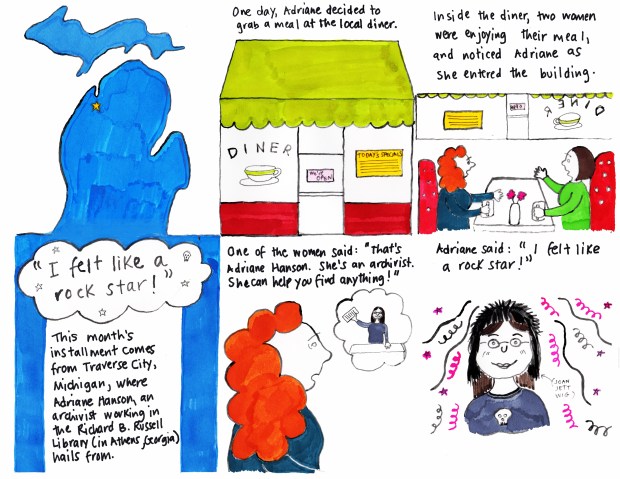
Beyond the Elevator, No. 3

e1b53781-071e-41b2-af35-754b577b1f6c

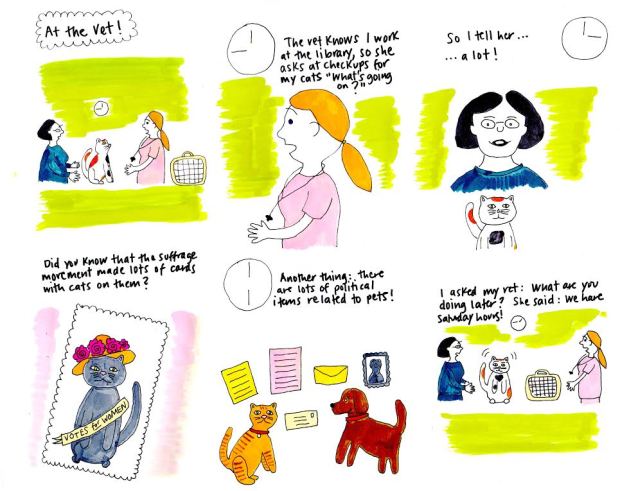
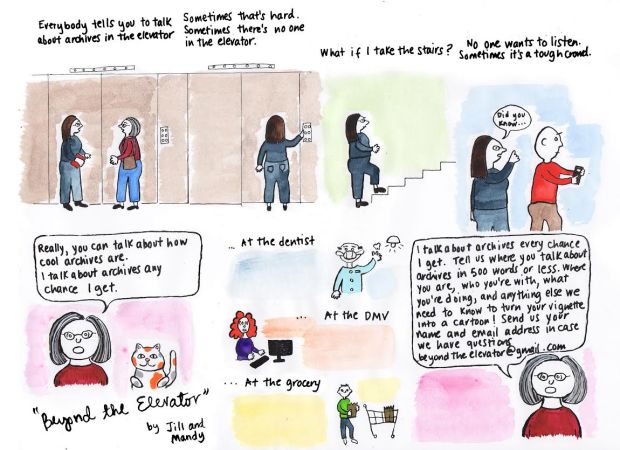
authorsportraitsBeyond the Elevator is a cartoon strip created by Mandy Mastrovita and Jill Severn. The strip expresses their heartfelt belief that the magic of archives can and should be worked into ANY conversation or situation.  The prospect of this axiom has exhorted the two into paroxysms of giggles, chortles, and howls despite the sober and noble subject matter.  Indeed, they have spent hours cooking up likely scenarios to bring to life in future cartoons.  These little gems appear in ArchivesAWARE! on amonthly basis for the foreseeable future, or until they run out of ideas. Which is where you, the reader can help. Tell them your best stories about talking archives—the wilder, the weirder, the crazier; the better They will even take an elevator story if you make it good. To share your story, please send a description of your concept, relevant details, and contact information (your name and your email address) to beyondtheelevator@gmail.com.

Archives Awareness on the Redesigned SAA Website

SAA_homepage

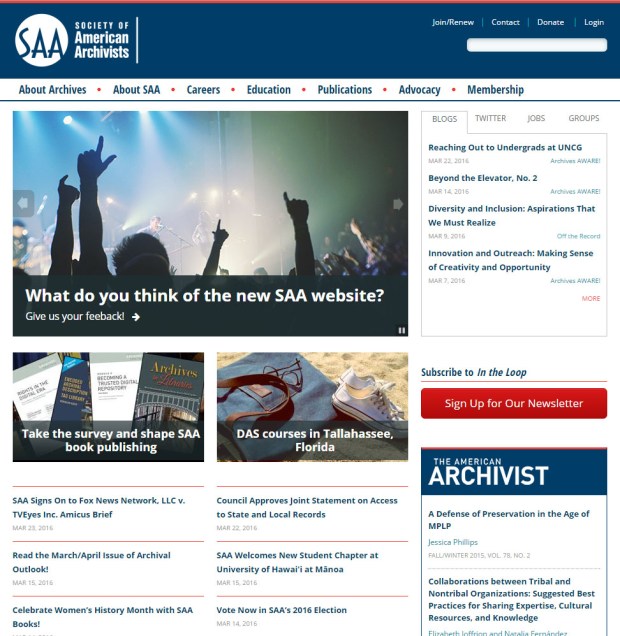
After many months of planning and development, the Society of American Archivists launched a redesigned website last week. Coordinated by SAA staff members, the new website reflects the work of many SAA constituent groups, including the Committee on Public Awareness (COPA) and the Committee on Advocacy and Public Policy (CAPP).

saa-strategic-plan-goals

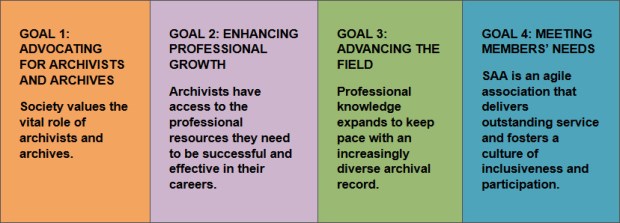
The four main goals of SAA’s 2014-2018 Strategic Plan.

As a reflection of SAA’s current Strategic Plan, which prioritizes Advocating for Archivists and Archives as Goal #1, “Advocacy” is now prominently featured on the website’s main navigation bar. In this context, SAA defines “Advocacy” as not only the shaping of public policy that impacts archives and archivists, but also includes the act of raising public awareness of archives collections, institutions, and professionals.

Advocacy Banner

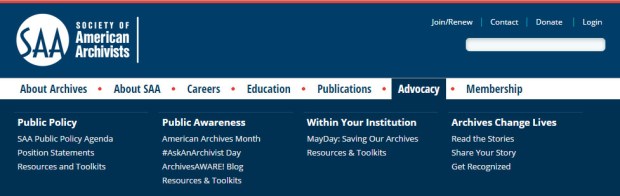
Advocacy links available directly from the main SAA page navigation bar.

Over the past year, COPA has worked to compile the many resources that lived throughout the former SAA website–on various sub-pages, constituent groups’ micro-sites, and external pages like this WordPress blog–and make them available in one centralized place on the redesigned website. These can now be found under “Resources & Toolkits” under Public Awareness.

The current list is just a starting point, with new additions to be added as they are identified. We welcome suggestions for additional Public Awareness resources and tools. They can be shared in the comments below, or e-mailed to archivesAWARE@archivists.org. As the ArchivesAWARE! blog was developed as a forum for sharing and discussing awareness-raising tools, tips, and experiences, we also welcome guest authors who want to highlight their resources on this blog, as a more dynamic compliment to the static Resources & Toolkits list!

Feedback

Just as the Advocacy and Awareness pages will continue to evolve, so will the entire website continue to expand–and the SAA office is eager for feedback. Take the survey and share your thoughts over the next few weeks!

Reaching Out to Undergrads at UNCG

Erin
This post was authored by guest contributor Erin Lawrimore, University Archivist, University of North Carolina Greensboro


Past SAA President Kathleen Roe kicked off her “Year of Living Dangerously with Archives” presidential initiative at the 2014 SAA annual meeting in Washington, D.C. by strongly encouraging all archivists to take bold actions in promoting the significance of archives and archivists to society. She stated that “if we are going to get beyond the point where archives and archival records are used in modest amounts, for a modest number of purposes by a modest range of users, then we also have to raise awareness of their value and importance.” [1]

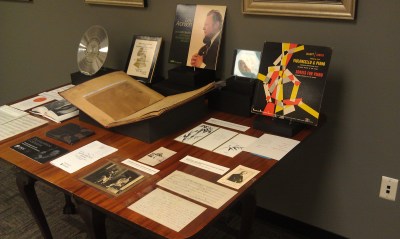
A pop up exhibit on our cello music collection

A pop up exhibit on our cello music collection

At the University of North Carolina at Greensboro’s Special Collections and University Archives, we’ve taken Kathleen’s challenge to heart. While we do have projects that are aimed at increasing awareness of our resources to University faculty, staff, and administrators, we’re purposefully trying to increase awareness among our student body population (particularly undergraduates). While we certainly aren’t the first archives to do any of these outreach activities, we are in all likelihood the first (and probably only) who will reach our student population here at UNCG. Some examples of our activities aimed at raising awareness among the undergraduate population include:

  • Pop Up Archives. Like popular “pop up” restaurants, our “pop up” archives exhibits are well focused in terms of content and strategically planned in terms of location. We want to be where the foot traffic is. The university center, the student recreation center, and even the sidewalk outside of the library building are great locations for engaging students. Each exhibit is tailored for the location (history of athletics at the student recreation center), is up for only 90 minutes or so (timed to coincide with lunch or a change in classes to increase foot traffic), and is small enough to fit on a card table (making planning and transportation simpler).
  • Campus Tours for First-Year Classes. While many first-year students might not make use of the archives as a research resource, many are quite interested in learning about the history of the place that will be their home for the next four years. To engage these students, we work with instructors teaching the University’s Foundations for Learning (FFL) courses, which are required of all incoming students, to schedule a historic walking tour of campus during one of their class sessions. During the tour, we provide the standard facts about the University’s history – but the piece that most students love most is that we also incorporate our three campus ghost stories into the general tour. In Fall 2014, we conducted tours for 18 FFL courses (approximately 250 students).
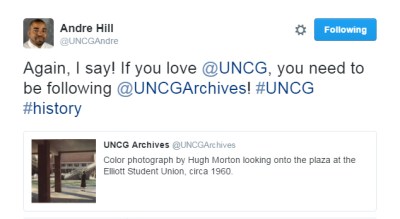
The Undergraduate Admissions directors are some of our biggest social media fans

The Undergraduate Admissions directors have become some of our biggest social media fans – and sources of new followers

In addition to these types of targeted activities, we’re taking an approach of “archives everywhere.” We want our records and knowledge of our department’s work to be spread across campus. We are using exhibit cases and bulletin boards in the library as well as in the university center to display reproductions of selections from our holdings. Our social media accounts are followed and retweeted/reblogged by the main University accounts as well as other accounts that reach large numbers of students (Admissions, Student Government Association, student newspaper, etc.). Our digital signage in the library building includes frequent references to University Archives and our current exhibits. And our promotional postcards, which include a historic photograph as well as links to our social media and digital collections, are available at all of the library’s service points.

These approaches don’t require a significant change to the work we’ve done in the past, but they do extend our reach far beyond the small percentage of students who physically come into the archives for a class. While we may have some students who graduate and remember only the “awesome ghost story the lady from the library told me,” we’ve made an impression and, for many more, hopefully sown a seed of awareness for archives and the work of archivists.

[1] Kathleen Roe, “The Year of Living Dangerously with Archives” (speech, Washington, D.C., August 16, 2014), Society of American Archivists Annual Meeting, http://www2.archivists.org/history/leaders/kathleen-roe/incoming-presidential-remarks-the-year-of-living-dangerously-for-archives. For more information on the “Year of Living Dangerously with Archives” initiative, see http://www2.archivists.org/living-dangerously.

Beyond the Elevator, No. 2

beyondtheelevator2


authorsportraits Beyond the Elevator is a cartoon strip created by Mandy Mastrovita and Jill Severn. The strip expresses their heartfelt belief that the magic of archives can and should be worked into ANY conversation or situation.  The prospect of this axiom has exhorted the two into paroxysms of giggles, chortles, and howls despite the sober and noble subject matter.  Indeed, they have spent hours cooking up likely scenarios to bring to life in future cartoons.  These little gems appear in ArchivesAWARE! on a monthly basis for the foreseeable future, or until they run out of ideas. Which is where you, the reader can help. Tell them your best stories about talking archives—the wilder, the weirder, the crazier; the better They will even take an elevator story if you make it good. To share your story, please send a description of your concept, relevant details, and contact information (your name and your email address) to beyondtheelevator@gmail.com.

Innovation and Outreach: Making Sense of Creativity and Opportunity

FullSizeRender

This post was authored by guest contributor Jill Severn,
Head of Access and Outreach at the University of Georgia’s Richard B. Russell Library


Innovation is a critical ingredient for providing outreach. An archives that follows the same approaches, rules, and standards even as its constituents raise new concerns and develop new needs and interests risks losing support by patrons and stakeholders, prevents connections to new users, and may demoralize or disconnect staff from the mission of the archives. Despite these consequences, this scenario certainly happens. The question is why?

Typically, there are two reasons that archives eschew innovation in the context of outreach. The first reason stems from a perceived lack of resources or expertise. Many archivists working in small repositories with few staff and small budgets find it challenging to think about engaging in active or new outreach programs. They cite insufficient time, staff, and financial resources to do more than provide basic services. They also see outreach as outside their essential activities. The second reason stems from a perceived level of success. Archives with this perspective often have popular collections that do not require significant outreach to attract patrons, or they have a captive audience that must use the archives collections for purposes related to work, legal issues, or other matters. Also, some archives do not receive a strong imperative from their respective stakeholders or parent bodies to refine and expand.

Some archives assume that what was good enough before will always be good enough. The problem is that the status quo almost never persists forever. New stakeholders replace old and have new expectations; patron interests shift; and resources wax and wane. When this happens, organizations that cling to the same old formula for success experience tremendous upheaval and face a daunting game of catch-up.

Archives with limited resources face stagnation or decline if they ignore the value and potential for growth that outreach provides. Operating within a profession swept up in a romance with technology, small archives with limited technical expertise may find it challenging to imagine, value, and pursue innovative outreach that is not driven by cutting edge technology. This perspective is shortsighted. Small archives can communicate their value and potential to new and existing audiences/supporters in innovative ways by employing simple, low technology strategies. Innovation is not necessarily synonymous with technology! At the same time, not all technology is expensive and often a modest investment can yield big results. Open source technology that is free to all who use it and open to further development is a boon for all archives small and large. Yet obtaining greater access to technological tools through open source or other means is not necessarily going to move every archives to the cutting edge. Innovation requires more than the technological ingredient.

Quite simply, innovation is the act of introducing something new—no more no less. In recent years, for many societies living in the developed world, this definition has become imbued with a strong connection to technological advances, particularly in the digital/Internet realm. Ask Americans what innovation means to them and most will say “new technology.” Of course, this is an important aspect of innovation in today’s context. New devices that entertain, educate, control, connect, and separate people play a crucial role in defining the lives and interactions of most Americans. Yet the definition of innovation does and should encompass much more than just new types of technology, and in the context of archival outreach it is worth widening our focus to embrace this broader view.

According to Egils Milbergs of Accelerating Innovation:

Technology plays a leading role in innovation, but it isn’t the only factor. What were once disruptive technologies now are commodities. Technology can be the establishing base for innovation, but people are the ones that drive it forward. Technology is really only the mechanics of the process. Real innovation is about great people generating and then implementing new ideas.¹

The most important aspects of innovation are not the tools that one employs to create it, but a posture or philosophy towards the entire process. The essential ingredients for innovation are: confidence, self-awareness, irreverence, creativity, and humility. Looking at innovation in this more expanded way, several key postures are worth adopting:

  • Be open
    • Learn what others have tried; seek new ideas and new ways of approaching challenges.
  • Embrace change
    • Accept that change is inevitable and learn to see change as a positive opportunity.
  • Use technology wisely and appropriately
    • What technical tools and resources are available? What is the cost and what will be the benefit? How have other archives used these tools? Are there tools available that are aimed at different user types that could be re-purposed for your needs?  Does the tool or resource offer a sandbox or demo option so you can experiment before adopting?
  • Know oneself and one’s Institution
    • Assess the organization’s goals, resources, needs, challenges, and opportunities through dialogue with staff, faculty, patrons, and colleagues.
    • Outreach should inform every phase of archival work so remember to brainstorm with the widest swath of your institution; this is where you will get great new ideas and fresh vision.
  • Multiply connections
    • Establish relationships with individuals and organizations that multiply connections–see patrons as donors, donors as patrons, patrons as cultural tourists, advisers as students, students as collaborators.
  • Embrace reciprocity
    • Look for relationships where each party can learn from one another, share with one another, support one another.
  • Be daring, but be humble
    • Seek or create working environments where risk and experimentation are valued. Do this by example and by supporting those who take risks and experiment. Build experimentation into planning and goal setting—“what are we going to test or try this year?” Take time to debrief and process after you try something new. The effort does not have to meet established goals to be successful; to be successful it is important to understand why it was successful or why it failed.
  • Be an opportunist
    • Always be mindful that a person one might meet or the experience that one may have may well lead to something exciting.
  • Husband the most important resource—archives staff and colleagues
    • Archivists cannot be innovative 24/7. It is vital to take time to recharge the batteries; take stock, savor success, examine problems, and rest.

¹Egils Milberg, “The Future of Innovation,” HR Funda:  Enabling Excellence by Fostering Collaboration, April 2006. http://hrfundablog.blogspot.com/2006/04/future-of-innovation.html (accessed September 16, 2008)

Highlight: Advocating Business Archives Toolkit

Grimwood_NominatingCommittee
This post was authored by guest contributor Scott Grimwood, System Manager of Archives, SSM Health Care


Most archivists acknowledge the importance of raising awareness of archives and their value to individuals, organizations, and society as a whole–especially in regards to major stakeholders and decision makers. For business archivists, this reality cannot be denied: effective advocacy is often directly related to a business archives’ (and archivist’s) continued existence within that organization.

Any business archives exists at the discretion of the business it serves and is at risk of being shut down if it is not seen as adding value to the organization, or as they say in the business world, providing adequate return on investment (ROI). This can be very difficult for business archivists since ROI is measured by how much money you either earned or saved the company.

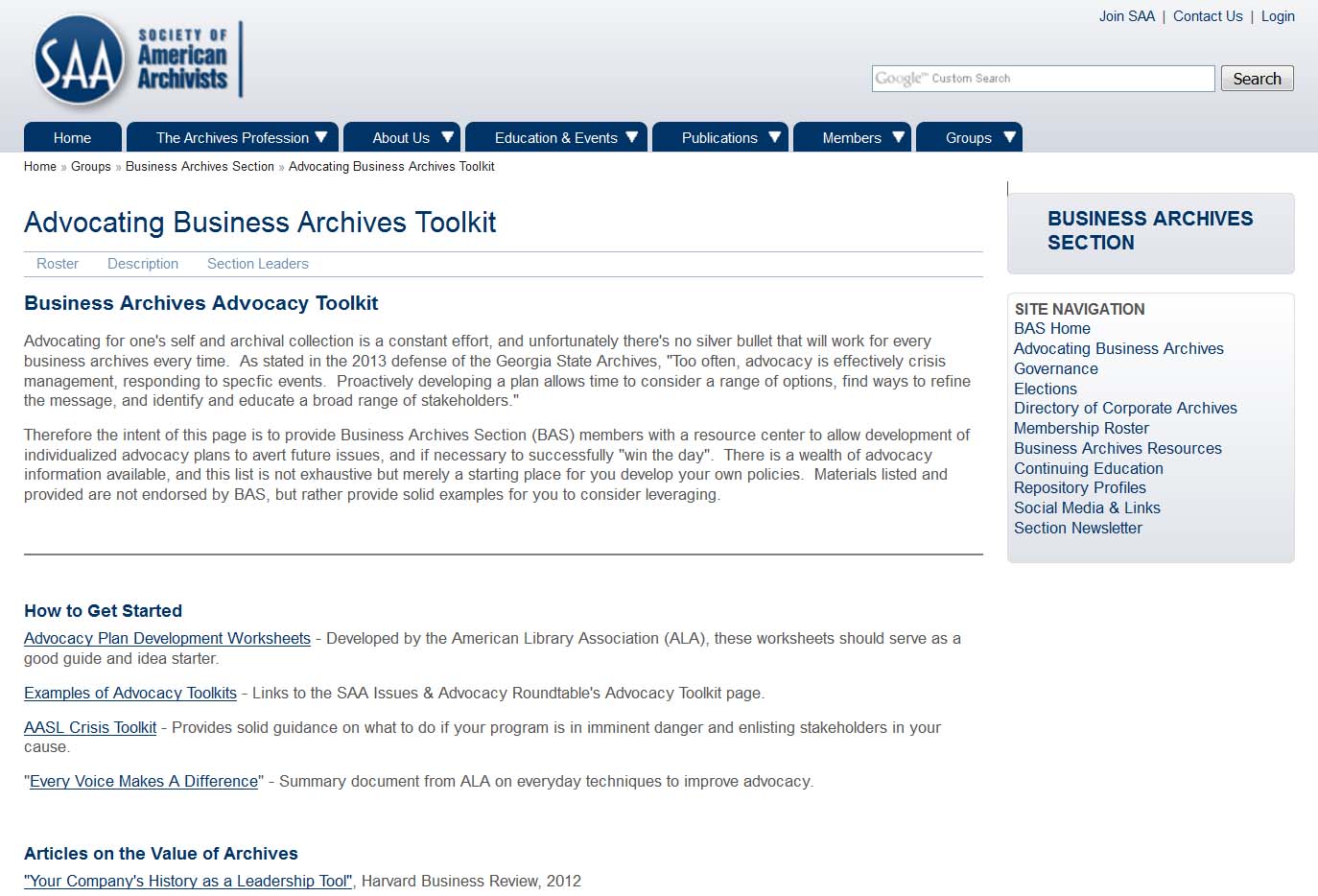
In 2014 the Business Archives Section (BAS) of the Society of American Archivists put together the “Advocating Business Archives Toolkit” as a central resource to its members, as a place where they could find extremely helpful information on and examples of successful advocacy. Because advocacy and awareness is vital to the to the entire archives profession, BAS encourages all archivists to utilize this valuable toolkit.

BAS

BAS Advocating Business Archives Toolkits screenshot, Society of American Archivists website

The Advocating Business Archives Toolkit has a wealth of information broken down into seven categories:

  • How to Get Started,
  • Articles on the Value of Archives,
  • BAS Member Recommendations & Success Stories,
  • Elevator Speech Examples,
  • Helpful Sites,
  • SAA Training Opportunities on Advocacy, and
  • Tips & Tricks.

The resources come from a wide variety of sources including external sources such as the American Association of School Librarians, American Alliance of Museums, and the Harvard Business Review.

The goal of the Toolkit is to provide archivists with the basic information to create and implement an advocacy program, and it does an excellent job. While the information from outside sources is very helpful, by far the best information comes directly from the experience of business archivists. Nothing beats a practical idea that has been tried and tested.

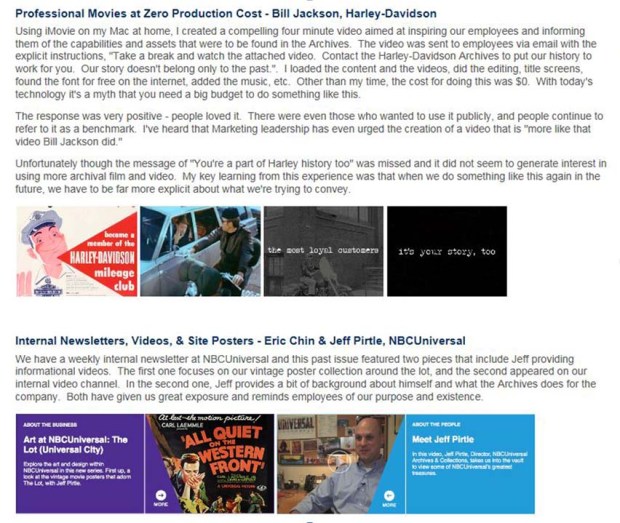
Most of the “archivist-tested” advocacy materials can be found in the “BAS Member Recommendations & Success Stories” and “Elevator Speech Examples” sections. The information and examples in both can be thought-provoking and inspiring, especially if you are looking to increase your advocacy efforts. Even if you do not work in a business setting, the motivations behind each example will be familiar to all archivists, and you’ll find many ideas that you can use as starting points to create an effective advocacy plan and individual projects and programs to raise awareness of your archives in your institution/organization/community.

Screenshot 2

Portion of the BAS Member Recommendations & Success Stories section of the BAS Advocating Business Archives Toolkit

While there can never be a single source for anything, the Business Archives Section’s “Advocating Business Archives Toolkit” comes pretty close when it comes to archival advocacy. It is worth your time to check out the toolkit and see what it contains that can be of help to you!

Share your favorite source of archival advocacy ideas in the comments below, or contact the ArchivesAWARE editors to contribute a guest post! Read more about the submission process on the About page, then contact the editors at archivesaware@archivists.org.

Articulating the Value of Your Archives to Resource Allocators

Erin
This post was authored by guest contributor Erin Lawrimore, University Archivist, University of North Carolina Greensboro


If someone asks “why is your archives important?,” how would you answer? Is your archives important because it preserves and provides access to important historical materials? Does its importance stem from its ability to foster a sense of community and “place?” Perhaps your response would focus more on its ability to provide accountability or serve as evidence of past actions. All are wonderful responses. But, when you are talking with a resource allocator – particularly one who has no past experience with archives – lofty ideals and notions of identity-building or remembrances of past events often aren’t going to cut it when they want to know why they should give you a sliver of the big (but shrinking) money pot. You need concrete evidence of the impact that your repository has in order to ensure that administrators’ support continues.

Cello_Music_CollectionThere are many ways to assess an archives’ value. From circulation numbers to gate counts to collection growth, each number gathered can provide useful clues as to how your archives is changing (or should be changing) over time. But, numbers alone do not make an effective argument for the archives. In order to advocate for your repository to administrators and others who hold the purse strings, you must frame these numbers in a way that fits their overarching missions and goals.

You must place the archives within the greater picture of your parent organization. To do this, of course, your parent organization must have clearly identified goals and objectives (hopefully it does, but, if not, that’s a whole different post!), and your archives must define its mission and purpose within those broader goals. How does your work contribute to the mission of your parent organization? For instance, a university archives is often housed within an academic library at a university. You should be able to clearly articulate how your archives directly impacts the library’s main objectives. If your library’s stated objective is to support undergraduate education, how does your archives contribute to this goal? How does your work help support undergraduate education at your institution?

Often you will need to advocate for your repository with administrators at an even higher organizational level. Returning to the example of the university archives, you may need to also consider how your archives contributes to the goals of the university (of course, ideally, your library’s goals will be in line with those of the university). Remember that you will often be advocating for your repository with non-archivists who, in all likelihood, are heavily focused on the present bottom line. Can you articulate the value of the archives in terms that non-archivists use and understand?

0205151447Once you understand and can articulate your value within the larger framework of your parent organization, you can then turn to the various metrics you have collected. How does each measurement demonstrate that you are contributing to the mission of your organization? For instance, return to the example of the library that is particularly focused on supporting undergraduate learning. A gate count of the number of undergraduates attending teaching sessions in the archives is one way of demonstrating your value to the library’s mission. But, that number might get lost in the world of general information literacy courses which most (if not all) undergraduates are required to attend at some point in their academic career. Perhaps adding information on the number of research hours accrued by undergraduate students coming into the archives for class assignments (as opposed to more basic instructional sessions) would enhance your advocacy and your ability to tie the unique contributions of the archives to the mission of the library.

Archives, libraries, and other cultural heritage institutions will always have the challenge of having numerous indirect and collective benefits that may not always be easy to directly measure and quantify. Yes, your archives holds unique information that can’t be found anywhere else and ensures that it is accessible now and in the future. But proving why that is important and why funding must be maintained (or increased) to support that role is critical to ensuring you get the money and support you need to do all of the work that goes into meeting that broad mandate.

Ball State University Drawings + Document Archive: The Movie

Street

Today we bring you an interview with Carol Street, Archivist for Architectural Records at Ball State University, and the outreach innovator behind
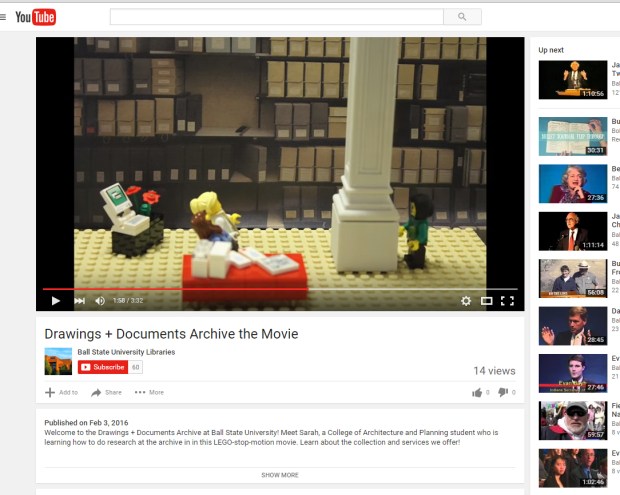
Drawings + Documents Archive: The [LEGO] Movie


Question: What was your inspiration for this video?

Carol Street: As always, inspiration came from a number of places. My 9 year old granddaughter, Anna, is probably my greatest inspiration when it comes to many things, but especially LEGO. Thanks to her, I’ve amassed a not insignificant collection of LEGO bricks and figures, and even created a LEGO model of the Drawings + Documents Archive. But the actual lightbulb moment came when I saw the wonderful stop-motion LEGO movie by the Library of Social Sciences at the University of Copenhagen. The video was the brainchild of the library director Christian Lauersen, who wanted a brief video to introduce students to the resources available at his library. He wrote a fantastic blog post on the making of the video and his reasons behind it, all of which I agreed with. There was that moment after the video ended where I thought—hey! we can do that, too!
YouTube_Screenshot

Screenshot of the Ball State University Drawings + Documents Archive video on YouTube.


Q: For the archivists out there who may be intimidated by the time, resources, and level of creativity required to produce an outreach video like this, could you give some insights into the production process for this video?

CS: There is a significant amount of time involved in making even a short video like this. As the only staff member in the archive, I would never have time to do this myself. Luckily, this year I have a very creative graduate assistant, Raluca Filimon, who embraced the project even though she had never made an animated movie before. Although it may seem daunting at first, the movie is really just a culmination of a lot of small projects. We began the process by breaking it down into those smaller projects—such as write a script, create scenes, borrow equipment, learn how to film LEGO figures, select music, record the narration—that ultimately resulted in the finished film. Because it was a fairly long process, we made sure to celebrate the major milestones along the way. Those moments of celebration built momentum for the next phase of the project.

I’ve been very fortunate to have some great graduate assistants from the College of Architecture and Planning.  They’re not only incredibly creative, but also good at project management and research. Raluca did a fantastic job bringing my ideas for the film to life. I had specific goals that needed to be reached, but allowed plenty of space for Raluca and other students to inject their own creativity. All of the graduate assistants who work in the archive added to the film in different ways. There were a lot of “what if….” moments where we would ask things like “what if the astronaut showed up at the end with the disco ball?” Sometimes those ideas were shot down, but others—like the fantastic disco finale—made the final cut. In the end, the process was very much a team effort that brought the students together.


Q: What other forms of outreach do you utilize for the Drawings + Documents Archive, now or in the past? How does the video diverge from and/or compliment those efforts?

CS: We utilize all of the typical forms of outreach, such as exhibits, instructional sessions, a newsletter, and a blog. Our audience is well-versed in design and very creative, so we try to also approach outreach in creative and interesting ways. Last fall my graduate assistants came up with a fantastic promotional campaign that is still filling up the cases outside the archives. The campaign is called “Be inspired” and shows photographs of students and faculty holding up something in the archive that inspires them. The person in the photo writes on the poster what inspires them. Right now our new architectural history professor is holding up a drawing by Piranesi and she wrote that she’s inspired by “historical context”. It’s a fresh, patron-driven way to showcase the amazing collections we have in the archive.
ArchivesAWAREGIF

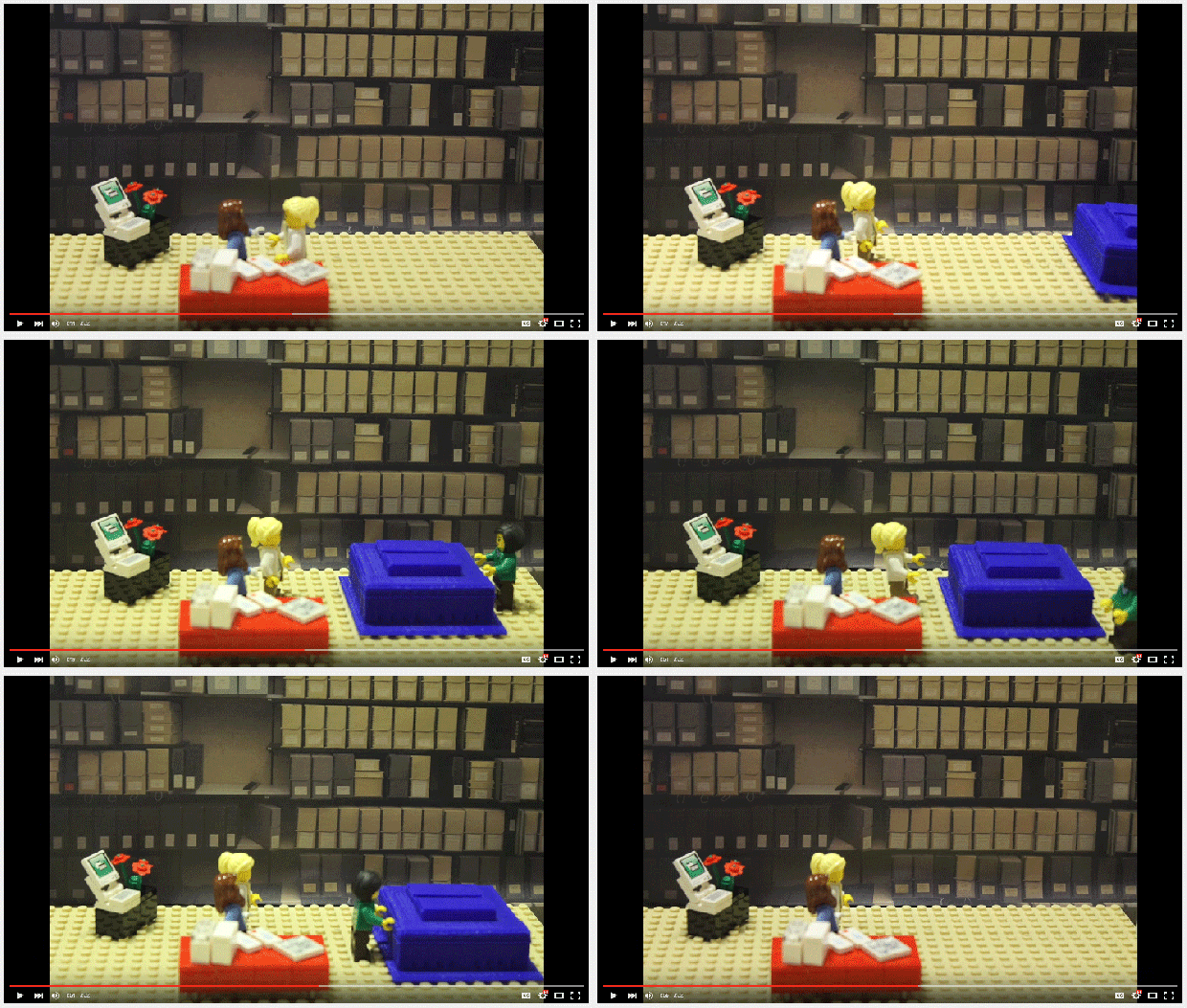
The Drawings + Documents Archive video features the Indiana Architecture X 3D collection.

We’ve also branched out into 3-D printed modeling of buildings and building details that are represented in the collection. The project is called Indiana Architecture X 3D and it has probably been our most effective form of outreach in terms of student reach. The models appeal to younger students who have yet to learn how to model and equally attract older students who are suitably impressed by the level of detail we can create. They all enjoy checking the 3-D printed model with the actual drawing to see if we were accurate in our modeling skills. Even faculty, who can be just as challenging as students to reach, specifically ask us to show them to visitors, potential students, and their classes. The project also allows us to now give something back to our donors who generously support the work of the archive. At the holidays we sent donors small, 3-D printed ornaments based on the collection, which were a big hit and garnered a lot of interest, good will, and even further financial support.


Q: What impact/results are you hoping to see from this video?

CS: I’m hoping that our students enjoy the film and remember the archive when it’s time to conduct research. We often throw far too much information at students during our instructional sessions because we feel it’s our one chance to tell them all about the archive and we want to tell them everything. Students couldn’t absorb all that information at once even if they wanted to. The more instructional sessions I give, the more I realize the time is best served by essentially building bridges for students to cross when they actually need us. I strive to make the archives a friendly, non-intimidating place where they can feel comfortable asking for help when their assignments or interests lead them here. And what’s friendlier and less intimidating than LEGO?

I’d also like everyone to equate archives with fun, not dust.

ArchivesAWAREGIF2


Beyond the Elevator (no. 1)

Beyondthe Elevator012016-MastrovitaSevern

Welcome to the inaugural Beyond the Elevator Cartoon!

Mandy Mastrovita and Jill Severn created the strip to express, through illustration, their heartfelt belief that the magic of archives can and should be worked into ANY conversation or situation. The prospect of this axiom has exhorted the two into paroxysms of giggles, chortles, and howls despite the sober and noble subject matter. Indeed, they have spent hours cooking up likely scenarios to bring to life in future cartoons, illustrating the varying places and situations in which archivists may find opportunities to explain their work to non-archivists. These little gems will appear monthly for the foreseeable future, but never ones to let greed guide them, Mandy and Jill would be delighted to have ideas for this comic from archivists and archivist enthusiasts everywhere. They welcome scenarios both real and imagined–based on actual interactions that archivists have had, or on dreams (nightmares?) haunted by the all-too-familiar “What is an archivist?”  question. To share your idea, please send a description of your concept, relevant details, and contact information (your name and your email address) to beyondtheelevator@gmail.com.