There’s an Archivist for That! Interview with Christine “LadyBee” Kristen, Burning Man’s Archivist, Art Collection Curator and Photo Gallery Editor

Photo of Christine "LadyBeen" Kristen standing outside on asphalt with tall grass in the background.

Christine “LadyBee” Kristen.

This is the newest post in our There’s an Archivist for That! series, which features examples of archivists working in places you might not expect.  COPA member Rachel Seale, Outreach Archivist at Iowa State University, brings you an interview with Christine “LadyBee” Kristen, Burning Man’s Archivist, Art Collection Curator, and Photo Gallery Editor.

Christine Kristen (a.k.a LadyBee) is Burning Man’s Archivist, Art Collection Curator and Photo Gallery editor. She was Burning Man’s art curator from 1999 to 2008, where she dealt with all things visual and aesthetic, including managing the art and the art grant program, photo-editing the Image Gallery, writing art content for the Burning Man website, working with the ARTery, managing the archives, and lecturing and writing about the art of Burning Man. She is the co-author of “The Jewelry of Burning Man,” with Karen Christians and George Post, and the curator of the exhibition “PlayaMade: Jewelry of Burning Man,” which debuted at the Fuller Craft Museum near Boston in 2017. It opens at the Bellevue Arts Museum in Seattle in January 2020. She has an MFA in sculpture from the Art Institute of Chicago.

How did you get your gig?

I was an art-world dropout who left New York City in the early 90s, disgusted with the art world I experienced there; I stumbled upon Burning Man in 1995 and was instantly at home, attracted to the intelligent, creative outsiders who were doing radical creative acts in the Black Rock Desert. As I had an art background (MFA Sculpture, School of the Art Institute of Chicago) I was hired by Larry Harvey in 1999 to run the new art grant program; for ten years I did that as well as several archival tasks, like starting our Material Culture archives and our (at the time) physical archive of press articles, books, and magazines.


This slideshow requires JavaScript.

I’m not trained as an archivist; I developed my skills by doing, in an environment that encouraged outside-the-box thinking. I left in 2008 to work for an arts startup which ran out of funding, and did some independent curating but realized that I only wanted to work for Burning Man, so I returned in 2012 as the art collection curator and archivist.

Tell us about your organization.

That’s a BIG task; Burning Man is complex and layered; basically it’s a temporary community in the Black Rock Desert that lasts for eight days each year — a city of 80,000 people characterized by art, creativity, generosity, gifting, and radical inclusion. This year we had over 400 art installations, scattered across a flat, barren desert. We have an airport, medical services, a DMV (our Department of Mutant Vehicles), several radio stations, two newspapers, a center cafe and performance space, ice sales, and lots of portable toilets. We do not have stages, hire bands, or put on entertainment; our community brings its hundreds of interactive theme camps, costumes, performance, and art. As Larry Harvey, our founder, said, “We create the hive, the participants bring the honey.” But it doesn’t end there; we are actively engaged in bringing art from the desert to cities; in addition to our art grant program for work on the playa, the prehistoric lake bed where Burning Man takes place, we fund temporary interactive art all over the world via our Global Arts Grants. We now have Regional groups in 35 countries all over the world who put on their own versions of Burning Man, with our guidance; there are over 100 such events annually. Within the Burning Man Project are two groups that do good in the world year round: Burners Without Borders, a disaster relief organization that helps out wherever they’re needed, and began when Hurricane Katrina struck during Burning Man 2005; and Black Rock Labs, which originally gave free or low-cost solar panels to schools within the desert event site area.


Burning Man is guided by our Ten Principles:

  • Radical Inclusion
  • Gifting
  • Decommodification
  • Radical Self-Reliance
  • Communal Effort
  • Civic Responsibility
  • Leave No Trace
  • Participation
  • Immediacy

They were crafted not as a dictate of how people should be and act, but as a reflection of the community’s ethos and culture as it had organically developed since the event’s inception. We are a global community of creative souls, doers, makers, gifters, artists and free thinkers.

Describe your collections.

I manage five archives; our press archive is now created digitally via the Meltwater Feed, a service to which we subscribe. Each week I archive domestic and international press, YouTube videos and TV and radio spots; all of these files are stored digitally. We also archive a few hard copies of magazines when it’s beneficial to do so. The second archive I manage is our library; Burning Man has allowed me to release my inner librarian! There are now 175 books in our library; these are books entirely about Burning Man, or with significant content about us. Our library also contains many magazines which have featured us, including National Geographic, Raw Vision, Wired, Leonardo Journal, Time, Architectural Review, Smithsonian, Rolling Stone, Forbes and Art Forum.

Shelves, that look like cubbies, with books.

Burning Man Library.

The third archive is our Internal Print Production collection, which I started in 1999; it includes the materials we hand out to participants on arrival in Black Rock City —  a city map, our What Where When, a guide to all playa events; an art map, and some logistical information. Also in this archive are the dozen stickers we produce each year, based on a design contest that participants enter; postcards/posters for our local events; tickets; programs from our annual fundraising events; and years of annual journals which are no longer produced.


The fourth archive is our collection of photographs and videos; we have flat files full of photographic prints back to our first year, 1986, and a large collection of digital files. Our Documentation Team is given assignments and covers all aspects of the event and related events; these are submitted digitally. We have VHS tapes from the earlier years, which have been digitized, and many DVDs of more recent videos; all of these have been digitized and archived.

The fifth archive is our Regional Archive, which contains printed materials from the 100+ events that occur worldwide including Afrika Burn in South Africa, Mid-Burn in Israel, KiwiBurn in New Zealand, Tropical Burn in Brazil, and the original regional burn, Burning Flipside, in Austin, Texas. They produce an event map and guide, like Burning Man, and also stickers, buttons, t-shirts and other memorabilia.
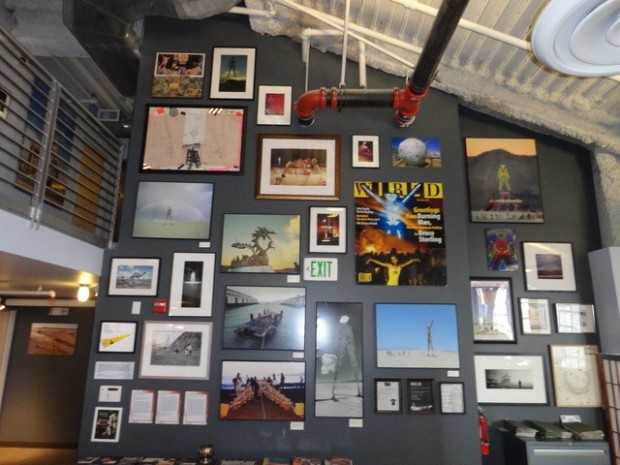
A wall of images from the 1990s, depicting history of Burning Man. Includes magazine covers and photographs.

The History Wall – images from the 1990s.

Large painting by JennyBIrd Alcantara , small painting, center, by Josh Coffy, organ and sheet music from the Church Trap by Rebekkah Waites, 2013

Large painting (left) by JennyBIrd Alcantara , small painting (center), by Josh Coffy, organ and sheet music from the Church Trap by Rebekkah Waites (art installation to the right), 2013.

What are some challenges unique to your collections?

Much of Burning Man is ephemeral and experiential, living on in participants’ memories, and in videos and photographs. Some of the art installations are burned at the event, never to be seen again. We are fortunate in that the Nevada Museum of Art maintains an archive donated by one of our founders; they created a historical exhibit that was included in the Smithsonian’s wildly successful show, No Spectators, which traveled to the Cincinnati Museum of Art, where it broke all previous attendance records, and is now at the Oakland Museum of California. Artists were asked to create work for the exhibit, which also features films, photographs, jewelry, costumes and an outdoor Temple.

What is the favorite part of your job?

My favorite task is curating and producing art for our World Headquarters (HQ) in San Francisco. Each year, post-event, I identify the best photos of the most interesting art, and a local burner and muralist prints and mounts them for us. I also seek artifacts from art installations, posters and items from our theme camps, and gift items from the event. I design the displays at HQ, and hang the art. I co-wrote the book, Jewelry of Burning Man, and I have a travelling exhibit, Playa Made: Jewelry of Burning Man, which I guest curated for the Fuller Craft Museum near Boston, and which will open at the Bellevue Art Museum near Seattle, this January. Each year I create a display at HQ of the jewelry I collect on playa; I have a maker group of over 90 people, and we meet each year at the event. My jewelry collection goes back to 1995. My style of display is far from minimal; I like to cover every available space with the art and objects from our madly creative community.


This slideshow requires JavaScript.

All photographs in this post courtesy of LadyBee.

Stay tuned for future posts in the “There’s an Archivist for That!” series, featuring stories on archivists working in places you might not expect. If you know of an archivist who fits this description or are yourself an archivist who fits this description, the editors would love to hear from you—share in the comments below or contact archivesaware@archivists.org to be interviewed for ArchivesAWARE!

Responses & Retrospectives: Not Just Your Problem: Metadata Shame, Imposter Syndrome, and Archivists by Jodi Allison-Bunnell,

Photo of Jodi Allison-Bunnell. Color.

Jodi Allison-Bunnell (courtesy of Jodi Allison-Bunnell).

This is the latest post in our series Responses and Retrospectives, which features archivists’ personal responses and perspectives concerning current or historical events/subjects with significant implications for the archives profession. Interested in contributing to Responses and Retrospectives?  Please email the editor at archivesaware@archivists.org with your ideas!

It usually happens during the tour of the stacks: As we stand among the grey boxes, in a dark corner, a colleague will lean toward me and confess, sotto voce, that their metadata—accession records, finding aids, donor records, or digital collections—is really a mess. Their eyes are downcast with shame at the gap between the standards that they know and what they actually have. They are certain that they are the only individual or institution with this problem.

But what I know—and am always truly delighted to tell them—is that they are not at all alone. Twenty-three years of work in large and small institutions, a regional consortium, and as a consultant has shown me that everyone has ugly metadata. Everyone carries shame about it. And it doesn’t need to be that way.

Last spring, at the annual meeting of Northwest Archivists in Bozeman, Montana, I co-presented a panel with fellow consultants Rachael Woody and Maija Andersen to predict the future of archives in 2020 (http://northwestarchivists.org/resources/Documents/NWA%202019%20Program.pdf). During that panel, we discussed a number of important themes, including salaries in the archival profession (Rachael’s passion!) and the continued certainty of constrained resources. I used the framework of “The good, the bad, and the ugly” to predict that a year from now, your metadata will still be ugly. And there’s no shame in that.

Metadata shame is part of a larger phenomenon: imposter syndrome. First identified in 1978 by Dr. Pauline Rose Clance and Dr. Suzanne A. Imes, it’s when an individual believes they have insufficient skills, intellect, and experience for a given task or environment, usually professional, despite objective evidence to the contrary. (Clance, Pauline R.; Imes, Suzanne A. (Fall 1978). “The Impostor Phenomenon in High Achieving Women: Dynamics and Therapeutic Intervention” (PDF). Psychotherapy Theory, Research and Practice. 15 (3): 241–247).  Although Clance and Imes’ initial paper was focused on high-achieving women, the term has since been applied to all genders of highly intelligent, qualified, and achieving people who suffer this crushing self-doubt.

The Clance Imposter Phenomenon Scale, a non-diagnostic self-assessment, asks a respondent to indicate degree of agreement or disagreement with statements that include: “I can give the impression that I’m more competent than I really am,” “I’m afraid people important to me may find out that I’m not as capable as they think I am,” “I rarely do a project or task as well as I’d like to do it,” and “Sometimes I’m afraid others will discover how much knowledge or ability I really lack.” (https://paulineroseclance.com/pdf/IPTestandscoring.pdf, accessed 2019 Oct 11. From The Impostor Phenomenon: When Success Makes You Feel Like A Fake (pp. 20-22), by P.R. Clance, 1985, Toronto: Bantam Books. Copyright 1985 by Pauline Rose Clance, Ph.D., ABPP.)

Clearly, there are many archivists who would agree with many of those statements. At the annual meeting of the Society of American Archivists last August, Session 701, “My Comeback Story: Overcoming Imposter Syndrome in the Archives Profession” drew hundreds of attendees that overfilled the largest room in the conference facility. The presenters shared their stories of struggling with imposter syndrome and how they have transformed that experience into positive outcomes. Some of their experiences were related to race, education, or the specific dynamics of their institution. But Drew Davis of the College of American Pathologists gave examples that are universal: We have so much to do and so much to know, and one response to that reality is shame. We compare ourself to other professionals and are certain that they are more successful. Davis ultimately found that he is naturally competitive. Instead of fighting that tendency, he turns his comparison with others into an opportunity to be inspired, motivated—and successful

His response is the map for all of us: rather than letting shame overcome us, we can put that energy toward action. When I was building a Digital Public Library of America hub at the Orbis Cascade Alliance, we confronted the challenge of half a million digital object records that had been created before the consortium had Dublin Core best practices. A few core fields needed remediation before the content could be aggregated efficiently at the regional and national level. As part of a series of workshops I developed with consultant Anneliese Dehner and Julia Simic (Assistant Head, Digital Scholarship Services, University of Oregon), we inserted humor and cultivated the concert of the “metadata shame-free zone.” We wanted to create an atmosphere that inspired action, bolstered skills, and created clear priorities for metadata cleanup. And we delivered the results we needed: 100,000 digital objects cleaned up, aggregated, and ready for DPLA.

So let’s come out of that dark corner of the stacks, openly reveal our challenges to colleagues, and support one another in developing solutions. Let’s share our comeback stories to make the profession better for all of us. No more metadata shame. And no more imposters.

This post was written by Jodi Allison-Bunnell. Jodi Allison-Bunnell has twenty-three years of experience leading and participating in collaborations to increase access to unique content in archives, libraries, and museums by using shared systems and standards. She is the owner and principal consultant at AB Consulting (http://consulting.allison-bunnell.net). She was the program manager for Unique and Local Content at the Orbis Cascade Alliance until 2018; prior positions include project manager for Northwest Digital Archives and archivist at the University of Montana. She holds an MA and an MLS from University of Maryland at College Park and a BA summa cum laude from Whitman College.

The opinions and assertions stated within this piece are the author’s alone, and do not represent the official stance of the Society of American Archivists. COPA publishes response posts with the sole aim of providing additional perspectives, context, and information on current events and subjects that directly impact archives and archivists.

Responses & Retrospectives: “maybe she just has to sing for the sake of the song” Rosemary K.J. Davis on Student Loan Debt and Its Impact on the Archival Profession

black-and-white head shot of Rosemary K.J. Davis.

Rosemary K.J. Davis (courtesy of Rosemary K.J. Davis).

This is the latest post in our series Responses and Retrospectives, which features archivists’ personal responses and perspectives concerning current or historical events/subjects with significant implications for the archives profession. Interested in contributing to Responses and Retrospectives?  Please email the editor at archivesaware@archivists.org with your ideas!

This text has been lightly adapted from its original form, which was presented at the Society of American Archivists Annual Meeting in Austin, TX on August 14, 2019.

maybe she just has to sing for the sake of the song

I owe almost $160,000 in student loans. This number is terrifying to me. I hate to say it out loud or even see all those digits lined up on the page. The very fact of it, the way it feels so inevitable yet so completely avoidable. And it’s both. Truly. 

There is little comfort in knowing that I am not alone in having this complex, conflicted element in my life. It’s an undercurrent for so many of us, a constant little…catch that is triggered by looking at your bank account, by searching for a new job, for paying some bills but not others, by taking on extra work, by not doing things like: having kids, buying a house, traveling, having adequate health insurance. 

Low pay and the notion of a thriving wage are vital topics of conversation within the archives field, certainly, but for me, and maybe for many others, compensation cannot be discussed without an open acknowledgement of debt, of the financial and emotional weights carried as we try to make space for ourselves in this profession.  

I took out my first student loan when I was eighteen because my divorced mom made just enough money that Northwestern University’s financial aid office assumed she magically had thousands and thousands of dollars in reserve to pay for my tuition and housing. The university assumed that those imaginary funds, along with non-existent child support from my dad, would certainly be enough to keep me afloat and pay the bills–I can assure you this was not the case.  

I took out student loans every semester because the choice between staying in Chicago and going back to East Texas didn’t feel like a choice at that point in my life. 

I had to make my first student loan payment six months after I dropped out of Northwestern halfway through my third year. There have been deferments and tearful calls to loan servicers begging for adjustments, but always, eventually, payments. Relentless. I know I am not alone in feeling the fear of this weird emotional and financial low-hanging cloud that dulls joy and takes away possibilities.

When I decided to go to library school, the fatalism of already being six figures deep in unrepayable debt was almost liberating. Because, you know, at that point: fuck it

I worked full-time and took classes at Pratt during the evening. At one point, I did a practicum at the Fales Library at NYU and while the experience I gained there was invaluable both practically and in the form of a resume line, it was also unpaid. Well, I wasn’t paid. But I did use student loan money to pay for tuition in order to get credit for my unpaid internship. 

That’s certainly a song that many of us know how to sing. Hello, to the choir of my colleagues. I can hear you.

I don’t really have a concrete number for how much debt I took on in order to get through my MSLIS degree, but it was most likely about $36,000, which is essentially the entire bill for grad school. Salary from my full-time office job paid for my rent, for my food. I’m aware of the immense amount of privilege it takes in order to just…decide I’m taking on this additional debt. The way that I just got to assume “I’ll figure it out somehow”–it’s particular brand of carelessness that so many people cannot emotionally, professionally, or financially afford to exercise. But when you are sunken so deep into the unreality of a number this big, a few more thousand can feel like pocket change. It can feel like both a salvation and like a curse you cast upon yourself.  

And obviously, the cost of dealing with this debt isn’t just financial. It’s depression. Guilt. Fear. Disenfranchisement. These are not uncommon states of being for many people in our profession. A recent contingent employment survey done by the New England Archivists  shows that a majority of us are taking on significant amounts of debt in order to finance a career in a profession that is chronically underfunded across the board and is, in many cases, still under the impression that unpaid internships that provide “good experience” are good enough, that job postings without salary information are just “an institutional prerogative” instead of an antiquated, bullshit form of gatekeeping that keeps applicant pools remarkably undiverse. 

The Issues and Advocacy Section of SAA recently completed a temporary labor survey that reveals some pretty unsurprising information: precarious, underpaid, unsupported labor not only actively drives people away from this profession, but it also creates a cross-section of archivists who are constantly searching for work, endlessly balancing multiple jobs in order to stay afloat, and who feel like they’ve taken on a mountain of debt for a shot at doing work they care about in conditions that deny them stability, progress, and joy.

After five years of jobs with expiration dates and less than stellar salaries, I am now paid well and in a permanent position. I’m thankful for that, certainly, but also: about 14% of the money I make every year goes directly to student loan payments. I am now almost two decades into making payments on my student loans and the principal amount has absolutely never decreased once. I doubt it ever will. Every year, my monthly payment amount goes up, instead of down–it’s pegged to my income (and to the income of my partner, who has zero debt but has become responsible for mine because we are in love and legally bound). I got word a couple of days ago that my promotion portfolio was accepted. Salary increases, like the one I will get with this promotion, are lovely, but usually feel a bit more grayscale than technicolor. I know that the increased amount siphoned away toward loan payments will absorb most of the small gains I make. 

I am so lucky right now. I can pay my bills. I have financial and emotional support from a wonderful partner. I don’t have dependents who require assistance. I did, finally, buy a house. I have debt beyond my student loans, but I can usually handle it. 

Still. 

Uncertainty and anxiety don’t slip away so easily. They become hardwired in a way that can feel impossible to dismantle. And when you’re surrounded by waves of professionals doing awesome work but who are struggling with a heaviness I can so well recognize, who are coming up against the same walls over and over again, who are facing limitations I can’t begin to imagine shouldering, you have to realize that reaching back to give a hand up is good but it’s certainly not enough. 

There has to be a systemic examination of how our profession values the labor being done. This examination must necessarily be linked to an acknowledgement of the full spectrum of experiences carried by the individuals who perform it. That includes debt, family obligations, health, and a raft of other needs that shape who we are and how we work.

None of this is news, but it is maybe my own little personal call to action. My nudge to examine your working conditions and those of the people supported by the work you do. My request that we make our labor more valued through visibility. My hope that together we can lift the tide a bit for all.

Let’s find some new songs to sing together. 

This post was written by Rosemary K. J. Davis. Davis is the Accessioning Archivist for the Beinecke Rare Book and Manuscript Library at Yale University. She received her MSLIS + Archives certificate from Pratt Institute. Currently, she serves as Vice-chair for SAA’s Committee on Ethics and Professional Conduct, as a member of the Steering Committee for SAA’s Women Archivists Section, as Co-chair for the New England Archivists’ Inclusion and Diversity Committee, and as Managing Editor for the Journal of Contemporary Archival Studies.

The opinions and assertions stated within this piece are the author’s alone, and do not represent the official stance of the Society of American Archivists. COPA publishes response posts with the sole aim of providing additional perspectives, context, and information on current events and subjects that directly impact archives and archivists.

There’s An Archivist For That! Interview with Jacqueline Seargeant, Global Archive Manager, John Dewar & Sons Ltd

This is the latest post in our There’s an Archivist for That! series, which features examples of archivists working in places you might not expect. In this entry, Committee on Public Awareness (COPA) member Rachel Seale brings you an interview with Jacqueline Seargeant, Global Archive Manager, John Dewar & Sons Ltd.

Jacqui Seargeant in the Scotch whisky archive

Jacqui Seargeant in the Scotch whisky archive. Photograph courtesy of Bacardi.

Jacqui graduated from Glasgow University with a Master of Arts in History in 1994, followed by a postgraduate Master’s degree in Archive Administration from the University of Liverpool. Her earliest archive work included cataloguing and managing collections at Herriot-Watt University, the Scottish Brewing Archive, and Allied Distillers.

Jacqui started working for John Dewar & Sons in 1999 as the Company Archivist. Her role has developed substantially since then and today Jacqui is the Global Heritage Manager for all historical collections owned by the Bacardi company, including unique business archives, family archives, museum and art collections.

Over the years she’s been instrumental in creating and developing many of the heritage elements for the Scotch Whisky brands, including the heritage exhibitions at the Home of DEWAR’S based at Aberfeldy Distillery. Other projects have included the development of the heritage elements of various brand visual identities, marketing initiatives, product packaging and new product development as well as historical brand education. It’s Jacqui’s meticulous curation of our extensive archives that allow Dewar’s to lay claim to being the World’s Most Awarded Blended Scotch.

How did you get your gig?

I came to the company on a one-year contract in 1999, to help them create a heritage exhibition at the newly created DEWAR’S brand home visitor center at Aberfeldy in Scotland. 20 years later I’m still with the company and the role has developed gradually from Dewar’s Archivist to the Global Archive Manager for all brands with archives. I joined the year after the Bacardi company acquired DEWAR’S Blended Scotch Whisky and with it an amazing business archive collection. I had already worked at the Scottish Brewing Archive and for Allied Distillers, so I understood the business and record types and was able to demonstrate the power of the collection for their business. I had, however, never managed my own archive collection, I had always been part of an archive team, so that was exciting for me and my career development. Within a very short time I was providing images to revamp office spaces, getting involved in the brand education program, helping to defend legal claims and providing heritage inspired ideas for new product developments. It was a steep learning curve for me and a bold move, but my previous work in the drinks industry gave me a foundation that allowed me to jump right in.

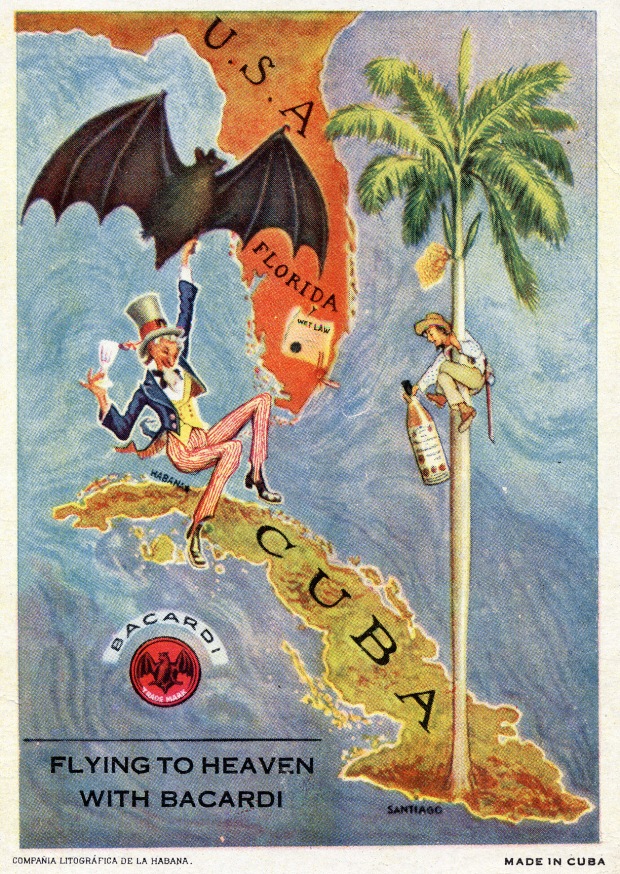
Bacardi prohibition era postcard email, has Florida at top and Cuba on bottom, with people drinking rum in between. Bacardi logo then text below "Flying to Heaven with Bacardi"

Bacardi prohibition era postcard email. Courtesy of the Bacardi Archive.

Tell us about your organization

Bacardi is the largest privately held spirits company in the world. What is most remarkable to me is that it remains a family-owned company after seven generations. The company was founded more than 157 years ago in Santiago de Cuba and has incredible stories made for the movies! Our company founder, Don Facundo Bacardí Massó, revolutionized rum making with the creation of the first light-bodied rum which transformed the rum industry. Since those early days the company has grown massively to cover more than 20 production sites across the globe. Today the Company owns more than 200 brands and labels, including the core heritage brands of BACARDÍ rum, DEWAR’S blended Scotch whisky, MARTINI vermouths and sparkling wines, BOMBAY SAPPHIRE gin, BARON OTARD cognac and NOILLY PRAT vermouth. Some of our brands, like BÉNÉDICTINE, have a 500+ year old history – we have a lot of heritage to preserve!

Describe your collections

We have amazing historical resources within our Company, including business archives, brand advertising materials and objects, bottles full of spirits and actual museum collections.  More than fifteen of our brands have a long history, and we have four main collections in five different countries – Bermuda, the USA, the UK, France and Italy. In total, we care for more than 3000 linear meters (3km) of archives which, if stacked up, is thirty two times the height of the Statue of Liberty. The archive collections are fundamental to our brand identities and brand developments. We are not just about preserving the past, we are about building the future by inspiring brand teams, mixologists and others who help craft new legacy cocktails and new campaigns.


This slideshow requires JavaScript.

The Bacardi Archive is at our north American Regional Headquarters in Coral Gables, FL. Bacardi was founded in Cuba in 1862, but on Oct 14th 1960 the Company’s Cuban assets were illegally confiscated by revolutionary government forces. As you would imagine that has affected what is in the collection, although the business did have a geographical reach beyond Cuba by that date including plants or offices in Spain, Mexico, the USA and Puerto Rico. The Bacardi Archive was created just over 20 years ago in Miami by a family member, passionate about preserving the story. Over the years, the collection has grown from a tiny shoebox of slides, to a room of more than 400 meters of shelving. It includes over 30,000 catalogued assets dating back to the 1850s, such as the early documents of the founding of the company, medals awarded since the 1870s, the company’s earliest advertising campaign from the 1890s, photographs of distilleries and family members, trademarks and promotional items as well as many rum bottles, including one from the pre-Prohibition Era.


This slideshow requires JavaScript.

The DEWAR’S collection is housed in Scotland where our whiskies are made. Here you will find one of the best advertising archives of any brand, including a copy of the first cinematic advert for a drinks products. The ad was made in 1897 and was the brainchild of one of the Company’s founders, Thomas Dewar, who was an early pioneer of new advertising techniques. You can see his influence in our many old adverts and promotional objects including numerous old ceramic flagons made by Royal Doulton which would have originally held the company’s whisky. We even have an 1897 patent in the archive for branding the tires of bicycles and cart wheels so they left your brand name in the dirt and mud of the street. Essentially if something could be branded, Thomas Dewar probably branded it.

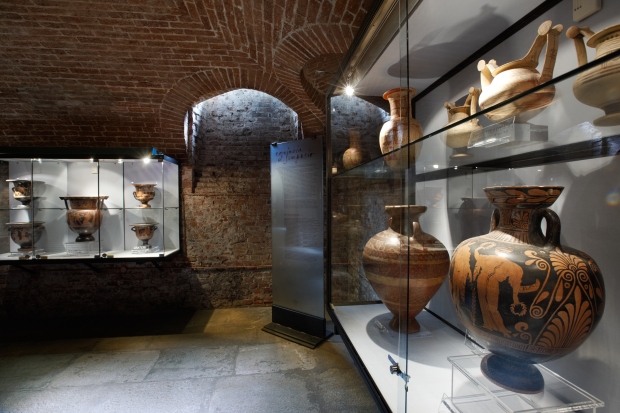
The Martini Museum of Wine

View of the Martini Museum of Wine courtesy of the Martini Archive.

In addition to our many business archives, we also own two incredible museum collections. The Martini & Rossi collection, which is located near Turin in Italy, includes the Martini Museum of Wine, which has 16 rooms of artefacts dating from the 7th Century BC onwards, relating to the production and enjoyment of wine. Our French brands archives in the north of France include the brands of NOILLY PRAT vermouth, BARON OTARD cognac and BÉNÉDICTINE liqueur. The Bénédictine collection incorporates a museum collection of religious antiquities, relating to the origins of the liqueur’s recipe and the Bénédictine order.

I love the fact that every item and object tells a story which relates to not just our own company and business, but also to local, national and international history and culture. For example, during the time of 1920s prohibition in the USA, Bacardi produced postcards in Cuba which featured a dry America and ‘wet’ Cuba, with a caricature of Uncle Sam having a cocktail in Cuba. Alcohol advertising was banned in the USA at this time, but American visitors to Cuba would be given these postcards for free, and send them back to friends in the USA and so they found their way in anyway and encouraged people to come and try BACARDÍ rum in Cuba!

What are some challenges unique to your collections?

As a spirits company we of course want to preserve and showcase old bottles and storing them has some fairly unique challenges. There can be a lot of evaporation from old corked bottles, so the atmosphere in the bottle archive can be quite humid, and caps may get moldy. For that reason (and due to the flammable nature of the liquid) we do attempt to keep the bottle collection separate from the paper collections, and we keep a close eye on evaporation and mold development. Some people would argue that the liquid could be thrown away, but that would significantly decrease the value of the collection, and a great deal of it should still be drinkable. Keeping the full bottles also allows us to potentially analyze the contents of blends of the past in our laboratories, in cases where the recipes no longer survive.

Products like BACARDÍ & cola kept in a can will eventually leak as the cola is quite acidic and will  work its way through the metal, so we need to remember to empty those before archiving (we learned this the hard way!). As if the bottles weren’t tricky enough, we also have some real bats in the archive, obviously long dead and preserved, but none-the-less challenging to keep in good condition! The bat has been the brand icon for BACARDÍ since the early days of the Company, when the founder’s wife discovered fruit bats nesting in the roof of the original distillery. According to Cuban and Spanish culture, they are a symbol of health, good fortune and family unity and the fruit bat has been a part of the Company logo ever since. The rum became known as ‘El Ron del Murcielago’ or The Rum of the Bat. More than 150 years later, the bat remains an icon and such a recognized brand symbol.

What is the favorite part of your job?

Hands on archive work, without a doubt – cataloguing, organizing, making order out of chaos and along the way discovering something new about our history. The best moments are when you uncover something new that you know is going to help your business – those moments are great. While researching one of the DEWAR’S founders, Thomas Dewar, I accidentally found a newspaper article from 1905 in which he claimed to be the first person to create the Highball cocktail during his first trip to New York in the 1890s. My further research revealed that the company had trademarked the words ‘high ball’ a few years later. We are now using this story as a major sales and marketing approach which is helping drive the popularity of the DEWAR’S Highball cocktail in Japan and other markets. It doesn’t get any better than that, feeling like you are keeping the history alive, at the same time as contributing to the current and future business.

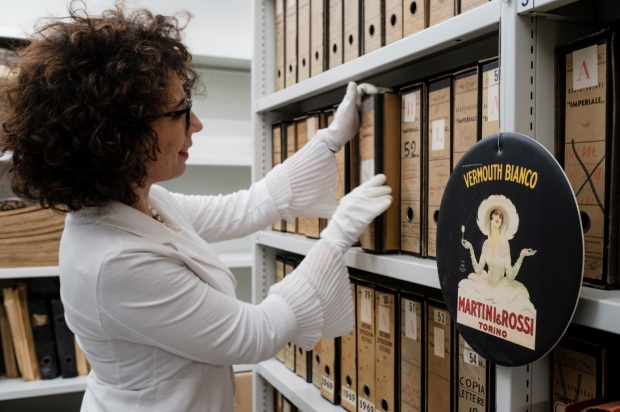
The new Martini Archive with Anna Scudellari our Archivist

The new Martini Archive with Anna Scudellari, our Archivist courtesy of the Martini Archive.

I think that example also reflects how we are a live part of the business, contributing to our brands’ successes and identities, as well as driving company culture. A series of oral history interviews with retired family members inspired our company’s effort to reignite our culture with the 3 Fs – Fearless, Family, Founders. These words simply came out of what the people were saying to our interviewer when talking about their time working for the company, it was a very clear and natural direction and links heavily into our heritage. Our contributions can therefore be unexpected and pivotal and we are lucky enough to work in a company where people listen to our ideas and discoveries because they understand the power of our heritage and how it contributes to who we are today.

Finally, I have to say that my role is especially privileged because as the Global Archive Manager I periodically have to visit our archives all over the world, including our brand homes and visitor centers which have heritage exhibitions, to oversee physical projects and develop exhibitions. The brand homes are where we enable the public to experience our brands, products and rich histories, usually in the historical place or ‘home’ where they are made. For example I was recently at Casa MARTINI, our brand home for the MARTINI brand to celebrate the 20th anniversary of the archive and the inauguration of our new archive storage there, with the Mayor of Turin attending our special reception. This is one of my favorite places, where you can enjoy a MARTINI Bianco and soda with a twist of lime (well that’s my favorite!!) in the Terrazza MARTINI, explore the origins and development of the beautiful MARTINI brand and even experience the Museum of wine with ancient Roman amphora and beautifully carved centuries old wine presses. For someone who loves history, this job ticks every box!

Stay tuned for future posts in the “There’s an Archivist for That!” series, featuring stories on archivists working in places you might not expect. If you know of an archivist who fits this description or are yourself an archivist who fits this description, the editors would love to hear from you—share in the comments below or contact archivesaware@archivists.org to be interviewed for ArchivesAWARE!

#AskAnArchivist Day 2019: the Twitter Takeover

This year, the Committee on Public Awareness (COPA) took over Society of American Archivist’s (SAA) Twitter for #AskAnArchivist Day on Wednesday, October 2nd. Today’s post summarizes COPA members’ experiences taking over SAA’s Twitter (@archivists.org) for the day.

Rachael Woody, Consultant & Owner of Rachael Cristine Consulting LLC

I really enjoyed the Twitter takeover. I saw it as an opportunity to help boost lower-visibility archives and projects, and to raise awareness of SAA resources that may be of use to membership. I was the last shift for the takeover and being on the west coast many of the larger institutions had already ended their participation. Using the SAA Twitter account to engage during the day until 5pm Pacific allowed us to help boost or answer posts from our Pacific coast colleagues. By utilizing COPA members across the country we were able to provide 12-hours of coverage for the day and I’m really proud we were able to participate and contribute for that length of time!

Lynn Cowles, Assistant Archivist and Assistant Professor, Nicholls State University

I participated in SAA’s #AskAnArchivist Day for the first time this year. It was a great experience, although I only asked one question and didn’t really get asked any. My question:

I got some excellent answers and I really appreciate the extended community that events like this highlight. Twitter is a fantastic tool for outreach!

Nick Pavlik, Curator of Manuscripts/Coordinator of Strategic Partnerships, Bowling Green State University

From the vantage of SAA’s Twitter account, I really enjoyed seeing the rather staggering extent of the profession’s participation in #AskAnArchivist Day.  It was impossible to keep up with all the notifications on the SAA account, but since that was an indicator of all the activity going on around the #AskAnArchivist hashtag, that was a good thing!  There were some wonderfully creative and engaging tweets from archivists and repositories that sparked substantial threads filled with insightful or simply hilarious responses, and I was really pleased to see the dedication to public outreach that was on display in our profession.  In that regard, I would say this year’s #AskAnArchivist Day was another resounding success.

At the same time, it’s no secret that generating actual engagement and participation in #AskAnArchivist Day from the general public has always been a challenge, and that seemed to be the case again this year – most tweets that I saw during my time slot seemed to come from within the field.  I certainly did see some public engagement, which was very gratifying – and I really appreciated seeing Pennsylvania governor Tom Wolf getting involved! – but generating more participation from those outside the archival profession remains a significant hurdle that I hope we can continually break down over time.

Nick’s Favorite Tweets of the Day

https://twitter.com/ref_archivist/status/1179441795048071168

Vince Lee, Archivist, University of Houston

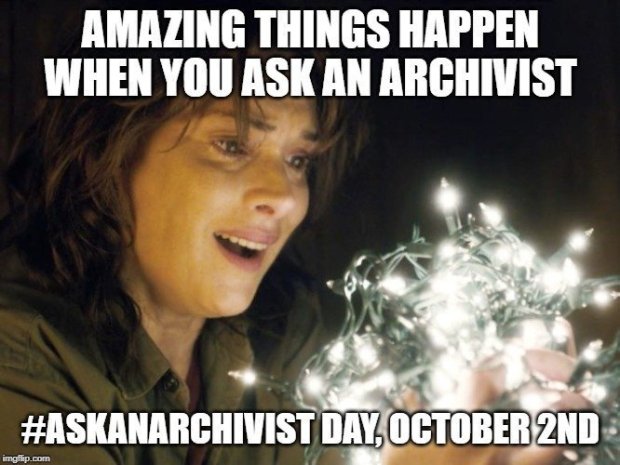
As a member and volunteer of COPA’s annual #AskAnArchivist Day event, I always look forward to creating and seeing others memes created leading up to the big day. Having binge watched Netflix’s “Stranger Things” series, I couldn’t wait to find the perfect meme to use. Turns out this year’s #AskAnArchivist Day would have bit of a different twist. In conjunction with participating and using our own Twitter handles, COPA members would do a scheduled “takeover” of SAA’s twitter handle answering, retweeting, liking, and in some cases asking questions throughout the day. 

EFvWdVBWoAETmGW

During the 11 hour takeover, from 8am-7pm EST, my fellow colleagues were on hand to take care and facilitate your #AskAnArchivist needs. To be honest, I really didn’t know how it would turn out or what to expect when I signed up (gulp). Turns out  I really had nothing to worry about. It was one of the fastest and most pleasurable work hours I ever spent. There is a certain cadence and rhythm when working and tweeting with Twitter. Obviously, there is the word limits when posting or responding, then there is monitoring of the streams of  incoming tweets, from fellow archivists and institutions that were contributing, and then there were the likes and retweets of posts.

What was eye opening to me is the power and reach of using SAA’s twitter handle. I wanted to share the love and exposure to other respositories, in this case the University of Manitoba Archive. By merely liking and retweeting their post I was able to spotlight their institution and question to a wider audience. Talk about the power of social media! 


Finally to round things off, I posed some questions myself, asking fellow members:

  1. How they get students and their community members excited about archives and their collections?
  2. What does a “hybrid collection” mean to them?

The first question was a popular one. I received back 10 replies, 2 retweets, and 5 likes to this.

I’m biased, but rather than have it be one day out of the year, everyday should be #AskAnArchivist Day and #ArchivesAware if it’s this much fun and activity to showcase what we all do collectively. 

Chris Burns, Curator of Manuscripts and University Archivist, University of Vermont

Chris’ Favorite Tweets of the Day

For more information on #AskAnArchivist Day check out previous posts about this super awesome day:

Responses & Retrospectives: Rachael Woody on Resources for How to Convey the Value of Archives

RachaelWoody

Rachael Woody (photograph courtesy of Rachael Woody).

This is the latest post in our series Responses and Retrospectives, which features archivists’ personal responses and perspectives concerning current or historical events/subjects with significant implications for the archives profession. Interested in contributing to Responses and Retrospectives?  Please email the editor at archivesaware@archivists.org with your ideas!

American Archives Month is an annual reminder of why we do what we do. Archivists across the country mobilize to promote collections, articulate what archives are, define what archivists do, and advocate for the value of our work. Articulating the value of archives and ourselves as archivists is hard to do. Speaking for myself, the value of archives and archivists is so evident that I have a hard time trying to explain our value proposition. The difficulty is often compounded when I realize I also need to explain why history is important, why liberal arts education is vital, and why critical thinking and the evaluation of historical resources are imperative for a healthy democracy. These are big concepts to convey and we as archivists need to continue our work on breaking them down so that they’re consumable for the public.

To get us started, I’ve compiled a list of resources to help use identify and articulate the value of archives.

Resources to Help you Talk About Archives and Their Value

Books on Advocating for the Value of Archives

Craft an Elevator Speech on Why We Value Archives

Check out COPA’s elevator speech cheat sheet with prompts to guide you toward your perfect pitch and review Talking Points on the Value of Archives for elevator speech examples.

SAA’s Role in Advocating for Archival Value

SAA’s advocacy efforts are directed to three principal audiences:

  • We target policymakers for important messages on archives- and records-related public policy.
  • We work to raise general public awareness of the importance of archives–and the important work of archivists.
  • And we provide resources for members to enhance advocacy within their own organizations with key decision makers, colleagues, and others.

SAA Groups Specific to Advocacy and the Value of Archives

SAA Resources for Advocacy and the Value of Archives

SAA’s Committee on Public Awareness – ArchivesAWARE! Blog

COPA’s ArchivesAWARE! Blog hosts several series to help to promote the value of archives and archivists.

  • There’s an Archivist for That! features examples of archivists working in places you might not expect.
  • Keeping ArchivesAware is a recurring roundup of some of the latest archives-related news stories, features, commentaries, announcements, and projects that have caught our eye, with links to the original sources.
  • Asserting the Archivist is focused on the importance of highlighting archivists and archival work in outreach efforts, rather than just focusing on the collections themselves.
  • Archives + Audiences features the perspectives of archival audiences – scholars, journalists, filmmakers, artists, activists, and more – for whom archives have been an important part of their life and work.
  • Archival Innovators aims to raise awareness of the individuals, institutions, and collaborations that are helping to boldly chart the future of the archives profession and set new precedents for the role of the archivist in society.
  • Responses & Retrospectives features archivists’ personal responses and perspectives concerning current or historical events/subjects with significant implications for the archives profession.

 Interested in Contributing to ArchivesAWARE!?

If you’re interested in contributing a piece to ArchivesAWARE! lease email the editor at archivesaware@archivists.org with your ideas!

Conclusion

We still have work to do when it comes to distilling for a general audience the complex issues that surround the importance of archives and our role as archivists. I’m interested in hearing your thoughts on how to communicate the value of archives and/or archivists. Please share them in the comments of this post or email me at consulting@rachaelcristine.com.

This post was written by Rachael Cristine Woody, a member of The Society of American Archivists’ Committee on Public Awareness (COPA). The opinions and assertions stated within this piece are the author’s alone, and do not represent the official stance of the Society of American Archivists. COPA publishes response posts with the sole aim of providing additional perspectives, context, and information on current events and subjects that directly impact archives and archivists.

THERE’S AN ARCHIVIST FOR THAT! INTERVIEW WITH JENN PARENT, REFERENCE ARCHIVIST, THE MUSEUM OF FLIGHT

This is the latest post in our There’s an Archivist for That! series, which features examples of archivists working in places you might not expect. In this entry, Committee on Public Awareness (COPA) member Anna Trammell brings you an interview with Jenn Parent, Reference Archivist at the Museum of Flight. 

[Reference archivist Jenn Parent in front of mural by Henry at T

Jenn Parent, Reference Archivist at the Museum of Flight in Seattle, WA

How did you get your job?

I came to archives and The Museum of Flight as my second profession, having spent well over a decade working as a bookstore manager. I loved helping people find books but at the same time I always felt limited in how I could help people. So, I went back to school to get my Masters in Library and Information Science with the goal of becoming a special collections librarian or an archivist. I did two internships at The Museum of Flight during grad school (one in the library, one in the archives), and due to the positive internship experiences I had, I added the organization to my “watch list” for jobs. About a month or so before graduation I saw an opening for a part-time Processing Archivist and applied. I got that job and started in July 2017. Then, in late December 2017, I was promoted to Reference Archivist, and I’ve been doing that since.

[Group portrait of Pan Am flight attendants]

Group portrait of Pan Am flight attendants, circa 1960s-1970s || The Denise (Babcock) Schmidt Pan Am Flight Attendant Collection/The Museum of Flight

Tell us about your organization.

The Museum of Flight is the largest private non-profit air and space museum in the world. Contrary to popular thought, we are not part of Boeing and never have been (although we enjoy a good relationship with Boeing!). With over 150 air and spacecraft, dozens of exhibits and experiences, and all kinds of programming and educational offerings The Museum of Flight (TMOF) is devoted to the preservation and sharing of aviation and aerospace history and technology. 

I work as part of the Collections team, which includes the Harl V. Brackin Library, The Museum of Flight Archives, and our small object collection. As the Reference Archivist, my main job is (you probably guessed it!) to answer reference inquiries, which are mostly related to photo requests and general research/reference. If an inquiry requires in-depth curatorial knowledge, it gets assigned to our Curators. On average, I personally handle 30 to 40 reference inquiries per month. We get requests from all over the world and our researchers vary, from students of all ages to authors to model makers to aircraft restorers and more. 

When I have time, I also still process and catalog archival collections because I love processing. It adds to my knowledge of the collection so I can better assist researchers, but also I just love making collections accessible for folks to use! In addition, I contribute to outreach efforts, such as participating in our monthly “Coffee with the Curator” (a themed presentation with materials on display from the library, archives, and objects), writing articles, leading Library & Archives tours and/or giving presentations about the Archives, and contributing to our team’s Instagram (shameless plug for @tmofcollections)! And of course, I help with “other duties, as assigned.”

[African-American Rosies with Boeing B-29 Superfortress]

African-American “Rosies” with Boeing B-29 Superfortress || Credit: The Museum of Flight Collection

Describe your collections.

The Museum’s collection contains over 25,000 small objects (classified as anything smaller than an aircraft), over 90,000 books and periodicals, over 18,000 aircraft manuals and technical reports, and nearly 5,000 cubic feet of archival materials. 

Our archival collections contain materials that document the entire evolution of manned flight, from the Wright Brothers to modern jet travel to space exploration. We have an estimated four million images, including photographic prints, film and glass plate negatives, slides, and transparencies. Our paper-based materials include maps, charts, drawings, blueprints, log books and diaries, manuscripts, research and technical documentation, correspondence and philately, and airline ephemera such as tickets, timetables, brochures, and luggage tags. 

What’s really awesome is that we’re becoming more publicly accessible, which is fantastic! We’re always open to the public via the Dahlberg Research Center. You do not need to be a Museum member or pay admission to visit us but we do recommend/prefer an appointment! But we can also be accessed via our Digital Collections, which went live December 2017 and currently has over 6,500 digital images and 100+ oral histories with more content being added on a regular basis. And in April of this year (2019), we also launched our public research portal, where folks can browse finding aids from our collection. We add to it weekly, and it currently has just shy of 300 collections, which is about 10% of our collection. We also encourage folks to reach out and ask if they don’t see something online, as these are just fragments of our collection!

[Convair (Theodore P. Hall) 118 Convaircar]

Convair (Theodore P. Hall) 118 Convaircar || Credit: The Peter M. Bowers Collection/The Museum of Flight

What are some challenges unique to your collections?

I don’t have an aviation or aerospace background so describing the technical aspect of many of the aircraft collections can be a bit daunting. Luckily, our Curators are great at helping me understand things so I can correctly explain it in a finding aid or to a researcher.

I’d also say our building is a bit wonky. It was originally meant to be a hazmat storage facility but was never used in that manner that we know of (at least I haven’t grown a tail yet). The building has very thick concrete walls and floor and a very thin aluminum roof, so in the event of an explosion, the roof would be forced up and (in theory) the walls and floor would withstand the blast, leaving only the roof to replace. Additionally the floors are very slick and slightly sloped (in case spills needed to be hosed into the also-present drains that happen to have gaps the exact width of a library cart wheel). This makes adding shelving quite a chore, as you can imagine. 

JennStacks

Jenn Parent at work at the Museum of Flight

What is your favorite part of your job?

 That’s a tough call. I really like continuously learning and encountering material that sparks an interest or moment of “Wow!” (so many rabbit holes to go down – like did you know Goodyear made a plane out of rubber? Look it up – the Inflatoplane!). I also enjoy that my days can be quite varied based on what I’m up to that day. From answering a photo request about the Aero Spacelines Super Guppy to giving a tour to students or from making “frankenfolders” to house oversize materials to helping relocate a missile in our storage area, it’s never dull. 

But I think my real favorite is simple – being able to successfully guide a researcher and help fulfill their information need, especially when they reach out to me with what they may think is a long shot. I recently had a researcher ask me if it was fun being both useful and magical. A resounding yes!


Responses & Retrospectives: Rachael Woody on October is American Archives Month

RachaelWoody

Rachael Woody (photograph courtesy of Rachael Woody).

This is the latest post in our series Responses and Retrospectives, which features archivists’ personal responses and perspectives concerning current or historical events/subjects with significant implications for the archives profession. Interested in contributing to Responses and Retrospectives?  Please email the editor at archivesaware@archivists.org with your ideas!

It’s that time of year again. No. Not pumpkin spice latte time – though it’s that time of year too. It’s American Archives Month!


Quick History Lesson

American Archives Month was launched in 2006 by the Society of American Archivists in support of their mission to advocate for the value of archives and archivists.

Archives Month Activities

Archives across the country can participate in archives month activities by doing any of the following:

  • Host an archives open house
  • Publish an article on your archives or collection
  • Create a display of highlights from your archives collection
  • Offer an archives workshop to the community
  • Give a lecture on a topic related to your archives
  • Write a blog post or post a video about your archives
  • Advocate for the resources you need for the archives to run smoothly

And Don’t Forget About #AskAnArchivist Day!

#AskAnArchivist day is October 2 this year and SAA’s Committee on Public Awareness (COPA) will be hosting a Twitter takeover of the SAA twitter account (@archivists_org). To learn more about #AskAnArchivist day and how you can participate please check out this SAA webpage.

Hone Your Archives Elevator Pitch

American Archives Month is a great time to work on your elevator speech. Not sure where to begin? Check out COPA’s elevator speech cheat sheet with prompts to guide you. Need examples to inspire you? Check out Talking Points on the Value of Archives for elevator speech examples. And for Twitter friendly speeches check out the Twitter #Archivesin5Words to see just how succinct (and funny) we can be.

American Archives Month Resources

A major partner and contributor to American Archives Month is the Council of State Archivists (COSA). Please check out the COSA Archives Month Resources page for information about Electronic Records Day, a sampling of Archives Month 2018 programming, press releases and governor proclamations, and example of state archives’ websites. COSA also offers a library of past American Archives Month posters to help inspire you.

Additional Resources to Help You Plan American Archives Month

Resources to Help with Media

 And don’t forget, International Archives Day is June 9, 2020!

In 2004, membership from the International Council on Archives petitioned the United Nations to create an International Archives Day. The date was chosen in honor of the ICA’s founding date: June 9, 1948. Just like Christmas in July, we can revisit our American Archives October activities and celebrate Archives Day in June.

Past American Archives Month Activities

To see a summary of activities archives across the country have hosted from 2006-2018, please see these pages:

Conclusion

Some of the resources offered in this blog post and on the American Archives Month webpage are dated. Do you have resources, tips, or toolkits we should know about? Please let the Committee on Public Awareness (COPA) know in the comments on this post or send an email to consulting@rachaelcristine.com so that COPA can continue to offer up to date outreach resources.

Now get out there and let us know what you’re doing for American Archives Month by sending an email to saahq@archivists.org.

This post was written by Rachael Cristine Woody, a member of The Society of American Archivists’ Committee on Public Awareness (COPA). The opinions and assertions stated within this piece are the author’s alone, and do not represent the official stance of the Society of American Archivists. COPA publishes response posts with the sole aim of providing additional perspectives, context, and information on current events and subjects that directly impact archives and archivists.

Responses & Retrospectives: Rachael Woody’s Annual Conference Coverage on the Value of Archival Labor Sessions

RachaelWoody

Rachael Woody (photograph courtesy of Rachael Woody).

This is the latest post in our series Responses and Retrospectives, which features archivists’ personal responses and perspectives concerning current or historical events/subjects with significant implications for the archives profession. Interested in contributing to Responses and Retrospectives?  Please email the editor at archivesaware@archivists.org with your ideas!

For me, attending the annual Society of American Archivists conference is time to reconnect with beloved colleagues and reengage with topics I care deeply about. I can’t afford to attend the conference every year, so I always view the conference program before I make the final decision. Are there sessions I want or need to attend? Are there topics that are new or finally being covered? Or, does it look like the conference is repeating topics without contributing anything new? As someone who has to pay my own way, I have to make sure there’s a return on my investment of both time and money. This year, SAA’s annual meeting theme had my attention from the start: TRANSFORMATIVE!. As in transforming archives. The program sessions followed suit with panelists willing to tackle tough topics and start new conversations.

My Work on Fighting the Devaluation of the Archivist

Before I dive into my response to a block of the SAA 2019 Annual Conference sessions, let me preface by saying that the value of archival labor is a topic that I am deeply involved with. In the last two-years I’ve:

  • Written the current NWA job posting policy requiring salary ranges;
  • Performed a literary review of American Archivist articles on everything from A*Census to the multiple articles on how recent graduates are struggling to find healthy employment in the field;
  • Conducted a regional survey on the value of archival labor (with findings forthcoming); and
  • Am currently spearheading the creation of a paid internship program at Northwest Archivists.

In my research I’ve found that the literal value of archival labor has been stagnate for the last ten-years. Additionally, the student loan debt to entering archivist salary ratio has caused instability in the profession; particularly in geographic areas that aren’t flush with archival repositories with government-backed budgets. I believe that we have reached a critical point in time in which we must acknowledge this devaluation of the archivist, and address it before our entire profession atrophies.  It’s through this lens that I respond to three SAA sessions focused on the value of archival labor.

SAA Sessions: My Response

On Sunday, August 4, 2019, there were three sessions dedicated to archival labor: an open forum, session 210, and session 410. Below are links to the sessions and the session summary italicized for easy reference:

Open Forum: SAA Council Forum on Archival Salaries

This special forum, hosted by SAA Council members Melissa Gonzales and Steven D. Booth, will explore the notion of requiring salary information in position descriptions for jobs boards, the benefits and challenges of doing so, and the potential impact this ideal may have on the archival profession. Invited panelists and the audience will explore why professional associations should and should not take a position, and if so, how can archivists at all levels frame it to truly advocate for the profession and not harm it.

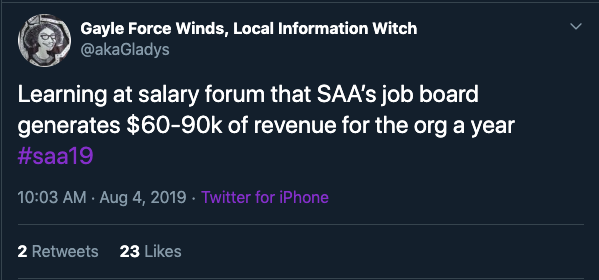
The open forum was well attended with several hundred seated in the ballroom. There was no formal content to present and the panelists began the discussion with SAA Council’s recent angst over whether or not to require salary ranges for job posts. What gets sticky here is that SAA makes money from the job board. So, trusting SAA to make the ethical decision to require job post quality indicators can be challenging when the system currently in place benefits SAA. As noted in several tweets, the forum discussion revealed that SAA makes $60,000-$90,000 in annual revenue from the job board. (SAA’s FY20 Budget states it revenued $85,000). Sadly, that amount is much more than the average mid-career archivist’s annual salary.

Screenshot of Tweet by @akaGladys: Learning at salary forum that SAA's job board generates $60-90k of revenue for the org a year #saa19" 10:03 AM Aug 4, 2019 Twitter by IPhone 2 Retweets 23 Likes

When reviewing the “cons” of SAA requiring a salary range on job postings there were no cogent arguments from the panelists. Instead, strawman arguments that showed more privilege than sense were provided. The following points were offered as a justification for SAA to forego responsibility of providing space to predatory job listings:

  1. People keep taking these low-paying jobs so organization will keep offering these low salaries.
  2. If SAA requires salary ranges “Will it really provide change that leads to better salaries?”.
  3. The assertion that people who seek higher paying jobs have “bad intentions”.

Screenshot of Tweet by @rachaelcristine Aug 4: Several #archivist salaries forum persons see "cons" to requiring salary range in job post. One remarks they would question motives for those who apply for jobs with more money. Me: Since when is being paid your worth a bad thing?! #saa2019 #saa19 #devaluationofthearchivist Symbols at bottom show one comment, 6 retweets, and 33 likes

The panelists who denied SAA’s responsibility placed it instead on those who are struggling against these damaging job practices currently allowed in the profession.

Patronizing statements were made by some of the panelists to those struggling, saying essentially:

  1. People should do their own research to determine what an adequate salary is. How?; when the Census data is extremely outdated and government salaries hardly translate to other organizations? SAA is in the best position to provide this information to archivists and organizations – with parameters given for organization type, geographic area, various job levels, and requisite salary.
  2. People should negotiate better. Negotiation is rarely available to those in the profession. Also, then shouldn’t SAA be providing negotiation education and support?
  3. People should be willing to move for a better job. Some of us can move. Others cannot due to family or other life obligations. This is a tone-deaf statement rejecting the real-life realities many archivists face.

Why Salary Range is so Important

Requiring salary ranges on job posts aids in salary transparency. Salary transparency reveals wage inequity and helps put a stop to gender, race, and gender identity or sexuality discrimination. Increased salary transparency across the profession will lead to healthier financial realities for archivists, and addressing wage inequity will support actual diversity within the profession. It’s important to note that both Northwest Archivists and Southwest Archivists have already made this a policy.

210 Low Pay in Archives: Review of Recent Events, and Where Do We Go From Here? [Pop-Up]

This Pop-Up Session will discuss the current state of generally low pay for archivists in the U.S., discuss SAA and regional archival organizations recent attempts at doing something about it, including archival certification, salary job listing requirements, recommended salary minimums, and the current literature in the field; look at salaries across the country and useful statistical data like the salary required to own a home in a specific city; and strategize additional ways the profession can help push salaries upwards, including possibly unionization.

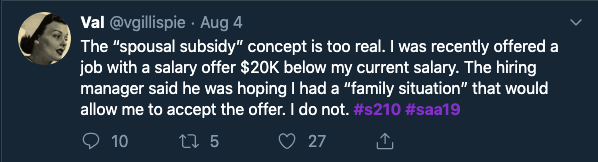
This session was a little less frustrating for me as the panelists appeared to agree that something needs to be done about the financial health of our profession. Rosemary Davis was brave and bared all – including her student loan debt number. This panel delivered real talk on what many in the profession are experiencing: you have a master’s degree with the student loan debt to show for it and you can’t make ends meet because entry-level archivist positions are sub-$45,000. This session introduced the concept of the “spousal subsidy”. As in, you can only afford the luxury of being an archivist on low pay because your spouse has the pay and benefits to cover you both. This has obvious repercussions on who can afford to be an archivist and directly damages diversity within the field.

Screenshot of a Tweet by @vgillispie Aug 4: The "spousal subsidy" concept is too real. I was recently offered a job with a salary offer $20K below my current salary. The hiring manager said he was hoping I had a "family situation" that would allow me to accept the offer. I do not. #s210 #saa19. Symbols show 1 comments, 5 retweets, 27 likes.

410 Short-Term Jobs for Long-Term Careers: Designing Ethical Project/Contract Positions

With SAA defining standards for interns and volunteers, archivists on short-term projects or contracts are the next frontier in the ethics question. These archivists have barriers to completing their work–including time, funding, and skills–making their supervisor’s role crucial in designing and supporting a successful contract employment experience. Aimed at project managers, supervisors, and contract archivists, this session is intended to foster dialog among participants about ways to create more sustainable models of project positions.

This panel is an adjacent topic to archivist salaries as temporary or project positions are becoming more and more common and less of a stop-gap measure for organizations that are struggling. It also highlighted that allowing regular archival work to become temporary or project-based only helps to devalue the work. And further, we must be more precise in identifying archival labor as work, a long-term endeavor that requires skill. Versus calling our work a project, a word that indicates it’s temporary, can be stopped at any time, and potentially requires less-skills. This thinking extends to how project positions are professional positions, not pre-professional positions, and should be treated (i.e. paid) accordingly.

Screenshot of Tweet by @alexiadpuravida Aug 4: Advocate that project positions ARE professional positions, not a pre-professional position [emojis show 4 hand claps] #saa 19 #s410 (symbols show 2 retweets, 24 likes)

SAA’s Mission and How We Are Actively Working Against It.

SAA’s mission is to promote the value and diversity of archives and archivists. The anti-salary range panelists (and the majority of SAA Council) appear to contradict SAA’s stated mission. How can we say we champion diversity and value archivists when we allow rapacious practices such as low-wage jobs, no salary transparency, temporary or term jobs, and unpaid internships? (Yes, SAA Council did vote to disallow unpaid internship job postings, but more can be done to discourage the practice pervasive in organizations nation-wide). It is known that by allowing these practices we perpetuate a system built on discrimination against race, gender, and gender identity and sexuality. If you’re in a management position, in academia, or work for the government – congratulations! You’ve avoided the worst of it with your elite position. But you’re leaving the rest of the profession behind and such short-sightedness will devalue the entire profession (including you).

Conclusion

We’re just beginning these tough conversations and there’s obviously a lot to be done before we can begin to see progress. Here’s what I’d like to see next:

Recommendations for SAA Council and Organization:

  1. Officially support the grass-roots archivist salary spreadsheet. Now at nearly 500 entries, this is the most recent and robust national archivist salary data we have available.
  2. Financially commit to conducting the census more regularly. Yes, I realize it costs money. However, letting the census lapse 15-years is absolutely preventable. Decisions about how to best support the profession can’t be made if we don’t have current and accurate numbers.
  3. Call for a membership vote on whether or not to require salary ranges for job postings.
  4. Take a more active role in protecting and advocating for archivists and not just archival organizations. Explore ways in which SAA can do this; such as: conducting an exploration of how SAA can support unionization, offer collective benefits, provide guidance on appropriate job salary scales, etc.

Recommendations for Archivists Against Devaluation:

  1. This was an excellent conference, but the conversation needs to continue. For those who did panels, tweeted, and discussed the topic in-person; we need you to do more of that. For those who want to join in, please join in!
  2. When SAA calls for guideline reviews, feedback, and votes; you have to show up and give your feedback. Better yet, run for Council. Council needs your voice.
  3. Contribute blog posts and professional writings to the field that help educate and advocate around this topic.
  4. Speak up and repeatedly at your work, at your regional group, and at SAA and related national conferences.

This post was written by Rachael Cristine Woody, a member of The Society of American Archivists’ Committee on Public Awareness (COPA). The opinions and assertions stated within this piece are the author’s alone, and do not represent the official stance of the Society of American Archivists. COPA publishes response posts with the sole aim of providing additional perspectives, context, and information on current events and subjects that directly impact archives and archivists.

There’s An Archivist For That! Interview with Brad San Martin, Digital Archivist, Apollo Theater

This is the latest post in our There’s an Archivist for That! series, which features examples of archivists working in places you might not expect. In this entry, Committee on Public Awareness (COPA) member Rachel Seale brings you an interview with Brad San Martin, Digital Archivist for Harlem’s Apollo Theater.

Brad San Martin

Brad San Martin. Photo credit Amber Duntley (www.flickr.com/adunt).

Prior to entering the archives field in 2015, Brad San Martin worked in the music and travel industries as a copywriter, content developer, and product manager, among other roles. He has also produced and/or annotated a number of acclaimed historical CD reissue projects, including Kevin Dunn’s No Great Lost: Songs 1979-1985 and Harlan County USA: Songs of the Coal Miner’s Struggle.

How did you get your gig?

I arrived at the Apollo after spending most of my professional life working in the music industry in a few different — including publicity, radio promotion, project management, copywriting, and artist relations — capacities. While in that world I had overseen several archival releases, compiling new CD collections from old tapes, researching the best available sources, clearing the rights, annotating them, and so on. Putting projects like those together inspired me to explore archives as a full-time pursuit. So, eighteen years or so after I finished undergrad, I went back to grad school to get my master’s degree in Library Science with a concentration in Archives. Throughout grad school I worked processing audiovisual materials at the Southern Folklife Collection, which was an incredible opportunity to learn about the nitty gritty of archiving and about the variety of media formats that are out there. I thought I knew them all…

When this position came across my radar, I was thrilled: What fan of popular music hasn’t been affected by an artist, a song, or a movement that was forged onstage at the Apollo? Being here feels like the culmination of everything I’ve been doing before — and it draws from all areas of my experience.

Tell us about your organization

The Apollo Theater takes inspiration from the rich legacy of the theater’s past in order to enrich the future. Through its education department, the theater introduces young people to the incredible contributions that have emerged from Harlem and the Apollo, while also offering students opportunities to learn about what goes on behind the scenes: production and tech, publicity, programming, and more. The Apollo is also positioning itself as a catalyst for a new canon of works, producing and presenting provocative, powerful new pieces of theater, dance, and music.

I always like to stress that while the Apollo has a remarkable backstory, what our programming team is doing now is every bit as vital. And being the archivist means that I get the best of both worlds: I get to help document the new programs we develop while also watching over the materials that allow us to tell the story of the theater’s history.

Describe your collections

The Apollo Theater Archives is a new initiative. I have been here for just about a year and a half now. The fact that I am here at all is a testament to the long-term vision of the Apollo’s past and present leadership — people like Laura Greer and Mikki Shepard, who kept the torch for the archives burning for years before I arrived. Over the past fifteen years, whenever funding was available, portions of the collection were inventoried and preserved. So when I got here, there were a mix of processed and unprocessed collections, in various stages of preservation. 

Apollo_Smithsonian_16

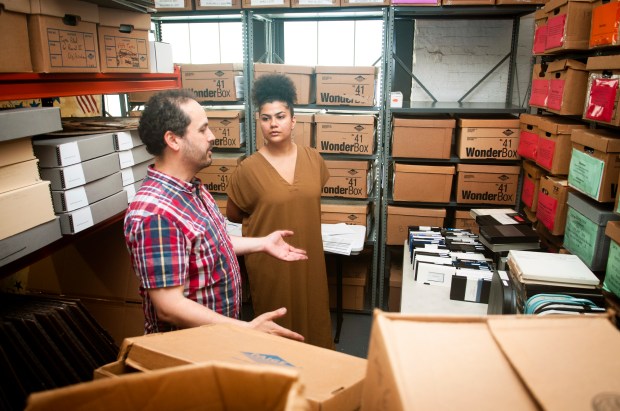
Photo by Megan Rossman. Working with Smith Fund intern Samantha Scott to arrange A/V materials in the Apollo’s collection.

The Apollo collection spans pretty much every conceivable audiovisual format, in addition to photographs, posters, program booklets, three-dimensional artifacts, ticket stubs and passes, and business records. In the mid-1980s, the Apollo had full broadcast and audio recording studio facilities, and as a result we have a lot of ¾” and open-reel video from both the theater and recorded for production clients. One of the most informative and illustrative areas of the collection is a set of more than 2000 hand-tinted photographs of artists who performed at the Apollo from the 1950s through the 1970s. Taken as a set, they tell us so much about who worked here — and not just the big stars, who are certainly represented, but the ventriloquists, the dancers, the MCs, the animal acts, and others who may have otherwise been forgotten. 

What are some challenges unique to your collections?

We face the same challenges that other largely audiovisual collections contend with: obsolete formats, unclear rights provenance, storage and preservation issues, et cetera. The Apollo is a working theater in Manhattan, so on-site storage space is at a premium. One of the biggest issues we face is that there is no way the collection can match the formidable legacy of the Apollo. People imagine a goldmine of photos, video, handbills, and posters documenting every one of the thousands of shows that happened here. But the Apollo was a working, for-profit theater for most of its life — people were too busy getting paying customers into the seats to prioritize creating a historical record. 

With that in mind, the collection is also not continuous: We have elements from all eras of the theater’s 85-year existence, but not all eras are represented evenly. A number of materials related to the theater were donated to the Smithsonian by the theater’s former owners. But thanks to the growing capacity of digital tools, we’re able to partner with other institutions and share certain items digitally, enriching our holdings and what we will eventually be able to offer potential users.  

Speaking of users, the Apollo Theater Archives are not yet open to the public — so it’s also a challenge for me to ask interested people to wait while we catalog, digitize, and preserve the materials in the collection in preparation for them to be accessed.

What is the favorite part of your job?

I’m incredibly fortunate to be able to discover new objects related to the theater’s history and performances on a very regular basis…but even more exciting is seeing the elements of the collection utilized on behalf of the Apollo Theater’s missions. We preserve these things for a reason, and that’s to share them. So watching them become a part of an educational or community program, or referenced by a visiting artist who is working to create a new work, is incredibly fulfilling.

IMG_1655

Photo by Lisa Mullins. Presenting materials with WNET’s Jenna Flanagan from the Apollo Theater Archives on stage at the Apollo’s annual Open House event, February 2, 2019.

That said, the best part of my job is continuing to discover just how much the Apollo means to people — especially those with roots in Harlem. The theater has been more than a performance venue: It’s a pillar of an incredibly vibrant, dynamic community. I see the theater’s role in people’s lives most vividly through our community events, which engage a largely local audience in conversations about history, culture, and politics. The delight and appreciation they express when they discover that we’re working hard to preserve and extend the legacy of a place they love so much is overwhelming. 

Stay tuned for future posts in the “There’s an Archivist for That!” series, featuring stories on archivists working in places you might not expect. If you know of an archivist who fits this description or are yourself an archivist who fits this description, the editors would love to hear from you—share in the comments below or contact archivesaware@archivists.org to be interviewed for ArchivesAWARE!