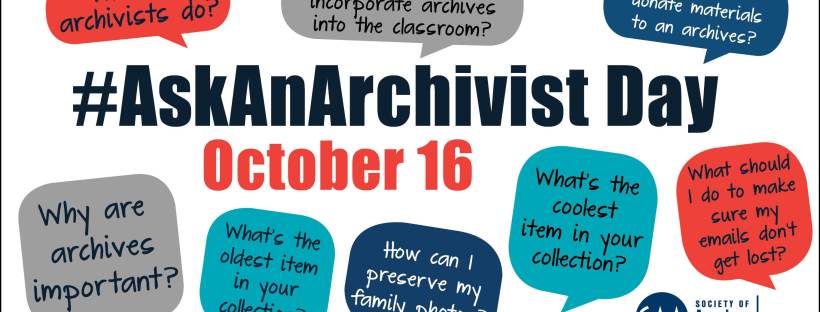
SAA Marketing and Communications Specialist, Julia Pillard, shares how we can all celebrate #AskAnArchivistDay on October 16th.
Coming as I do from an academic background, I have long appreciated the value of archives. I can recall touring the archives at Norlin Library at the University of Colorado in Boulder during my graduate degree and being so impressed by the extensive knowledge of the archivists giving us the tour. From my experience, I know exactly how amazing archives can be and what treasures they have to offer.
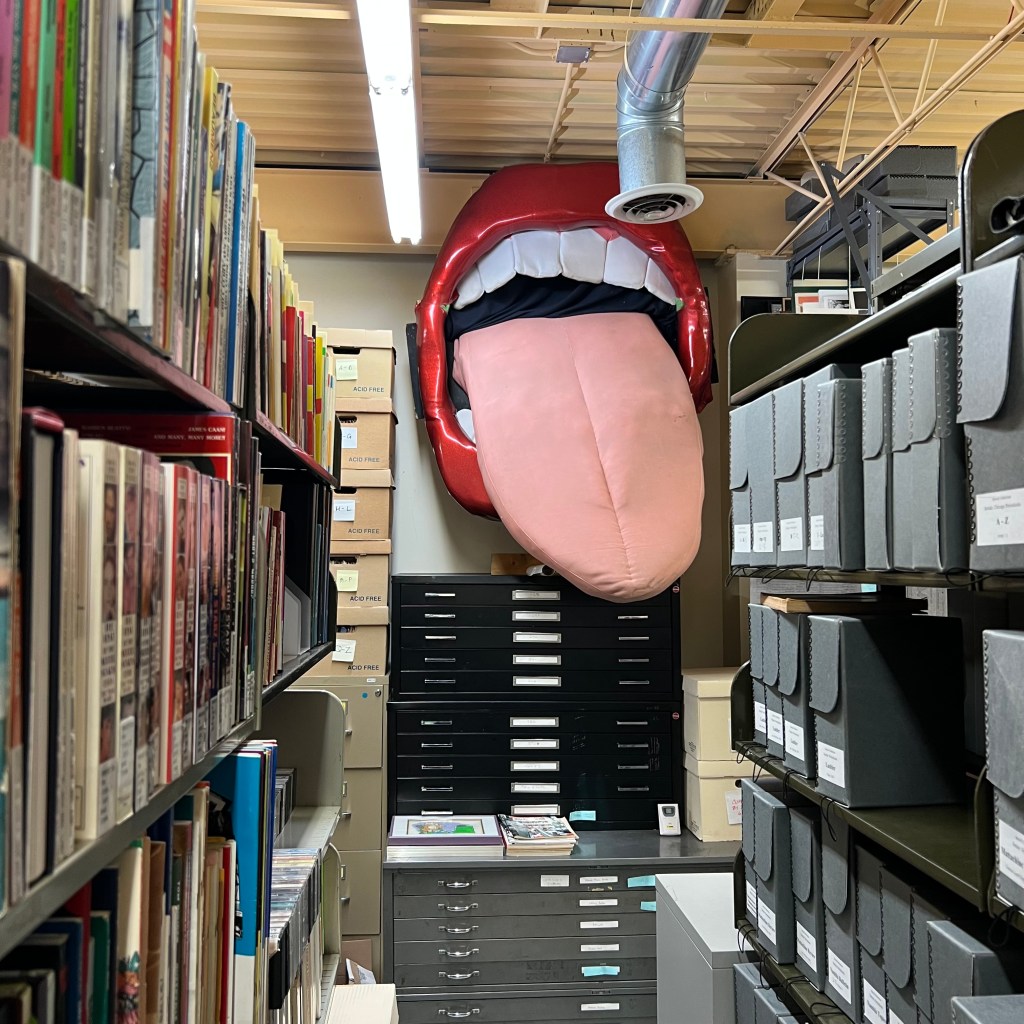
Last year, for the first time, SAA embarked upon a new endeavor to celebrate #AskAnArchivist Day. We put out a call for submissions from archives and repositories around the country, asking for them to share “a picture of the most interesting thing in your archives” to then be features on SAA’s Instagram page. We received dozens of responses and featured twenty-six pieces on our Instagram that day. Our most liked post was from the Gerber/Hart Library & Archives, who shared a massive tongue sculpture that hangs in their archives.
Gerber/Hart is one of the largest LGBTQ+ repositories in the world! There are a lot of interesting items in the collection, but this massive tongue often draws the most attention! Perched atop the poster collections is the enormous mouth that once hung in Carol’s Speakeasy, a Chicago disco and club institution from 1978-1992. Named for Mother Carol (Richard Carroll Farnham), the tongue symbolized ‘loud-mouth’ Mother Carol herself. The tongue has been featured in a few exhibits at Gerber/Hart and takes around four people to move. When the tongue was donated to Gerber/Hart, it was black from years of cigarette smoke and had to be cleaned before being transferred to the archive. Courtesy of the Gerber/Hart Library & Archives.
We had such fun with this experience that we’ve decided to do it again this year! If you want to share a high-resolution photo from your institution, archives, or repository, send it to jpillard@archivists.org along with a caption. And get inspired with some of favorite photos from last year:
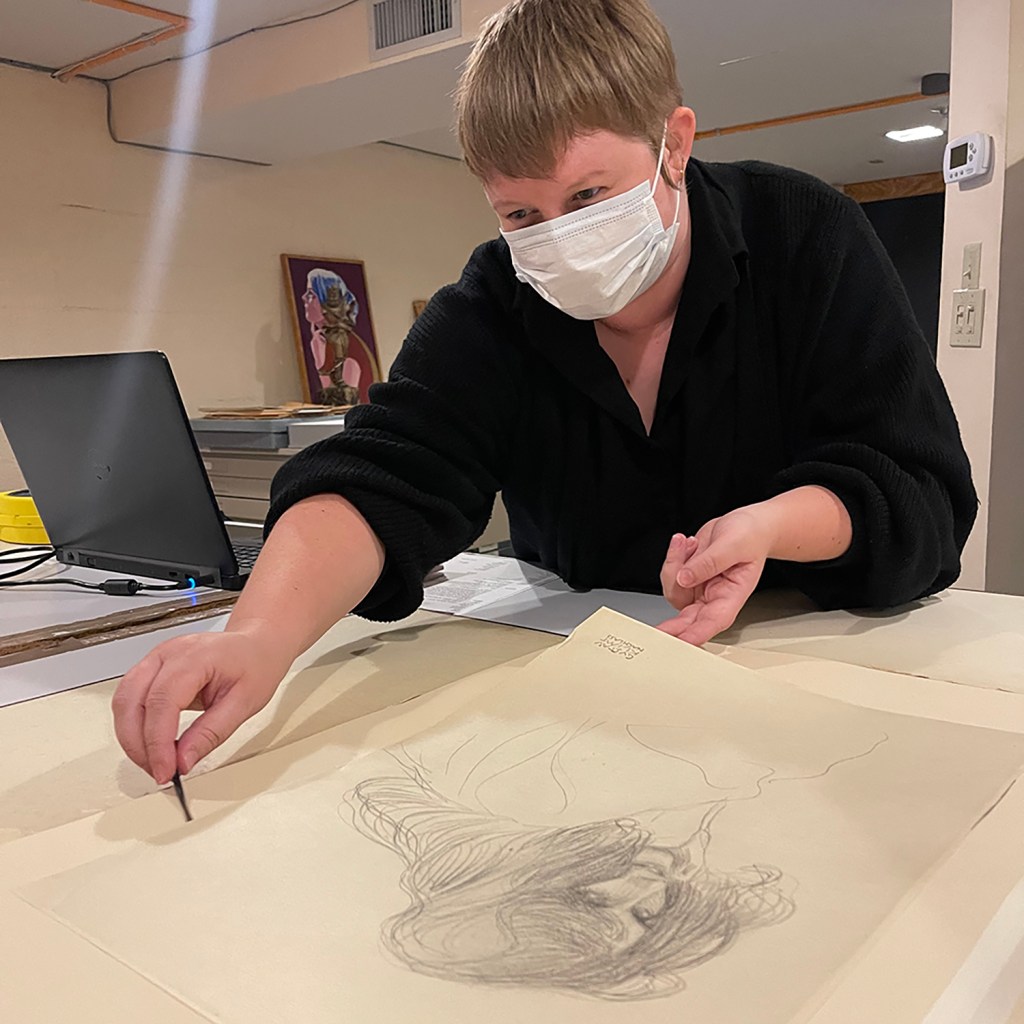
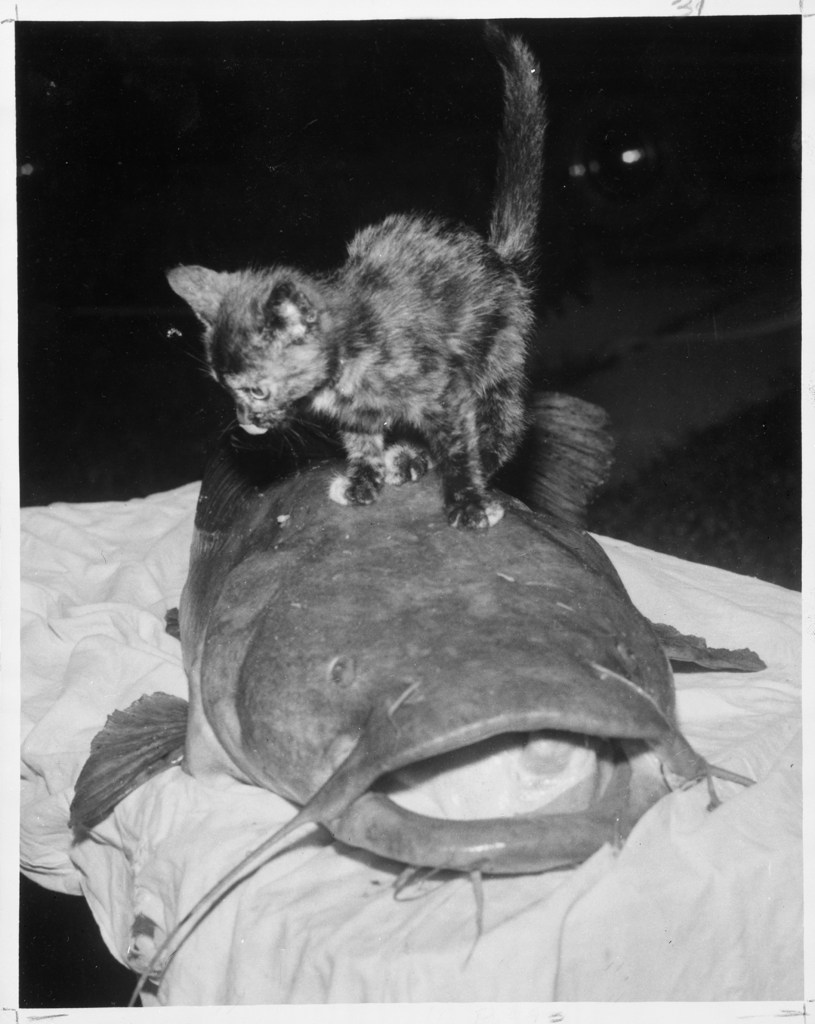
A Frank Lloyd Wright Foundation archivist assesses the Gustav Klimt portfolio owned by Lloyd Wright. Courtesy of the Frank Lloyd Wright Foundation.The Indiana Archives shared a photo of a kitten sitting on a catfish from between 1930 and 1969. Courtesy of the Indiana Archives.The updated Search Room at Maryland State Archives. The new tables were designed to offer three times as much space for visitors. Courtesy of the Maryland State Archives.
In this series, we hope to share information and resources for new professionals or those folks in need of change. First up, an interview with Meredith Lowe, the creator of Archives Gig, a website devoted to sharing job postings for archives around the globe. At ARCHIVES*RECORDS 2024, Archives Gig and INALJ (I Need a Library Job) received the Exemplary Service Award from SAA.
What inspired you to start Archives Gig? When did you start it?
I started Archives Gig in 2010, when I was relatively fresh out of my library science graduate program and interested in breaking more permanently into the archives field. I worked in an iSchool (and still do – my career goals changed!). We had been doing some career services projects for our students that included posting open positions. I wanted to broaden the scope of the work and make it accessible to alumni and others, so I built the first iteration of Archives Gig on LiveJournal. LiveJournal was maybe not the most logical choice looking back on it, but it was a platform I was familiar with. It moved to WordPress in 2014 and I got a paid WordPress account relatively soon after that, so it’s hanging out at archivesgig.com nowadays and still hosted on WordPress.
The About page from Archives Gig’s website.
How did you choose the platform you post on and has that changed? How many social media accounts do you link to?
I already mentioned the switch to WordPress. People can sign up to get emails when I post positions, and some find me through Facebook. Archives Gig used to feed to X/Twitter as well, but apparently X stopped playing nice with WordPress at some point and connection is no longer supported. If there are other platforms out there that would connect nicely with WordPress I would be happy to consider expanding to those! I am always willing to hear feedback.
Were you aware of any changes during or after the COVID pandemic?
Yes, for sure. 2020 was the lowest annual total posts I have made since I moved to WordPress in 2014. I usually put up 1400-1600ish postings annually; 2020 had 1,061 total postings. I have definitely seen an increase, anecdotally, in remote positions and positions that are explicitly hybrid. People are very interested in remote roles, those are always the ones that get the most engagement from followers. However, very few remote roles are permanent, full-time positions.
Who do you think uses the resource most often? New professionals or folks familiar with the field?
I’m going to hazard a guess on this. I did a brief survey earlier this spring (2024) to get a quick survey for a Council of State Archivists webinar presentation I was working on. I got about 200 responses and when I asked what general level of career experience respondents had, it was about 35% early career (0-3 years), 25% experienced (7+ years), 17% fairly experienced (3-7 years), and 17% grad students. There were some other smaller groups but those were the biggest groups. So the biggest group still seems to be grad students and early career archivists, but I still have a decent number of people who are more experienced looking at this resource.
Does running Archives Gig give you hints about the job market? (For example, jobs in similar positions or certain areas of the country or kinds of repositories)
The biggest concentrations of jobs are unsurprisingly in areas of high population density. For example, New York, California, and the Washington, DC area all are higher in the number of postings relative to other places. I don’t think that’s too surprising. Sometimes state archives positions are more concentrated in a state’s smaller capital city rather than its urban centers (for example, Albany, NY or Frankfort, KY).
My sense is that another change is that institutions are slightly more transparent with salary listings than they were a few years ago. Finally, I’m seeing many more positions that have particular qualifications in digital archives projects, such as digitization, digital preservation, digital asset management, and so on. I suggest that acquiring skills in these areas will likely make a candidate more competitive on the job market.
Have you always listed international positions? How do you learn about them?
I have always posted international positions, but I have a few caveats. The audience for Archives Gig is based mostly in the USA and Canada, so I require the position description to have an English language version. I used to seek international positions out more intentionally, but in the interest of time and to be most helpful to my mostly North American-based followers, I now usually only post international positions that are sent to me directly.
Do you ever hear back from folks about landing a job?
Yes and I love to hear it! It’s my favorite kind of email to get and I’m so pleased when someone lets me know about their successful job search! I have heard from people at this point who have found more than one job through Archives Gig and it’s amazing to have been a resource during someone’s career journey.
This series celebrates all the great information that exists in ArchivesAWARE!
This post originally published on May 12, 2020, challenges us to think about who we consider archivists.
This is the latest post in our series Responses and Retrospectives, which features archivists’ personal responses and perspectives concerning current or historical events/subjects with significant implications for the archives profession. Interested in contributing to Responses and Retrospectives? Please email the editor at archivesaware@archivists.org with your ideas!
Rachel Thomas, MA, is the University Archivist at George Fox University in Newberg, Oregon. She is passionate about the archival profession and opening the field to new professionals from all walks. Thomas is a member of Society of American Archivists and Northwest Archivists and recently served on the inaugural Northwest Archivists Archivist-in-Residence committee which is dedicated to working on the problem of unpaid internships in the archival profession. Linkedin profile: https://www.linkedin.com/in/rachel-thomas-5b21b38a
Six year ago I walked into my first professional gathering of archivists. As a lone arranger, I was excited to meet some of my colleagues. It was an unconference, inviting members of our profession to gather and discuss some of the issues surrounding our work. As the evening began, talk quickly turned to archives certification and qualifications. What makes an archivist and archivist? We gathered into groups to discuss this. I was excited to share my background and how I came to the field and hear how others entered this field I love.
However, as soon as we sat down, one of the members of my group said, “If you don’t have an MLIS, you are not an archivist. We have to have some standards!”
I was floored. I didn’t have an MLIS. I had just been hired by a university I respected, I had completed a MA in Early American and United States History, I had apprenticed in a large, well known, respected archive under a leader in the profession, I had worked for four years as an archive assistant at another university. I knew DACS, processing, other archival ethics and standards. I was a member of SAA and my regional association. I didn’t have my MLIS, but I was an archivist, wasn’t I?
As the discussion continued I found my voice. I expressed that I believed that being an archivist is about following the ethics and practices of the profession, not based on a certain set of letters behind a name. I shared examples of devoted archivists who had come to the field with no professional training. Some agreed with me, others held the position that the MLIS should always be required. The original speaker did not back down, she told me that she was sorry, but I didn’t belong in the field. According to her there were too many “non-professionals” calling themselves archivists and taking jobs from real archivists.
Eventually the night moved onto other topics. I learned a lot from colleagues in the room. I was able to network and build some contacts, learn about opportunities to serve in my regional professional organization. It was a successful evening by all accounts, however, I left doubting myself, hit hard with imposter syndrome.
A few years later and a few years wiser, I know that I am an archivist. I know I belong to the profession, and I know I bring value to my work. I have learned to appreciate my ability to think outside of the box, and largely credit it to the alternate route I took into the field. However, I still generally advise interns and students desiring to enter the field to pursue an MLIS. I know that it will prepare them well for the workplace, and I know that it has become a requirement for most positions in the field. I want them to be able to find work.
Photograph provided by Rachel Thomas.
At the same time, I want to challenge our profession to broaden their understanding of how one can become an archivist. I think we need to lean into the value of divergent perspectives brought by alternate education and career paths. We need to come to an understanding that the MLIS is not the only way to enter into our field. Other education and career paths can help us approach problems differently, they can help us develop new solutions, creative ideas, and the ability to diversify our collections and practices to fit a broader cross section of society. Employers must reconsider whether or not requiring the MLIS is unnecessarily limiting their applicant panel, disqualifying candidates who could bring new strengths and experience to the position. Archivists must check their assumptions about their colleagues. We must seek to be inclusive, not only in our collections, but among our colleagues.
This story does have a happy ending. At a recent conference I had a chance to have a heart to heart with one of the archival leaders in our region. He had been working as an archivist for decades and had received recognition at regional and national levels for his contributions. Everyone knew his name. I mentioned that sometimes I thought we were too focused on degrees in our field. That much of the work could be learned in other ways. That I had struggles with imposter syndrome because of my MA. He laughed, and said, “Guess I don’t belong in the field then! I only have a bachelor’s degree!”
This post was written by Rachel Thomas, MA. The opinions and assertions stated within this piece are the author’s alone, and do not represent the official stance of the Society of American Archivists. COPA publishes response posts with the sole aim of providing additional perspectives, context, and information on current events and subjects that directly impact archives and archivists.
This is the newest post in our There’s an Archivist for That! series, which features examples of archivists working in places you might not expect. In this article, Donna Wojcik talks about her job as Research/Archivist/Oral Historian for the New Mexico Farm and Ranch Heritage Museum.
1. How did you get your gig?
I started volunteering at the New Mexico Farm and Ranch Heritage Museum when it opened in 1998, serving as a greeter and oral history transcriber. I became a full-time staff member in 2001 as a receptionist/oral history transcriber. In 2012 I assumed the responsibility for the oral history program as the Oral Historian. In 2018 I was tasked with archiving twenty-five years of photos and paper items, with my title reclassified as Research/Archivist. In 2023 I became responsible for the library/archive, which is now called the Resource Room, continuing to identify and document photos, slides, and paper items in the archive and oversee our resource library.
2. Tell us about your organization.
We are a 47-acre facility that connects the present generation to the history of farming and ranching in New Mexico with a goal to inspire a deeper appreciation and understanding of the state’s rich heritage. We create exhibits and programs that enable others to understand and learn from the past to enrich their present lives and help them shape a better future. Public access to our Resource Room is by appointment and provides access to our oral history collection, Ancestry.com, livestock brand books, rare books, and books on a wide variety of subjects related to New Mexico history, culture, and arts.
3. Describe your collections.
My responsibility is rare books, research books, maps, ledgers, and our collection of over 400 oral history interviews each containing a recording, abstract, and literal transcript. I am also tasked with creating/managing our institutional archive, which documents twenty-five years of events, exhibits, educational activities, outreach, and staff.
4. What are some challenges unique to your collections?
I was given the directive to “create an archive” so I am literally building one from scratch. I have nine wonderful volunteers who help me to accomplish this goal. We have sorted and identified over 3,100 photographs from boxes that date back to 1996 and are in the process of scanning these items and entering everything into a database. I think that the biggest challenge for me is to be comfortable deciding what should be kept and what can be removed.
5. What is your favorite part of your job?
My favorite part of the job is creating something that will last for years to come and knowing that I have been a part of it from the beginning. I enjoy teaching the public about oral history and enjoy helping them with livestock brand research. I love working with volunteers and recognize that I could not do my job without their help and dedication.
This series celebrates all the great information that exists in ArchivesAWARE!
This interview originally published on May 2, 2016, is one of the most popular posts on the blog.
Among the resources in SAA’s advocacy toolkit is Public Relations and Marketing for Archives: A How-To-Do-It Manual (2011), edited by Peter Wosh and R. James and co-published by SAA and Neal-Schuman Publishers, Inc. Today we bring you an interview with Peter Wosh, Professor of History and Director of the Archives/Public History Program at New York University. In this interview with David Carmicheal, Peter revisits the book and discusses the ways it relates to current advocacy efforts.
David: What prompted the book in 2011? Was there an event that brought advocacy to SAA’s attention?
Peter: Back when I was publications editor for SAA [2007-2013] the Publications Committee regularly scanned the literature to identify gaps, and we discovered that SAA’s last real advocacy book had been published in 1994 (Advocating archives: An introduction to public relations for archivists, by Elsie Freeman Finch). Our scan of journals also showed very little literature about advocacy. There was much more archival writing on technical topics. Then, too, by 2011 archivists had become much more conscious about how central to our work advocacy is and how we need to spend more time on it. So the time was right for that book.
How do public relations and marketing relate to advocacy? Are they the same thing?
They relate, but I think of advocacy as a much broader concept that incorporates marketing and public relations. The public relations and marketing book focuses on how archives relate to user communities—primarily external communities—and how to make your archives more visible by using new technologies. This kind of marketing doesn’t include, for example, political advocacy. Advocacy includes internal audiences, which marketing and PR don’t generally consider.
When we decided to revise the Archival Fundamentals series (Archival Fundamentals III is due to be published in 2017) we thought it important to include a specific volume about Advocacy (being authored by Kathleen Roe) because the publications board thought it was so vital to what we do and had to be more encompassing than marketing and PR.
Advocacy versus marketing—do archivists favor one over the other?
I think they are more comfortable serving more traditional research communities and are still in the process of developing tools to promote themselves and their place in their particular institutions. To some extent archivists are also still hesitant to enter the public sphere of debate when archival issues come to the fore, though that is getting much better. I think it’s hard to mobilize the archival community around issues. Professional associations like SAA and CoSA take a stand on key issues, but I wonder how many people really take a personal responsibility to advocate. Advocacy needs to be sustained and ongoing and not just crisis management. We are better at responding to threats, but successful advocacy is being there all the time and promoting yourself in a constructive way 365 days a year.
How do we turn archivists into advocates?
Advocacy isn’t built enough into archival training and education. Archivists are good at standards and best practices and applying rules and regulations, and that has been the emphasis of our education and professional literature to a great extent. We don’t necessarily need individual courses in advocacy but every course should incorporate advocacy—how does what you’re learning in this course helps you express the importance of what archivists do. It needs to become part of our everyday lives.
Do you have an advocacy success or failure in your career that is instructive?
When I was at the American Bible Society I would ask myself what are the big issues facing the organization I work for and can I put together historical background papers to send to the Vice President or others that might show them the value of the archives. They responded well to my taking existing information and packaging it in a way that was meaningful to them.
When I was an Archdiocesan archivist it was a time when making church records open was a new idea, and many officials were nervous about who might be using the records. I would send them user reports (not just statistical) that included stories about how lives were touched by the archives. By talking about the range of users I was able to demonstrate that making the records available was actually supporting their larger mission to help parishioners and people in general.
I would say, finally, that just doing your job strategically is a form of advocacy. Doing the job well communicates the value of what we do in a quiet way.
This is the latest entry in our Archives + Audiences series, which features the perspectives of archival audiences – scholars, journalists, filmmakers, artists, activists, and more – for whom archives have been an important part of their life and work. In this post, COPA Career Member Kristi Chanda interviews Susan Smith. Dr. Smith, Winton M. Blount Research Chair for the Smithsonian’s National Postal Museum, discusses the museum’s archival holdings and her role in supporting research in postal history.
KBC: What is the overall mission of your institution?
SNS: The mission of the Smithsonian is “the increase and diffusion of knowledge.” Within this framework, the role of the National Postal Museum is to preserve, study and present postal history and philately. More specifically, the museum’s mission states that “Through the preservation and interpretation of our postal and philatelic collections, the Smithsonian National Postal Museum educates, challenges, and inspires its audiences on the breadth of American experiences.”
KBC: What are your current goals and how will hiring an archivist help achieve these goals?
SNS: My job as the Winton M. Blount Research Chair is to enable and support research in the fields of philately and postal history. This involves research conducted by the staff of the National Postal Museum and the Smithsonian as well as by researchers from around the world. In order to more effectively promote the scholarship related to the museum’s mission, I am working to make the museum’s archival holdings more accessible while expanding their depth and breadth. Although I am not an archivist, I am a historian with a tremendous appreciation of archives born of my own experiences as a researcher. Moreover, and more importantly, discussions with staff and external researchers have made evident the ways in which we could improve how we support the development of the philatelic and historical fields. The materials held by the museum are varied in type and include personal papers, citizens’ letters to postal officials, interviews, logbooks, airmail contract cards, print and digital photographs, postal forms, postal registers and ledgers, blueprints, and stamp production designs. These and other materials are housed in several different spaces. Museum staff continue to be offered intriguing potential donations but have been reluctant to accept them for the lack of an established space and system of categorization.
The challenges we face limit access to materials that would enable historians to examine broad and diverse topics. These range from philately as a very popular hobby to the state-sponsored design and iconography of stamps from around the world; cultures of letter-writing; the development of domestic and international business ties and practices; America’s expansion, with new post offices marking the arrival of the federal government and potential markets for industries that built upon as well as supplied the postal system; the role of the Postal Service in creating and breaking employment barriers based on race and gender; and the bureaucratic, labor and business practices and problems in an organization which, at its peak in 1999, had nearly 800,000 employees spread throughout the United States and its territories. There is potential to create and communicate knowledge about these subjects, but we have to unlock the sources by locating, acquiring, preserving, and organizing the material to be searchable and findable. And we haven’t forgotten that we must also do these things as we begin to collect the born-digital material that will enable us to document the operations and innovations of the modern Postal Service, stamp design, and mailing industries. The museum is working to hire an archivist who will help us define the intellectual framework that will both improve access and respond to trends in the fields that intersect with philately and postal history.
KBC: In what ways are you advocating for archiving in your institution?
SNS: Smithsonian staff are fortunate to be able to compete for funds from the Smithsonian’s Women’s Committee to undertake projects that provide greater access to Smithsonian collections. I successfully applied for funds to hire an archival contractor to survey the materials and establish the scale of the work to be done. My colleagues in the curatorial and collections departments and the librarian shared their extensive institutional knowledge with the contractor, and archivists in other units shared insights. When pandemic protocol finally allowed limited access to collections, the contractor was able to examine some of the materials. She provided a blueprint for steps to be taken to realize intellectual and organizational frameworks and to create the policies necessary for an accessible archive, producing an excellent starting point for the museum’s future archivist.
KBC: What lessons can be learned from your experience?
SNS: I have loved working in archives, but not every person who works at, interacts with, or is a stakeholder in the museum has had the same experiences. In advocating for the development of a formal archive at the museum, I have had to learn how to speak with internal and external stakeholders about the differences between museum and archival practices and functions. The response has been overwhelmingly favorable because of the shared goals to improve and advance access and use of the materials for all. I imagine that the lesson that can be learned from my experience is a common and essential one: keep in mind the people who must be involved to make an archive possible, accessible, and successful, and work with them early and consistently.
This is the latest post in our series Archival Innovators, which aims to raise awareness of individuals, institutions, and collaborations that are helping to boldly chart the future of the archives profession and set new precedents for the role of archivists in society. In this installment, COPA member Kristi Chanda interviews Julie Rockwell, archivist and “lone arranger” from Pennsylvania’s East Broad Top Railroad.
KC: What are your responsibilities at East Broad Top Railroad?
JR: First, I’m a Lone Arranger. I was hired in April of last year to herald the East Broad Top Railroad’s new Archives and Special Collections program, and I’m pretty much heralding everything from the beginning – from scratch. I’m actually building the program. The East Broadtop Railroad National Historic landmark was in operation during its Common Carrier Era, as we call it, from its developments in 1856 to its closing in 1956. There was a little lag time in operations where it then went into tourist railroad operations, which basically stopped in 2011. The actual historic site was dormant until a new foundation, the EBT Foundation, purchased the railroad. There’s 33 miles of property that encompasses the National Historic Landmark, and they hired an archivist to tackle the inestimable amount of paper materials. bound volumes, ephemera, physical objects that encompass what we would call, either museum collections or typical organizational records and archives. I basically walked into a passenger station, which was built in 1906. In the station are 3 fireproof brick vaults, each between 950 and 1,400 cubic feet, and all of them 12 to 14 feet high. The vaults are filled with materials that have basically never been touched since the Common Carrier Era. Also, the headquarters of East Broad Top was in Philadelphia so all of those materials, when the railroad closed down, came to the Orbisonia passenger station. All of what we call the tourist excursion era, all of those documentation and recordings of office and records management stayed in the vault. We’re also starting to collect this new revitalization and restoration documentation of the railroad, which is to become a steam excursion railroad once again. I came in with an overwhelming, daunting task. I can’t thank the Johns Hopkins dual Museum Studies and Digital Curation Program, from which I graduated in December of 2020, for offering, and really preparing me for these foundational skills. I was able to take the courses in the foundations of archives, digital preservation and curation, and collections and catalog management, and really see archives from a bigger picture lens of what preservation means, and how much it takes to advocate for preservation purposes. For the EBT, I started to understand what materials we have, the conditions they are in, and what I can do to better secure and better environmentally protect the materials that are basically in a station that was built in the early twentieth century, considerations that have never been addressed before. I knew I had to build a mission statement, a scope of collections, a collections management policy, access and use policy, and all of the policies that are under that umbrella of preservation.
I also knew I needed help. I reached out to the Conservation Center for Art and Historic Artifacts in Philadelphia. I was familiar with the Conservation Center. I had attended many online seminars and was also able to meet contacts there through PA Museums and the American Association of State and Local History (AASLH).
I called my contact up, and I said guess what i’m doing, and I know that we need a third party assessment. This was the only way that we could leverage big picture funding, and to have that deeper lens into what exactly we need from a conservation and preservation professional viewpoint and perspective. The Conservation Center experts were able to meet me and various advocates on the Foundation Board, as well as their sister organization, an all volunteer organization (and both of these are non-profit), the Friends of the East Broad Top. I had these particular constituents come together, meet with Dyani Feige and her preservation team, along with the director of the Conservation Center. After a couple of months, we were able to set up the ability to have an archival preservation needs assessment conducted. The greatest thing about this is that we have incredible donors who were able to fund this assessment.
Our mission, protecting, preserving, and providing access, not only to the historic site and to the railroad, could now address this deeper lens and the beauty of what we can find in the contextual layers of all of these archival materials. This mission is something that keeps me thinking about the archives every day, every night, and gets me up every morning.
KC: How did you prioritize your collections?
JR: It was first to really get an idea of the scope of what we have. I was fortunate last summer to have an intern from one of the local colleges, and the first priority was to do a spot inventory. We were able to go into every area that we could find,what we would call archival materials,identify them by giving a general title, location, and noting the condition of the materials. Some items that need triaging would definitely be maps and drawings that the railroad operations actually need to help restore: track engines, box cars, different rolling stock, etc. Inventory pretty much took all summer and I’m actually still in the process of doing it. Almost every day I find something, and or someone has texted me that has another box of stuff on my desk. So it’s really an inestimable amount of linear feet but I’ve estimated between 3500 and 5000 ft of linear materials. The other triage that I focused on were the bound volumes. I do have bound volumes that are pretty depreciating, regarding conditions in terms of the bindings. However, all of the material inside, the documentation, is quite intact, which is fabulous. But just to make sure that they’re not handled, we have stored them separately. I did store them in bins. Unfortunately they’re not acid-free. I’m doing everything on a shoestring budget. I am doing the “good enough” practices that I know that when I reach the next level, once I get a line item, funding, and a storage facility/repository, then I will be able to go to the next levels of preservation and conservation and have the materials reviewed by a conservator. For now they’re wrapped in acid-free paper, and they’re put away.
KC: What projects are you in the process of working on and what ones have you completed?
JR: Most important for me, I think as a Lone Arranger, is to know that there can be someone there to assist. I have 2 volunteers from the Friends, one is Scarlett Wirt. She worked with collections with the National Park Service, and she has organizational record experience. We also have, who we call the primary EBT scholar and historian, Dr. Lee Rainey, who knows everything you could imagine about the East Broad Top Railroad. They have been what we call our worker bees. The new archives task force appointed the 3 of us to work together closely. We have met almost every Tuesday on Zoom since last August, after I completed my initial report. We are building the program together. We are still developing policy and procedures. We know we can’t move forward unless we have many policies and procedures in place. Having the mission statement, having our goals and a strategic plan for at least the first 2 years, and then moving into the access and use policy, the scope of collections and all of those that will fall under environmental conditions is a priority. The second component of that is my experience with digital curation and what I learned in school and applying this knowledge for the born digital records that are coming out of the Foundation, which is very important. We’re understanding that many grants will really want you to already have a collection online and public access in place. We don’t have an accessible reading room and we haven’t formally processed collections yet. Also, looking at the next step of digitization is making sure we have the right hardware and digital storage. We just purchased our computer workstation. So, making sure that all of my digital content is going to be safe, secure, and that the integrity of the digital objects and data are going to be in long-term, sustainable condition is a priority. Then there’s the digitization policy and making sure that the selected collections are doable, and that there’s a balance between that selection and also of what the public would like to see. For example, I just documented the workflow of how to protect a map with mylar and that might seem very simple to many of us who are experienced in archives, but when I’m bringing on volunteers and interns, I want them to learn the right way. So it’s building all of these different layers, so we can actually, yes, scan our first small collection, which was a donation that we received last year and actually take it through the entire archival processing methodology, from the appraisal, the arrangement, the description, and then finally producing a finding aid, plus having the collections digitized and then accessible online. I’m kind of doing everything, well, all at once.
KC: What are some of the obstacles you have encountered and how did you overcome them?
JR: Last summer, Sammy, my intern, and I mostly worked on the second floor of the passenger station, and we would have a designated space for one day, but maybe that space would have to change. So we’d have to move our work for the day to another area.
We would have maps splayed out to try to conduct our inventory on these small little tables.
We didn’t have a space to call ours. I basically said that I don’t know what else I can do unless I have a designated space, that is, for the archives. I need tables to lay out materials, and I need shelves to at least start putting bins of materials on so they’re kept off the floor, and also to create my computer workstation. Having that space and advocating for that space was really critical, and having the necessary, organizational support from the management.
Photo credit to the EBT Foundation, Inc., courtesy of Matthew Malkiewicz
The other challenge to overcome is having people believe in the archives. Unfortunately, creating a formal archive was not, at first, a priority. I imagine the conversation starting with, “Oh, by the way, what are we going to do with all of these paper materials?” Many inherently understood the value of them, but they didn’t necessarily see the bigger picture of hiring someone to actually do that type of work. So I think that the biggest challenge right now is that I’m funded by donations, and I’m only funded part-time. Advocating for my role as the archivist is kind of like singing for my supper, and that can be very exhausting. There’s a balance between showing them what we can do, and I say “we,” because I think that we have a community of passionate people that are working for the EBT and I’m the leader heralding the archives work, but also helping the public understand that they need to support the archives. Together, through the organization and the public, there’s more advocacy coming from all points of the spectrum. The public desires to see the materials. The Foundation and the Friends need to make sure that the archives continue with their organizational legacies and with their mission statements, which align with ours – to protect, preserve, and provide this access, and also allows for me to continue doing this work. Or, it just falls apart. So it’s a balance of doing the work and advocating for the work.
KC: What goals do you have moving forward?
JR: My goal is to just keep doing the work strategically and carefully. I’ve been really mindful and open to understanding my limitations. I think the Foundation knows my general manager has been really happy to find someone who is adaptable and flexible, and not perhaps expected in a more established archives. I guess you could say that I understand that there’s limited resources. When you see where we started from last April to what we see now, we’ve done a heck of a lot to have a formal preservation needs assessment report in our hands, to have a great space where I can work, a designated space assigned in January specifically for the archives, to have the funding to keep me going for at least this year, having Sammy return after he graduates this spring as an assistant, and also to have another college intern work on a specific project funded by a grant. We applied for a grant from the National Railroad Historical Society for our maps and drawings project so we can purchase a wide format scanner, and actually start processing the inestimable amount of these materials. With hopefully getting this first grant, we hope we can garner more funding. We can advocate for more permanent funding also make sure that we have our T’s crossed and our I’s dotted to to leverage grant funding and become more prepared to be competitive. I think that the goal is just to keep doing the work and know that it’s time-consuming, it’s tedious, but I can’t imagine doing anything else right now,
KC: What lessons have you learned and what tools/skills have you developed as a result of your experience?
“Lost Tracks Of Time” Photo credit to the EBT Foundation, Inc., courtesy of Matthew Malkiewicz
JR: More leadership skills in the archives and trusting that it’s not what I’m always physically doing, but mentally knowing what work needs to be done. I credit a lot of this understanding from the Society of American Archivists (SAA). This will be my third year that I’ve been a member, and I feel that the organization’s inclusivity to archivists at all stages of the field is encouraging. I don’t necessarily like using the word ‘emerging’ because I think we all start from somewhere, and we build upon all of the different experiences that we have at different times in our careers. We’re always ‘emerging’. This is my fourth career, so I come from a long history of project management, being a director in the theater, teaching culinary arts and teaching American history. I come to this work from different perspectives and different career sets and skill sets, which makes me believe that archivists can have many talents and many different roadmaps to lead them to this point. I think that SAA has really connected me with amazing archivists that are mentors. I can even learn something from them just by following them on Twitter. Also really understanding that resources are out there. Especially for all archivists is to understand that we’re all in this together. There are different SAA section groups such as Preservation, Lone Arrangers, Collections Management, and Museum Archives, and you know somebody is gonna be in that group who will be very willing to talk to you and answer a question and provide you with additional resources. So I think that it’s knowing how to network, knowing how to ask the right questions, and not being afraid to ask those questions. For example, reaching out to the Conservation Center was an epiphany that I had in the middle of the night. I’m so glad that I trusted my instincts to know that I can’t do this alone, and if I have to be a Lone Arranger, then at least I’m gonna have a posse behind me to help lead me on.
This is the latest post in our series Archival Innovators, which aims to raise awareness of individuals, institutions, and collaborations that are helping to boldly chart the future of the archives profession and set new precedents for the role of archivists in society. In this installment, COPA member Claudia Willett interviews four members of SAA’s newest committee, the Committee on Research, Data and Assessment (CORDA), who provide an update on the Committee and one of its newest initiatives, the Facts+Figures website. Jennifer King and Erin Passehl Stoddart are co-chairs of CORDA and Dennis Meissner and Chris Marino serve on the Facts+Figures team that led the redesign of the website.
What is CORDA?
The mission of the Committee on Research, Data and Assessment (CORDA) is to elevate awareness of archives by making central the role that research, data and assessment play in our ability as archivists to tell the story and show the impact of archives. There are many ways to increase awareness of archives – and one of the most powerful ways is to reveal trends and increase awareness through understanding data. How does CORDA elevate the importance of research and innovation, you might ask? CORDA provides access to significant and useful data and research about SAA, American archives, and their users that evidence the value of archives for society and help us improve our services to SAA members and to our consumers. The Committee supports research and creates, gathers, and preserves data by directing and engaging in these areas of activity:
● Providing SAA members with standardized tools for gathering and analyzing data;
● Providing a repository or portal for data and other research outputs;
● Providing training on gathering, analyzing, interpreting, and using data; and
● Providing up-to-date and reliable basic facts and figures about archives and archivists
Rounding out our charge is the task of asserting a research agenda to help guide research, assessment and data going forward.
Since establishment in 2019, CORDA has established and manages the SAA Dataverse; the SAA Facts and Figures website; training for archivists to conduct research; and an inclusively developed research and innovation roadmap to frame the profession’s work going forward. Accomplishing the above in a fairly short period of time has been made possible through the exceptional work of our committee[1].
Tell us about the Facts+Figures [F+F] microsite.
Facts+Figures (F&F) is designed to provide users with quick and simple access to information resources important to archivists or their constituencies. The resources on the site share the common quality of being derived from data – data compiled or created by archivists as a result of their research, data about archivists and archives from external agencies, and tools to enhance archival practice resulting from research data.
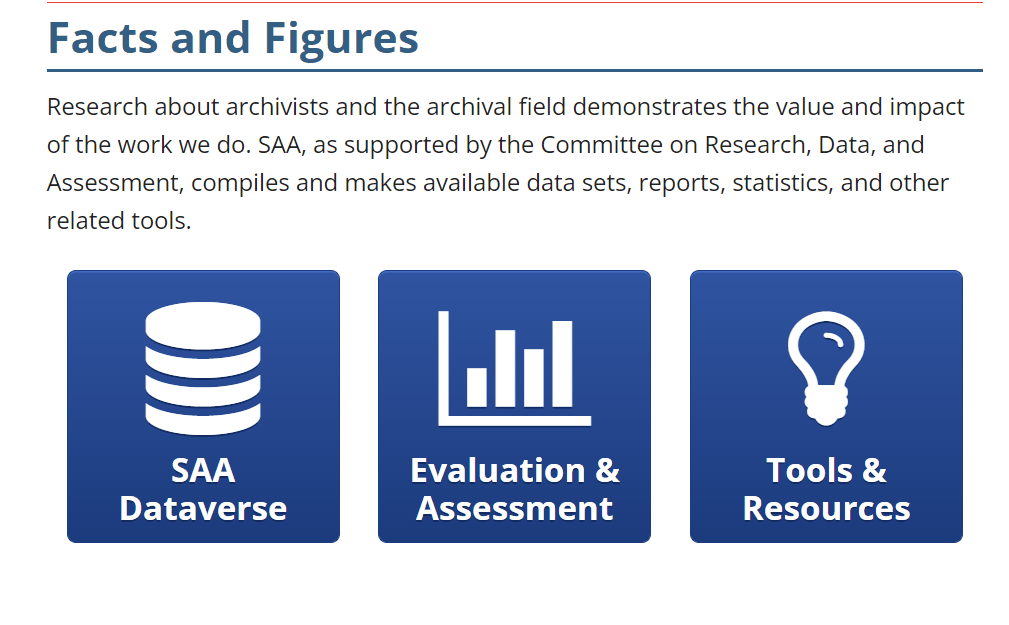
The newly redesigned F+F site is divided into three content channels: SAA Data Repository (SAA Dataverse), Evaluation + Assessment, and Tools + Resources. The Data Repository supports the deposit and reuse of datasets for purposes of fostering knowledge, insights, and a deeper understanding of archives and archivists. The page contains a search bar that enables users to search across the Dataverse and learn about the submission procedures and collection development policy. The Evaluation + Assessment channel may include at-a-glance dashboards, charts, graphs, reports, fact sheets and quick guides that support advocacy, explain archives and archivists to external entities, and provide insight into the functions of archivists and their repositories. The Tools + Resources channel may include software recommendations to perform tasks, how-to instructions and guidelines, checklists, best-practice guides, and self-assessment tools to employ data in support of advocacy efforts and in assessing archival impact.
Unlike the Facts and Figures page that preceded it, the reimagined F+F will be actively curated by CORDA and is a dynamic resource that will be augmented with new content items on a continuing basis. It will be a resource for archivists to turn to for quick information to aid them in advocacy efforts, to help them benchmark their performance against peers, and to adopt or adapt tools to make their work easier or conform better to best practices.
Do you see a role for data as an archival advocacy and awareness tool?
Yes! It is hard to imagine a more powerful storytelling tool than data. In fact, it is that desire that drove the creation of CORDA. In his SAA presidential address, “Bare Necessities,” Dennis Meissner argued that SAA must “concentrate on gathering, evaluating, and presenting the real quantitative and qualitative evidence that supports all the compelling narratives and theoretical arguments about the value of archives. We need this evidence because we have struggled for many years with the challenge of demonstrating the ‘value’ of archives via anything resembling objective measures.” He proposed that SAA form a Committee on Research and Evaluation (CORE), with a goal “to provide access to compelling data about American archives and their users that speak to the value of archives for society and that also help us improve our services to our consumers.”
In addition to archivists, who might benefit from these resources?
Funding, policies, and cultural heritage priorities are better informed when decision-makers have access to regular and reliable research, data and assessment. Future-thinking, forecasting and change initiatives grounded in facts and figures will best ensure that society values archives, and plans for the ongoing protections required to promote archival stewardship.
Research, data and assessment is also critical for auditing our efforts as repositories. Efforts like A*CENSUS I and II, and RepoData are more meaningful when data is gathered regularly and enables longitudinal analysis. Social reform is often made possible when decision-makers are confronted with incontrovertible data. As archivists, collections and records serve an evidentiary role and can impact decision making and analysis.
Management of archival resources requires short-term and long-range planning, and both always benefit from access to data. The need for data to underpin short-term and long-range planning is intensified during times of political instability, climate change, and interrogation of the racialization of memory work. Archivists, along with other professions in the cultural heritage fields, need centralized infrastructure for their assessment, data and research efforts, as well as an idea of how those efforts might be complementary efforts in a broader research framework. CORDA hopes that archivists will be inspired to see resources aggregated into a more coherent whole and inspired to help address gaps and all demand factual accounting of archival efforts.
What are the next steps for F+F?
Continue to build out and organize content for quick and simple access! Every archivist has their “go-to” resources that aid them in explaining their value, promoting themselves and their missions, and understanding their impacts and potential. We want to harness that knowledge and share it with the wider community. To contribute content to F+F, visit our microsite and click “suggest new content.”
[1] CORDA committee members, past and present: Nancy Beaumont (SAA Executive Director) Mary Biddle, Sarah Buchanan, Paul Conway (Chair), Julia Corrin (Education Committee Liaison), Courtney Dean, Jasmine Jones (Council Liaison), Jennifer King (Chair), Amanda Hawk, Cristina Horak, Gwendolyn Higgins, Carli Lowe, Chris Marino, Sarah Pratt Martin, Dennis Meissner, Nance McGovern (Ex Officio), Jacqualine Price Osafo (SAA Executive Director), Ricky Punzalan (Council Liaison), Erin Passehl Stoddart (Chair), Jennifer Wachtel (Education Committee Liaison).
This post is the 11th in the series “Federal Funding Impact Stories,” as published on the ArchivesAWARE blog. As archivists, librarians, and museum professionals, we know how our collections, institutions, and local communities have benefited from grant funding from federal agencies, such as: Institute of Museum and Library Services, National Endowment for the Arts, National Endowment for the Humanities, and National Historical Publications and Records Commission. Personal impact is powerful. Submitted stories will be posted to the ArchivesAWARE blog by the SAA Committee on Public Awareness, and promoted by the Society of American Archivists through their website and social media channels. All posts will be tagged #ImpactStories, along with tags for the funding agency and the state where the home institution is located. We hope to gather stories representing all types of archival repositories, and in all 50 states and the District of Columbia, so please consider sharing your story–no impact is too small when it comes to advocating for federal support for the arts and humanities!
This Federal Funding Impact Story comes to us from Astoria Public Library, located in Astoria, Oregon. Astoria is a port city situated at the junction of the Columbia River and Pacific Ocean. It was named after John Jacob Astor, an investor from New York City whose American Fur Company founded Fort Astoria in 1811. Astoria holds the distinction of being the first, permanent, non-Native American settlement on the Pacific coast. The collection holds nearly 70,500 physical items, including historical materials unique to Astoria and the Pacific Northwest region. The City of Astoria’s earliest records are general ledgers, lien documents, general warrants, planning maps, and settler-era cemetery records. In addition, there are materials documenting Astoria’s growth specific to logging, salmon, cannery industries, and additional port-related activities.
Congressional District: Oregon’s 1st Congressional District
Grant Period: June 2019-August 2021; COVID-19 extension
Award Amount: $50,000
Background
This archive initiative began when Jimmy Pearson became the Library Director at Astoria Public Library in October 2016. For decades, archive materials dated from the present to before the founding of Astoria (1811) collected in the library basement. A previous lack of interest and resources meant the collections remained dormant and unidentified until recently: 2018. With an Oregon Heritage grant ($21,700), Director Pearson engaged a consulting historian and archivist, and put together a plan for approximately 1200 linear feet of historical materials. Under Pearson’s leadership, a team of experts and library volunteers worked to complete a collection assessment that identified needs and recommendations. Training for handling and processing archival collections was delivered and an amazing cadre of volunteers have since processed approximately half of the collection. With an assessment performed and actionable activities identified, the next phase for the library was to find a sustainable yet effective method of publishing collections online for the community to access freely.
A note on the critical role local grants play.
It’s important to note that the Oregon Heritage grant was the first grant the library received for work on the basement archives, and it allowed the library to bring in additional expertise to help guide necessary foundation work. Upon successfully completing the grant, Director Pearson was able to seek out and secure both an Oregon Cultural Trust and an Institute for Museum and Library Services grants for FY2020 and FY2021. The work completed during the Oregon Heritage grant provided an essential underpinning to the application requests. Information gathered during the collection assessment, the adoption of a clear collection plan, and an existing base of trained volunteers helped create a compelling case for further funding. For organizations that are just starting out or are newer to grant writing, applying for local grants is a necessary first step and should be included in their funding strategy.
In March 2022, APL received a Library Services and Technology Act (LSTA) grant to digitize The Astoria Toveri. The Toveri was a newspaper produced by the Finnish community in Astoria in the early-20th century. The grant will be used to support a partnership with the University of Oregon Libraries’ Oregon Digital Newspaper Program. Digitization efforts will begin between July 1, 2022 and June 30, 2023
Specific to the IMLS grant, what was the need for the grant?
The archive collection was locked in the basement, unprocessed, and forgotten—for decades. No one knew what was down there, the community couldn’t access the materials, and the items remained largely unused in any regional history work. Two previous grants helped to facilitate assessment, identification, and description of the collections, but nothing was online. It was impossible to find the treasure trove of historical materials unless you knew about the basement in Astoria’s public library. The next step for the library was to shift to digital, but digitization, description creation, and cataloging projects are a massive undertaking—especially for a small, rural library. Additionally, a platform needed to be selected to facilitate the storage and presentation of the digitized collection.
What did the IMLS-funded project do to help meet this need?
With the IMLS grant, the library was able to thoughtfully research and select a platform that incorporates the following:
Digital preservation best practices
Archival descriptive standards
Easy to use for all user types
Financially sustainable
Facilitates online collection access
Once a platform was in place, the team was able to move forward with describing, cataloging, and publishing 500 collection items to be available online.
Where we found best practices meets sustainability.
Permanent.org meets a majority of the library’s identified needs for an online collection platform. In choosing Permanent.org, the library was able to use the IMLS award to cover the 1x cost for joining. (There is no annual cost). This fiscal advantage means Director Pearson doesn’t have to worry about finding money annually to cover the cost. Additionally, as Permanent.org is cloud-based with a supportive team and community, the library can benefit from Permanent.org-provided support—keeping the cost of outside technical support down. For the library, Permanent.org offered the best balance of: easy to use, meets digital preservation best practices, and is financially sustainable. In other words, it’s permanent.
To offer a balanced perspective, it is important to note that Permanent.org wasn’t originally created for archives, and doesn’t host the usual data fields we’ve come to expect. Currently, to meet basic requirements for Describing Archives: A Content Standard (DACS), missing data fields like “Creator” or “Identifier” have to use the tag field to capture the information. For example: “Creator:John Smith”. On a technical level this appears to meet DACS, though not in the traditional way we are used to.
For more on Permanent.org, please check out this webinar.
For more information on how Astoria Public Library is using Permanent.org, check out the Family Archiving with Permanent.org and Rachael Woody webinar that originally aired on September 20, 2021.
Abstract: Amberly Russell, Preservation Services Manager at Permanent hosts this informative talk about Preservation Services and what it is like working to create lasting legacies online. In this webinar we speak to Professional Archivist Consultant Rachael Cristine Woody about her experiences creating digital archives online for family and organizations.
Without volunteers, this project would not have been possible. No, seriously.
The COVID-19 pandemic altered our ability to do the project as originally envisioned. A squad of the library’s volunteers had received updated training and were meant to facilitate digitization and description work. This was no longer possible due to pandemic-related closures and limitations. Fortunately, the IMLS grant included budget lines for a consulting archivist and historian who now needed to perform the bulk of the descriptive work. But even this work wouldn’t have been possible without the thousands of volunteer hours invested prior to this project. For example, digital archivist volunteer, Eric Williams spent more than five years scanning items in the collection. When it was clear the IMLS project would need to be altered and mostly remote, the project was able to pull from the hundreds of items that had already been digitized, helpfully labeled, and available via Dropbox—thanks to Mr. Williams. Additionally, prior to the pandemic, Clatsop Community College students contributed to collection care, management, and identification while under John Goodenberger’s supervision. Their work provided insight into multiple facets of the collection and were the basis for descriptive work. Director Pearson notes that 1200 volunteer hours were contributed during this project thanks to Ove and Barbara Rasmussen, and Eric Williams.
In April 2022, Eric Williams was named an Oregon Heritage Commission Standout Heritage Volunteer as part of the Oregon Heritage Excellence Awards. Please join us in congratulation Eric on this well-deserved acknowledgement!
COVID-19 forced a reimagining of community outreach.
Available federal funding has a natural focus on how the award will benefit the community. Originally, the outreach the library intended to do involved onsite collection tours and a traveling lecture series. Neither of these were possible during 2020 and 2021. However, Director Pearson and the consultants were able to reimagine the in-person events into virtual events and recordings. There is now a YouTube playlist of collection features, an Ask Me Anything event, and showcasing the collections online. Below is a link to the playlist and a few example videos.
The Astoria Public Library Archive Collections are Online, published October 28, 2021.
Abstract: This video announces the completion of an Institute of Museum and Library Services grant to digitize, describe, and publish 500 historical artifacts online via Permanent.org. Jimmy Pearson (Library Director) introduces the recorded announcement followed by Rachael Woody (archivist) and John Goodenberger (historian) who discuss the IMLS project, explain how they adapted their work due to COVID-19, and showcase the final product with Goodenberger highlighting several of the items and their interconnection. The collections can be viewed on Permanent.org here: https://https://www.permanent.org/p/archive/03pw-0000.
Ask Me Anything: Astoria Public Library’s Historical Collections, published December 17, 2020.
Abstract: This is an Ask Me Anything (AMA) session where City of Astoria historian John Goodenberger and consulting archivist Rachael Woody team up to answer questions related to the history of Astoria and the treasure trove of historical artifacts found in the basement of the Astoria Public Library. This webinar was made possible thanks to the Astor Library Friends Association and the Oregon Cultural Trust.
Featuring the August Hildebrand Collection from Astoria Public Library, published November 14, 2020.
Abstract: This video features items from the August Hildebrand collection. Listen in as city historian John Goodenberger shares highlights from the collection with consulting archivist, Rachael Woody. This project was made possible thanks to the Oregon Cultural Trust.
The historical collections at Astoria Public Library are now online via Permanent.org! The immediate and obvious impact is the library was able to acquire a critically necessary tool for broader access to the historical materials. The IMLS award made it possible for the library to implement Permanent.org and upload more than 500 digitized and described collection items. Thanks to the IMLS award and previous volunteer work, the library could continue making progress on the archive in an adjusted form. Finally, reimagined outreach in the form of videos has already attracted attention and use by Astorians, historians, the Preservation Artisans Guild of Portland (OR), and the great-granddaughter of August Hildebrand (the creator of one of our featured collections)!
APL would like to thank John Goodenberger and Eric Williams for their extensive contributions toward chronicling the history of Astoria, Oregon. This project was made possible in part by the Institute of Museum and Library Services Grant: LG-27-19-0187-19.
About the Author: Rachael Cristine Woody is the owner of Rachael Cristine Consulting, a firm that provides services to archives, museums, and cultural heritage organizations. Rachael holds an MSLIS with a concentration in archives management, and more than 15 years of experience in history organizations — including the Smithsonian Institution and the Oregon Wine History Archive.
This is the newest post in ourThere’s an Archivist for That! series. In this post, Harold Housley, Archivist for Architecture, Arts and Design at Arizona State University Library, describes the uniqueness and challenges of Design and Architecture Collections and offers his interpretation of the International Design Day theme, Suspended in Transition. This interview was conducted by Committee on Public Awareness (COPA) member Claudia Willett.
Claudia Willett: Let’s start with a brief introduction of yourself to the readers.
Harold Housley: I’ve worked for Arizona State University (ASU) Library since 2007, currently as Archivist for Architecture, Arts and Design. My previous experience includes working as an archivist for the National Park Service. I am a member of the Academy of Certified Archivists and SAA. I earned a Master of Arts in History from Arizona State University and a Bachelor of Arts in History from the University of Arkansas-Little Rock.
CW: Can you talk about your role as Archivist for Architecture, Arts and Design?
HH: I am responsible for overall management of Design and the Arts Special Collections, which is primarily an architectural archives and manuscript repository. The collection developed in the 1970s and 1980s out of interest by School of Architecture faculty members in collecting primary and secondary sources on two prominent architects important in Arizona history, Paolo Soleri and Frank Lloyd Wright. The opening of a new building for the College of Architecture and Environmental Design in 1989 created the space to develop and expand the collection to include architectural drawings and files from prominent architects such as Victor Olgyay, a pioneer in climate-responsive architecture, and Blaine Drake, a former Frank Lloyd Wright apprentice and key figure in post-World War II modernism in Arizona.
Desert Cabana (1939), rendering from the Blaine Drake Collection, Design and the Arts Special Collections, Arizona State University Library
The collection has evolved over the years to include textual records, architectural drawings, presentation boards, and project files that document desert-sensitive design and the development and evolution of mid-century and modern architecture in the Southwest. The greater Phoenix area has a rich history of significant mid-century modern architecture and the presence of the architectural school at ASU has helped the library to acquire the drawings and papers of architects such as Alfred Newman Beadle and Will Bruder.
CW: Can you describe your organization and the collections?
CW: International Design Day is April 27 and the theme is ‘Suspended in Transition’. How does this theme apply to your work or experience with design collections?
HH: I find this theme very relevant to my work as an archivist and probably many other archivists would agree that traditional ways of acquiring and managing collections are in transition and need to evolve to meet the challenges of the present and future. I think other aspects of the theme are also relevant to archivists, such as that the pandemic has fostered the proliferation of new methods of collaboration and communication and created an opportunity to explore alternative ways of doing our work.
CW: Can you talk about some challenges unique to your collections?
HH: The large number of oversize items usually found in architectural collections definitely creates storage challenges. The variety of records found in architectural/design collections means you need to have both traditional archival shelving to accommodate paper records and photographs but also lots of flat filing cabinets for drawings.
Reference also presents some interesting challenges beyond dealing with large-format materials. For example, the access point for many researchers looking at a specific building is the address, which is often not listed in a finding aid. So I have found it useful to have separate drawings inventories that provide those item-level details that help in reference but may not be included in a collection finding aid.
CW: What is something you wish more people knew about Architecture and Design collections?
HH: There are some real “hidden treasures” in architecture and design collections. Examples include designs for buildings that, for one reason or other, were never built. It is fascinating to imagine what a completed building may have looked like. I also really enjoy looking at houses that architects design for themselves. Residential design projects usually involve the architect and client working closely together to bring a design into reality. But when the architect does not need to cater to the wishes of the client, I think there is more freedom to explore a particular theme or experiment in a style without having to answer to an outside client.
House designed by Alfred Newman Beadle for himself and his family, Beadle House 6 (1954), Phoenix; from the Alfred Newman Beadle Collection, Design and the Arts Special Collections, Arizona State University Library
Architecture and design collections, because of their strong visual appeal, have the ability to connect with everyone. Most architectural collections found in archives are a blend of personal papers and business or professional records, so you have documents, such as correspondence, that are typically found in other types of manuscript collections. But you also have lots of very eye-catching materials that are works of art, such as full-color architectural renderings. So even if someone has no prior knowledge of or experience using archives, they can appreciate the value of what they are looking at.









 ArchivesAware