Sound and Vision: Using Video to Tell the Tales of Archives and Archivists

BurnsPortrait

This post was authored by ArchivesAWARE! editor Chris Burns, Manuscripts Curator and University Archivist at the University of Vermont.

This is the first in a series of posts about the use of video as an archival awareness tool. This initial post will feature videos which focus on what an archives is and what archivists do.  Future posts will look at promoting these videos, determining their impact, and will take a closer look at some of the other topics archives are using this format to cover. Feel free to contact the editors of this blog at archivesaware@archivists.org if you have a video or topic you would like to see covered, or if you would like to contribute to this series.

On August 26, 2015, Kathleen Roe premiered the Society of American Archivists’ Archives Change Lives video during her plenary talk at SAA’s annual meeting. As of this writing, the video has over 3,400 views on YouTube. The video clocks in at just under three minutes and features Kathleen Roe, Dennis Meissner, Steven Booth and Samantha Norling talking about the power of archives, cut with images from archives, of archivists at work, and of people interacting with archives. The core message of the video is articulated by Kathleen Roe, “What I hope that my colleagues and I will all be able to do together is to explain to people in clear, compelling language why we think archives matter, why what we do is valuable.”

The video was unveiled at the end of Roe’s year as President of SAA, a year where she led Year of Living Dangerously for Archives initiative, which challenged SAA’s membership to increase their advocacy for archives. One compelling way to get this message across, as Kathleen and SAA demonstrated, is through the use of video. A search of YouTube for videos relating to archives, archivists, and special collections turns up a number of attempts to do just that. These videos tackle a range of topics and vary in their approach, goals, budget, and production quality.

The National Archives UK has done a series of videos, compiled in an Explore Your Archive playlist, that tackle big questions as well as feature archivists talking about particular records.

One of the big questions they address is What is an Archive? The production elements are similar to the SAA video, it clocks in at just under 3 minutes, features a combination of talking heads and still images, and has music playing in the background throughout. Like the SAA video, the premise is simple and direct, it is a short video of archivists and archives users speaking passionately about the power and importance of archives. The three-minute length of these two videos is no accident, as it is often recommended as the maximum length for promotional videos. The video was published in October, 2013 and has been viewed over 4,100 times.

A video produced in 2014 by Duke University’s Rubenstein Library begins with a voice stating, “I think it’s a challenge and a curse to explain what an archive is to people, and it’s because it means so many different things to different people.” The video, The Guardians of History, digs a little deeper than the two mentioned above, taking a look at the work of seven archivists at Duke. This video is a little longer, coming in at just under 9 minutes, but again features interviews, still images of archives and archivists, and a musical backing track during part of the video. The interviewees speak candidly about the difficulty they have in explaining what they do to friends and family members, one speaker noting, “sometimes it’s not worth the effort to explain what an archivist is, so I’ll go ‘Oh, I’m a librarian.’” The video is an honest look at the work of archivists, giving voice to their passion for the work, and discussing some of the humorous and very human items in archival collections. The video is a good introduction to archival work. The budget is not on a Hollywood scale, but the quality of the sound, images, and editing are all very good. To date, the video has been viewed over 1,500 times.

At an Institutional level, BYU took a novel approach in 2011 when they made a fictional trailer for their L. Tom Perry Special Collections, parodying the trailers of blockbuster Hollywood adventure films. To date, the clip has been viewed over 13,000 times.

Two years later, they made a more conventional, and more informative, introductory video. This video has been viewed just under 800 times.

Of course, the number of views a video gets does not really tell us whether a video has successfully met its goals. Those goals could be for an institution to experiment with the process of producing a video, or to create a video that can be played in a classroom setting or sent to a patron in advance of a research visit. However, creating a high quality video that people want to watch and share should also not be understated. It is relatively easy to shoot footage, and increasingly easy to edit that footage, but creating a video where the sound quality is consistent, the edits are relatively seamless, and the content is compelling takes a certain level of skill and patience.

A number of videos get into the question of what an archivist does, which can be helpful in explaining our profession to people who might be interested in a career in archives as well as getting the word out more broadly.

A 2010 example of this type of video comes from the Freer Gallery of Art and Arthur M. Sackler Archives, A Day in the Life of an Archivist. The video features an archivist explaining their work over a musical backing track. As the comments indicate, from both viewers and the creator, this was an initial attempt by the Sackler Archives to work in this medium and there are some issues with sound levels. That said, the video has been viewed over 12,000 times, which demonstrates that this is a topic of interest, and is either well promoted or frequently found through internet searches.

By comparison, another video done at the same time, Freer Gallery of Art and Arthur M. Sackler Gallery Archives Introduction, has been viewed just under 1,900 times.

Some other videos that introduce viewers to archivists and their work are:

Meet Our Vintage Collection Archivist, Bill Bonner – National Geographic (over 45,000 views)

 A Day in the Life of a Processing Archivist, UALR Center for Arkansas History and Culture, 2014 (300+ views)

 Aaron Rubenstein, University and Digital Archivist, UMass Amherst Libraries, 2014 (around 150 views)

 Peter Hirtle’s Thoughts on Being an Archivist, Debra Schiff, Here and There Blog, 2011 (2,300+ views)

 Not all institutions are as well-known or have the same ability to promote content as the National Geographic, but there are a few key principles that we should keep in mind as we develop content in this area in order to ensure our videos successfully reach their intended audience.

  • Compelling content. As archivists, we know we do interesting work. Video is not and should not be the only way to tell our stories, but the passion we have for our work and the visual appeal of the materials we work with make video a great opportunity for archivists. Demonstrating that passion, telling fascinating stories from our work, exhibiting collection highlights, and using humor are effective ways we can pull in viewers.
  • Clearly defined goals. Why are you making the video? Who do you hope to reach with the video and how will you reach them? Is your video aimed at an internal audience or a much broader audience?
  • Production value matters. Experimentation and a Do-It-Yourself ethos are laudable, but we should also be striving for something that people want to watch and share. Poor production quality will compromise good content.
  • Promotion is key. Creating a well-produced video with a good story is only the beginning. Working with whatever outreach outlets are available and appropriate for your video is essential to achieving success.

The videos highlighted above show that there is an audience for stories about and from the archives. We can create a larger audience for this content by collectively developing more content. Some of it will necessarily be institution-specific, but there is also certainly a role for more videos produced by SAA and others that talk more generally about archives and archivists. Video is a powerful medium, and we as archivists should be taking advantage of it to promote our institutions and the archival profession.

New Ideas for Outreach at Archives*Records 2016

edwards-headshot
This post was written by guest contributor Chloë Edwards, who is a digital records archivist at the Mississippi Department of Archives and History and session chair of “Remembering the Afterthoughts: Outreach to Archives’ Underserved Constituents.”

As early career employees of the Mississippi Department of Archives and History (MDAH), Krista Sorenson and I were interested in finding a way to participate in this year’s joint SAA-CoSA conference.  When thinking up a session proposal our biggest goal was to create a session we would want to attend, something with a practical focus that could speak to the daily work of archives. It came down to outreach for a couple of reasons. First, whether you work for state government, a university or a corporation, whether you’re a lone arranger or one staff member out of 50, we all have to do outreach in one form or another. Second, Krista and I both work on different outreach programs at MDAH that have been fairly successful and easy to implement at little or no cost, and we knew we couldn’t be the only people with good outreach ideas to share.

With this in mind, we realized that the lightning round format would be a great fit. We could bring together a much larger group of people to tap into a wider range of experiences. Even better, each session participant would get just a few minutes to share the basics of their most interesting or most successful outreach programs without getting bogged down in the institution-specific details that can make other people’s programming seem inappropriate or out of reach for your context. Recruiting a mix of state government and university archivists would let us and the audience learn from the best of what two professional groups that don’t always interact have to offer.

To that end, finding a good mix of speakers was going to be the key to our panel’s success. We thought long and hard about where we wanted to reach out. At this session you will hear from early and mid-career professionals working in institutions across the southeast. Limiting the search to this geographic area was a strategic decision. Conceptually, it provided a nice geographic theme to tie everything together. Practically, recruiting would be easier if those with limited travel budgets—especially other state government archivists—were in driving distance of Atlanta.

We ended up with a fantastic group who were overwhelmingly enthusiastic about participating. Two of our speakers come from small, private, liberal arts colleges, one secular (Oglethorpe University) and one affiliated with the Baptist Commission (Samford University). Another speaker represents the Georgia Institute of Technology, a large, public research university that was founded as a school to train engineers after the Civil War. Also represented is Duke University, a highly ranked private research university in North Carolina, and most uniquely, the Atlanta University Center, a consortium of historically black colleges and universities whose Robert W. Woodruff Library serves the student body of three separate institutions.

Our government archives speakers come from the Library of Virginia, which serves as both the state library and state archives for the Commonwealth; the South Carolina Department of Archives and History, which grew out of the dedicated collecting work of the South Carolina Historical Society; and of course, the Mississippi Department of Archives and History, one of the nation’s few comprehensive state historical agencies.

The outreach initiatives you will hear about in our session are similarly varied:

  • Jessica Hills from the South Carolina Department of Archives and History will talk about SCDAH’s annual electronic records training day for state agency employees.
  • Krista Sorenson from MDAH will discuss how the Local Government Records Office has worked to deliver individualized training to county governments across Mississippi.
  • Amy McDonald of Duke University will discuss her pop-up outreach to student groups on the Duke campus.
  • Jody Thompson of Georgia Tech will share how she has reached out to working architects to bring their collections into the archives.
  • Eli Arnold from Oglethorpe University will impart how on-campus exhibits have helped foster cross-campus connections.
  • Claire Radcliffe of the Library of Virginia will talk about collections blogging at LVA.
  • Chloë Edwards from MDAH will discuss the department’s efforts to bring the archives to the state legislature.
  • Rachel Cohen of Samford University, a Baptist institution, will share how the archives has bolstered its connection with the Baptist Historical Commission.
  • Andrea Jackson of the Robert W. Woodruff Library will discuss her efforts to promote the Tupac Amaru Shakur Collection through events including a block party and on-site conference.

We look forward to sharing our stories with you in Atlanta next month!

The lightning round “Remembering the Afterthoughts: Outreach to Archives’ Underserved Constituents” will take place at Archives*Records 2016 on Saturday, August 6th at 10:30 am.

Untitled-2

Effective Media Relations for Your Archives

Erin
This post was authored by guest contributor Erin Lawrimore, University Archivist, University of North Carolina Greensboro


Working with journalists in any medium – tv, radio, print, electronic, etc. – requires a strong focus on relationship building, an understanding of the person or venue you are targeting, and an effective press release to concisely convey your key points. Without a little leg work, you

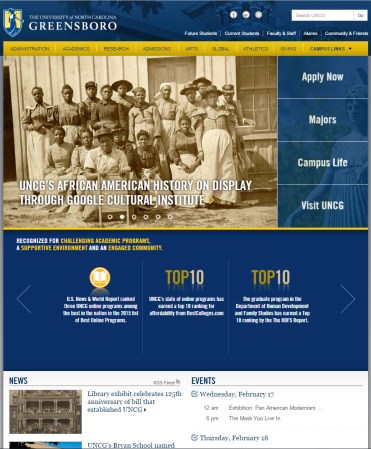
The wonderful day we had not one but TWO archive story on the University's homepage.

The wonderful day we had not one but TWO archives stories on the University’s homepage. Campus-based journalists and feature writers are interested in local, interesting content.

might be wasting your time writing and sending information off into a media abyss.

First, the key word to remember in talking about media relations is “relations.” Effective media relations is all about building the relationships with the right people. Don’t wait until you have a story in hand to contact your local press. Instead, put your information-finding skills to the test and learn all that you can learn about particular reports and media outlets in your local area. Who has written about issues or events similar to yours in the past? Who has an audience similar to the one you are trying to reach?

When you’ve identified individuals you can target with your news information, contact these folks directly. Ask them to meet you in a coffee shop near their base of operations. See if they would be interested in coming to meet you in the archives. Try to get a face-to-face meeting so that you can continue to build your relationship. A potential bonus: If you establish yourself as a useful source for local information, the reporter may turn to you for guidance on future pieces that are tangentially related to your work.

With relationships in place, your press release will carry a bit more clout. If the reporter knows you, she’s more likely to read your email and not simply delete it along with the others received during the day. But, even with an established relationship, you need to make sure that your press release is a good one. Here are a few tips for making sure that your press release is one that will catch the attention of a busy journalist:

  • Be sure that what you have to say is really newsworthy. Don’t flood your new reporter friend’s inbox with notes about every event, activity, or acquisition. Focus in on the really important things that have a strong, and potentially lasting, community impact.
  • Create an informative, jargon- and acronym-free headline that would allow a reasonably-intelligent person to understand the importance of your message.
  • Write in a clear and concise manner. Think Strunk and White (or read The Elements of Style if you haven’t already). Avoid passive voice (“The archives hosts…” instead of “The archives has been hosting…”).
  • Keep your release short, factual, and to the point. Aim for 500 words or less (definitely keep it to one page!), and include links to your website for additional information.
  • Focus on your opening sentence. This is your sales pitch. It needs to contain all of your critical information (who, what, when, and where), and it needs to convince the busy reporter to read on.
  • Don’t forget to include contact information (name, email, and telephone number)!
021815Feature_CSPAN

Filming a segment on our special collections for C-SPAN’s 2015 Cities Tour

When you’ve written your press release, email it to those reporters you identified as covering similar topics or reaching your intended audience. You can include it as the text of the email itself (remembering the importance of the subject line), or you can attach a PDF to the email message. If you choose to go with an attachment, write a factual, one-paragraph message for the email itself then point to the attachment. Or, if you have an institutional blog, send the one-paragraph message with a link to a lengthier blog post on the topic.

Remember that journalists are busy, busy folks, and your press release is far from the only one they will receive on any given day. Think about reporters’ deadlines and schedules before sending a press release. For instance, many print reporters will appreciate releases early in the morning as opposed to the afternoon. Additionally, avoid the urge to call the reporter directly immediately after sending the email. It’s doubtful that the message got lost in the internet ether, but it’s likely that the hard-working reporter hasn’t had time to read it. Bugging her isn’t going to get your message read any quicker.

Finally, if a reporter does indeed report on your event or activity, either by using your press release directly or giving you any kind of media coverage, follow up with a “thank you.” And, two or three months after your event, follow up again with a quick email to let the reporter know how the event went or what the lasting impact of the activity has been. This will give your journalist friend a sense of how you fit in to the greater community – your impact and influence. Also, this can be an incentive to report on you even more when the next big story pops up!

Have other tips about or examples of successful media relations? Share in the comments below or consider contributing them to ArchivesAWARE! Read more about the submission process on the About page, and send your ideas or drafts to the editors at archivesaware@archivists.org.

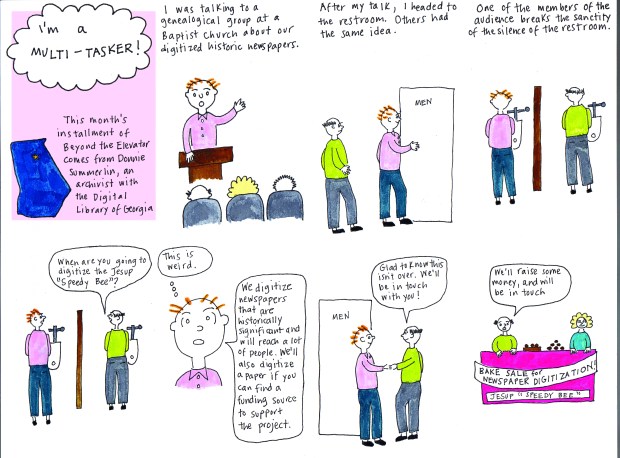
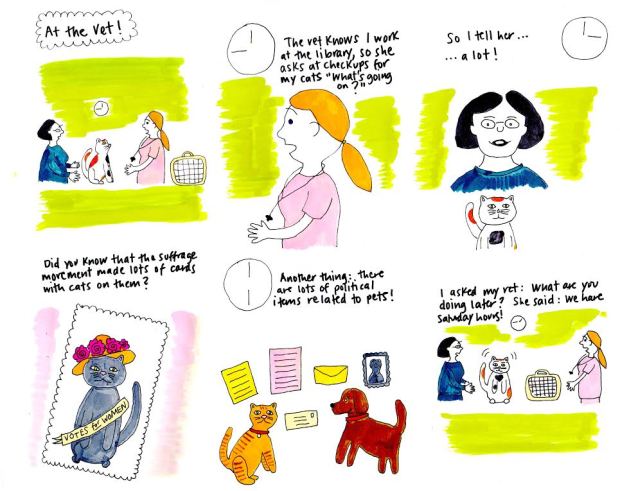
Beyond the Elevator, No. 4

beyond elevatorfour001

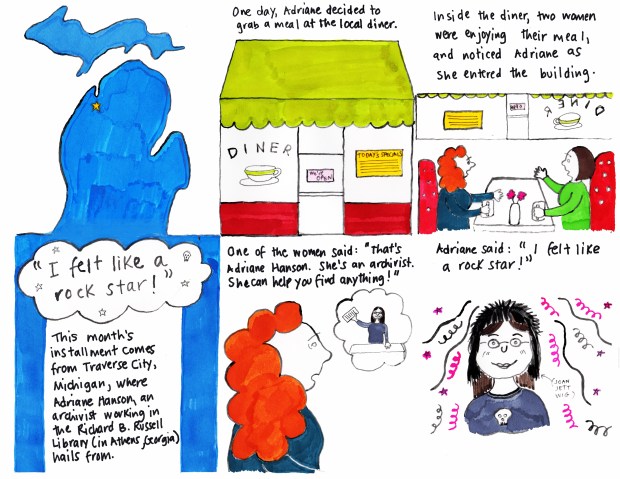
authorsportraitsBeyond the Elevator is a cartoon strip created by Mandy Mastrovita and Jill Severn. The strip expresses their heartfelt belief that the magic of archives can and should be worked into ANY conversation or situation.  The prospect of this axiom has exhorted the two into paroxysms of giggles, chortles, and howls despite the sober and noble subject matter.  Indeed, they have spent hours cooking up likely scenarios to bring to life in future cartoons.  These little gems appear in ArchivesAWARE! on amonthly basis for the foreseeable future, or until they run out of ideas. Which is where you, the reader can help. Tell them your best stories about talking archives—the wilder, the weirder, the crazier; the better They will even take an elevator story if you make it good. To share your story, please send a description of your concept, relevant details, and contact information (your name and your email address) to beyondtheelevator@gmail.com.

Matching Undergrads with Archives: “Speed Dating” in the UNC-Asheville Special Collections

Gene Hyde headshot

This post was authored by guest contributor Gene Hyde, Head of Special Collections at University of North Carolina Asheville

Undergraduate research is a hallmark of the University of North Carolina Asheville, the state’s designated Public Liberal Arts University.  As part of this institutional mission, we in Special Collections work closely with the History Department and other departments to incorporate primary materials into the research process. This is the tale of how Special Collections worked with one particular class, History 373.

History 373, taught by Dr. Ellen Pearson, was the first digital humanities course at UNCA. The class was small, with three teams of students, each working with a collection or collections. Their assignment was to conduct research using primary materials from Special Collections as well as other primary and secondary materials, then write and create digital humanities projects rather than traditional papers. We planned one class session for the student teams to select the collections they would be using for their projects, and we selected a “speed dating” process to introduce them to the collections.

DigitalHistoryClass

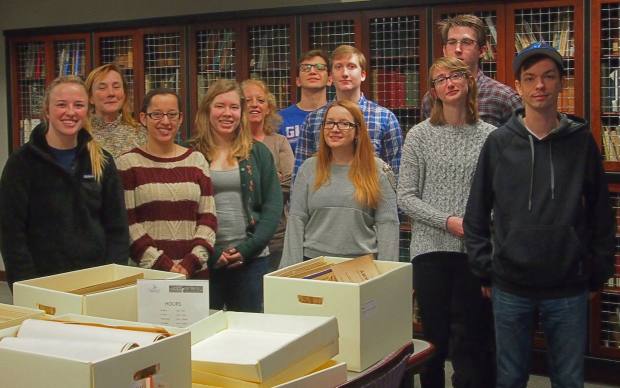
Digital History class at UNCA with Professor Ellen Pearson

The role of Special Collections in this process was somewhat traditional in that we were serving as a resource for materials rather than supporting the technological issues and platforms that digital humanities projects entail. For the technology side, the class was also paired with a Computer Science class and had extensive support from the library’s Media Design Lab.

Knowing that this was a one-semester project, we kept certain parameters in mind as we curated collections for this “speed dating” class, selecting collections that met the following criteria:

  1. We came up a with an initial list of a dozen or so collections, then consulted with Dr. Pearson. She took the topical pulse of the class, and we narrowed it down to six collections covering three basic themes in local history. The students had access to the finding aids for these six collections prior to the class.
  2. To facilitate the visual component of digital humanities, we selected collections that had maps, photographs, brochures, newspaper articles, and other images in addition to manuscripts.
  3. The collections each had a “full tale” to tell – that is, there was enough documentation in one or more of these collections to craft a complete narrative within the span of one semester.
  4. We kept copyright in mind, opting for collections where we owned the copyright, the collections contained public documents, or we knew that copyright could easily be secured. We knew that some students would probably want to use entire articles from the local newspaper in their digital projects, so I made a quick call to the managing editor and secured permission for this. Special Collections regularly provides them with photos for local history columns and they were glad to reciprocate for student projects.
  5. We located other collections that complimented the collections we were suggesting. For instance, we owned the city record documenting a downtown mall development proposal, and special collections at the local public library had the records of the citizens groups that fought the downtown mall development project. We work closely with the archivists at the public library, so I called and gave them a heads up about what we had in mind for this student project. They were delighted to help the students, and access to both the city and the citizens’ group records were critical in the success of that project.

Why this emphasis on pre-selecting collections? UNCA requires a final capstone research project for all majors, and we have seen some students struggle to settle on a research topic. We also knew that, in addition to choosing a topic, some might experience learning curves with the technology involved in Digital History projects. For these reasons,  Dr. Pearson and I agreed that pre-selecting particular collections for the students to choose from would allow the students to concentrate on their research and mastering the technology.

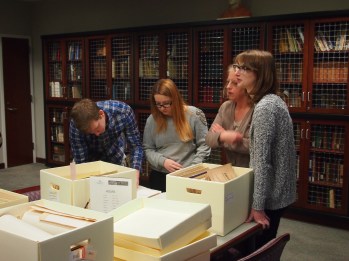
When the class came in, we had arranged representative materials from the six collections on tables around the reading room – setting the stage for “speed dating.”

OLYMPUS DIGITAL CAMERA

We walked around and introduced each collection to the students, describing the content, research possibilities, and the kinds of images and graphics in each collection. We also noted when there were related collections (at UNCA and the public library) that would help with their research.

We laid down basic ground rules for handling collections – only remove one folder at a time, respect the original order within the folders, and only use pencils, laptops, or cell phone cameras. Each team could spend five minutes to “date” a collection, then it was time to move on. We then cut them loose on the collections!

The three teams quickly fanned out and began examining the collections, moving to different ones, talking with each other, asking us questions, and conferring with Dr. Pearson. We circulated and provided more context  about the collections, pointing out useful related materials that were not on display in the reading room that they might find helpful.

OLYMPUS DIGITAL CAMERAThe reading room was abuzz with activity and collaboration, and it was clear that a number of students were excited about what they were finding. As they settled in and began looking deeper into the collections, talking waned and serious examination began to take place.

Dr. Pearson then told everyone that “the first team to claim a collection gets it,” resulting in some friendly competition between the teams as they jostled to claim their favorite collections. Selections made, the teams were then ready to start their research.

Over the course of the semester the three student teams were regulars in the Reading Room. We assisted them with documents, helped them with scanning, consulted on finding secondary materials, helped them navigate copyright issues, and generally helped them with the primary resource component of their digital history projects.

OLYMPUS DIGITAL CAMERAFeedback from the students and Dr. Pearson was very positive – they found the “Speed Dating” to be an effective way to gain a short, intensive immersion into each collection’s possibilities.
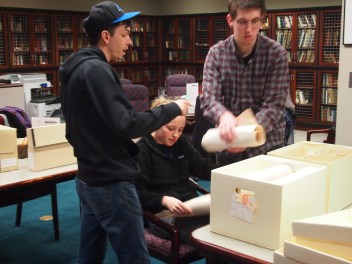
A news article about the project with a photo of the Downtown Mall Project group (taken in Special Collections) was posted to the UNCA webpage, which highlighted the role of Special Collections in the process.

I Advocate, You Advocate, We Advocate…with the Advocacy Toolkit

GeorgeC

This post was authored by guest contributor Christine George, Archivist and Faculty Services Librarian, Charles B. Sears Law Library, SUNY Buffalo Law School


Advocacy is a tricky thing. Sure there are definitions for it, but it seems like it means something slightly different to everyone. If you want proof, check out the Steering Shares on the Issue & Advocacy (I&A) Roundtable’s blog. One of the questions each I&A Steering Committee Member answers is “How would you define advocacy?” Each and every one of us has a different answer. Not drastically different, but each comes from a different perspective. Though the Steering Shares are only from the current I&A leadership, I feel fairly confident that past leadership also had varied perspectives.

One of the things to come out of those varied perspectives is the Advocacy Toolkit. Created by I&A’s 2013–2014 leadership, the Advocacy Toolkit was meant to pull together resources on advocacy for archives and archivists. In its own words:

A large part of advocacy involves convincing financial and political stakeholders of the value that archives add to a given community, and all related efforts need be supported by evidence. The resources listed, which also serve as access points to more resources, contain the types of quantitative information and qualitative narratives that help make the case for archives. This list is not exhaustive; rather it is a starting point for those looking for facts, arguments, and compelling reasoning to lend weight to their advocacy efforts. The resources linked here do not indicate endorsement, but offer some templates which can be used to formulate advocacy efforts.

The Toolkit has been updated by subsequent I&A Steering Committees. Over the years, the Advocacy Toolkit hasn’t caught on. We wanted to change that in a big way when we decided to tackle the latest update. To start, the Advocacy Toolkit got a new home. Beginning in 2016, we moved the Advocacy Toolkit and the I&A blog to our new website. Then we reached out to the Regional Archival Associations Consortium (RAAC) to help us expand the Advocacy Toolkit.

Step 1 of this collaboration is to evaluate what we have and plan out how to move forward. To do that, we need your help. Yes you. Chances are that if you haven’t already had to advocate for yourself or your collections you will have to at some point. We’d like your feedback on what we have and what you think might be missing. Please take a few moments and review the Advocacy Toolkit and then go and take our survey available at https://www.surveymonkey.com/r/T9XZ97Y. The survey will be open until THIS MONDAY, 5/16/16. If you have questions about the survey, or thoughts beyond the survey, feel free to contact us at archivesissues@gmail.com.

Beyond the Elevator, No. 3

e1b53781-071e-41b2-af35-754b577b1f6c

authorsportraitsBeyond the Elevator is a cartoon strip created by Mandy Mastrovita and Jill Severn. The strip expresses their heartfelt belief that the magic of archives can and should be worked into ANY conversation or situation.  The prospect of this axiom has exhorted the two into paroxysms of giggles, chortles, and howls despite the sober and noble subject matter.  Indeed, they have spent hours cooking up likely scenarios to bring to life in future cartoons.  These little gems appear in ArchivesAWARE! on amonthly basis for the foreseeable future, or until they run out of ideas. Which is where you, the reader can help. Tell them your best stories about talking archives—the wilder, the weirder, the crazier; the better They will even take an elevator story if you make it good. To share your story, please send a description of your concept, relevant details, and contact information (your name and your email address) to beyondtheelevator@gmail.com.

Beyond the Elevator, No. 2

beyondtheelevator2


authorsportraits Beyond the Elevator is a cartoon strip created by Mandy Mastrovita and Jill Severn. The strip expresses their heartfelt belief that the magic of archives can and should be worked into ANY conversation or situation.  The prospect of this axiom has exhorted the two into paroxysms of giggles, chortles, and howls despite the sober and noble subject matter.  Indeed, they have spent hours cooking up likely scenarios to bring to life in future cartoons.  These little gems appear in ArchivesAWARE! on a monthly basis for the foreseeable future, or until they run out of ideas. Which is where you, the reader can help. Tell them your best stories about talking archives—the wilder, the weirder, the crazier; the better They will even take an elevator story if you make it good. To share your story, please send a description of your concept, relevant details, and contact information (your name and your email address) to beyondtheelevator@gmail.com.

Innovation and Outreach: Making Sense of Creativity and Opportunity

FullSizeRender

This post was authored by guest contributor Jill Severn,
Head of Access and Outreach at the University of Georgia’s Richard B. Russell Library


Innovation is a critical ingredient for providing outreach. An archives that follows the same approaches, rules, and standards even as its constituents raise new concerns and develop new needs and interests risks losing support by patrons and stakeholders, prevents connections to new users, and may demoralize or disconnect staff from the mission of the archives. Despite these consequences, this scenario certainly happens. The question is why?

Typically, there are two reasons that archives eschew innovation in the context of outreach. The first reason stems from a perceived lack of resources or expertise. Many archivists working in small repositories with few staff and small budgets find it challenging to think about engaging in active or new outreach programs. They cite insufficient time, staff, and financial resources to do more than provide basic services. They also see outreach as outside their essential activities. The second reason stems from a perceived level of success. Archives with this perspective often have popular collections that do not require significant outreach to attract patrons, or they have a captive audience that must use the archives collections for purposes related to work, legal issues, or other matters. Also, some archives do not receive a strong imperative from their respective stakeholders or parent bodies to refine and expand.

Some archives assume that what was good enough before will always be good enough. The problem is that the status quo almost never persists forever. New stakeholders replace old and have new expectations; patron interests shift; and resources wax and wane. When this happens, organizations that cling to the same old formula for success experience tremendous upheaval and face a daunting game of catch-up.

Archives with limited resources face stagnation or decline if they ignore the value and potential for growth that outreach provides. Operating within a profession swept up in a romance with technology, small archives with limited technical expertise may find it challenging to imagine, value, and pursue innovative outreach that is not driven by cutting edge technology. This perspective is shortsighted. Small archives can communicate their value and potential to new and existing audiences/supporters in innovative ways by employing simple, low technology strategies. Innovation is not necessarily synonymous with technology! At the same time, not all technology is expensive and often a modest investment can yield big results. Open source technology that is free to all who use it and open to further development is a boon for all archives small and large. Yet obtaining greater access to technological tools through open source or other means is not necessarily going to move every archives to the cutting edge. Innovation requires more than the technological ingredient.

Quite simply, innovation is the act of introducing something new—no more no less. In recent years, for many societies living in the developed world, this definition has become imbued with a strong connection to technological advances, particularly in the digital/Internet realm. Ask Americans what innovation means to them and most will say “new technology.” Of course, this is an important aspect of innovation in today’s context. New devices that entertain, educate, control, connect, and separate people play a crucial role in defining the lives and interactions of most Americans. Yet the definition of innovation does and should encompass much more than just new types of technology, and in the context of archival outreach it is worth widening our focus to embrace this broader view.

According to Egils Milbergs of Accelerating Innovation:

Technology plays a leading role in innovation, but it isn’t the only factor. What were once disruptive technologies now are commodities. Technology can be the establishing base for innovation, but people are the ones that drive it forward. Technology is really only the mechanics of the process. Real innovation is about great people generating and then implementing new ideas.¹

The most important aspects of innovation are not the tools that one employs to create it, but a posture or philosophy towards the entire process. The essential ingredients for innovation are: confidence, self-awareness, irreverence, creativity, and humility. Looking at innovation in this more expanded way, several key postures are worth adopting:

  • Be open
    • Learn what others have tried; seek new ideas and new ways of approaching challenges.
  • Embrace change
    • Accept that change is inevitable and learn to see change as a positive opportunity.
  • Use technology wisely and appropriately
    • What technical tools and resources are available? What is the cost and what will be the benefit? How have other archives used these tools? Are there tools available that are aimed at different user types that could be re-purposed for your needs?  Does the tool or resource offer a sandbox or demo option so you can experiment before adopting?
  • Know oneself and one’s Institution
    • Assess the organization’s goals, resources, needs, challenges, and opportunities through dialogue with staff, faculty, patrons, and colleagues.
    • Outreach should inform every phase of archival work so remember to brainstorm with the widest swath of your institution; this is where you will get great new ideas and fresh vision.
  • Multiply connections
    • Establish relationships with individuals and organizations that multiply connections–see patrons as donors, donors as patrons, patrons as cultural tourists, advisers as students, students as collaborators.
  • Embrace reciprocity
    • Look for relationships where each party can learn from one another, share with one another, support one another.
  • Be daring, but be humble
    • Seek or create working environments where risk and experimentation are valued. Do this by example and by supporting those who take risks and experiment. Build experimentation into planning and goal setting—“what are we going to test or try this year?” Take time to debrief and process after you try something new. The effort does not have to meet established goals to be successful; to be successful it is important to understand why it was successful or why it failed.
  • Be an opportunist
    • Always be mindful that a person one might meet or the experience that one may have may well lead to something exciting.
  • Husband the most important resource—archives staff and colleagues
    • Archivists cannot be innovative 24/7. It is vital to take time to recharge the batteries; take stock, savor success, examine problems, and rest.

¹Egils Milberg, “The Future of Innovation,” HR Funda:  Enabling Excellence by Fostering Collaboration, April 2006. http://hrfundablog.blogspot.com/2006/04/future-of-innovation.html (accessed September 16, 2008)

Articulating the Value of Your Archives to Resource Allocators

Erin
This post was authored by guest contributor Erin Lawrimore, University Archivist, University of North Carolina Greensboro


If someone asks “why is your archives important?,” how would you answer? Is your archives important because it preserves and provides access to important historical materials? Does its importance stem from its ability to foster a sense of community and “place?” Perhaps your response would focus more on its ability to provide accountability or serve as evidence of past actions. All are wonderful responses. But, when you are talking with a resource allocator – particularly one who has no past experience with archives – lofty ideals and notions of identity-building or remembrances of past events often aren’t going to cut it when they want to know why they should give you a sliver of the big (but shrinking) money pot. You need concrete evidence of the impact that your repository has in order to ensure that administrators’ support continues.

Cello_Music_CollectionThere are many ways to assess an archives’ value. From circulation numbers to gate counts to collection growth, each number gathered can provide useful clues as to how your archives is changing (or should be changing) over time. But, numbers alone do not make an effective argument for the archives. In order to advocate for your repository to administrators and others who hold the purse strings, you must frame these numbers in a way that fits their overarching missions and goals.

You must place the archives within the greater picture of your parent organization. To do this, of course, your parent organization must have clearly identified goals and objectives (hopefully it does, but, if not, that’s a whole different post!), and your archives must define its mission and purpose within those broader goals. How does your work contribute to the mission of your parent organization? For instance, a university archives is often housed within an academic library at a university. You should be able to clearly articulate how your archives directly impacts the library’s main objectives. If your library’s stated objective is to support undergraduate education, how does your archives contribute to this goal? How does your work help support undergraduate education at your institution?

Often you will need to advocate for your repository with administrators at an even higher organizational level. Returning to the example of the university archives, you may need to also consider how your archives contributes to the goals of the university (of course, ideally, your library’s goals will be in line with those of the university). Remember that you will often be advocating for your repository with non-archivists who, in all likelihood, are heavily focused on the present bottom line. Can you articulate the value of the archives in terms that non-archivists use and understand?

0205151447Once you understand and can articulate your value within the larger framework of your parent organization, you can then turn to the various metrics you have collected. How does each measurement demonstrate that you are contributing to the mission of your organization? For instance, return to the example of the library that is particularly focused on supporting undergraduate learning. A gate count of the number of undergraduates attending teaching sessions in the archives is one way of demonstrating your value to the library’s mission. But, that number might get lost in the world of general information literacy courses which most (if not all) undergraduates are required to attend at some point in their academic career. Perhaps adding information on the number of research hours accrued by undergraduate students coming into the archives for class assignments (as opposed to more basic instructional sessions) would enhance your advocacy and your ability to tie the unique contributions of the archives to the mission of the library.

Archives, libraries, and other cultural heritage institutions will always have the challenge of having numerous indirect and collective benefits that may not always be easy to directly measure and quantify. Yes, your archives holds unique information that can’t be found anywhere else and ensures that it is accessible now and in the future. But proving why that is important and why funding must be maintained (or increased) to support that role is critical to ensuring you get the money and support you need to do all of the work that goes into meeting that broad mandate.