There’s an Archivist for That! Interview with Anne L. Foster, Yellowstone National Park Archivist

This is the first post in our new “There’s an Archivist for That!” series, which will feature examples of archivists working in places you might not expect.  To launch this new series, COPA member Rachel Seale, Outreach Archivist at Iowa State University, brings you an interview with Anne L. Foster, Archivist at Yellowstone National Park.

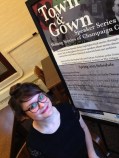
Anne Foster.resized

Photograph of Anne L. Foster. (Courtesy of Anne L. Foster).

Anne L. Foster has served as Yellowstone National Park’s Archivist since 2010. Prior to that, she was the University Archivist at the University of Alaska Fairbanks, Traveling Archivist for the Montana Historical Society, NHPRC Fellow in Archival Administration at Fort Lewis College in Colorado, and Assistant Archivist at the Sharlot Hall Museum in Arizona. She is a Certified Archivist (CA), Digital Archives Specialist (DAS), and holds an Masters in Library Science (MLS) from the University of Maryland.

RS: How did you get your gig?

AF: As an undergraduate history student at nearby Montana State University in my hometown of Bozeman, Montana, I used to see flyers advertising an internship in the archives at Yellowstone. While I couldn’t take advantage of the program at the time (I was working three other jobs to pay for school), the fact that archives was a potential career for a history major and that someplace I loved like Yellowstone had one stuck with me. For the next fifteen years, through graduate school and several other archives jobs, I would periodically check and see Yellowstone was hiring. And then, on one random check—they were! I’d just been tenured and promoted at my academic repository, but finally, my dream job was available.  All those other jobs were probably a good thing, though, because they gave the skill set needed to step in as the first professional archivist in Yellowstone and tackle one of the largest backlogs in the National Park Service.

Processing room during our Archives Blitz grant project

Processing room during the Archives Blitz grant project (courtesy of Anne L. Foster).

RS: Tell us about your organization.

AF: The Archives is part of Yellowstone’s Heritage & Research Center (HRC), which also houses the Park’s museum collection, herbarium, and research library.  The HRC is part of the Yellowstone Center for Resources, which is tasked with managing all those things that make Yellowstone so special like the thermal features, wolves and bears, and the scientific research that guides management decisions. While we are part of the National Park Service, we are very fortunate to also have Yellowstone Forever, our philanthropic and educational partner. Yellowstone Forever actually started life in the 1930s as the Yellowstone Museum and Library Association, so our collections have long been a key part of their efforts. Most people think of Yellowstone as the place for geysers and wildlife—and we are–but the Archives is the place where we document those special features and our efforts to preserve them, which to me is something special.

HRC

Entrance to Yellowstone National Park Heritage and Research Center (Courtesy of Anne L. Foster).

RS: Describe your collections.

AF: Like many archives in the U.S., we are both an institutional repository and a collecting institution. Our institutional records are government records and we are subject to federal records laws and guidelines. There are actually two types of records within the government collection: resource management records and administrative/historical records. All national parks keep resource management records. Parks are created to manage a resource or resources and as long as that resource exists, we need to keep records pertaining to those resources to help inform future management decisions (these records are considered “permanently active” as long as the resource is active).  Unlike other national parks, however, we also retain our permanent administrative and historical records like Superintendent’s correspondence, planning documents, partnership agreements and other records that don’t pertain quite so directly to resources. For other parks, those records are sent to the National Archives. Yellowstone is fortunate to be one of the few Affiliated Archives of the National Archives and Records Administration (NARA). This means that the records become part of NARA’s collection, but so long as we meet their standards for preservation, security, and access, we can keep them in our location. This makes it easier for our researchers, both staff and the public, to access our history in one place.

Our third category of collection is our donated or manuscript collections. These materials range from Park visitors’ photo albums, diaries, and scrapbooks through the research of scholars and  scientists who donate their data for future comparative or longevity studies to records of businesses who have operated in the Park over its nearly 150 years. In fact, our Yellowstone Park Company (YPC) records, the main Park concessioner for the first 100 years, is our most accessed collection because it includes payroll records. The YPC hired hundreds of college kids every summer and, apparently, that summer was so memorable that the employees would spend the rest of their lives talking about their summer in Yellowstone. Now, we’re getting those employees’ kids and grandkids coming in to find out what Grandma or Grandpa really did in Yellowstone.

Archives stacks

Yellowstone National Park Heritage and Research Center Archives stacks (courtesy of Anne L. Foster).

RS: What are some challenges unique to your collections?

AF: People love Yellowstone, so much so that there isn’t much about the Park that they aren’t interested in.  This makes archival appraisal a bit challenging—the most routine things truly have the potential for historical value.  Our NARA-approved NPS records schedule, for example, classifies most supply records as temporary. Of course it does—why would one need records for equipment once that item is used up or sold? But, we get queries regularly from people who have purchased former Park vehicles (buses, boats, snowmobiles) and want to know all about their item, down to paint formulas and the names of Rangers who drove them; it’s frustrating not to be able to answer their questions. At the same time, we can’t possibly keep everything.  So, it comes down to a rigorous and often detailed appraisal process.

We can have some unique preservation challenges as well.  Some of our most interesting records are logbooks–bound books used to record eruption data, visitor comments, or deep thoughts about wilderness. But, many of the logbooks are kept in less than optimal locations during creation—backcountry cabins, rock cairns on top of mountains, or next to erupting geysers.  By the time they are filled and transferred to the archives they can be nibbled, rained upon, or even somewhat eaten away by the acidity of geyser spray. During the 1988 fires, the Park’s historian actually flew with a fire crew in a helicopter to several backcountry cabins in order to rescue the logbooks (fortunately, all of the historic cabins were saved). Today, we have a more regular transfer of the logs to help cut down on damage and make use of digital duplication in cases where the damage is significant or potentially harmful to other items.

RS: What is the favorite part of your job?

AF: The location; it is magical to go to work in Wonderland and even more extraordinary to be the keeper of the documentary record for the world’s first national park. That feeling is shared by my coworkers as well as our visitors and researchers—it makes for a lot of enthusiasm and interest in the Park’s history. Every day is different and that makes for interesting and challenging work. There’s a huge amount of variety to my day: the types of records, the archival functions, and the research questions are as varied as Yellowstone’s landscape.

Stay tuned for future posts in the “There’s an Archivist for That!” series, featuring stories on archivists working in places you might not expect. If you know of an archivist who fits this description or are yourself an archivist who fits this description, the editors would love to hear from you—share in the comments below or contact archivesaware@archivists.org to be interviewed on ArchivesAWARE!
 

Giving It a Try: #AskAnArchivist Day


This post was authored by guest contributor Caryn Radick, Digital Archivist, Special Collections and University Archives, Rutgers University Libraries, and current member of SAA’s Committee on Public Awareness (COPA).

In late September, my colleague and I declared this would be the year that Rutgers Special Collections and University Archives would participate in #AskAnArchivist Day! Although most of our social media outreach happens on Facebook and Instagram, taking part in #AskAnArchivist Day would would give us a ready-made opportunity to expand our social media reach further into the Twittersphere.

How we prepared:

Given our late declaration, we had to scramble. We decided to do the following:

  • Reach out to our libraries’ communications office about our participation to see if they could offer suggestions and/or support.
  • Leverage our Instagram presence by preparing posts that could go on Twitter throughout #AskAnArchivist Day using Later.
  • Look for “fun/interesting facts” to post about Rutgers’ collections throughout the day, but to set “office hours” for our participation.

The results of those decisions helped us prepare the day:

  • The communications office offered suggestions (like making videos) and promoted the chat on the Rutgers University Libraries web page and through social media.

  • Using Later let us schedule some posts, in case we got pulled away from our Twitter account during non-office hours.
  • We enjoyed gathering the fun/interesting facts, particularly making a video demonstrating how our dumbwaiter works.

During the office hours (1-2:30) we spent a lot of time interacting on Twitter, but most of our tweeting was with other #AskAnArchivist Day participants. Questions from researchers or people interested in archival life were few. This “are we just talking to each other”? observation came up on Twitter as well. I’d be curious to know which archives have high non-archivist engagement and how they achieve it.

After the session was over, we compiled some quick statistics about the day on Twitter. Our preliminary tally indicated we got about 150 likes and 13 new followers. We later learned that we had made the “What’s Trending” section of the Rutgers Today newsletter (with a tweet about President Obama’s chair from when he attended Rutgers’ commencement).

We also had three of our items posted on that day shared in the Upworthy Story about strange objects found in archives.

Lessons learned from #AskAnArchivist Day:

  • Figure out what you want to achieve and frame your day in a way that supports it.  For example, if our goal was to gain more Twitter followers and share info about our collections, we were successful. If we intended to interact with researchers and people who want to know more about being an archivist, then it was less fruitful.
  • Start planning early! This allows more time to decide upon and gather images, videos, and facts to share.
  • Think about your set-up for monitoring Twitter. We had multiple screens open and were working on two computers. Sometimes we got a little lost in the toggling, but having two people offering different perspectives was useful.
  • Vary the breadth of objects and media you plan to share. It is tough to predict what will generate the most likes and retweets, so mix it up.
  • Get a good sense of your Twitter statistics (number of followers, averages likes and retweets, etc) prior to #AskAnArchivist Day. This provides a good baseline for comparison.
  • Promote the event through other social media channels. We did this for about a week before the event and it seemed to generate interest.

What lessons have you learned from #AskAnArchivist Day? If you’ve participated for multiple years, what changes have you made since you started?

#AskAnArchivist Day 2017 Summary


This post was authored by guest contributor Anna Trammell, Archival Operations and Reference Specialist at the University of Illinois Archives Research Center/Student Life and Culture Archives, and current member of SAA’s Committee on Public Awareness (COPA).


#AskAnArchivist Day was once again a huge success, allowing archivists from across the country to communicate directly with the public about their work. #AskAnArchivist was trending in the United States from 10:00 am to 1:00 pm with 8,927 total tweets on October 4 from 4,077 unique users. An additional 759 tweets appeared on October 3 and 1,595 on October 5 (at last count). While the total number of tweets using #AskAnArchivist on Wednesday was down from last year, the number of unique users and hashtag use before and after #AskAnArchivist Day was up significantly.

The top tweet received over 2,300 retweets and 6,300 likes.

https://twitter.com/KevinIsHistory/status/915605700381958144

Other top tweets highlighted specific items,

https://twitter.com/j_vvsm/status/915627211507482624

provided a behind-the-scenes look,

and answered (almost) every preservation question.

#AskAnArchivist Day not only provided a forum for archivists to interact with the public, but it also encouraged dialogue between archivists. These top tweets are just two examples of these discussions:

https://twitter.com/ireashiamonet/status/915580855631990784

https://twitter.com/frecklewars/status/915594679772745730

Members of SAA’s Committee on Public Awareness used #AskAnArchivist Day to ask members of the profession about their outreach activities,

special visitors,

surprising archives positions,

https://twitter.com/NickPavlik/status/915593645222449153

and how they’d describe an archivist in 5 words.

For more #AskAnArchivist Day tweets, check out SAA’s highlights.

What was your favorite question on #AskAnArchivist Day? How did you promote #AskAnArchivist Day at your institution? Any suggestions for archivists wanting to participate for the first time next year? Let us know in the comments!

Thank you to all who participated in this year’s #AskAnArchivist Day and helped make it a success!

Beyond the Elevator, No. 10

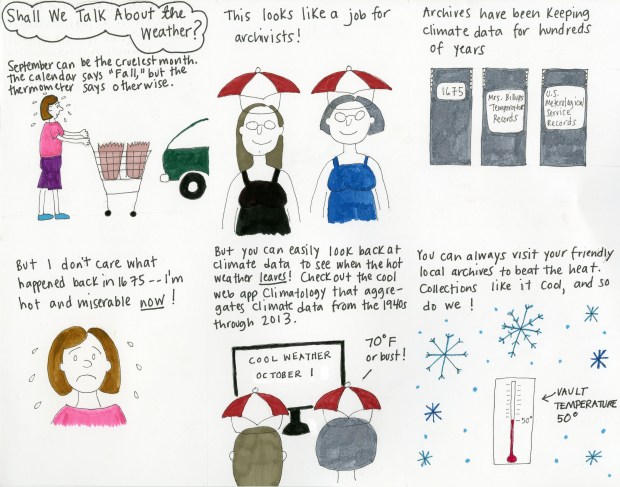
bteseptember2016

authorsportraitsBeyond the Elevator is a cartoon strip created by Mandy Mastrovita and Jill Severn. The strip expresses their heartfelt belief that the magic of archives can and should be worked into ANY conversation or situation.  The prospect of this axiom has exhorted the two into paroxysms of giggles, chortles, and howls despite the sober and noble subject matter.  Indeed, they have spent hours cooking up likely scenarios to bring to life in future cartoons.  These little gems appear in ArchivesAWARE! on a monthly basis for the foreseeable future, or until they run out of ideas. Which is where you, the reader can help. Tell them your best stories about talking archives—the wilder, the weirder, the crazier; the better.  They will even take an elevator story if you make it good. To share your story, please send a description of your concept, relevant details, and contact information (your name and your email address) to beyondtheelevator@gmail.com.

October 4th is Ask An Archivist Day!

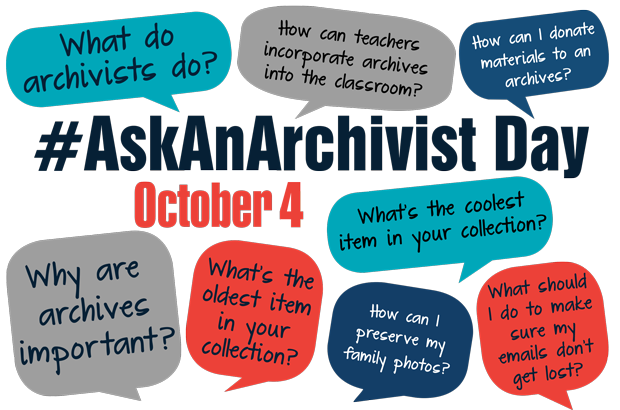
AskAnArchivist_GIF_2017What Is #AskAnArchivist Day?

It’s an opportunity to:

  • Break down the barriers that make archivists seem inaccessible.
  • Talk directly to the public—via Twitter—about what you do, why it’s important and, of course, the interesting records with which you work.
  • Join with archivists around the country and the world to make an impact on the public’s understanding of archives while celebrating American Archives Month!
  • Interact with users, supporters, and prospective supporters about the value of archives.
  • Hear directly from the public about what they’re most interested in learning about from archives and archivists.

How Does It Work?

On October 4, archivists around the country will take to Twitter to respond to questions tweeted with the hashtag #AskAnArchivist. Take this opportunity to engage via your personal and/or institutional Twitter accounts and to respond to questions posed directly to you or more generally to all participants.

Questions will vary widely, from the silly (What do archivists talk about around the water cooler?) to the practical (What should I do to be sure that my emails won’t get lost?), but each question will be an opportunity to share more about our work and our profession with the public. Visit SAA’s Storify that summarizes the 2016 #AskAnArchivist Day to get more examples of questions and answers. Last year generated thousands of questions and answers, some of which have been Storified:

Between now and October 4:

PROMOTE #AskAnArchivist Day among your users and constituents via your institution’s website, Twitter account, blog, newsletter, and any other mediums available to you. Click here for the public announcement (and feel free to pick up language from it for your own promotions). Memes are a great way to drum up excitement and are easily created through an online meme generator. Check out examples of last year’s promotional “Philosoraptor” memes here and here.

For additional inspiration on what your promotion of #AskAnArchivist Day might look like, check out what your peers did last year:

And see our Storify of marketing from a previous #AskAnArchivist Day, as well as these great examples of museums’ promotions of #AskACurator Day:

Examples of possible Twitter promotion:

  • Happy #AskAnArchivist Day! Our archivists are waiting for YOUR questions. Tag us at @TWITTERHANDLE and use #AskAnArchivist.
  • Archivists at @TWITTERHANDLE are gearing up for #AskAnArchivist Day on October 4! Literally—documents and photo boxes stacked and waiting!

ENCOURAGE the public to use #AskAnArchivist and your institution’s Twitter handle (e.g., @smithsonian) when asking questions so you won’t miss any that are intended for you and so we will be able to track questions and answers to measure overall participation.

TALK to your staff and colleagues to develop a plan for responding to tweets throughout the day.  Will one person respond to all tweets?  Will you share the task? Will individuals sign up for time slots and let the public know who will be available when?

Here’s one example:

  • During #AskACurator Day, one person at the Indianapolis Museum of Art was selected to monitor both the general hashtag and tweets sent directly to @imamuseum. When direct questions came in or interesting general questions were posed via the hashtag, the designated monitor sent the questions to participating curators via email. The curators (and their archivist!) replied with their answers, and the monitor posted all answers from the @imamuseum Twitter account. (See the Storify of the IMA’s participation in #AskACurator Day for results.)

CREATE an institutional Twitter account if you don’t already have one. #AskAnArchivist Day and American Archives Month are both great opportunities to start one! Click here to get started.

And if an institutional Twitter account is not an option for you, answer questions from your personal Twitter account! If your institutional affiliation and job title are not already listed on your profile, be sure to add that for the duration of #AskAnArchivist Day.

If you plan to participate, please email SAA Editorial and Production Coordinator Abigail Christian with your Twitter handle so we can create a list of participants.

TWEET and GREET! Take advantage of this opportunity to join with archivists from around the country to talk to and hear directly from the public on October 4.

Beyond the Elevator, No. 9

BTE June 30 2017001

authorsportraitsBeyond the Elevator is a cartoon strip created by Mandy Mastrovita and Jill Severn. The strip expresses their heartfelt belief that the magic of archives can and should be worked into ANY conversation or situation.  The prospect of this axiom has exhorted the two into paroxysms of giggles, chortles, and howls despite the sober and noble subject matter.  Indeed, they have spent hours cooking up likely scenarios to bring to life in future cartoons.  These little gems appear in ArchivesAWARE! on a monthly basis for the foreseeable future, or until they run out of ideas. Which is where you, the reader can help. Tell them your best stories about talking archives—the wilder, the weirder, the crazier; the better.  They will even take an elevator story if you make it good. To share your story, please send a description of your concept, relevant details, and contact information (your name and your email address) to beyondtheelevator@gmail.com.

Federal Funding Impact Story #6

Project: Michiana Memory – Digitizing Local African American, Latinx, and LGBTQ Materials in St. Joseph County, Indiana

front (1)

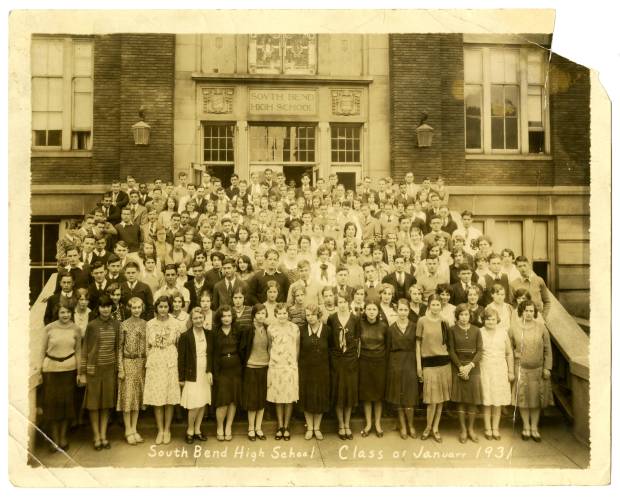
Odie Mae Johnson, at graduation, 1931. Courtesy of Indiana University South Bend Archives.

Granting Agency: Institute of Museum and Library Services (IMLS)
Grant Program: LSTA Grants to States
State Library Administrator: Indiana State Library
Institutions: St. Joseph County Public Library, Indiana University South Bend Archives, IU South Bend Civil Rights Heritage Center
State: Indiana
Congressional District: 2nd Indiana Congressional District
Grant Period: 2014-2017
Award Amount: $28,880
Institutional Match Amount: $6,000

Jobs Created:
3 FTE for 36 months
9 PTE 20 hr/wk positions for 36 months.

Project Description
In January 2014, the St. Joseph County Public Library reached out to the IU South Bend Civil Rights Heritage Center and IU South Bend Archives to combine their collections related to African American and civil rights history. The combined archives launched within the Michiana Memory history website in February 2015. Since then, thousands of guests have accessed the materials. The renewal of the LSTA Indiana Memory Digitization Grant from the Institute of Museum and Library Services of the Indiana State Library in 2015 led to the inclusion of more materials than ever, including oral histories about African American and Latino history, and the first collection of LGBTQ history in the Michiana community. Guests can access the collections now by visiting http://michianamemory.sjcpl.org.

What was the need for the grant?
We saw the need to make digital content available to the public from St. Joseph County, Indiana. And specifically we wanted to make voices speak out from the primary sources from marginalized portions of our community: African Americans, Latinos, and LGBTQ communities. The Archives at Indiana University South Bend partnered with the St. Joseph County Public Library and the Civil Rights Heritage Center to make this happen.

What has been the primary impact of this project?
We have been monitoring use through Google Analytics – and seeing it in use in the thousands every month. The Archivist at IU South Bend has also been seeing many students’ bibliographies citing the site for primary source research. Further, many reference requests are spurred by people’s use of the site. The requests come in on the national – and sometimes international – level. Consistently – month by month – using Google Analytics – the Civil Rights and African American History section of Michiana Memory, funded by LSTA and IMLS, is in the 2,000 to 3,000 user area – the highest user area of all the sections on the local history site.

Submission by: Alison Stankrauff, Archivist and Associate Librarian, Indiana University South Bend
Image

Federal Funding Impact Story #5

Project: Music Quest

Capture

Granting Agency: Institute of Museum and Library Services (IMLS)
Grant Program: LSTA Grants to States
State Library Administrator: California State Library
Grant Program: Eureka! Leadership Program
Institution: Contra Costa County Library
State: California
Congressional District: 11th California Congressional District
Grant Period: 2014-2015
Award Amount: $5,000
Institutional Match Amount: $5,000

Project Description
Music Quest was created to help supplement the lack of music programs in the lower income community in Pittsburg, CA by offering free music workshops for teens, which allowed them to learn the fundamentals of playing musical instruments, improve their reading and social skills, and to help them learn how to integrate music into their
lives.

What was the need for the grant?
The objective of implementing this program at the Pittsburg Library and Oakley Library was to offer lower income youth an introduction to music at no cost, which would enhance their understanding and knowledge of music and empower them to seek out other musical opportunities. After doing extensive research it was determined that music is a highly effective motivator for teens and as I have seen first hand it can change a teens life to learn to play an instrument.  After delivering the guitar and drum workshops, it was clear that the students were learning basic skill levels in guitar and drums and would be able to continue to play on their own. After these workshops, these students began to understand the power of music lessons and wanted to continue with instruction to further their skill and knowledge.  Some of the students were at the time of the workshop sessions homeless and despite their challenged living situation they attended every single workshop.  It became clear that when the teens were learning and playing the instruments they became inspired, motivated, and wanted to learn more.  They also connected with their fellow peers, bonded, and some formed lasting friendships and are still connected even now.

What has been the primary impact of this project?
Music Quest participants were evaluated on attendance plus participation and were given a survey at the end of the workshop series in order to gauge increased skill level, opinion of the workshop content and the instruction process. By observing the workshops and evaluating the surveys, the results proved that all of the teens that participated in the guitar workshops ended up with more than a basic understanding of the different parts of the guitar, tuning, and were able to learn chord progressions and drum beats. The program definitely had an impact on the local community.  Partnerships were made with the City of Pittsburg and Pittsburg High School, Freedom High School in Oakley. Local music instructors were chosen to give the lessons and spent many hours working with the teens at the library.  Local musicians visited the sessions and a special finale concert was put together for the community to gather together to see these amazing teens play instruments.

A total of 87 students participated in the Music Quest program over a one year span at the library.  After taking the music lesson workshops, these students began to understand the power of music lessons and wanted to continue with instruction to further their skill and knowledge. In addition, through the workshop survey, it was determined that all of the students that participated in the guitar and drum workshops agreed that music is a lifelong source of enrichment and became much more interested
and aware of music opportunities available to them such as careers in music, recording, and sound management.

Submission by: Kimberli Buckley, Community Library Manager, Contra Costa County Library


Federal Funding Impact Story #4

Project: Detroit Institute of Arts Archives Assessment

Capture

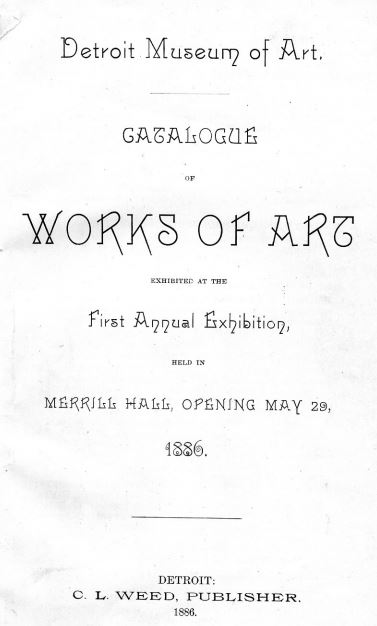
Detroit Museum of Art exhibition catalog, 1886.


Granting Agency: National Endowment for the Humanities (NEH)
Grant Program: Humanities Collections and Reference Resources
Institution: Detroit Institute of Arts
State: Michigan
Congressional District: 13th Michigan Congressional District
Grant Period: June 20, 2016-July 31, 2017
Award Amount: $40,000
Institutional Match Amount: $40,000

Jobs Created:
– 1 PTE 28 hr/wk position for 12 months
– 3 graduate students earning 3 credits each for 5 months of experience

Project Description
Assess and establish intellectual control over a collection of 11,000 linear feet of the museum’s administrative records, dating back to its founding, including 30 years of unprocessed artists’ correspondence, acquisition records, director’s files and curators’ exhibition papers.

What was the need for the grant?
Documents within the DIA’s Research Library and Archives detail pivotal moments in the City of Detroit’s history. Most recently, they described the DIA’s role in the resolution of the City of Detroit’s 2013 bankruptcy. It was the largest municipal bankruptcy filing in U.S. history both by debt, estimated at $18 billion, and by population, over 700,000 residents. At the time, the DIA was owned by the City of Detroit. It was also the city’s most valuable asset. Following the bankruptcy filing, creditors asked for the sale of DIA art. News agencies predicted the museum would close.

During bankruptcy proceedings, the DIA’s archival records helped save the museum. During the trial, over 180,000 DIA records were digitized for court proceedings. The documents showed that most of the museum’s most important works came from non-City of Detroit support. They were used extensively during the approval of a financial agreement that would come to be known as the “Grand Bargain.”

Unfortunately, like most of the DIA’s archival records, very few of the bankruptcy documents had previously been appraised, accessioned or processed. All such activities stopped thirty years ago, following severe museum-wide budget cuts and the dissolution of the DIA’s archival team. Therefore thirty years of records, including artist correspondence, directors and curators’ papers, and acquisition documents, have not received archival treatment. Many of the museum’s earlier documents, dating back to the late 19th century, have not been processed either.

Following Detroit’s bankruptcy and its resolution, the museum has better financial stability than at any other time in its modern history. With financial stability and a bankruptcy behind it, the DIA has resumed its commitment to its archival activities.

What has been the primary impact of this project?
The holdings survey was the key to understanding the unknowns of the materials currently held in RL&A. The museum is fully committed to making its archives more available and better organized for researchers. The Project Director and DIA Archivist are now able to better strategize future use of the DIA archives upon discovering its full contents. An immediate outcome of the holdings survey is improved access to collection, in particular, those that have been “hidden.” The collections-based reports can subsequently be translated into finding aids and catalog records for better access to the local, national, and international community.

The Project Team synthesized the results of the holdings survey with the input of the Advisory Team. The combined intelligence has been used to strengthen physical and intellectual control over the collection. The holdings survey provided the evidence needed to move forward with making sound decisions for improvements in description and access, prioritizing preservation needs, informing workflows, identifying issues we were not aware of, and plan for future projects (such as a future digitizing project).
Impact 3: To date, 164 collections (approximately 8,000 cases and 4,700 cubic feet) have been identified within the Library Stacks (the library’s book storage area) Archives Stacks, the DIA’s offsite Warehouse, and various other departments within the museum including AV offices and the Photography Department. Materials in each of these locations were inventoried and compiled into a single database for ready reference with rankings to reflect housing quality, physical quality, physical access, intellectual access, and intellectual value. These rankings are to inform and prioritize for future digitization efforts.

Submission by: Danae Dracht, Project Archivist, Detroit Institute of Arts
Image Source

Federal Funding Impact Story #3

Project: Documenting Modern Living

Splash Page 3

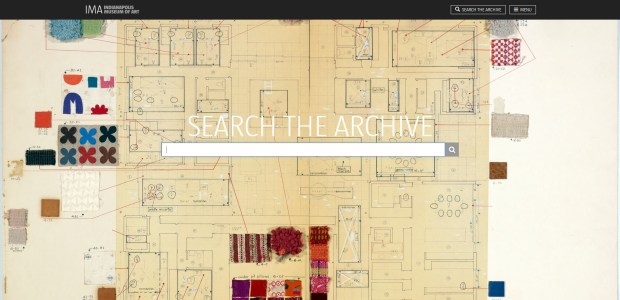
Alexander Girard textile design floor plan, ca. 1956, on the IMA Archives Digital Archives Portal landing page (archive.imamuseum.org)

Granting Agency: National Endowment for the Humanities
Grant Program: Preservation and Access: Humanities Collections and Reference Resources
Institution: Indianapolis Museum of Art
State: Indiana
Congressional District: Indiana US District 7
Grant Period: April 2012 – May 2015
Award Amount: $190,000
Institutional Match Amount: $221,000

Jobs Created:
The largest portion of the award received from NEH went to the hiring of two full time employees–one for 18 months, and the other for 24 months.

Project Description
Digitization of the Miller House and Garden Collection, and creation of a Digital Archives Portal for delivery of content.

What was the need for the grant?
The Miller House and Garden Collection documents the design, construction, decoration, and maintenance of the iconic mid-century modern property for over 50 years. When the house and garden were gifted to the Indianapolis Museum of Art, this important archival collection also came to the museum. To assist the IMA in successfully stewarding the home and the many collections materials that came along with it, increased access and better preservation of the archival collection were key. Digitization would solve both needs, and a grant would allow for the purchase of digitization equipment and the hiring of staff to undertake the years-long process.

What has been the primary impact of this project?
This project has allowed for unprecedented access to an important mid-century design collection that documents the legacies of Daniel Urban Kiley, Eero Saarinen, and Alexander Girard. The easy availability of this material has made it possible for the Indianapolis Museum of Art to present the story of the home to the Columbus and broader Indiana  and national communities at a level of detail and accuracy that would not have been possible without the grant award. Perhaps the greatest impact that this project has had is on the country’s future architects, as architecture students from around the country have requested the high-resolution images of the home and landscape architectural drawings to further their studies. Students of interior design have similarly benefited, and will continue to do so for many decades to come.

This grant from the National Endowment for the Humanities has also had a direct impact on the lives of the two full time, temporary employees hired with the grant funds. One has gone on to further the Columbus Indiana Architectural Archives as their archivist, and the other was offered a job at a high-profile design company immediately following the grant period as a result of their work on the Documenting Modern Living project.

Submission by: Samantha Norling, Archivist, Indianapolis Museum of Art
Image