
This is the newest post in our There’s an Archivist for That! series, which features examples of archivists working in places you might not expect. In this article, COPA member Claudia Willett interviews Chloe Pfendler and Chris Doan about their jobs as Archivists for the Silicon Valley Archives (SVA) at Stanford University.
How did you get your gig?
In 2022, through the Hohbach Program Endowment, we were both hired to process the historical records and materials documenting the history and development of the Silicon Valley region of California. Harold Hohbach was a patent lawyer and real estate developer who was passionate about the legacy of technological and scientific innovation that is synonymous with the area we know as Silicon Valley. He donated money to help support the Silicon Valley Archives program at Stanford, which included funding for two processing archivist positions. We entered our roles with professional backgrounds that include experience in working with historically diverse archival collections and processing a variety of formats.
Tell us about your organization.
Silicon Valley Archives (SVA) is a sub-unit within Stanford University Library’s Special Collections Manuscript Division. The goal of SVA is to acquire and promote collections that document the industry and impact of Silicon Valley, as well as the history and the culture of this geographic region. We have the unique opportunity to work with an entire team (which includes the curator for Science and Technology, Business, Henry Lowood, as well as a curatorial assistant, historian, and exhibits coordinator) by aiding in their efforts to make the history of science and technology in Silicon Valley an engaging and educational experience for students, researchers, and the general public.
Describe your collections.
Our collections are pretty diverse! They run the gamut in terms of formats – lots of obsolete computer media and hardware, as you might imagine, but also various forms of audiovisual media, photographs, objects, organizational files, personal papers, etc. The history of Silicon Valley is multifaceted, and since coming onboard, we have processed several collections with content that showcases this, such as innovation in the early stages of electrical vehicle design and production seen in the Robert Wing EV Collection and the John Newell Collection; cultural influences as found in the activities of the San Francisco non-profit Point Foundation, which was an evolution of Stewart Brand’s Whole Earth Catalog project; and social concerns as reflected in the Computers, Freedom, and Privacy conferences that were organized in the Bay Area during the early days of the World Wide Web.


Images from the John Newell collection on the history of electric vehicles, M0963, Top: Electric Automobile Association of California newsletter; Bottom: Deborah MacArthur’s electric race car for the Alternative Vehicle Regatta held in New Hampshire, 1975
What are some challenges unique to your collections?
Given the “tech” nature of many Silicon Valley enterprises, these collections tend to be media-dense. For example, we could be dealing with energy emittance captures taken on
Polaroid film during the 1980s from the inside of an electron device, cassette tapes of regional conferences on elements of text encoding, or boutique software from a defunct startup that might require emulation. We also encounter a lot of computer hardware and “born digital” materials. This all brings up issues and challenges surrounding the preservation and access of these types of materials, some of which are dependent upon obsolete technologies, software, and very technical processes.
What is your favorite part of your job?
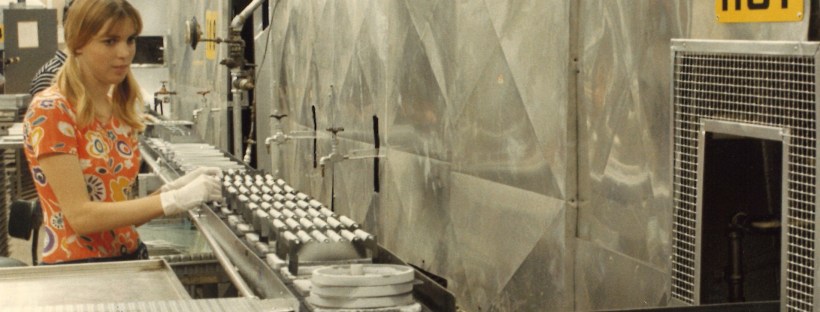
We both find working with the material exciting in various ways, especially all the new information you tend to learn as a by-product of processing a collection. Many of our collections concern the historical origins of industries that have had a far reaching, global effect, and it’s been very interesting to dig deeper into some of these stories. One example of this is learning about the hidden labor that exists in technology industries, particularly the production and assembly line workers who were typically women and other people from marginalized communities. For researchers interested in this particular kind of Silicon Valley history, collections containing company in-house produced photographs can be a rich source of information. We also enjoy the opportunity to work with our SVA exhibits coordinator from time to time to help promote the archives and give the public a closer look at our collections.
 ArchivesAware